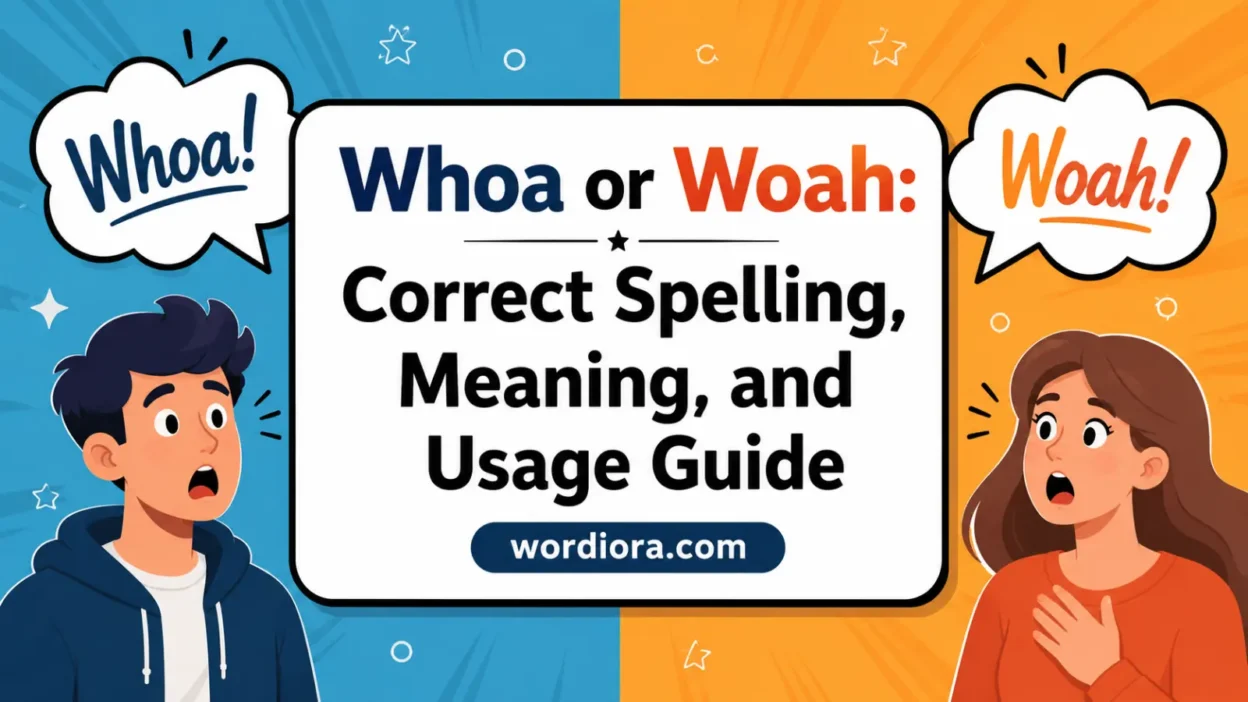
If you are choosing between whoa or woah, use whoa in standard American English. It is the safer spelling for school writing, articles, captions, dialogue, emails, and any polished public text.
Woah is widely understood, especially online, but it is less standard. Many readers will see it as a casual variant or a spelling mistake. That does not mean people will misunderstand you. However, it does mean woah can look less careful in formal or edited writing.
The difference is not meaning. The real difference is acceptance, tone, and audience expectation.
Quick Answer
Whoa is the standard spelling in US English. Use it when you mean “stop,” “slow down,” “wait,” or “I am surprised.” Woah is a less common variant that appears mostly in casual online writing, texts, comments, memes, and song titles. For almost every US writing situation, whoa is the better choice.
Why People Confuse Them
People confuse whoa and woah because both spellings look like they could match the sound. The word rhymes with go, no, and show, so many writers expect the letters to follow a simpler pattern.
Another reason is that woah appears often in casual digital writing. When readers see it enough times in posts, comments, and messages, it starts to feel normal.
Still, common use does not always make a form the best choice. In American English, whoa remains the standard spelling.
A third reason is that whoa looks unusual. The silent-looking h after w can make the spelling seem backwards to modern readers. Even so, that is the form most US readers expect in careful writing.
Key Differences At A Glance
| Context | Best Choice | Why |
|---|---|---|
| School assignment | whoa | It is the standard spelling. |
| Blog article | whoa | It looks polished and accepted. |
| Fiction dialogue | whoa | It works for surprise, alarm, or stopping someone. |
| Text message to a friend | whoa | Still safest, though woah may feel casual. |
| Meme or social post | whoa or woah | Woah can look informal or stylized. |
| Professional email | whoa | If used at all, the standard spelling is safer. |
| Command to stop | whoa | This is the traditional spelling for the command. |
| Expressing shock | whoa | It is standard and clear. |
| Song title or brand style | woah | Creative spelling may be intentional. |
Meaning and Usage Difference
Whoa means “stop,” “slow down,” “wait,” or “I am surprised.” It can be used as a command or as an emotional reaction.
Use whoa when telling someone to pause:
Whoa, slow down. I missed the last part.
Use it when reacting to something surprising:
Whoa, that sunset is incredible.
You can also use it when someone says something too quickly or assumes too much:
Whoa, I never said I agreed to that.
Woah usually means the same thing. The problem is not meaning. The problem is that woah is less standard in American English. It may work in a casual text, but it can look off in edited writing.
A practical pronunciation note helps here: whoa is usually pronounced like woh, rhyming with go. Woah is often meant to have the same sound, but some readers may pause because the spelling looks like it could rhyme with Noah.
Tone, Context, and Formality
Whoa is casual, but it is still the accepted spelling. It belongs in dialogue, friendly articles, social captions, comments, and informal explanations. It can also appear in polished writing when the tone allows an exclamation.
Woah feels more casual, more digital, and sometimes more playful. It may fit a meme, a song title, or a dramatic text from a friend. However, it can also make careful writing look unedited.
Use this compact comparison:
• Whoa: standard, expected, safer, clear in US English.
• Woah: informal, less common, often digital, sometimes seen as a mistake.
• Best rule: when unsure, write whoa.
Neither form belongs naturally in very formal writing unless it appears in quoted speech or dialogue. For example, a research paper would rarely need whoa unless it quoted someone’s reaction.
Which One Should You Use?
Use whoa almost every time.
Choose whoa for:
schoolwork, articles, captions, dialogue, emails, scripts, comments, copywriting, and any text where spelling matters.
Choose woah only when you intentionally want a casual or stylized look. For example, a character in a text-message scene might write:
Woah, that was unexpected.
That spelling can show a relaxed voice. Still, if your goal is clean US English, whoa is the better form.
A simple memory trick helps: whoa starts with who. Think: Who said stop? Whoa.
When One Choice Sounds Wrong
Woah sounds wrong to many US readers when the writing is supposed to look polished.
This sentence may distract careful readers:
Woah, the report changed overnight.
This version looks cleaner:
Whoa, the report changed overnight.
The same issue appears in fiction. If the narrator uses standard spelling but suddenly writes woah, readers may notice the spelling more than the emotion.
However, woah may not sound wrong in a quick text:
Woah, you got tickets?
In that setting, the informal spelling may feel natural. Even then, whoa still works.
The safest point is clear: woah is understandable, but whoa is more acceptable in US writing.
Common Mistakes (and Quick Fixes)
Mistake: Treating whoa and woah as different meanings.
Quick fix: Use whoa for both “stop” and “surprise.”
Mistake: Writing woah in a polished article.
Quick fix: Change it to whoa unless the spelling is intentional.
Mistake: Thinking whoa is only for horses.
Quick fix: Use whoa for people, reactions, and pauses too.
Mistake: Overusing exclamation points.
Quick fix: Use one mark when the feeling is strong. Use a comma when the tone is lighter.
Correct:
Whoa! That was close.
Also correct:
Whoa, I did not expect that answer.
Mistake: Using woah because it looks more phonetic.
Quick fix: Remember that standard spelling is not always the most obvious spelling.
Everyday Examples
Whoa, that car came out of nowhere.
Whoa, slow down before you make a decision.
Whoa, I did not know the price changed.
Whoa! That puppy grew fast.
Whoa, that is a lot of coffee for one morning.
The trainer said, “Whoa,” and the horse stopped near the fence.
Whoa, let’s not blame her before we know what happened.
I opened the door and thought, whoa, this place looks amazing.
Whoa, you finished the whole project already?
The video was only ten seconds long, but the ending made everyone say, “Whoa.”
Here are casual examples where woah may appear, though whoa is still safer:
Woah, that text came out of nowhere.
Woah, I did not expect that plot twist.
Woah, this playlist is better than I thought.
Use those only when you want a relaxed or stylized feel.
Dictionary-Style Word Details
Verb
whoa: In some dictionary treatment, whoa can be labeled as an imperative verb because it works as a command: Whoa, boy. In everyday grammar terms, many readers understand it as an interjection or exclamation.
woah: Not commonly used as a regular verb in standard US English. It may appear as a less common spelling of whoa when giving the same command, but it is not the safest edited form.
Noun
whoa: Not commonly used as a standard noun in everyday US English. It can appear as a quoted word or a playful plural in phrases like the whoas in the crowd, but that is not its main use.
woah: Not commonly used as a standard noun in US English. It may appear in titles, names, or stylized writing, but not as a normal everyday noun.
Synonyms
whoa: Closest plain alternatives depend on context: stop, slow down, hold on, wait, wow, yikes, easy, pause.
woah: Closest plain alternatives are the same because the meaning usually matches whoa: wow, hold on, wait, slow down, stop.
Clear antonyms do not fit every use. For the command meaning, go on or keep going can work as loose opposites. For the surprise meaning, there is no clean single-word antonym.
Example Sentences
whoa: Whoa, that meeting ended faster than expected.
whoa: The rider pulled the reins and said, “Whoa.”
whoa: Whoa, let’s check the numbers before we post them.
woah: Woah, that was a wild ending.
woah: She texted, “Woah, I just saw your message.”
woah: The caption said, “Woah, best night ever.”
Word History
whoa: The spelling is older and more established. It is connected with older commands used to stop or slow an animal, and it later became common as a reaction of surprise or alarm.
woah: This spelling is newer as a common modern variant. Its history is less firmly established in standard US references, so it is better to describe it as a less common or informal variant rather than a separate word with a separate origin.
Phrases Containing
whoa: whoa there, whoa, Nelly, like whoa, whoa, whoa, whoa, say whoa, make someone say whoa.
woah: woah there and like woah may appear in casual or stylized writing, but whoa there and like whoa are safer in standard US spelling.
Conclusion
For American English, the best choice is whoa. It is the standard spelling for a command to stop, a request to slow down, or a reaction of surprise.
Woah is not a different word with a special meaning. It is a less standard variant that appears mostly in casual online writing, texting, music, and stylized contexts.
When you want your writing to look clean, correct, and natural to US readers, write whoa.