
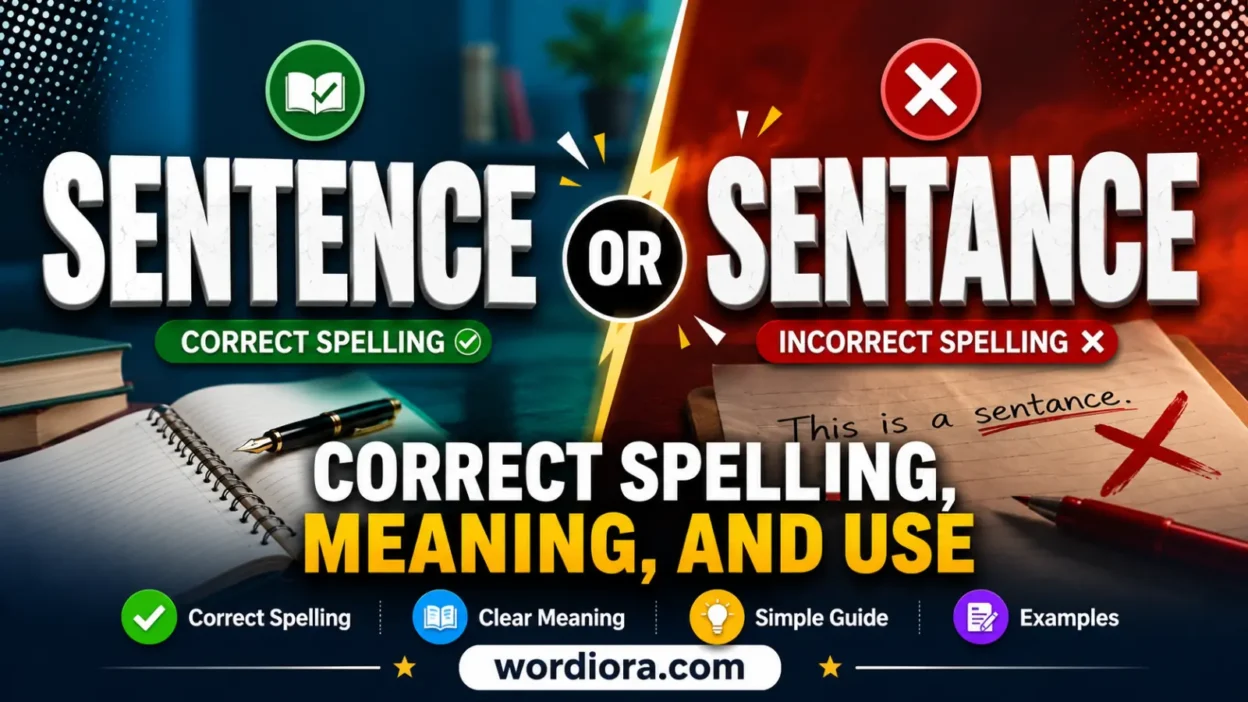
A single vowel causes the confusion in sentence or sentance. The two forms may look equally possible, especially because the unstressed middle sound is not very clear in everyday speech.
Only one form belongs in standard US English. Sentence is the correct word for a complete unit of language, a court-imposed punishment, or the act of imposing that punishment. Sentance is a misspelling and has no separate accepted meaning.
Quick Answer
Use sentence, never sentance, in standard writing.
A sentence can be a group of words that communicates a complete idea. It can also be a punishment ordered by a court. As a verb, sentence means to officially give someone a legal punishment. The spelling stays the same in every meaning: sentence.
Why People Confuse Them
In American speech, sentence is commonly pronounced roughly as SEN-tuhns. The second syllable is weak, so the vowel does not clearly announce whether the spelling should contain an a or an e.
Writers may also recognize many familiar words ending in -ance, such as chance, distance, and importance. That pattern can make sentance look believable. However, similarity to other words does not make it standard.
The safest memory cue is simple: sentence ends in -ence.
Key Differences At A Glance
| Context | Best Choice | Why |
|---|---|---|
| School assignment | sentence | It is the standard spelling. |
| Business email | sentence | It is correct in professional writing. |
| Text message | sentence | Informal context does not change the spelling. |
| Grammar discussion | sentence | It names a complete language unit. |
| Court punishment | sentence | It names the penalty imposed by a court. |
| Legal verb | sentence | It means to impose a court punishment. |
| Any intended standard use | sentence | Sentance is not an accepted alternative. |
Meaning and Usage Difference
There is no subtle choice between two standard words.
- sentence: The correct noun and verb.
- sentance: A nonstandard spelling error with no separate definition.
As a grammar noun, sentence refers to a complete unit of expression. Many sentences contain a subject and a verb, though commands may leave the subject understood.
As a legal noun, sentence refers to a punishment imposed after a conviction. As a verb, it describes the court’s act of imposing that punishment.
Correct: Please shorten the final sentence.
Correct: The court may sentence the defendant next month.
Incorrect: Please shorten the final sentance.
Tone, Context, and Formality
Sentence works in every level of formality. It fits essays, workplace messages, news reports, legal documents, classroom notes, and casual texts.
Sentance does not become acceptable because the setting is relaxed. A friend may understand it in a quick message, but it still reads as a spelling mistake.
Pronunciation does not create a distinction. Both forms would likely be read aloud the same way, but only sentence is standard in writing.
Which One Should You Use?
Choose sentence whenever you need the word.
Use it when discussing writing: “That sentence needs a comma.”
Use it for a court penalty: “The judge announced the sentence.”
Use it as a verb: “The judge will sentence him on Friday.”
The choice does not depend on meaning, audience, region, or formality. The spelling remains sentence in all standard uses.
When One Choice Sounds Wrong
Sentance may not sound wrong when spoken because readers usually interpret it as sentence. The problem appears on the page.
It looks especially out of place in schoolwork, applications, resumes, reports, published writing, and legal material. The error can also spread into related forms.
Incorrect: sentanced
Correct: sentenced
Incorrect: sentancing
Correct: sentencing
Notice that sentencing drops the final e before adding -ing.
Common Mistakes (and Quick Fixes)
One common mistake is changing the ending to -ance because of the pronunciation. Fix it by remembering the final pattern: sent-ence.
Another mistake is assuming the grammar meaning and legal meaning use different spellings. They do not. A written sentence and a prison sentence use the same word.
Writers also sometimes produce sentanced or sentancing after starting with the wrong base form. Return to the correct base word first, then add the ending: sentence, sentenced, sentencing.
A final mistake is trusting familiarity. A misspelling can look normal after repeated exposure. Check the ending rather than relying only on appearance.
Everyday Examples
The teacher asked us to write one sentence about our weekend.
Your opening sentence is clear and direct.
I deleted the last sentence from the email.
Can you use that word in a sentence?
The court issued a five-year sentence.
Her attorney asked for a lighter sentence.
The judge will sentence the defendant after the hearing.
He was sentenced to community service.
She is scheduled for sentencing next month.
Each example uses sentence or one of its correct related forms.
Dictionary-Style Word Details
Verb
sentence: A transitive verb meaning to officially impose a legal punishment on someone. Common forms are sentences, sentenced, and sentencing. Example: “The court sentenced him to probation.”
sentance: Not commonly used as a verb in standard US English. It is a misspelling of sentence.
Noun
sentence: A countable noun. In grammar, it means a complete unit of expression. In law, it means a punishment imposed by a court. Example: “The final sentence was brief.” Example: “She received a suspended sentence.”
sentance: Not a standard noun. Use sentence instead.
Synonyms
sentence: Exact substitutes depend on the meaning. For the grammar sense, closest plain alternatives include statement or utterance, though neither matches every use. For the legal noun, punishment or penalty may fit. For the verb, condemn or punish can overlap in some contexts but are not exact replacements.
sentance: No valid synonyms because it is not a standard word. The intended correction is sentence.
Example Sentences
sentence: “Please revise the first sentence.” “The judge may sentence the offender tomorrow.”
sentance: Incorrect in standard writing. Write “Please revise the first sentence,” not “Please revise the first sentance.”
Word History
sentence: English received the word through Old French from Latin sententia, which carried ideas such as thought, opinion, judgment, or decision. Those earlier senses help explain both the language-related and legal meanings used today.
sentance: It has no separate standard word history. It appears as a spelling error formed by replacing the second e in sentence with a.
Phrases Containing
sentence: Common phrases include complete sentence, sentence structure, sentence fragment, run-on sentence, topic sentence, prison sentence, life sentence, suspended sentence, and sentence someone to a punishment.
sentance: No standard phrases contain this spelling. Correct any intended phrase by using sentence.
FAQs
Is sentence or sentance the correct spelling?
Sentence is the correct spelling in standard US English. Sentance is a common misspelling and should not be used in schoolwork, emails, reports, legal writing, or casual messages. The correct word always ends in -ence, whether it refers to a written statement or a court punishment.
Is sentance a real English word?
No, sentance is not recognized as a standard English word. It usually appears when someone spells sentence according to its pronunciation. Although readers may understand the intended meaning, the spelling should always be corrected to sentence.
What does sentence mean in grammar?
In grammar, a sentence is a complete unit of expression that communicates an idea, question, command, or feeling. It usually begins with a capital letter and ends with a period, question mark, or exclamation point. For example, “The meeting begins at nine” is a complete sentence.
Can sentence also be used as a legal word?
Yes. As a noun, sentence can mean the punishment ordered by a court after someone is convicted. For example, “The judge announced a five-year sentence.” The meaning becomes clear from the legal context.
Can sentence be used as a verb?
Yes. As a verb, sentence means to officially give someone a legal punishment. For example, “The judge will sentence the defendant next week.” Its related forms include sentenced, sentences, and sentencing.
Why do people spell sentence as sentance?
The mistake often happens because the second syllable in sentence is weak when spoken. It may sound like “tuhns,” so the correct vowel is difficult to hear. Familiar words ending in -ance may also influence the error. A simple reminder is that sentence ends with ence.
What are the correct related forms of sentence?
The correct forms are sentence, sentences, sentenced, and sentencing. Avoid incorrect spellings such as sentance, sentanced, or sentancing. Always begin with the correct base word before adding an ending.
Conclusion
The correct choice is sentence. Use it for a complete unit of language, a court punishment, and the verb meaning to impose that punishment.
Sentance is not a second word, a regional form, or an informal option. It is simply a misspelling. Remember the -ence ending, and use sentence in every standard context.