Both first conditional and second conditional are correct grammar forms. The choice depends on what you mean.
Use the first conditional when you are talking about a real or possible situation and its likely result.
Use the second conditional when you are talking about an imagined, unlikely, or unreal situation and its possible result.
The tricky part is that both can talk about the present or future. The real difference is not only time. It is how realistic the condition feels to the speaker.
Quick Answer
Use first conditional for a real future possibility:
If I finish work early, I’ll call you.
This means finishing early is realistic.
Use second conditional for an imagined or unlikely situation:
If I finished work early, I would call you.
This suggests finishing early is unlikely, not expected, or only imagined.
The simple guide is this:
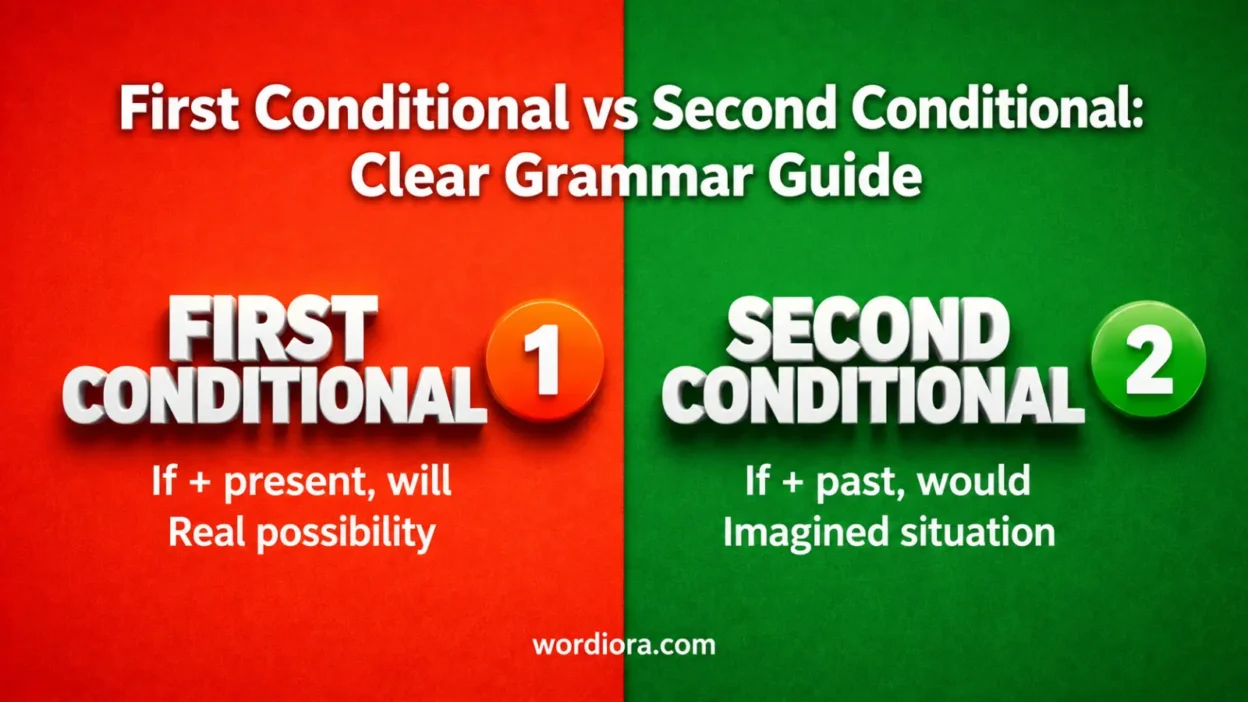
First conditional = real possibility.
Second conditional = imagined or unlikely possibility.
Why People Confuse Them
People confuse these forms because both often start with if and both can point to the future.
Look at these two sentences:
If I have time, I’ll stop by.
If I had time, I would stop by.
Both are about stopping by. Both may refer to a future visit. But they do not feel the same.
The first sentence sounds realistic. Maybe I will have time.
The second sentence sounds less realistic. It suggests I probably will not have time, or I am imagining a different situation.
That is why the verb form matters. The grammar shows how close or distant the situation feels from real life.
Key Differences At A Glance
| Context | Best Choice | Why |
|---|---|---|
| A real plan or likely result | First conditional | The condition may really happen. |
| A warning | First conditional | The result depends on a realistic condition. |
| A promise or practical offer | First conditional | The speaker treats the situation as possible. |
| A dream or unlikely wish | Second conditional | The condition is imagined or unlikely. |
| Advice using “if I were you” | Second conditional | The speaker imagines being in another person’s place. |
| A situation opposite to current reality | Second conditional | The condition is not true now. |
Meaning and Usage Difference
The first conditional usually follows this pattern:
If + present simple, will + base verb
Examples:
If it rains tonight, we’ll order food.
If she texts me, I’ll send you the address.
If the price drops, I’ll buy the laptop.
The condition is possible. The result is also possible.
The second conditional usually follows this pattern:
If + past simple, would + base verb
Examples:
If it rained tonight, we would stay home.
If she texted me, I would know what happened.
If the price dropped, I would buy the laptop.
In the second conditional, the past form does not usually mean past time. It creates distance from reality. The speaker is imagining the situation instead of treating it as likely.
Here is the key contrast:
• If I get the job, I’ll move to Denver.
This means getting the job is a real possibility.
• If I got the job, I would move to Denver.
This means getting the job feels less likely, more imagined, or uncertain.
Tone, Context, and Formality
Both forms are standard in American English. Neither one is more “correct” by itself.
The first conditional often sounds practical, direct, and realistic. It fits daily plans, work decisions, school situations, warnings, and promises.
Examples:
If the meeting ends by 3, I’ll pick up the kids.
If you miss the deadline, your application won’t be reviewed.
The second conditional often sounds more hypothetical, doubtful, polite, or reflective. It fits dreams, advice, unlikely situations, and things that are not true right now.
Examples:
If I had more savings, I would take a month off.
If I were you, I would ask for the details in writing.
The second conditional can also soften advice. If I were you, I would… sounds less blunt than You should…
Which One Should You Use?
Choose the first conditional when the condition is realistic.
Use it when you mean:
• this may happen
• this is a real plan
• this is a real warning
• this result depends on a possible condition
Examples:
If traffic is light, we’ll get there by 6.
If you call before noon, they’ll schedule you today.
Choose the second conditional when the condition is imagined, unlikely, or not true now.
Use it when you mean:
• this probably will not happen
• this is only a dream or idea
• this is not true in the present
• I am imagining a different situation
Examples:
If I lived closer, I would visit more often.
If we had a bigger budget, we would hire another designer.
Here is a compact comparison:
| Feature | First Conditional | Second Conditional |
| Basic meaning | Real or possible condition | Imagined, unlikely, or unreal condition |
| Common form | If + present simple, will + base verb | If + past simple, would + base verb |
| Time focus | Present or future | Present or future |
| Speaker attitude | This could really happen | This is less real or only imagined |
| Example | If I see him, I’ll ask. | If I saw him, I would ask. |
When One Choice Sounds Wrong
The first conditional can sound wrong when the situation is clearly unreal.
Awkward: If I am a billionaire, I’ll buy an island.
Better: If I were a billionaire, I would buy an island.
The first sentence sounds as if becoming a billionaire is a realistic condition in the current situation. The second sentence makes it clear that this is imagined.
The second conditional can sound wrong when you are talking about a real plan.
Awkward: If the package arrived tomorrow, I would bring it over.
Better: If the package arrives tomorrow, I’ll bring it over.
The first version sounds doubtful or imaginary. The second version sounds like a real plan based on a real delivery.
Sometimes both are possible, but the meaning changes:
If I find a cheaper flight, I’ll book it.
This sounds realistic.
If I found a cheaper flight, I would book it.
This sounds less likely, as if cheaper flights are hard to find.
Common Mistakes and Quick Fixes
One common mistake is using will in the if-clause of the first conditional.
Incorrect: If I will see her, I’ll tell her.
Correct: If I see her, I’ll tell her.
Another common mistake is using would in the if-clause of the second conditional.
Incorrect: If I would have more time, I would help.
Correct: If I had more time, I would help.
A third mistake is thinking the second conditional always talks about the past.
If I had more time, I would help.
This does not mean I had more time in the past. It means I do not have enough time now, or I am imagining having more time.
Another common question is if I was vs if I were.
In careful writing, if I were is the safer choice for unreal situations:
If I were you, I would wait.
In casual speech, many people say if I was, especially with he, she, or it:
If she was available, she would help.
For polished writing, especially in advice or clearly unreal situations, were often sounds better.
Everyday Examples
First conditional:
If I get paid Friday, I’ll pay the bill.
Second conditional:
If I got paid more, I would move to a better apartment.
The first sentence is about a real expected paycheck. The second imagines a different pay situation.
First conditional:
If the school closes early, I’ll leave work at noon.
Second conditional:
If the school closed early every Friday, I would change my schedule.
The first is a possible event. The second imagines a different routine.
First conditional:
If you send me the file, I’ll review it tonight.
Second conditional:
If you sent me the file, I would know what to fix.
The first sounds like a real request. The second suggests the file has not been sent, so the speaker is imagining what would happen.
First conditional:
If we save enough money, we’ll buy a car next year.
Second conditional:
If we saved enough money, we would buy a car next year.
The first sounds like a real goal. The second sounds less certain or more hypothetical.
Dictionary-Style Word Details
Verb
• First conditional: Not commonly used as a verb in standard US English. It is a grammar label, not an action word.
• Second conditional: Not commonly used as a verb in standard US English. It is also a grammar label, not an action word.
Noun
• First conditional: A noun phrase that names a type of conditional sentence. It usually refers to a sentence about a real or possible present/future condition and its result.
Example: The sentence “If it rains, I’ll drive” uses the first conditional.
• Second conditional: A noun phrase that names a type of conditional sentence. It usually refers to a sentence about an imagined, unlikely, or unreal present/future condition and its result.
Example: The sentence “If I had a car, I would drive” uses the second conditional.
Synonyms
• First conditional: Closest plain alternatives include type 1 conditional, real conditional, and real future conditional. These labels can vary by grammar program, so use the one your class, editor, or teacher expects.
• Second conditional: Closest plain alternatives include type 2 conditional, unreal conditional, and present unreal conditional. These are not always perfect one-for-one replacements in every teaching system, but they often point to the same basic structure.
Clear antonyms do not work well here. The two terms contrast with each other, but they are grammar labels, not exact opposites like hot and cold.
Example Sentences
• First conditional: If I hear from the landlord, I’ll let you know.
• First conditional: We’ll reschedule the appointment if the storm gets worse.
• Second conditional: If I knew the answer, I would tell you.
• Second conditional: If they offered remote work, more people would apply.
Word History
• First conditional: The phrase is a teaching label used to name one common conditional sentence pattern. The word first marks its place in a common learning sequence, not its importance.
• Second conditional: The phrase is also a teaching label. The word second marks its place in that same learning sequence. It does not mean the form is less useful or less correct.
The broader word conditional comes from the idea of a condition: one thing depends on another thing.
Phrases Containing
• First conditional: first conditional sentence, first conditional form, first conditional example, first conditional question, first conditional clause.
• Second conditional: second conditional sentence, second conditional form, second conditional example, second conditional question, second conditional clause.
FAQs
What is the main difference between first conditional and second conditional?
The first conditional talks about a real or possible situation and its likely result. The second conditional talks about an imagined, unlikely, or unreal situation and its possible result.
Example: If I study, I’ll pass.
This sounds possible.
Example: If I studied more, I would pass.
This sounds more hypothetical or less likely.
When should I use the first conditional?
Use the first conditional when the condition could really happen. It is common for plans, warnings, promises, offers, and real future possibilities.
Example: If it rains tomorrow, we’ll stay home.
When should I use the second conditional?
Use the second conditional when the condition is imagined, unlikely, or not true right now.
Example: If I had more money, I would buy a new car.
This means you do not have enough money now, but you are imagining the situation.
Can both first and second conditional talk about the future?
Yes. Both can talk about the future, but they show a different attitude.
If I get the job, I’ll move.
This sounds like a real possibility.
If I got the job, I would move.
This sounds less certain or more imagined.
Why does the second conditional use past tense?
The past tense in the second conditional usually does not mean past time. It shows distance from reality.
Example: If I lived in New York, I would take the subway.
This does not mean the past. It means you do not live in New York now.
Is “if I were” or “if I was” correct in the second conditional?
In careful American English, if I were is usually preferred for unreal situations.
Example: If I were you, I would apologize.
In casual speech, many people use if I was, but if I were is safer in formal writing and grammar lessons.
Can I use “will” after if in the first conditional?
Usually, no. In the first conditional, use the present simple after if, not will.
Incorrect: If I will see him, I’ll tell him.
Correct: If I see him, I’ll tell him.
Can I use “would” after if in the second conditional?
Usually, no. In the second conditional, use the past simple after if, not would.
Incorrect: If I would have time, I would help.
Correct: If I had time, I would help.
Are first conditional and second conditional interchangeable?
No. They can sometimes describe a similar situation, but they do not mean the same thing.
If I win, I’ll celebrate.
This sounds possible.
If I won, I would celebrate.
This sounds imagined or unlikely.
What is an easy way to remember first conditional vs second conditional?
Remember this simple rule:
First conditional = real possibility.
Second conditional = imagined or unlikely situation.
Example: If I save enough money, I’ll travel.
Example: If I had more money, I would travel.
Conclusion
The difference between first conditional vs second conditional is mainly about how real the condition feels.
Use the first conditional when the condition is realistic or possible:
If I see her, I’ll ask.
Use the second conditional when the condition is imagined, unlikely, or not true now:
If I saw her, I would ask.
Both forms are correct. The best choice depends on your meaning. If you believe the situation can really happen, use the first conditional. If you are imagining a different or unlikely situation, use the second conditional.