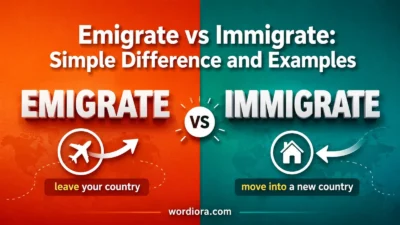
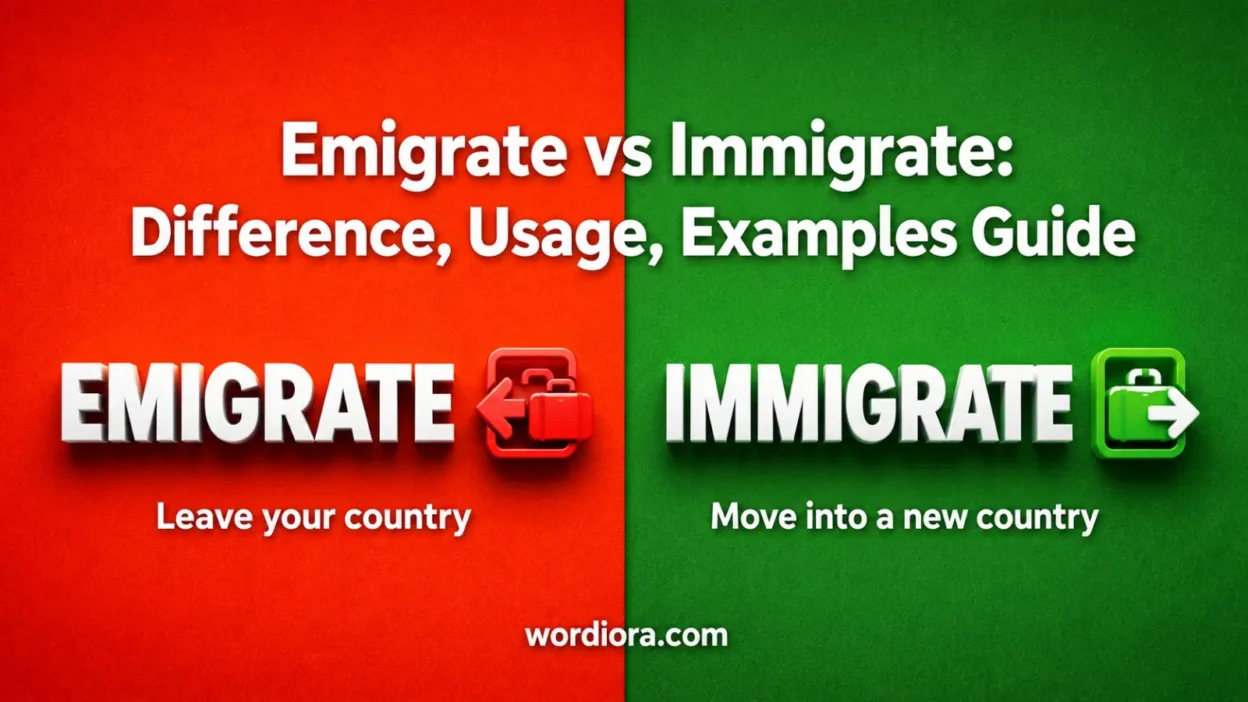
Emigrate vs immigrate is a common word-choice problem because both words describe moving from one country to another. The difference depends on the direction you want to emphasize.
Use emigrate when the focus is on leaving a country. Use immigrate when the focus is on entering a new country to live there.
A person can do both in the same life event. For example, someone may emigrate from Brazil and immigrate to the United States. The move is the same, but the viewpoint changes.
These words are not casual spelling choices. They are standard verbs with different meanings in context. Once you know whether your sentence looks at the old country or the new country, the choice becomes much easier.
Quick Answer
Use emigrate for leaving. Use immigrate for entering.
Think of it this way:
- Emigrate = exit a country.
- Immigrate = come into a country.
Correct examples:
- My grandparents emigrated from Italy in the 1950s.
- My grandparents immigrated to the United States in the 1950s.
- She emigrated from the Philippines and immigrated to California as a child.
The most common pattern is emigrate from and immigrate to. However, you may also see emigrate to when the sentence still focuses on leaving home and the destination is added afterward.
Why People Confuse Them
People confuse emigrate and immigrate because the words look similar, sound similar, and describe the same larger event. Both involve a person moving across a national border to live somewhere else.
The difference is point of view.
If you are talking about the country someone left, emigrate is usually the better choice. If you are talking about the country someone entered, immigrate is usually better.
Pronunciation can also add to the confusion. In plain US pronunciation, emigrate sounds like EM-uh-grayt, while immigrate sounds like IM-uh-grayt. The first syllable changes, but the rest sounds almost the same.
That small sound difference matters because the meaning changes with it.
Key Differences At A Glance
| Context | Best Choice | Why |
|---|---|---|
| Focus on leaving a home country | emigrate | The sentence looks at departure. |
| Focus on entering a new country | immigrate | The sentence looks at arrival and settlement. |
| Using “from” after the verb | emigrate | “From” points back to the country left. |
| Using “to” after the verb | immigrate | “To” points toward the destination country. |
| Talking about one person’s full move | either, depending on focus | The same person may do both. |
| Writing about a new country’s population | immigrate | The new country receives immigrants. |
| Writing about people leaving a country | emigrate | The old country loses emigrants. |
Meaning and Usage Difference
Emigrate means to leave one country or region to live in another. It looks back at the place someone left.
Example:
Maya emigrated from India after college.
The sentence focuses on India as the starting point.
Immigrate means to come into a new country to live there. It looks toward the place someone entered.
Example:
Maya immigrated to the United States after college.
The sentence focuses on the United States as the destination.
Both words are usually verbs. They often appear in serious, factual writing about families, history, law, travel records, and population changes. Still, they can also appear in everyday conversation.
The safest pattern is simple:
- emigrate from a country
- immigrate to a country
When both countries appear, choose the verb that matches the focus of the sentence.
Tone, Context, and Formality
Both emigrate and immigrate are standard words in US English. Neither word is slang. Neither word is automatically rude. However, the topic can be personal, so accuracy matters.
Emigrate often appears when the writer focuses on the country someone left:
- why people emigrated
- families who emigrated during a crisis
- workers who emigrated for better jobs
Immigrate often appears when the writer focuses on the country someone entered:
- people who immigrated to the United States
- a family’s immigration story
- rules for immigrating to a new country
In formal writing, use the exact word that matches the direction. In personal writing, either word may be correct if your meaning is clear. Even so, the wrong choice can make a sentence sound backward.
Which One Should You Use?
Choose emigrate when your sentence answers the question, “Where did the person leave?”
- Carlos emigrated from Mexico.
- Her family emigrated from South Korea.
- Many workers emigrated from rural areas to larger economies.
Choose immigrate when your sentence answers the question, “Where did the person move into?”
- Carlos immigrated to the United States.
- Her family immigrated to Canada.
- Many workers immigrated to countries with more job openings.
Use both when you want the full route:
- Carlos emigrated from Mexico and immigrated to the United States.
- Her parents emigrated from South Korea and immigrated to Canada.
That structure is clear because it shows both the starting point and the destination.
When One Choice Sounds Wrong
The wrong word usually sounds wrong because it points in the wrong direction.
Incorrect:
She immigrated from Vietnam in 1998.
Better:
She emigrated from Vietnam in 1998.
The word from points to the country she left, so emigrated is clearer.
Incorrect:
They emigrated to the United States last year.
This sentence is not always impossible, but it can sound less direct if the main focus is arrival in the United States.
Clearer:
They immigrated to the United States last year.
Use emigrated to only when the sentence still feels centered on leaving home:
- They decided to emigrate to Australia after years of planning.
Here, the focus is on the decision to leave their home country.
Common Mistakes and Quick Fixes
One common mistake is using immigrate whenever someone moves countries. That does not always work. If the sentence focuses on the country left behind, use emigrate.
Mistake:
My uncle immigrated from Poland.
Fix:
My uncle emigrated from Poland.
Another mistake is using emigrate whenever the sentence includes a destination. The destination alone does not decide the word. The focus decides it.
Mistake:
My uncle emigrated to the United States.
Possible fix:
My uncle immigrated to the United States.
Better full version:
My uncle emigrated from Poland and immigrated to the United States.
A third mistake is treating the noun forms as the same. Emigration is the act of leaving. Immigration is the act of entering. Emigrant refers to a person from the leaving-country viewpoint. Immigrant refers to a person from the receiving-country viewpoint.
Everyday Examples
- My grandmother emigrated from Greece before starting a new life in Chicago.
- My grandmother immigrated to the United States before starting a new life in Chicago.
- The family emigrated from Cuba when their children were young.
- The family immigrated to Florida when their children were young.
- His parents emigrated from Nigeria for work.
- His parents immigrated to the United States for work.
- She wrote a school essay about why her family emigrated from Ukraine.
- He shared the story of how his father immigrated to New Jersey.
Here is the compact comparison:
| Feature | emigrate | immigrate |
| Main meaning | leave a country | enter a new country |
| Common preposition | from | to |
| Viewpoint | old country | new country |
| Person noun | emigrant | immigrant |
| Action noun | emigration | immigration |
Dictionary-Style Word Details
Verb
emigrate: Commonly used as a verb. It means to leave one country or region to live in another.
Example: They emigrated from Ireland.
immigrate: Commonly used as a verb. It means to enter another country to live there.
Example: They immigrated to the United States.
Both verbs are usually used for people, families, or groups. They are not normally used for a short vacation, business trip, or study visit unless the person is moving to live there.
Noun
emigrate: Not commonly used as a noun in standard US English. Use emigration for the action and emigrant for the person.
- Emigration changed the town’s population.
- Her grandfather was an emigrant from Norway.
immigrate: Not commonly used as a noun in standard US English. Use immigration for the action and immigrant for the person.
- Immigration shaped the city’s history.
- Her grandfather was an immigrant to the United States.
Synonyms
emigrate: There is no perfect one-word synonym in every sentence. Closest plain alternatives include leave one’s country, move abroad, or relocate from one country to another.
immigrate: There is no perfect one-word synonym in every sentence. Closest plain alternatives include move to a new country, settle in another country, or relocate to another country.
The clearest contrast is leave vs enter, but those words are broader than emigrate and immigrate. A person can leave a room or enter a store, but they do not emigrate or immigrate unless the context involves moving to live somewhere else.
Example Sentences
emigrate:
- Her family emigrated from Lebanon before she was born.
- Many people emigrate for work, school, safety, or family reasons.
- He planned to emigrate after receiving a long-term job offer overseas.
- The novel follows a young couple who emigrate from their home country.
immigrate:
- Her family immigrated to Michigan before she was born.
- Many people immigrate for work, school, safety, or family reasons.
- He hoped to immigrate after receiving a long-term job offer in Canada.
- The article describes families who immigrated to the United States.
Word History
emigrate: The word comes from a Latin root idea connected with moving away or moving out. That history matches the modern meaning: leaving a place to live elsewhere.
immigrate: The word comes from a Latin root idea connected with moving into a place. That history matches the modern meaning: entering a new country to live there.
The history can help you remember the difference, but you do not need it to use the words correctly. In daily writing, focus on direction: leaving or entering.
Phrases Containing
emigrate:
- emigrate from a country
- emigrate to another country
- plan to emigrate
- decide to emigrate
- forced to emigrate
- families who emigrated
immigrate:
- immigrate to the United States
- immigrate from one country to another
- apply to immigrate
- hope to immigrate
- families who immigrated
- people who immigrated as children
FAQs
Is it emigrate or immigrate?
Use emigrate when you mean someone is leaving a country. Use immigrate when you mean someone is entering a new country to live there. For example, a person may emigrate from Mexico and immigrate to the United States.
What is the easiest way to remember emigrate vs immigrate?
Remember this simple trick: emigrate = exit and immigrate = into. If the sentence focuses on leaving the old country, use emigrate. If it focuses on entering the new country, use immigrate.
Do you emigrate from or immigrate from a country?
The usual phrase is emigrate from a country. For example, “She emigrated from Germany.” Because from points to the place someone left, emigrate is usually the correct word.
Do you immigrate to or emigrate to a country?
The usual phrase is immigrate to a country. For example, “They immigrated to Canada.” However, emigrate to can sometimes be correct when the sentence focuses on the decision to leave home and move elsewhere.
Can one person both emigrate and immigrate?
Yes. One person can do both during the same move. Someone may emigrate from one country and immigrate to another. The action is the same, but the viewpoint changes.
What is the difference between an immigrant and an emigrant?
An immigrant is a person viewed from the new country’s perspective. An emigrant is a person viewed from the country they left. For example, someone who moved from Ireland to the United States was an emigrant from Ireland and an immigrant to the United States.
Is immigrated from wrong?
In most cases, immigrated from sounds unclear or incorrect because immigrate focuses on entering a country. A clearer choice is emigrated from. For example, write “He emigrated from Poland,” not “He immigrated from Poland.”
Are emigrate and immigrate used for short trips?
No. These words usually describe moving to another country to live there. For vacations, business trips, or short visits, use words like travel, visit, go to, or move temporarily instead.
Conclusion
The difference between emigrate and immigrate is direction.
Use emigrate when your sentence focuses on leaving a country. Use immigrate when your sentence focuses on entering a new country to live there.
The same person can be both an emigrant and an immigrant. Someone may emigrate from one country and immigrate to another. That is why the words are closely related, but they are not the same choice in every sentence.
When you are unsure, look for the preposition. From usually points to emigrate. To usually points to immigrate. Then check the sentence’s focus: old country or new country. That simple test will he