Must be and have to be are both correct, but they do not always feel the same.
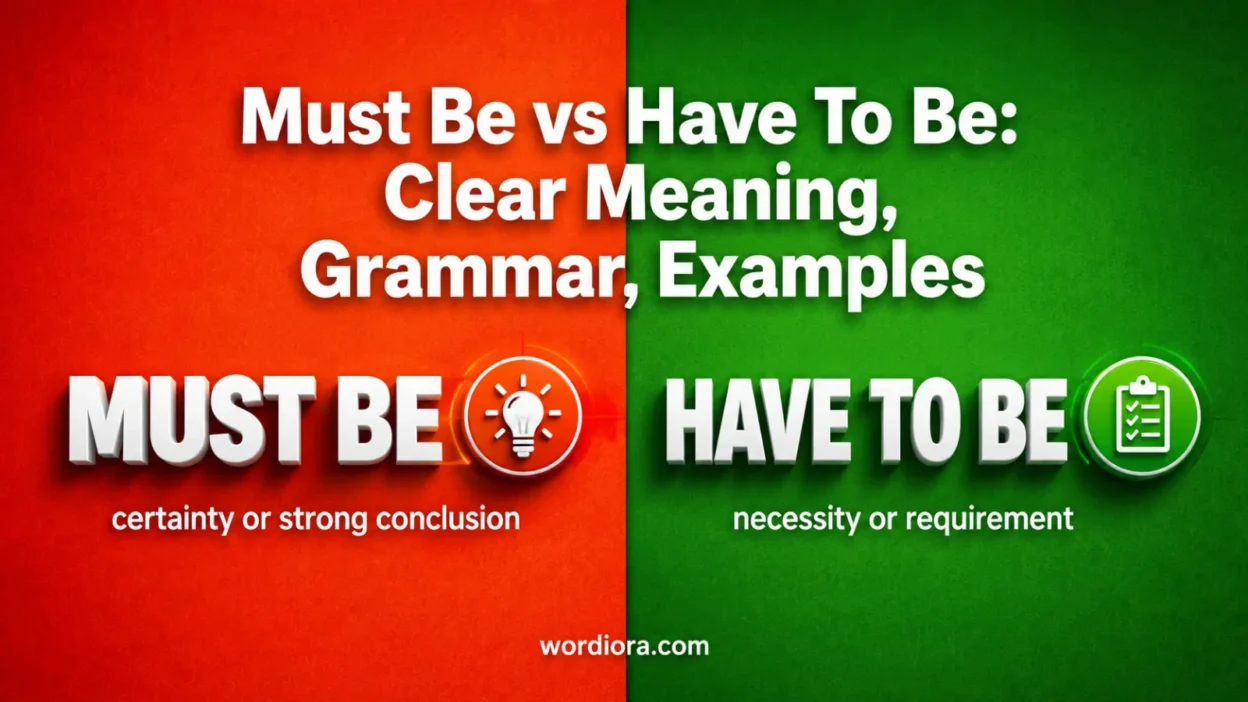
Both can show that something is required or necessary. The difference is in tone, structure, and context. Must be often sounds stronger, more formal, or more certain. Have to be often sounds more conversational and more connected to rules, conditions, or practical requirements.
The best choice depends on what you mean: a firm rule, a strong conclusion, or an everyday requirement.
Quick Answer
Use must be when you want to sound firm, official, or very certain.
Use have to be when you are talking about a practical requirement, an outside rule, or something that is necessary in normal conversation.
Examples:
Correct: Applicants must be at least 18 years old.
Correct: You have to be logged in to view the file.
In many requirement sentences, both can work. But they do not always sound equally natural.
Why People Confuse Them
People confuse must be and have to be because both point to necessity.
If a job posting says, “Candidates must be available on weekends,” it means weekend availability is required.
If a manager says, “You have to be available on weekends,” the meaning is also about requirement.
The confusion grows because must be has another common meaning: strong certainty.
“That must be the new teacher” means “I am almost sure that is the new teacher.”
“That has to be the new teacher” can also mean that, but it sounds more casual and emphatic.
So the phrases overlap, but they do not always carry the same tone.
Key Differences At A Glance
| Context | Best Choice | Why |
|---|---|---|
| Official rule or policy | must be | Sounds firm, formal, and rule-based |
| Everyday requirement | have to be | Sounds natural in conversation |
| Strong conclusion | must be | Clearly means “is almost certainly” |
| Website or app condition | have to be | Fits practical requirements |
| Warning or instruction | must be | Sounds direct and serious |
| Casual question | have to be | “Does it have to be…?” is more natural |
| Past requirement | had to be | “Must” does not work as a normal past obligation form |
| Future requirement | will have to be | More natural for a future requirement |
Meaning and Usage Difference
Must be is a verb phrase made with the modal verb must plus be.
It can mean that something is required:
“All forms must be submitted by Friday.”
“Employees must be ready before the doors open.”
It can also mean that something is almost certainly true:
“She must be tired after that long flight.”
“That must be the package I ordered.”
Have to be is a verb phrase made with have to plus be. It usually points to a requirement, condition, or necessity.
“You have to be on time for the exam.”
“The password has to be at least eight characters.”
“We have to be careful with the budget.”
Compact comparison:
- Must be: stronger, more formal, often used for rules or strong certainty.
- Have to be: more conversational, often used for practical needs or outside requirements.
- Must be does not change form by subject: I must be, she must be, they must be.
- Have to be changes with the subject: I have to be, she has to be, they have to be.
- For past or future requirements, use forms of have to be: had to be, will have to be.
Tone, Context, and Formality
Must be can sound serious, official, or firm.
“Visitors must be checked in at the front desk.”
“Food must be stored at the proper temperature.”
This tone works well in policies, signs, instructions, legal-style rules, workplace notices, and safety language.
In everyday speech, must be is common when you are making a strong guess:
“You must be exhausted.”
“That must be hard.”
For ordinary requirements in conversation, have to be usually sounds more natural:
“I have to be at work by eight.”
“You have to be quiet during the movie.”
“She has to be home before dinner.”
The question form also matters. In normal US English, Does it have to be…? sounds more natural than Must it be…?
Natural: Does it have to be printed?
Formal: Must it be printed?
Which One Should You Use?
Use must be when the sentence sounds like a rule, standard, warning, or strong conclusion.
Good uses:
“Applications must be complete.”
“Children must be accompanied by an adult.”
“That must be the reason she left early.”
Use have to be when the sentence sounds like a normal requirement in daily life.
Good uses:
“You have to be there by 6.”
“The file has to be smaller than 10 MB.”
“We have to be ready before the guests arrive.”
For most casual conversations, have to be is the safer choice for requirement. For formal instructions, must be often sounds cleaner and stronger.
When One Choice Sounds Wrong
Sometimes must be sounds too stiff.
Stiff: I must be at the dentist by 3.
Natural: I have to be at the dentist by 3.
The first sentence is understandable, but many US speakers would use have to be in normal conversation.
Sometimes have to be sounds too casual for an official rule.
Casual: Passengers have to be seated during takeoff.
More official: Passengers must be seated during takeoff.
Both make sense, but the second fits an announcement or written rule better.
For strong certainty, must be is usually the cleaner choice.
Natural: That must be the answer.
Casual but possible: That has to be the answer.
Common Mistakes and Quick Fixes
Mistake: She musts be ready by noon.
Fix: She must be ready by noon.
Must does not add -s with he, she, or it.
Mistake: She have to be ready by noon.
Fix: She has to be ready by noon.
Have to changes to has to with he, she, and it.
Mistake: Yesterday, I must be at work early.
Fix: Yesterday, I had to be at work early.
For past requirements, use had to be.
Mistake: Tomorrow, I will must be available.
Fix: Tomorrow, I will have to be available.
For future requirements, use will have to be.
Mistake: You don’t must be perfect.
Fix: You don’t have to be perfect.
Use don’t have to be when something is not required.
Mistake: You must not be perfect.
Better: You don’t have to be perfect.
Must not be usually means something is not allowed or must not happen. It does not mean “not necessary.”
Everyday Examples
“You must be joking.”
Meaning: I strongly doubt what you just said, or I am surprised.
“You have to be joking.”
Meaning: Similar idea, but more casual and emphatic.
“You must be careful near the edge.”
Meaning: Strong warning or serious advice.
“You have to be careful near the edge.”
Meaning: Practical warning; still strong, but more conversational.
“The report must be finished today.”
Meaning: A firm rule or deadline.
“The report has to be finished today.”
Meaning: A practical requirement, often because of a deadline.
“You must be the new neighbor.”
Meaning: I am almost sure you are the new neighbor.
“You have to be the new neighbor.”
Meaning: Possible in casual speech, but more forceful and less neutral.
Dictionary-Style Word Details
Verb
must be: A verb phrase using the modal auxiliary must plus the base verb be. It can show requirement or strong certainty.
Example: The room must be cleaned before the meeting.
Example: That must be your brother.
have to be: A verb phrase using have to plus the base verb be. It usually shows that something is required or necessary.
Example: You have to be signed in to continue.
Example: She has to be at practice by 5.
Noun
must be: Not commonly used as a noun in standard US English. The phrase works as a verb phrase.
have to be: Not commonly used as a noun in standard US English. The phrase works as a verb phrase.
Note: The single word must can be a noun, as in “A helmet is a must,” but that is different from the phrase must be.
Synonyms
must be: Closest plain alternatives depend on meaning.
For requirement: is required to be, needs to be, has to be.
For strong certainty: is almost certainly, is very likely, has to be.
have to be: Closest plain alternatives include needs to be, is required to be, must be, and has got to be in casual speech.
Clear negative contrast:
must not be means “is not allowed to be” or “must not happen.”
doesn’t have to be means “is not required to be.”
Example Sentences
must be:
“Applicants must be 18 or older.”
“The kitchen must be cleaned before closing.”
“She must be upset after that call.”
“This must be the right address.”
have to be:
“You have to be on the list to enter.”
“The answer has to be in complete sentences.”
“We have to be ready by noon.”
“It doesn’t have to be perfect.”
Word History
must be: The useful point for modern writers is that must works as a modal auxiliary. It does not take -s, and it is followed by the base form be.
have to be: The useful point for modern writers is that have to behaves more like a regular verb pattern. It changes form: have to be, has to be, had to be, and will have to be.
The history of the two forms matters less than their current grammar: must be is fixed in form, while have to be changes for subject and tense.
Phrases Containing
must be:
must be careful
must be completed
must be 18 or older
must be true
must be joking
must be signed
have to be:
have to be there
has to be ready
had to be finished
will have to be approved
does it have to be
doesn’t have to be perfect
FAQs
Is “must be” correct?
Yes. Must be is correct when you want to show a firm requirement or a strong conclusion.
Example: “Employees must be on time.”
Example: “She must be tired after work.”
Is “have to be” correct?
Yes. Have to be is correct when something is required, necessary, or expected because of a rule, situation, or condition.
Example: “You have to be signed in to see your account.”
What is the main difference between must be and have to be?
Must be often sounds stronger, more formal, or more certain. Have to be sounds more natural in everyday conversation and often points to a practical requirement.
Which is more formal: must be or have to be?
Must be is usually more formal. It works well in rules, notices, instructions, and official writing.
Example: “Applications must be received by Friday.”
Which one is better for everyday speech?
Have to be is usually better for everyday speech when you mean “required.”
Example: “I have to be at work by 8.”
Can must be and have to be mean the same thing?
Sometimes, yes. Both can show that something is necessary.
Example: “The room must be clean.”
Example: “The room has to be clean.”
The meaning is close, but must be sounds firmer and more official.
Does “must be” mean “probably is”?
Yes, it can. Must be often shows a strong guess or conclusion.
Example: “That must be your sister.”
Meaning: I am almost sure that is your sister.
Can “have to be” also show a strong guess?
Yes, but it sounds more casual or emotional.
Example: “That has to be the best pizza in town.”
This means the speaker strongly believes it is true.
Should I say “must be” or “has to be” with he, she, or it?
Use must be or has to be.
Correct: “She must be ready.”
Correct: “She has to be ready.”
Incorrect: “She have to be ready.”
What is the past form of must be?
For past requirement, use had to be.
Correct: “I had to be there early yesterday.”
Incorrect: “I must be there early yesterday.”
What is the future form of must be?
For future requirement, will have to be often sounds more natural.
Correct: “The report will have to be finished tomorrow.”
Awkward: “The report will must be finished tomorrow.”
What is the difference between “must not be” and “doesn’t have to be”?
Must not be means something is not allowed.
Example: “The answer must not be copied.”
Doesn’t have to be means something is not required.
Example: “The answer doesn’t have to be long.”
Conclusion
Must be and have to be are both correct, but they fit different situations.
Choose must be for firm rules, formal instructions, serious warnings, and strong conclusions.
Choose have to be for everyday requirements, outside rules, practical conditions, and normal conversation.
A simple guide works well: if it sounds like a written rule or a strong guess, use must be. If it sounds like a normal real-life requirement, use have to be.