Further vs moreover can confuse writers because both words can add information. Still, they do not work the same way in every sentence.
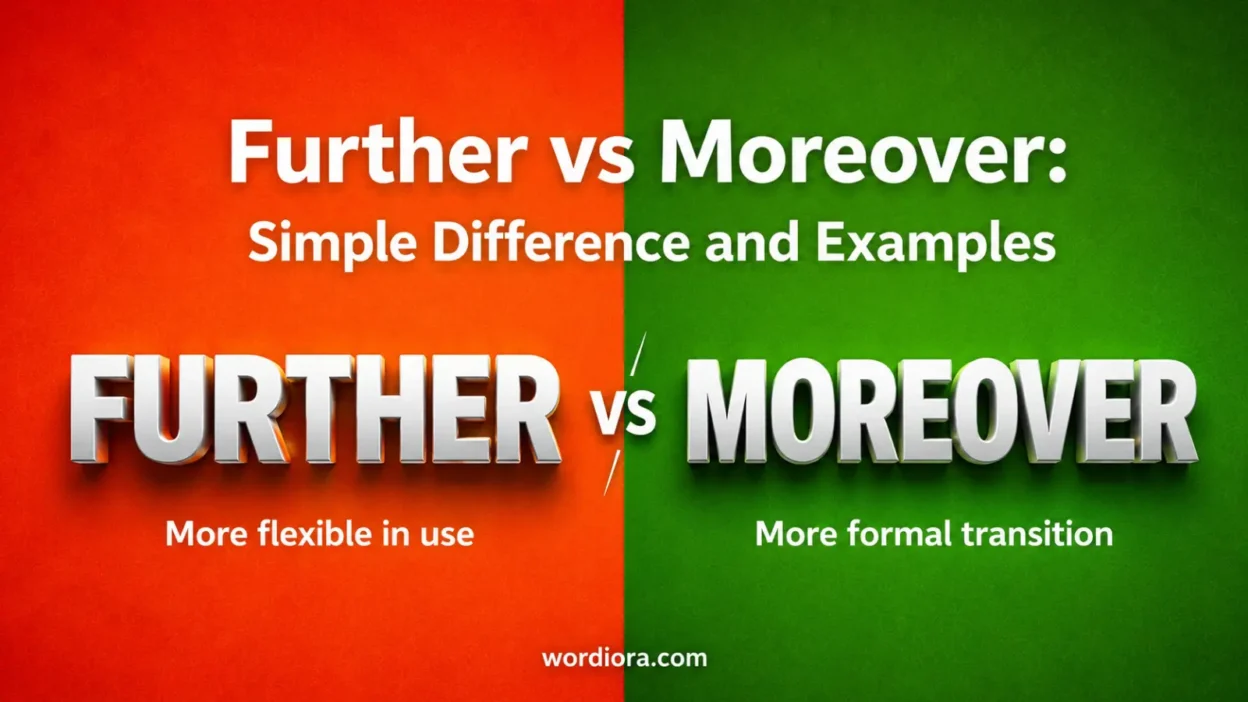
Further is more flexible. It can mean additional, to a greater degree, at a more advanced point, or to help something progress. Moreover is more specific. It is a formal adverb that adds another point, often one that strengthens what was just said.
Quick Answer
Use further when you mean more, additional, to a greater extent, or to promote progress. Use moreover when you want to add a formal supporting point to a previous statement. In short, further has several grammar roles, but moreover mainly works as a linking adverb.
Why People Confuse Them
People confuse these words because further can sometimes mean “in addition.” That meaning overlaps with moreover.
For example, a writer might say, “Further, the plan would save money.” That means almost the same thing as “Moreover, the plan would save money.” However, this overlap does not make the words fully interchangeable.
Further can describe more information, more distance, more progress, or an action that helps something move ahead. Moreover does not do those jobs. It only adds a related point to what has already been said.
Key Differences At A Glance
| Feature | further | moreover |
|---|---|---|
| Main use | More, additional, to a greater extent, or promote progress | Adds a supporting point |
| Grammar role | Adverb, adjective, or verb | Adverb |
| Tone | Neutral to formal | Formal |
| Common phrase | further information | moreover, it matters |
| Best for | Extra detail, progress, extent, or advancement | Adding a strong related point |
The biggest difference is range. Further has a wider job. Moreover has a narrower job.
Meaning and Usage Difference
Further can work in several ways.
As an adjective, it means more or additional: “Please send further details.” As an adverb, it can mean to a greater degree or more deeply: “We need to discuss this further.” As a verb, it means to help something develop: “The grant will further the research.”
Moreover is simpler. It is an adverb used to add information that supports or strengthens a previous statement: “The plan is affordable. Moreover, it is easy to manage.”
So, further can describe amount, degree, progress, or added information. Moreover only adds another related point.
Tone, Context, and Formality
Further fits many settings. It can sound natural in school, work, business, instructions, and everyday writing.
Examples include “further notice,” “further action,” “further information,” and “look further into the issue.” These phrases sound normal in American English.
Moreover sounds more formal. It works well in essays, reports, business writing, and serious explanations. It can sound too heavy in casual speech.
For example, “I’m tired. Moreover, I’m hungry” sounds stiff in everyday conversation. Most people would say, “I’m tired, and I’m also hungry.”
Which One Should You Use?
Choose the word based on the job it does in the sentence.
| Context | Best Choice | Why |
| Asking for more details | further | It means additional |
| Adding a formal supporting point | moreover | It connects one point to another |
| Talking about progress | further | It can mean help advance |
| Talking about degree | further | It can mean to a greater extent |
| Writing a formal essay transition | moreover | It sounds polished and logical |
| Casual conversation | further or simpler wording | Moreover may sound too formal |
When in doubt, ask this: “Am I adding a formal point, or do I mean more/additional/progress?” If you are adding a formal point, use moreover. If you mean more in a broader way, use further.
When One Choice Sounds Wrong
Moreover sounds wrong when the sentence needs an adjective.
Incorrect: “Please send moreover information.”
Correct: “Please send further information.”
Moreover also sounds wrong as a verb.
Incorrect: “This program will moreover student success.”
Correct: “This program will further student success.”
Further can sound awkward if you only need a smooth formal connector. It is not always wrong, but moreover may be clearer.
Acceptable: “Further, the policy may reduce costs.”
Smoother: “Moreover, the policy may reduce costs.”
Common Mistakes and Quick Fixes
Mistake 1: Using moreover before a noun.
Wrong: “We need moreover evidence.”
Fix: “We need further evidence.”
Mistake 2: Using moreover as a verb.
Wrong: “The class will moreover his career.”
Fix: “The class will further his career.”
Mistake 3: Using further when the sentence needs a strong formal connector.
Weak: “Further, the offer includes training.”
Better: “Moreover, the offer includes training.”
Mistake 4: Treating both words as equal in every sentence.
Fix: Remember that further has several meanings. Moreover has one main linking job.
Everyday Examples
“Please contact us if you need further information.”
“The company took no further action after the review.”
“She moved further into the project after the first meeting.”
“The scholarship helped further his education.”
“The apartment is close to work. Moreover, the rent is reasonable.”
“The report is clear. Moreover, it includes useful examples.”
“This plan saves time. Moreover, it reduces stress for the team.”
“The claim needs further proof, and moreover, the timing seems questionable.”
Dictionary-Style Word Details
Verb
further: Commonly used as a verb meaning to help something grow, develop, or move forward.
Example: “The internship will further her career.”
moreover: Not commonly used as a verb in standard American English.
Example: Do not write, “The class will moreover his goals.”
Noun
further: Not commonly used as a noun in standard American English. It is mainly an adverb, adjective, or verb.
moreover: Not commonly used as a noun in standard American English. It is mainly an adverb.
Synonyms
further: Closest plain alternatives depend on use. For “additional,” use more or extra. For “promote,” use advance, support, or help develop. For “to a greater extent,” use more deeply or more.
moreover: Closest plain alternatives include furthermore, in addition, also, and besides. These are not always equal in tone. Moreover often feels more formal and more forceful.
Clear antonyms are not very useful for moreover. For further as “promote,” possible opposites include hinder or block.
Example Sentences
further: “We need further review before making a decision.”
further: “The new training will further the team’s skills.”
further: “Let’s discuss the budget further tomorrow.”
moreover: “The software is easy to use. Moreover, it is affordable.”
moreover: “The proposal is practical. Moreover, it solves the main problem.”
moreover: “The restaurant has great food. Moreover, the service is fast.”
Word History
further: The word has older roots connected with the idea of forward movement, greater distance, or advancement. Its modern use still keeps that sense of moving ahead, adding more, or helping progress.
moreover: The word is built from more and over. In modern use, it works as a formal connector that adds another point on top of what has already been said.
Phrases Containing
further: further information, further notice, further action, further details, further study, further review, further along, go further, look no further.
moreover: moreover, it is important; moreover, the evidence shows; moreover, this suggests; and moreover; but moreover.
FAQs
Is further the same as moreover?
No. Further can sometimes mean “in addition,” but it also means more, additional, to a greater extent, or to help progress. Moreover only adds a supporting point.
Can I start a sentence with moreover?
Yes. “Moreover” often starts a sentence in formal writing. Example: “Moreover, the plan is affordable.”
Can I say “further information”?
Yes. “Further information” is correct and natural. Do not say “moreover information.”
Is moreover too formal for texting?
Usually, yes. In casual messages, also, plus, or and are more natural.
Can further be a verb?
Yes. It can mean to help something develop or move forward. Example: “This course will further my career.”
Which word is better for essays?
Use moreover when adding a formal supporting point. Use further when you mean additional, more deeply, or to a greater extent.
Conclusion
Further and moreover overlap only when both add information. The safer difference is simple: further is broader, while moreover is more specific.
Use further for additional details, greater extent, progress, or advancement. Use moreover when you want to add a formal point that supports what you already said.