
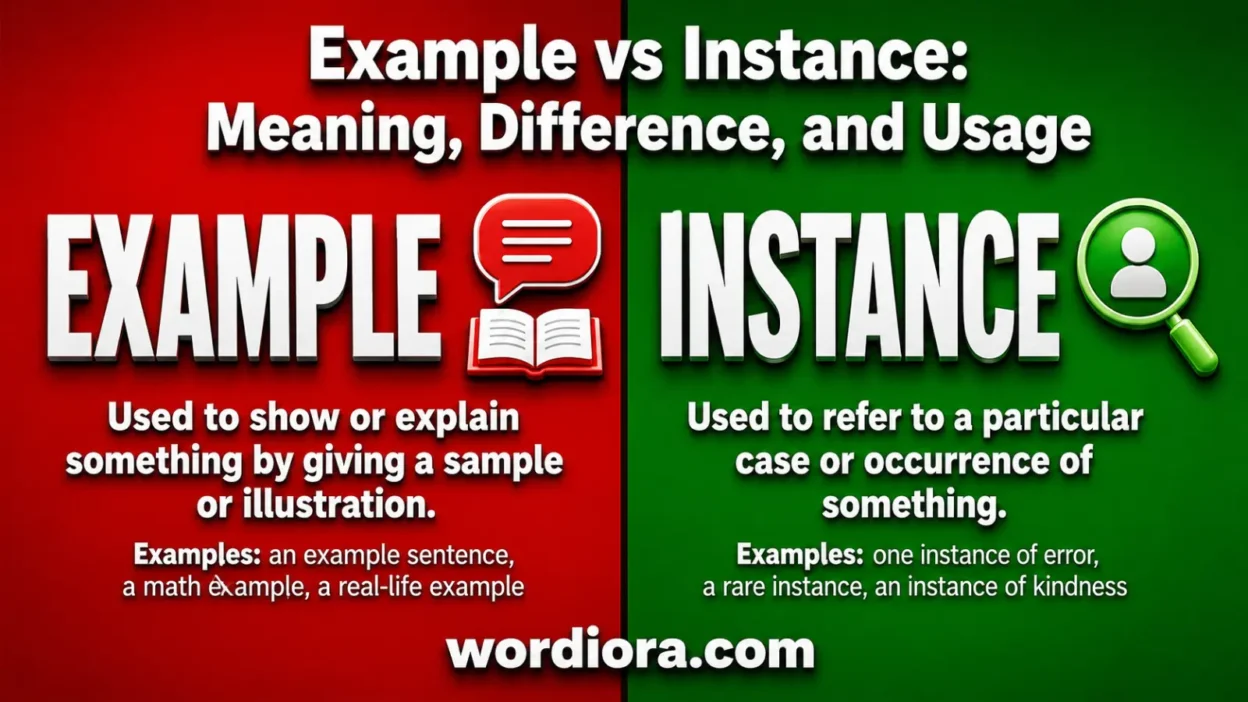
“Example” and “instance” are both correct words, but they do not always feel the same in a sentence.
Use “example” when you mean something that explains, shows, or represents a larger idea. Use “instance” when you mean a specific case, event, or occurrence of something.
The short answer: “example” is usually the safer everyday word. “Instance” is more precise when you are talking about one case among several.
Quick Answer
Choose “example” when you are giving something to help someone understand.
Choose “instance” when you are pointing to a specific case or occurrence.
Both words can overlap. That is why “for example” and “for instance” are often close in meaning. But as standalone nouns, “example” feels more general and reader-friendly. “Instance” feels more case-based and a little more formal.
Why People Confuse Them
People confuse “example” and “instance” because both can point to one thing that represents a bigger idea.
You might say:
“I can give you an example.”
You might also say:
“I can name one instance.”
Both sentences can make sense. The difference is in focus. “Example” helps explain. “Instance” points to a specific event, case, or situation.
Key Differences At A Glance
| Context | Best Choice | Why |
|---|---|---|
| Teaching a point | example | It helps explain an idea clearly. |
| Naming one event | instance | It points to a specific case. |
| Everyday speech | example | It sounds natural and simple. |
| Reports or formal writing | instance | It can sound more precise. |
| Showing a model to follow | example | “Set an example” is the natural phrase. |
| Talking about a rare case | instance | “In rare instances” is common and clear. |
Meaning and Usage Difference
An “example” is something used to explain, show, or represent an idea.
For example:
“Can you give me an example of a healthy lunch?”
Here, the speaker wants a sample answer that makes the idea clearer.
An “instance” is a particular case or occurrence.
For example:
“There was one instance when the app crashed during checkout.”
Here, the speaker means one specific event.
A helpful way to think about it:
• Example: “Here is something that shows what I mean.”
• Instance: “Here is one case where it happened.”
That difference is useful, but it is not absolute. “Instance” can also mean an example in some contexts, and “example” can point to a specific case. Still, the usual focus is different.
Tone, Context, and Formality
“Example” sounds natural in everyday speech, school writing, emails, guides, and explanations.
Use it when clarity matters most:
“Here’s an example of a stronger subject line.”
“Instance” sounds a little more formal or technical when it means a case or occurrence.
Use it when the sentence is about a record, report, pattern, or event:
“The manager found three instances of duplicate billing.”
Pronunciation does not need much attention here. The two words do not sound alike, and most confusion comes from meaning, not speech.
Which One Should You Use?
Use “example” when your goal is to explain.
Say:
“Can you show me an example?”
“This is a good example of teamwork.”
“Use this sentence as an example.”
Use “instance” when your goal is to identify a case.
Say:
“In this instance, the refund was approved.”
“We found several instances of late payments.”
“That was the only instance I noticed.”
For most everyday writing, “example” will sound warmer and clearer. For reports, records, complaints, and case-based writing, “instance” may be the better fit.
When One Choice Sounds Wrong
“Example” sounds wrong when the sentence needs a specific occurrence, not a teaching sample.
Awkward:
“The report found six examples of login failure.”
Better:
“The report found six instances of login failure.”
“Instance” sounds wrong when the sentence needs a simple explanation or model.
Awkward:
“Can you give me an instance of how to write the sentence?”
Better:
“Can you give me an example of how to write the sentence?”
Also, do not replace fixed phrases without checking how they sound.
Natural:
“She set a good example.”
Not natural:
“She set a good instance.”
Common Mistakes (and Quick Fixes)
Mistake 1: Using “instance” just to sound formal.
Weak:
“Here is an instance of a good resume summary.”
Better:
“Here is an example of a good resume summary.”
Mistake 2: Using “example” for repeated recorded events.
Weak:
“There were five examples of the error last week.”
Better:
“There were five instances of the error last week.”
Mistake 3: Treating the words as always interchangeable.
They overlap, but they are not always equal. “Example” explains. “Instance” identifies a case.
Everyday Examples
Example:
“Here’s an example of what I mean.”
“This photo is a great example of careful lighting.”
“Jordan set a strong example for the rest of the team.”
“Can you send me an example before Friday?”
Instance:
“In this instance, the customer was right.”
“We found two instances of missing paperwork.”
“There was one instance when the door did not lock.”
“In most instances, the update only takes a few minutes.”
Compact comparison:
• Use “example” for explanation, teaching, models, and samples.
• Use “instance” for cases, events, occurrences, and situations.
• Use “for example” and “for instance” when introducing a specific item that supports a larger point.
• Use “in this instance” when you mean “in this specific case.”
Dictionary-Style Word Details
Verb
• example: Rare as a verb in modern standard US English. Most writers should avoid it and use “show,” “illustrate,” or “serve as an example of” instead.
• instance: Can work as a verb meaning to cite or mention as an example, but it is uncommon in everyday US English. Most writers should use “cite,” “mention,” or “give as an example.”
Noun
• example: A thing, person, action, sentence, or case that explains, represents, or gives a model of something.
• instance: A particular case, event, situation, or occurrence, often one item in a larger set.
Synonyms
• example: closest plain alternatives include “sample,” “model,” “illustration,” and “case.” “Model” fits when someone or something should be followed. “Sample” fits when one item represents a larger group.
• instance: closest plain alternatives include “case,” “occurrence,” “situation,” and sometimes “example.”
Clear antonyms are not always useful for either word. In many sentences, the opposite depends on the context. For “example,” a loose opposite may be “counterexample” when something disproves a point.
Example Sentences
• example: “This budget is a clear example of smart planning.”
• example: “Please include one example in your answer.”
• instance: “In this instance, we need approval from the owner.”
• instance: “The team documented three instances of the same problem.”
Word History
• example: The word has older roots connected with the idea of taking out or showing a sample. In modern use, the practical meaning matters most: something that shows, explains, or represents.
• instance: The word has older roots tied to urgency, presence, and a case or request. In modern use, it most often points to a specific case, event, or situation.
Phrases Containing
• example: “for example,” “set an example,” “lead by example,” “make an example of,” “a good example,” “a prime example.”
• instance: “for instance,” “in this instance,” “in most instances,” “in rare instances,” “in the first instance.”
FAQs
Is “example” or “instance” more common?
“Example” is more common in everyday English. It is usually the better choice when you are explaining something or giving a sample sentence.
Are “example” and “instance” interchangeable?
Sometimes, but not always. “Example” is better for explanation. “Instance” is better for a specific case, event, or occurrence.
What is the main difference between example and instance?
An “example” helps show or explain an idea. An “instance” points to one specific case where something happened.
Should I say “for example” or “for instance”?
Both are correct. “For example” is more common and simple. “For instance” is also correct, but it can sound a little more formal.
What does “in this instance” mean?
“In this instance” means “in this specific case” or “in this situation.”
Example:
“In this instance, we should contact the customer first.”
Can “instance” mean “example”?
Yes, “instance” can sometimes mean an example, especially when it refers to one case that supports a larger point. Still, “example” is usually clearer for general explanations.
Which word should I use in school writing?
Use “example” when you are explaining an idea or supporting a point. Use “instance” when you are talking about a specific case or event.
Which word should I use in business writing?
Use “example” for clear explanations, samples, and models. Use “instance” for reports, records, complaints, or repeated cases.
Is “instance” more formal than “example”?
Often, yes. “Instance” can sound more formal or report-like, especially in phrases such as “in this instance” or “several instances.”
What is a simple way to remember the difference?
Use “example” when you mean “this shows what I mean.” Use “instance” when you mean “this is one case where it happened.”
Conclusion
“Example” and “instance” are close, but they are not identical in everyday use.
Use “example” when you want to explain, show, teach, or give a model. Use “instance” when you want to point to a specific case, event, or occurrence.
When in doubt, choose “example” for clear everyday writing. Choose “instance” when the sentence is about one case in a larger pattern.