Example vs sample is a common word-choice question because both words can point to something smaller that represents something bigger.
The difference is purpose.
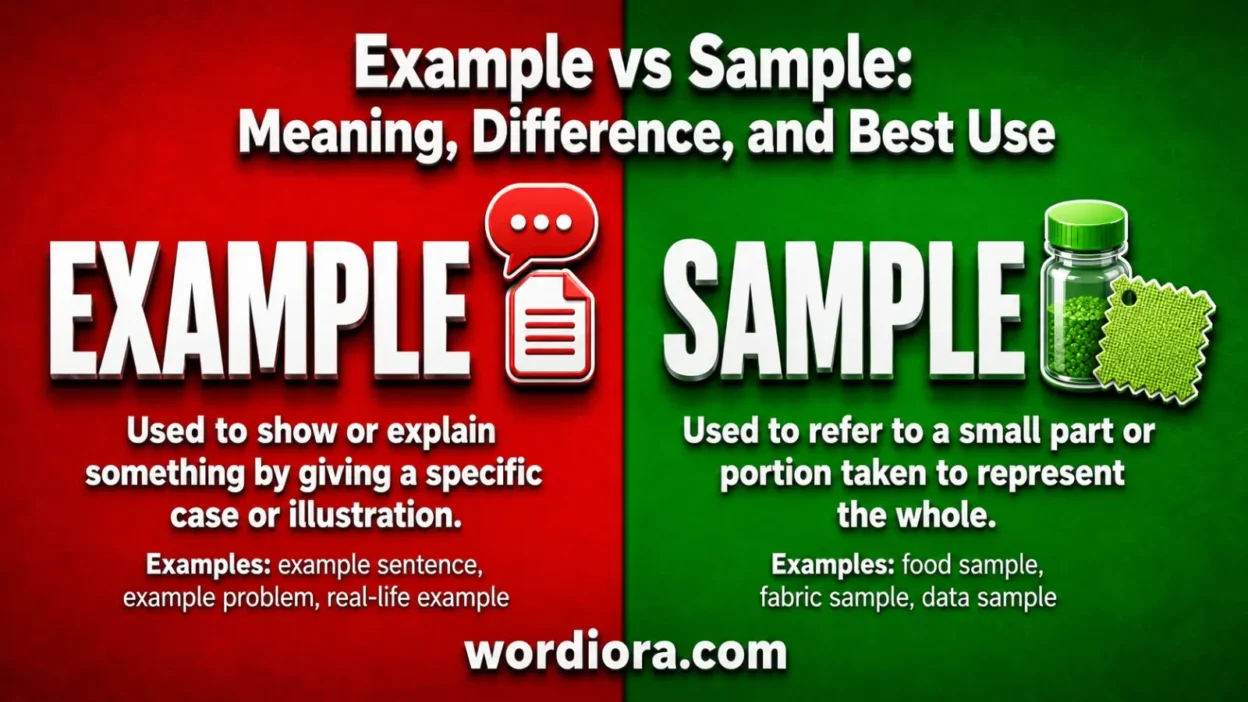
An example helps explain, prove, or illustrate an idea. A sample is a small part of something larger, often used to test, preview, study, or show quality.
Quick Answer
Use example when you mean a specific case that helps explain a point.
Use sample when you mean a small part taken from a larger whole.
Say “Give me an example” when you want someone to explain what they mean.
Say “Give me a sample” when you want a piece, portion, trial item, or part of a larger set.
Why People Confuse Them
People confuse example and sample because both can represent a larger idea, group, or category.
For instance, a teacher may give an example of a strong thesis statement. A writing coach may ask for a sample of your writing. Both involve one item, but they do different jobs.
The example teaches or explains. The sample shows what the whole thing is like.
Key Differences At A Glance
| Feature | example | sample |
|---|---|---|
| Main idea | A case used to explain | A part taken from a larger whole |
| Common use | Teaching, proving, showing meaning | Testing, previewing, studying, showing quality |
| Common form | Usually a noun | Noun, verb, and sometimes adjective |
| Best question | “Can you show what you mean?” | “Can I see or test part of it?” |
Meaning and Usage Difference
An example is a case, sentence, action, person, or thing used to explain something.
Examples often answer questions like:
What do you mean?
Can you show how it works?
Can you give a case that proves your point?
A sample is a small amount, piece, group, or portion used to show what the rest is like.
Samples often answer questions like:
Can I try it first?
Can we test part of it?
Can this small group tell us something about the whole group?
The pronunciation is simple, but it may help: example sounds like ig-ZAM-puhl. Sample sounds like SAM-puhl.
Tone, Context, and Formality
Both words are standard in everyday and professional US English.
Example is common in school, work, writing, teaching, and conversation. It sounds natural when someone is explaining an idea.
Sample is common in business, science, research, medicine, shopping, music, and product testing. It often sounds more concrete or technical because it refers to something taken, tested, tried, or reviewed.
In casual speech, you might hear:
“Can you give me an example?”
“Can I try a sample?”
In professional writing, you might see:
“The report includes several examples.”
“The study used a sample of 500 adults.”
Which One Should You Use?
| Context | Best Choice | Why |
|---|---|---|
| Explaining a rule | example | It shows how the rule works. |
| Asking what someone means | example | You want clarification. |
| Showing a product piece | sample | It is part of the larger product. |
| Testing blood, water, or soil | sample | It is taken for analysis. |
| Surveying a group | sample | It represents a larger population. |
| Showing model behavior | example | A person or action can be a pattern to follow. |
| Trying food in a store | sample | It is a small portion offered for trial. |
| Giving a sentence in a grammar lesson | example | It illustrates usage. |
When One Choice Sounds Wrong
Use example, not sample, when the goal is explanation.
Correct: “Can you give me an example of a polite refusal?”
Wrong: “Can you give me a sample of a polite refusal?”
The second sentence sounds odd unless you mean an actual written script, recording, or document excerpt.
Use sample, not example, when the goal is testing or previewing a real portion.
Correct: “The lab tested a water sample.”
Wrong: “The lab tested a water example.”
The lab is not testing an illustration. It is testing part of the water.
Common Mistakes (and Quick Fixes)
Mistake: “Here is a sample of what I mean.”
Better: “Here is an example of what I mean.”
Use example when you are explaining an idea.
Mistake: “The doctor took an example of my blood.”
Better: “The doctor took a sample of my blood.”
Use sample for a physical or measurable portion.
Mistake: “The teacher gave us a sample sentence.”
Better in most lessons: “The teacher gave us an example sentence.”
Use example sentence when the sentence teaches a pattern. Use sample sentence only when the sentence is part of a set, form, test, or template.
Mistake: “We surveyed an example of voters.”
Better: “We surveyed a sample of voters.”
Use sample for a smaller group chosen from a larger group.
Everyday Examples
“I need an example before I understand the assignment.”
“The store gave out free samples of the new snack.”
“She is a great example of calm leadership.”
“The company asked applicants to submit a writing sample.”
“Can you show me an example of the email you want?”
“The survey used a sample of 1,200 adults.”
“His apology was an example of clear communication.”
“The lab collected a soil sample from the backyard.”
Dictionary-Style Word Details
Verb
• example: Rare as a verb in standard US English. Most people do not say “This examples the problem.” They say “This is an example of the problem” or “This exemplifies the problem.”
• sample: Common as a verb. It means to try, test, taste, study, or take a small part of something.
Example: “We sampled three sauces before choosing one.”
Noun
• example: A person, thing, case, sentence, action, or situation used to explain, prove, warn, or serve as a model.
Example: “This chart is an example of clear design.”
• sample: A small part, amount, group, or item taken from a larger whole.
Example: “The team reviewed a sample of customer comments.”
Synonyms
• example: closest plain alternatives include instance, case, illustration, model, and pattern.
Useful opposite idea: counterexample, when one case disproves or challenges a claim.
• sample: closest plain alternatives include specimen, portion, piece, selection, and trial amount.
Useful opposite ideas depend on context: whole, entire set, or full amount.
Example Sentences
• example: “Please include one example in each paragraph.”
• example: “Her work ethic set a good example for the team.”
• example: “That mistake is a clear example of poor planning.”
• sample: “The bakery handed out samples near the entrance.”
• sample: “The nurse sent the blood sample to the lab.”
• sample: “The poll was based on a sample of local voters.”
Word History
• example: The word comes through older forms connected with a Latin word meaning a pattern or model. The main modern use is still close to that idea: something set out to explain, show, or guide.
• sample: The word is historically related to example, but modern usage has moved toward a more specific meaning: a portion, specimen, or trial part of something larger.
Phrases Containing
• example: for example, set an example, lead by example, make an example of, follow someone’s example.
• sample: sample size, sample group, random sample, free sample, blood sample, writing sample, sample questions.
FAQs
Is “example” the same as “sample”?
No. An example explains or illustrates an idea. A sample is a small part taken from a larger whole to test, preview, or study.
When should I use “example”?
Use example when you want to show what something means or how something works.
Example: “Can you give me an example of a strong opening sentence?”
When should I use “sample”?
Use sample when you mean a small part, portion, group, or item that represents something larger.
Example: “The lab tested a water sample.”
Is “for example” correct?
Yes. For example is correct when introducing a case that explains or supports your point.
Example: “Some jobs require writing skills, for example, editing, reporting, and marketing.”
Can I say “sample sentence”?
Yes, but example sentence is more common when the sentence is used to teach a grammar or writing point. Sample sentence works better when the sentence is part of a test, form, worksheet, or template.
What is the difference between a writing example and a writing sample?
A writing example may be one piece used to explain a writing style or technique. A writing sample is usually a piece of writing submitted to show someone’s actual ability or work quality.
Can “sample” be used as a verb?
Yes. Sample can be a verb meaning to try, test, taste, or take a small part of something.
Example: “We sampled three flavors before choosing one.”
Can “example” be used as a verb?
Not commonly in standard US English. Most of the time, example is a noun. Use exemplify if you need a verb.
Better: “This case exemplifies the problem.”
Which is correct: “give me an example” or “give me a sample”?
Both can be correct, but they mean different things. Say “give me an example” when you want an explanation. Say “give me a sample” when you want a small piece, portion, preview, or test item.
What is the easiest way to remember example vs sample?
An example explains. A sample represents part of a whole.
Conclusion
The easiest way to remember example vs sample is this:
An example explains.
A sample represents a larger whole.
Use example when you want to make an idea clearer. Use sample when you mean a small part used for testing, previewing, studying, or showing quality.
They can overlap in a few settings, especially with work, writing, and model items. Still, the choice depends on purpose. If it teaches the point, choose example. If it is a piece of the whole, choose sample.