Last Updated: July 27, 2026
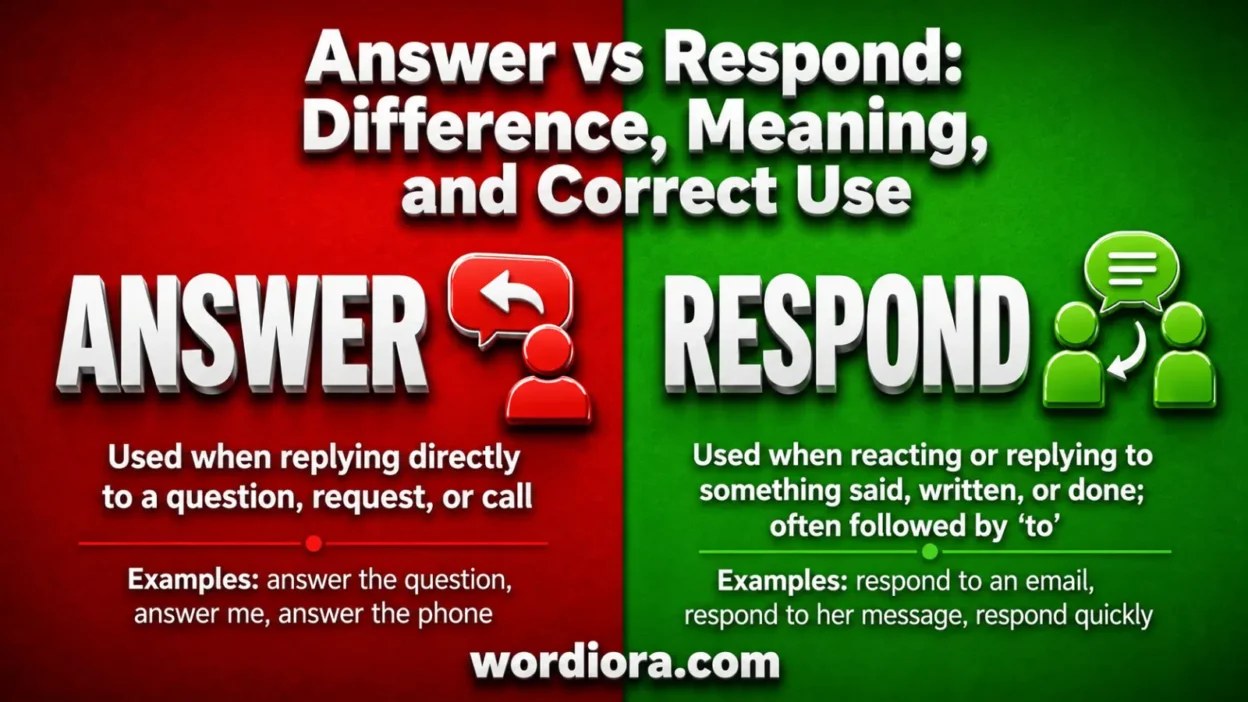
Answer vs respond is a common word-choice question because both words can mean saying something back. The difference is in what kind of situation you are talking about.
Use answer when someone asks a question, calls you, or needs a direct solution. Use respond when someone reacts to a message, event, request, problem, feeling, or situation.
Both words are correct, but they do not always fit the same sentence.
Quick Answer
Answer is usually the better choice for a direct question.
Example:
Please answer my question.
Respond is usually the better choice for a reaction or a more formal reply.
Example:
The manager will respond to your email by Friday.
A simple rule helps most of the time: you answer a question, but you respond to a situation, request, email, complaint, or change.
Why People Confuse Them
People confuse answer and respond because both can involve words. If your friend texts you a question, you can say you answered it or responded to it.
The difference becomes clearer when there is no direct question.
You can respond to criticism, stress, treatment, bad news, a fire alarm, or a customer complaint. In those cases, answer often sounds too narrow because there may not be a question to solve.
Answer points to the information given back. Respond points to the reaction.
Key Differences At A Glance
| Feature | answer | respond |
|---|---|---|
| Main idea | Give a direct reply or solution | React or reply to something |
| Common grammar | answer something | respond to something |
| Best fit | Questions, calls, problems | Requests, emails, events, feedback, treatment |
| Tone | Plain and direct | Often more formal or professional |
| Noun use | Common noun: an answer | Not commonly used as a noun |
Meaning and Usage Difference
Answer means to give the reply that a question, call, problem, or request needs.
Examples:
I need to answer one more question.
She did not answer the phone.
There is no easy answer to the problem.
Respond means to say or do something as a reaction. That reaction can be spoken, written, physical, emotional, medical, or professional.
Examples:
He did not respond to my text.
The company responded to the complaint.
The patient responded well to treatment.
That is why respond is broader. An answer is usually a kind of response, but a response is not always an answer.
Tone, Context, and Formality
Answer sounds direct, simple, and everyday. It is the natural word for school, tests, phone calls, short questions, and clear requests for information.
Example:
Can you answer this before lunch?
Respond often sounds more formal, professional, or careful. It works well in business, customer service, public statements, medical contexts, and situations where the reaction matters as much as the words.
Example:
Our team will respond to your request within one business day.
This does not mean respond is always formal. You can say, “She never responded to my text.” Still, in many settings, respond sounds a little more polished than answer.
Which One Should You Use?
| Context | Best Choice | Why |
|---|---|---|
| A direct question | answer | The person wants specific information. |
| A test or quiz | answer | The task is to give the correct reply. |
| A phone call | answer | This is the standard verb for picking up. |
| An email asking for information | answer or respond | Use answer for the question; use respond for the message as a whole. |
| A complaint | respond | It suggests a professional reaction or action. |
| Criticism | respond | The reaction may be spoken, written, or behavioral. |
| Medical treatment | respond | It means the body reacts to treatment. |
| An emergency | respond | It often means taking action, not just speaking. |
When One Choice Sounds Wrong
Use answer when the sentence needs a direct object.
Correct:
Please answer my question.
Wrong in standard use:
Please answer to my question.
Use respond with to when naming the thing that caused the reaction.
Correct:
Please respond to my question.
Wrong:
Please **respond my question.
Answer can also mean “be responsible to someone,” as in “She answers to the director.” That is a different pattern, not the usual way to talk about replying to a question.
Common Mistakes (and Quick Fixes)
Mistake:
I will respond your email tonight.
Fix:
I will respond to your email tonight.
Mistake:
Can you answer to this question?
Fix:
Can you answer this question?
Mistake:
The patient answered well to the medicine.
Fix:
The patient responded well to the medicine.
Mistake:
The company gave no respond.
Fix:
The company gave no answer.
The company did not respond.
The main grammar fix is simple: answer something, but respond to something.
Everyday Examples
I asked a simple question, but he did not answer.
The teacher told us to answer every question in complete sentences.
Can you answer the phone while I’m cooking?
She gave a clear answer during the meeting.
The support team will respond to your ticket soon.
He did not respond when I mentioned the schedule change.
The dog responded to the trainer’s command.
The city responded quickly after the storm.
A good customer service email should answer the question and respond politely to the concern.
Dictionary-Style Word Details
Verb
• answer: Commonly used as a verb. It means to reply to a question, solve a problem, pick up a call, or meet a need.
Example: Please answer the question clearly.
• respond: Commonly used as a verb. It means to reply or react to something said, done, requested, felt, or experienced.
Example: Please respond to the email today.
Noun
• answer: Commonly used as a noun. It means the reply, solution, or information given.
Example: Her answer was short but clear.
• respond: Not commonly used as a noun in standard US English. The noun form normally used for this idea is response.
Example: We received a quick response.
Synonyms
• answer: closest plain alternatives include reply, solution, and explanation, depending on the sentence.
Example: “solution” fits when you mean an answer to a problem.
• respond: closest plain alternatives include reply, react, and act in return, depending on the sentence.
Example: “react” fits when no direct question is being answered.
Clear antonyms are not always exact. In many everyday sentences, the opposite idea is simply not answer, not respond, or ignore.
Example Sentences
• answer: I can answer that question after I check the file.
• answer: No one had a good answer for the delay.
• respond: The owner promised to respond to the complaint.
• respond: Some people respond better to written instructions.
Word History
• answer: Word history is not the main reason to choose it today. In modern US English, the useful point is that answer is the direct word for a reply, solution, or phone call.
• respond: Word history is also less important than modern use. In current US English, respond is the broader word for reacting, replying, or taking action after something happens.
Phrases Containing
• answer: answer a question, answer the phone, answer an email, answer a request, answer for a mistake, give an answer.
• respond: respond to a question, respond to an email, respond to criticism, respond with a smile, respond well to treatment, first responders.
FAQs
Is it better to say “answer” or “respond”?
Use answer when someone asks a direct question. Use respond when someone reacts to a message, request, complaint, event, or situation.
Do you answer an email or respond to an email?
Both can be correct. Use answer an email when you are giving the information someone asked for. Use respond to an email when you mean replying to the message in general.
Is “respond” more formal than “answer”?
Often, yes. Respond sounds more formal or professional in many business and customer service settings. Answer sounds more direct and everyday.
Is it correct to say “respond my question”?
No. The correct phrase is respond to my question. With answer, you do not need to: answer my question.
Is it correct to say “answer to my question”?
Usually, no. In standard US English, say answer my question. The phrase answer to has a different use, as in “She answers to the manager.”
Can “respond” mean taking action?
Yes. Respond can mean saying something or doing something as a reaction. For example, emergency workers respond to a call, and a company may respond to a complaint by taking action.
Can “answer” be a noun?
Yes. Answer can be a noun or a verb. You can answer a question, and you can also give an answer.
Is “respond” a noun?
No, respond is normally a verb. The noun form is response. For example: “We received a quick response.”
What is the easiest way to remember the difference?
Remember this pattern: answer something, but respond to something. Say answer the question and respond to the email.
Conclusion
Use answer when the focus is a direct question, call, problem, or solution. Use respond when the focus is a reaction to something someone said, did, sent, requested, or caused.
The easiest pattern to remember is this: answer something, but respond to something.
So, in answer vs respond, choose answer for the direct reply and respond for the broader reaction.