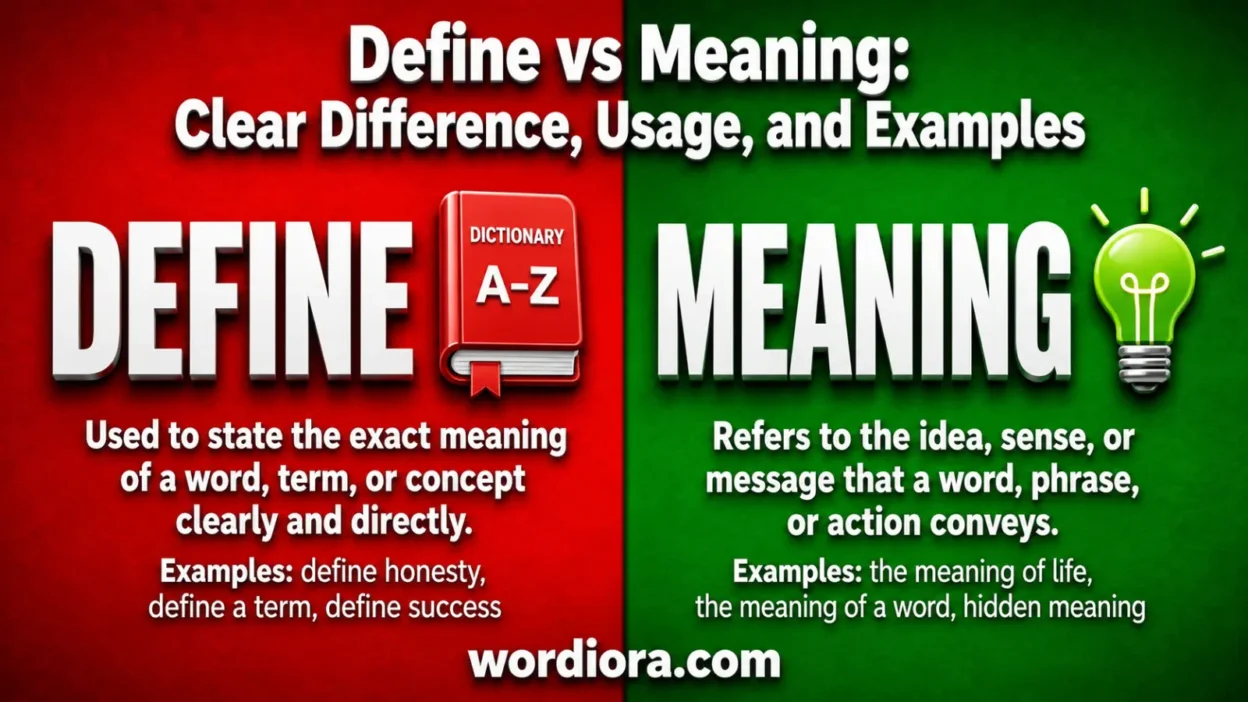
Both define and meaning are correct English words, but they do different jobs.
Use define when you need a verb. It means to explain what something is, state what a word means, set limits, or make something clear.
Use meaning when you need a noun. It names the idea, sense, purpose, or message behind a word, phrase, action, or situation.
So the choice is not about which word is “better.” It is about grammar and sentence structure.
Quick Answer
Define is usually an action word.
Meaning is usually a thing word.
Say:
“Can you define this term?”
Say:
“What is the meaning of this term?”
Do not say:
“Can you meaning this term?”
Do not say:
“What is the define of this term?”
The easiest rule: define is what you do; meaning is what you explain.
Why People Confuse Them
People confuse define and meaning because the ideas are closely connected. When you define a word, you explain its meaning.
That connection does not make the words interchangeable. In a sentence, they fill different grammar roles.
A teacher may ask you to define a word. Your answer gives the word’s meaning.
That is the whole difference in everyday use.
Key Differences At A Glance
| Context | Best Choice | Why |
|---|---|---|
| Asking someone to explain a word | define | You need a verb. |
| Naming the idea a word expresses | meaning | You need a noun. |
| Writing a school or work instruction | define | It tells someone what action to take. |
| Talking about purpose or message | meaning | It names the sense or importance. |
| Describing clear limits | define | Define can mean set boundaries. |
| Talking about emotional or hidden significance | meaning | Meaning can name deeper sense or value. |
Compact comparison:
- define: verb, action, explain or set limits
- meaning: noun, idea, sense, purpose, or significance
- define fits after subjects like you, we, the writer, the policy
- meaning often follows words like the, a, its, this, hidden, literal
- define answers “What should someone do?”
- meaning answers “What does it express?”
Meaning and Usage Difference
Define means to explain what something means or to make something clear. It can also mean to set the limits of something.
Examples:
“Please define the word before you use it.”
“The contract defines each employee’s role.”
“The fence defines the edge of the yard.”
Meaning is the idea or sense carried by a word, sentence, symbol, action, or event.
Examples:
“What is the meaning of this word?”
“Her comment had a different meaning than I first thought.”
“The photo has special meaning for our family.”
Use define when the sentence needs an action. Use meaning when the sentence needs the thing being explained.
Pronunciation is simple here and usually not the main source of confusion. Define sounds like dih-FINE. Meaning sounds like MEE-ning.
Tone, Context, and Formality
Both words are standard in US English.
Define often sounds a little more direct, academic, legal, or professional because it asks for a clear explanation or boundary.
“Define the project scope.”
“Define your terms before the debate.”
Meaning sounds natural in everyday speech, school writing, business writing, and personal writing.
“The meaning of the email was clear.”
“That song has a lot of meaning for me.”
Neither word is slang. Neither word is too formal for normal writing. The difference is mainly grammatical.
Which One Should You Use?
Use define when you can place it after a subject and before an object.
“I need to define the problem.”
“The policy defines late payments.”
“Can you define that phrase?”
Use meaning when you can place it after the, a, its, this, or another noun marker.
“The meaning is unclear.”
“I understand its meaning now.”
“She explained the meaning of the quote.”
A quick test helps:
If you can replace the word with explain, you may need define.
If you can replace it with sense or significance, you may need meaning.
When One Choice Sounds Wrong
Define sounds wrong when the sentence needs a noun.
Wrong: “The define of the word is simple.”
Correct: “The meaning of the word is simple.”
Wrong: “I do not understand the define.”
Correct: “I do not understand the meaning.”
Meaning sounds wrong when the sentence needs a verb.
Wrong: “Can you meaning this word?”
Correct: “Can you define this word?”
Wrong: “The guide meanings each symbol.”
Correct: “The guide defines each symbol.”
One phrase can be correct but wordy: “define the meaning of this word.” In most cases, write define this word or explain the meaning of this word.
Common Mistakes (and Quick Fixes)
Mistake: using define as a noun.
Fix: use meaning or definition, depending on the sentence.
Mistake: using meaning as a verb.
Fix: use define, explain, or clarify.
Mistake: writing “what is define?”
Fix: write “what does define mean?” or “what is the meaning of define?”
Mistake: using define when talking about personal importance.
Fix: use meaning.
Less natural: “This necklace defines a lot to me.”
Better: “This necklace has a lot of meaning for me.”
Everyday Examples
“Can you define ‘budget’ for the new team member?”
“The meaning of ‘budget’ changes depending on the context.”
“The coach asked players to define success for themselves.”
“The award had real meaning because the whole team voted.”
“The law defines what counts as paid leave.”
“I missed the meaning of her joke at first.”
“Before we start, let’s define the problem.”
“The meaning of the message was clear after I reread it.”
Dictionary-Style Word Details
Verb
- define: Commonly used as a verb. It means to explain meaning, identify qualities, set limits, or make something clear.
Example: “The report defines the main issue.” - meaning: Not commonly used as a verb in standard US English. In normal writing, do not use meaning to mean “explain.”
Noun
- define: Not commonly used as a noun in standard US English. Use meaning when you mean the idea or sense. Use definition when you mean the formal wording that explains a term.
- meaning: Commonly used as a noun. It can refer to the sense of a word, the purpose of an action, the message in a work, or the importance something has.
Synonyms
- define: closest plain alternatives include explain, describe, specify, clarify, outline, and set the limits of. Antonyms depend on context, but blur, confuse, or obscure may fit some uses.
- meaning: closest plain alternatives include sense, significance, idea, purpose, message, and intention. Clear opposites are limited, but meaninglessness can fit when the idea is “lack of meaning.”
Example Sentences
- define: “The teacher asked us to define three key terms.”
- define: “The new rule defines who qualifies for the discount.”
- meaning: “I looked up the meaning of the word.”
- meaning: “That small gift had a lot of meaning.”
Word History
- define: Reliable dictionaries trace it through older French and Latin forms connected with setting limits or giving an exact description. That history matches one modern use: to mark boundaries or make something clear.
- meaning: Reliable dictionaries record meaning as an old English noun connected with what is intended, expressed, or understood. For today’s reader, the key point is its role as a noun.
Phrases Containing
- define: clearly define, loosely define, narrowly define, define the terms, define the scope, define the problem
- meaning: the meaning of life, hidden meaning, literal meaning, figurative meaning, special meaning, know the meaning of
FAQs
Is “define” the same as “meaning”?
No. Define is usually a verb. It means to explain what something means. Meaning is usually a noun. It is the idea, sense, purpose, or message behind a word or action.
Which is correct: “define of a word” or “meaning of a word”?
Meaning of a word is correct.
Do not say define of a word.
Correct: “What is the meaning of this word?”
Incorrect: “What is the define of this word?”
Can I say “Can you meaning this word?”
No. That is not correct in standard US English. Use define instead.
Correct: “Can you define this word?”
Incorrect: “Can you meaning this word?”
What is the difference between “define a word” and “meaning of a word”?
Define a word means to explain it.
Meaning of a word refers to the idea or sense the word expresses.
Example:
“The teacher asked us to define the word.”
“The meaning of the word was easy to understand.”
Is “meaning” ever a verb?
In normal modern US English, meaning is not used as a verb. It is usually a noun, as in “the meaning of the sentence.” The verb form is mean, not meaning.
Is “define” a noun?
No, define is normally a verb. If you need a noun, use meaning or definition, depending on the sentence.
Example:
Correct: “The definition is clear.”
Correct: “The meaning is clear.”
Incorrect: “The define is clear.”
Should I write “define the meaning” or “explain the meaning”?
Explain the meaning usually sounds more natural. Define the meaning can be wordy because define already means to explain meaning.
Better: “Please define this word.”
Also correct: “Please explain the meaning of this word.”
What is the easiest way to remember define vs meaning?
Use define for the action. Use meaning for the idea.
You define a word.
A word has a meaning.
Conclusion
Use define when you need the action of explaining, describing, or setting limits.
Use meaning when you need the idea, sense, purpose, message, or importance being explained.
The simple choice is this: you define a word; the word has a meaning.