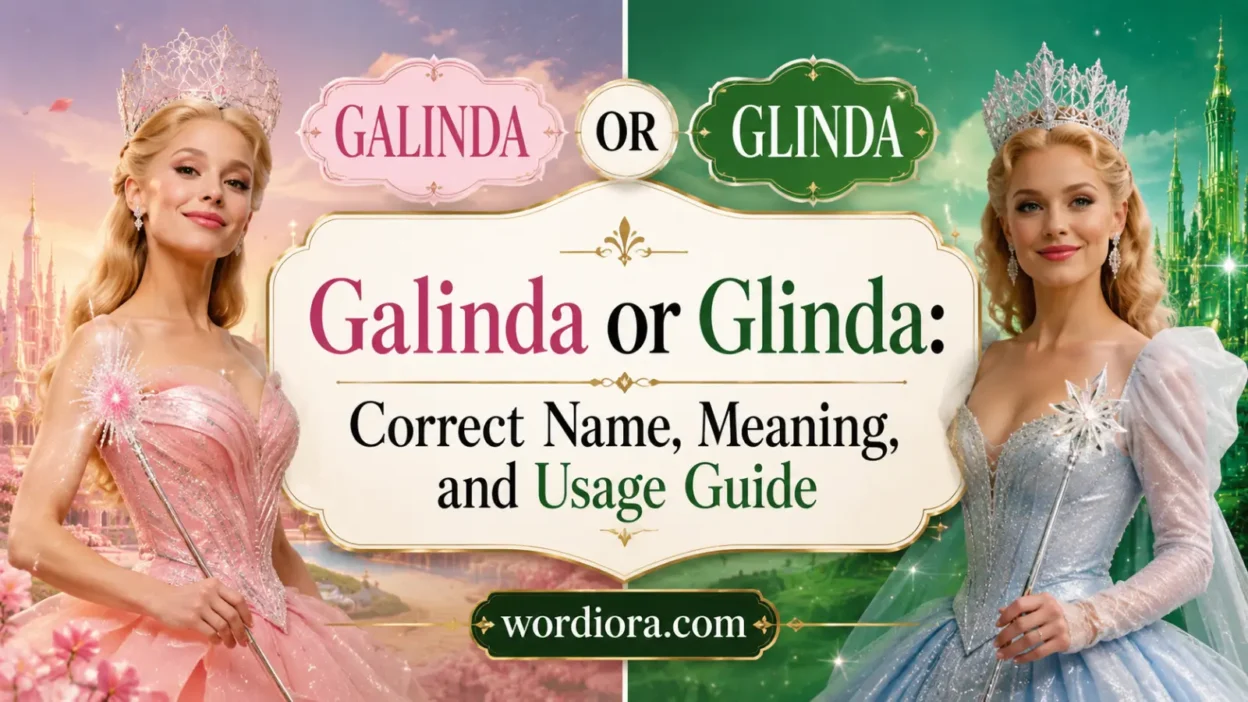
If you are choosing between Galinda or Glinda, the right answer depends on the context. These are not two ordinary English words. They are proper names tied to Oz and Wicked.
In simple terms, Glinda is the better choice for the famous Good Witch in Oz and for most general references. Galinda is best when you mean her earlier name in Wicked, before she changes it. Because both names point to the same character in some Wicked contexts, writers often mix them up.
Quick Answer
Use Glinda for the well-known Oz character and for most references to the Good Witch. Use Galinda when you are talking about the earlier Wicked version of the character, especially during her Shiz University years or before the name change. In Wicked, Galinda later becomes Glinda, so both names can be correct in different moments.
Why People Confuse Them
The confusion happens because Wicked gives the character a name arc. She starts as Galinda, then later uses Glinda.
That is different from many Oz references, where readers know only Glinda. So someone who grew up with The Wizard of Oz may expect Glinda, while someone watching Wicked may hear Galinda first.
Pronunciation also adds to the mix. Galinda sounds like “guh-LIN-duh.” Glinda sounds like “GLIN-duh.” The missing “a” changes both the spelling and the sound.
Key Differences At A Glance
| Context | Best Choice | Why |
|---|---|---|
| General Oz reference | Glinda | This is the established name of the Good Witch. |
| Wicked before the name change | Galinda | This is her earlier name in the story. |
| Wicked after the name change | Glinda | The character adopts the shorter name. |
| Talking about the name change itself | Galinda and Glinda | Both names are needed to explain the shift. |
| Movie or musical cast reference | Glinda | Roles are commonly credited under Glinda. |
| Fan discussion about Shiz scenes | Galinda | It fits the younger, earlier identity. |
| Formal article about Oz | Glinda | It is clearer for broad readers. |
| Character growth analysis | Galinda to Glinda | The change marks part of her public identity shift. |
Meaning and Usage Difference
Galinda and Glinda are proper nouns. They name a fictional character, not a general idea or object.
The simplest difference is this:
• Galinda: the earlier Wicked name, especially before she becomes the public figure known as Glinda.
• Glinda: the established Oz name and the later name used for the Good Witch.
This is not like choosing between two spellings of the same everyday word. The choice depends on story timing. If your sentence is about her early school life, Galinda may be more accurate. If your sentence is about the Good Witch known across Oz, Glinda is usually better.
Tone, Context, and Formality
Glinda feels more familiar to general readers because it is the name most people connect with the Good Witch. It also works better in formal summaries, broad articles, and character lists.
Galinda feels more specific. It signals that you are talking about Wicked, especially the character before her public transformation. In fan writing, it can also suggest the younger, polished, status-conscious version of the character.
Neither name is casual slang. The difference is not formality. It is context.
Which One Should You Use?
Choose Glinda if your reader may not know the full Wicked backstory. It is the safer name for titles, summaries, movie references, and general Oz discussions.
Choose Galinda when the timing matters. For example, use it when discussing her arrival at Shiz, her early friendship with Elphaba, or the moment before she adopts the shorter name.
Use Galinda/Glinda or Galinda, later Glinda when you want to avoid confusion in one sentence.
When One Choice Sounds Wrong
Galinda can sound wrong if you are talking about the classic Good Witch without a Wicked-specific reason. A sentence like “Dorothy meets Galinda at the end of the Oz story” may confuse readers because the famous name in that context is Glinda.
Glinda can sound less precise if you are describing her early Wicked scenes before the name change. It is not always wrong, but it can erase the story point that she once used Galinda.
The safest rule is simple: match the name to the version of the character you mean.
Common Mistakes (and Quick Fixes)
Mistake: Calling every version of the character Galinda.
Fix: Use Glinda for most general Oz references.
Mistake: Saying Galinda is just a misspelling of Glinda.
Fix: Treat Galinda as the earlier Wicked name, not merely an error.
Mistake: Using Glinda when explaining the name-change scene.
Fix: Use both names: Galinda changes her name to Glinda.
Mistake: Treating the words like common nouns.
Fix: Capitalize both because they are names.
Mistake: Forcing a grammar rule onto the pair.
Fix: Explain the story context instead.
Everyday Examples
Correct: Galinda arrives at Shiz with confidence and charm.
Correct: Glinda becomes one of the most recognizable figures in Oz.
Correct: In Wicked, Galinda later chooses the name Glinda.
Correct: Ariana Grande plays Glinda in the Wicked film adaptation.
Correct: The article explains why Galinda and Glinda both appear in Wicked discussions.
Incorrect: Dorothy asks Galinda for help in the classic Oz ending.
Better: Dorothy asks Glinda for help in the classic Oz ending.
Incorrect: Glinda is just the wrong spelling of Galinda.
Better: Glinda is the established Oz name, while Galinda is the earlier Wicked name.
Incorrect: galinda and glinda are common nouns.
Better: Galinda and Glinda are proper names, so both should be capitalized.
Dictionary-Style Word Details
Verb
• Galinda: Not used as a verb in standard US English. It is a proper name.
• Glinda: Not used as a verb in standard US English. It is also a proper name.
Do not write sentences like “She glindaed the room” unless you are making a playful joke. That would not be standard usage.
Noun
• Galinda: A proper noun used for the earlier Wicked identity of the character. Example: Galinda studies at Shiz.
• Glinda: A proper noun used for the established Good Witch identity. Example: Glinda speaks to the people of Oz.
Both names should begin with capital letters.
Synonyms
• Galinda: There is no exact synonym because this is a name. Closest plain alternatives include “early Glinda,” “Shiz-era Glinda,” or “Glinda before the name change.”
• Glinda: There is no exact synonym. Closest plain alternatives include “Glinda the Good,” “the Good Witch,” or “the Good Witch of Oz,” depending on context.
Clear antonyms do not really apply. Names do not usually have opposites.
Example Sentences
• Galinda: Galinda tries hard to appear polished and popular at school.
• Galinda: The scene makes more sense when you remember that she is still Galinda at that point.
• Galinda: Fans often use Galinda when discussing her early Wicked personality.
• Glinda: Glinda is the name most readers connect with the Good Witch.
• Glinda: The film credits the character as Glinda.
• Glinda: In a general Oz article, Glinda is the clearer choice.
Word History
• Galinda: This name is strongly tied to Wicked, where it marks the character’s earlier identity. Avoid claiming a firm real-world origin unless your article is specifically about baby names and cites name-history sources.
• Glinda: This is the long-established Oz name for the Good Witch. In Wicked, the character’s move from Galinda to Glinda gives the name extra story meaning.
The safest history note is this: Glinda is the broader Oz name, while Galinda is the Wicked-specific earlier name.
Phrases Containing
• Galinda: Galinda Upland, Galinda at Shiz, Galinda before the name change, Galinda from Wicked.
• Glinda: Glinda the Good, Glinda the Good Witch, Glinda of Oz, Glinda from Wicked, Glinda and Elphaba.
Use the phrase that fits the version of the character you mean.
FAQs
Is it Galinda or Glinda?
Both names can be correct, but they fit different contexts. Use Glinda for the famous Good Witch of Oz and most general references. Use Galinda when you mean the earlier Wicked version of the character before she changes her name.
Why is Glinda called Galinda in Wicked?
In Wicked, Galinda is the character’s earlier name. The story later shows her using Glinda, which connects her more clearly to the well-known Good Witch identity. That is why both names appear in discussions about the musical, movie, and character arc.
Is Galinda the same person as Glinda?
Yes. In Wicked, Galinda and Glinda refer to the same character at different points in her story. Galinda is the earlier name, while Glinda is the later and more widely recognized name.
Which name should I use in an article?
Use Glinda if your article is about Oz, the Good Witch, or the character in a general way. Use Galinda only when discussing her early Wicked scenes, her school life, or the name-change moment.
Is Galinda a misspelling of Glinda?
No. Galinda is not simply a spelling mistake in Wicked context. It is used as the character’s earlier name. However, outside Wicked, many readers expect Glinda, so Galinda may look confusing if the context is not clear.
How do you pronounce Galinda and Glinda?
Galinda is usually pronounced “guh-LIN-duh.” Glinda is usually pronounced “GLIN-duh.” The extra “a” in Galinda changes both the spelling and the sound, which is one reason people confuse the two names.
Should I write Galinda, later Glinda?
Yes, that is a clear choice when your readers may not know the Wicked backstory. Writing Galinda, later Glinda explains both names quickly without making either one seem wrong.
Conclusion
For most readers, Glinda is the safer and clearer choice. It is the famous Oz name and the later public name used for the Good Witch.
Use Galinda only when you are talking about the earlier Wicked version of the character or the name-change moment. If your sentence needs both, write Galinda, later Glinda. That keeps the meaning clear and avoids making either name look like a mistake.