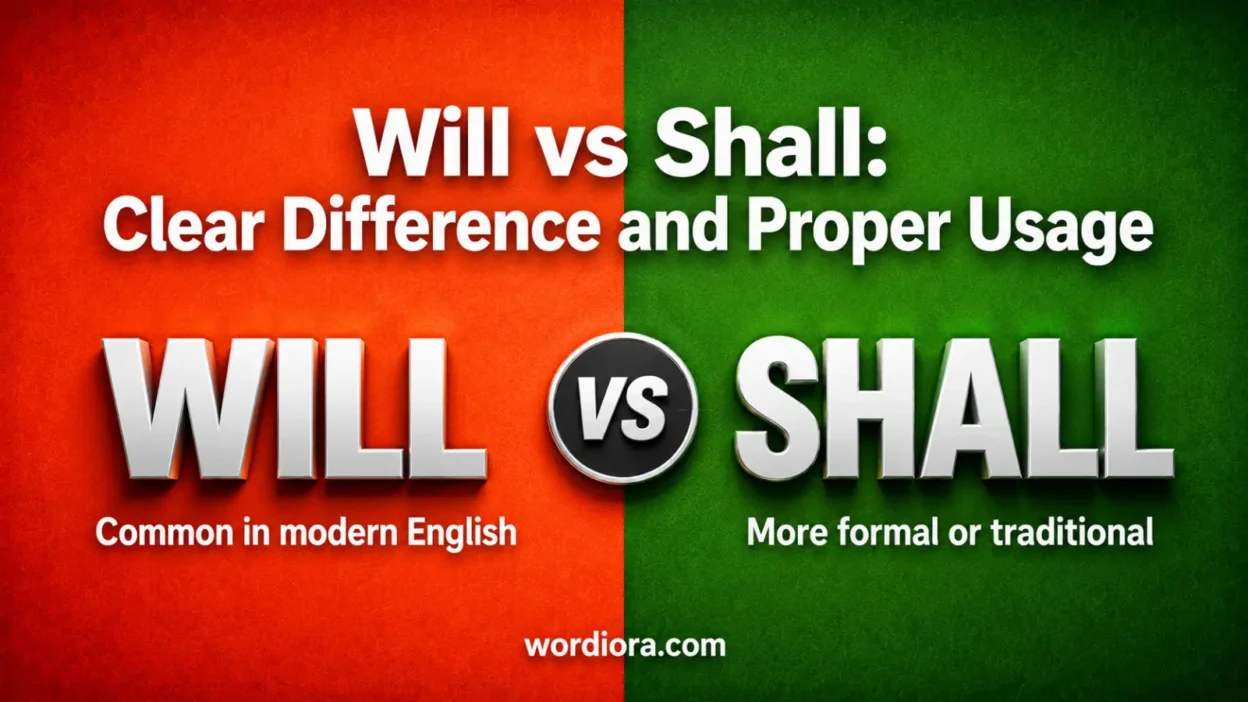
Will vs shall is a common word-choice question because both words can talk about the future. The real difference is how they sound and where they are used today.
In modern American English, will is the normal choice for future actions, promises, predictions, decisions, and requests. Shall is much less common. It usually sounds formal, old-fashioned, legal, ceremonial, or polite in questions with I and we.
For most everyday sentences, choose will.
Quick Answer
Use will for normal modern English.
Examples:
I will call you after work.
The meeting will start at 9.
We will send the report tomorrow.
Use shall mainly when you are making a polite offer or suggestion with I or we.
Examples:
Shall I open the window?
Shall we begin?
What shall we do next?
You may also see shall in formal, legal, ceremonial, or dramatic writing.
Example:
The winner shall receive a certificate.
For regular American speech and writing, will is safer, clearer, and more natural.
Why People Confuse Will and Shall
People confuse will and shall because older grammar lessons gave a rule that many modern speakers no longer follow.
The old rule said to use shall with I and we for simple future, and will with other subjects.
Old-style example:
I shall return tomorrow.
Modern American English:
I will return tomorrow.
That older pattern still appears in formal speeches, older books, and some grammar lessons. But in everyday American English, people usually say:
I will
we will
you will
she will
they will
The confusion also comes from the fact that shall has more than one use. It can point to the future, suggest an action, offer help, or express a rule. That is why context matters.
Key Differences At A Glance
| Context | Best Choice | Why |
|---|---|---|
| Everyday future statement | Will | It is the normal modern choice. |
| Casual conversation | Will | Shall often sounds too formal. |
| Business email | Will | It sounds clear and professional. |
| Offer with I | Shall | “Shall I…?” sounds polite and helpful. |
| Suggestion with we | Shall | “Shall we…?” is a natural set phrase. |
| Legal or rule-like sentence | Must or shall | Must is often clearer; shall is still formal. |
| Dramatic or ceremonial tone | Shall | It can sound serious or elevated. |
| Negative future statement | Will not / won’t | These are common in modern US English. |
Meaning and Usage Difference
Will is a modal verb. It goes before the base form of another verb.
Examples:
I will call you after work.
She will send the file today.
The store will close at 9 p.m.
In modern American English, will is the standard word for future meaning.
Will can also show willingness, a quick decision, a request, or a strong expectation.
Examples:
I’ll help you with that.
Will you check this form?
That will be the delivery driver.
Shall is also a modal verb, but its use is narrower today. It can still refer to the future, especially with I and we, but it often sounds formal or old-fashioned in ordinary American speech.
Formal:
I shall return your call by Friday.
We shall review the request.
More natural in everyday American English:
I will return your call by Friday.
We will review the request.
Shall sounds most natural in polite first-person questions.
Examples:
Shall I open the door?
Shall we start the meeting?
What shall we do next?
These questions are not just about the future. They usually offer help, suggest an action, or ask for guidance.
Tone, Context, and Formality
Will sounds natural in almost every modern US context. It works in texts, emails, conversations, school writing, business writing, instructions, and articles.
Example:
We will update the schedule tomorrow.
Shall sounds more formal. In American English, it may sound stiff in ordinary future sentences unless it appears in a polite question such as Shall I…? or Shall we…?
Natural:
Shall we go?
Stiff in casual American speech:
I shall text you later.
Better:
I will text you later.
In legal, policy, or rule-like writing, shall has often been used to express a requirement.
Formal:
Applicants shall submit the form by June 30.
Clearer modern version:
Applicants must submit the form by June 30.
This does not mean shall is always wrong in formal rules. It means must is often clearer when the meaning is “required to.”
Which One Should You Use?
Use will when you are talking about a normal future action, plan, promise, prediction, or request.
Examples:
I will meet you outside.
We will send the invoice today.
Will you help me move this table?
The package will arrive tomorrow.
Use shall when you are making a polite offer or suggestion with I or we.
Examples:
Shall I save you a seat?
Shall we take a break?
Shall I call the office for you?
You can also use shall when you want a formal, ceremonial, legal, or dramatic tone.
Examples:
We shall remember this day.
The tenant shall maintain the property.
You shall not pass.
In most everyday American sentences, will is the better choice.
When One Choice Sounds Wrong
Sometimes shall is grammatically possible, but it sounds wrong for the situation.
Awkward:
I shall grab coffee after work.
Better:
I will grab coffee after work.
Awkward:
She shall arrive at noon.
Better:
She will arrive at noon.
Awkward:
They shall email us tomorrow.
Better:
They will email us tomorrow.
However, shall sounds fine in a polite offer:
Shall I grab you a coffee?
It also sounds natural in a formal or dramatic sentence:
We shall not forget their courage.
The key difference is tone. Will sounds normal. Shall adds a special effect.
Common Mistakes And Quick Fixes
Using shall just because the subject is I or we
Old-fashioned:
I shall be there at 8.
Modern American English:
I will be there at 8.
Using shall with you, he, she, or they in casual future sentences
Unnatural:
You shall like this movie.
Better:
You will like this movie.
Using shall when must would be clearer
Less clear:
Employees shall wear ID badges.
Clearer:
Employees must wear ID badges.
Treating will and shall as exact equals
They overlap in some future uses, but they do not always sound the same.
Compare:
We will begin now.
This sounds plain and direct.
Shall we begin?
This sounds like a polite suggestion.
Everyday Examples
I will call you tonight.
This is a normal future plan.
We will send the receipt by email.
This is clear business writing.
Will you help me with this box?
This is a polite request.
The store will close at 9 p.m.
This is a simple future fact.
Shall I save you a seat?
This is a polite offer.
Shall we order lunch now?
This is a polite suggestion.
What shall we do if the printer stops again?
This asks for guidance.
You shall not pass.
This sounds formal, dramatic, or command-like.
The tenant shall maintain the property.
This is formal rule-like wording.
The tenant must maintain the property.
This is clearer modern wording for a requirement.
Dictionary-Style Word Details
Verb
Will: In this comparison, will is mainly a modal auxiliary verb. It comes before the base form of another verb.
Examples:
I will wait.
She will answer.
They will arrive soon.
Will can also be a main verb meaning to cause something by determination or to leave property through a legal will.
Examples:
She tried to will herself to stay calm.
He willed the house to his daughter.
Shall: Shall is mainly a modal auxiliary verb. It also comes before the base form of another verb.
Examples:
We shall see.
Shall I continue?
The rule shall apply to all entries.
Shall is not commonly used as a normal main verb in standard modern American English.
Noun
Will: Will can be a noun. It can mean determination, desire, choice, or a legal document that explains what should happen to someone’s property after death.
Examples:
She has a strong will.
He updated his will last year.
Shall: Shall is not commonly used as a noun in standard American English.
Synonyms
Will: For future meaning, close alternatives include am going to, is going to, and are going to.
Examples:
I will call you.
I am going to call you.
For willingness, close alternatives include agree to or be willing to.
Shall: For obligation, close alternatives include must, has to, and is required to.
Example:
Applicants shall submit the form.
Applicants must submit the form.
For polite suggestions, close alternatives include should we, do you want me to, or let’s.
Examples:
Shall we leave?
Should we leave?
Let’s leave.
Clear antonyms do not always fit because will and shall work mainly as helping verbs. For obligation-like shall, the opposite idea may be may, does not have to, or is not required to, depending on the sentence.
Example Sentences
Will:
I will meet you outside the theater.
The team will review your application this week.
Will you send me the address?
This plan will save us time.
We will call if anything changes.
Shall:
Shall I bring an extra chair?
Shall we take a short break?
We shall respond in writing.
Participants shall follow the posted safety rules.
We shall remember their sacrifice.
Word History
Will and shall both have very old roots in English. Over time, both became modal verbs used with another verb.
Older grammar lessons taught a stricter difference between them, especially with I and we. Modern American English has mostly moved away from that strict pattern.
Today, will is the usual future word in everyday use. Shall remains common in set questions such as Shall I…? and Shall we…?, as well as in formal, ceremonial, legal, or old-fashioned language.
Phrases Containing
Will:
will do
will call
will be
will not
won’t
free will
strong will
where there’s a will, there’s a way
Shall:
shall we
shall I
shall not
shan’t
we shall see
never shall
shall apply
shall be required
FAQs
Is it correct to say “I shall” in American English?
Yes. I shall is grammatically correct, but it sounds formal or old-fashioned in most American English. In everyday speech and writing, I will is more natural.
Example:
I will call you tomorrow.
What is the main difference between will and shall?
Will is the normal modern word for future actions, plans, promises, and predictions. Shall is more formal and is mostly used in polite questions with I or we, formal statements, or rule-like writing.
Examples:
We will meet at 10.
Shall we begin?
Should I use will or shall in everyday conversation?
Use will in everyday conversation. It sounds natural, clear, and modern in American English.
Example:
I will text you when I arrive.
When should I use shall?
Use shall when making a polite offer or suggestion with I or we.
Examples:
Shall I open the door?
Shall we take a break?
You may also see shall in formal, legal, ceremonial, or dramatic writing.
Is “shall we” correct?
Yes. Shall we is correct and still sounds natural when making a polite suggestion.
Examples:
Shall we start the meeting?
Shall we order lunch?
Is shall more formal than will?
Yes. Shall usually sounds more formal than will. In American English, it can also sound old-fashioned in ordinary future sentences.
Formal:
We shall respond in writing.
Everyday:
We will respond by email.
Can will and shall be used interchangeably?
Sometimes they overlap, but they are not perfect equals. Will is the safer choice for normal future meaning. Shall can make a sentence sound formal, polite, legal, ceremonial, or old-fashioned.
Which is correct: “I will” or “I shall”?
Both are correct, but I will is the better choice in modern American English.
Everyday:
I will be there soon.
More formal:
I shall be there soon.
Which is correct: “shall I” or “will I”?
Both can be correct, but they mean different things.
Shall I usually asks for permission, guidance, or offers help.
Example:
Shall I call her now?
Will I asks about what is going to happen.
Example:
Will I need a ticket?
Is shall used in legal writing?
Yes. Shall often appears in legal or rule-like writing to express a requirement. However, must is often clearer in modern writing.
Formal:
Employees shall wear ID badges.
Clearer:
Employees must wear ID badges.
What is the negative form of will?
The negative form of will is will not. The contraction is won’t.
Examples:
I will not be late.
I won’t be late.
What is the negative form of shall?
The negative form of shall is shall not. The contraction is shan’t, but shan’t is rare in American English and may sound old-fashioned.
Example:
We shall not forget this moment.
Is shall old-fashioned?
In many everyday American sentences, yes, shall can sound old-fashioned. But it is still natural in phrases like Shall we…? and Shall I…?
Natural:
Shall we go?
Old-fashioned in casual speech:
I shall go now.
What should I use in business writing: will or shall?
Use will for most business writing because it sounds clear and professional.
Example:
We will send the report by Friday.
Use shall only if your document needs a formal, legal, or rule-like tone.
What is the easiest rule for will vs shall?
Use will for almost all modern American English. Use shall mainly in polite questions with I or we, or when you need a formal tone.
Examples:
I will call you later.
Shall we begin?
Conclusion
For will vs shall, the best modern American rule is simple: use will for normal future meaning.
Use shall only when it truly fits the context. It works in polite questions with I or we, in formal or ceremonial language, and in some rule-like writing. Even then, must is often clearer than shall when you mean a requirement.
When in doubt, choose will. It sounds natural, clear, and modern.