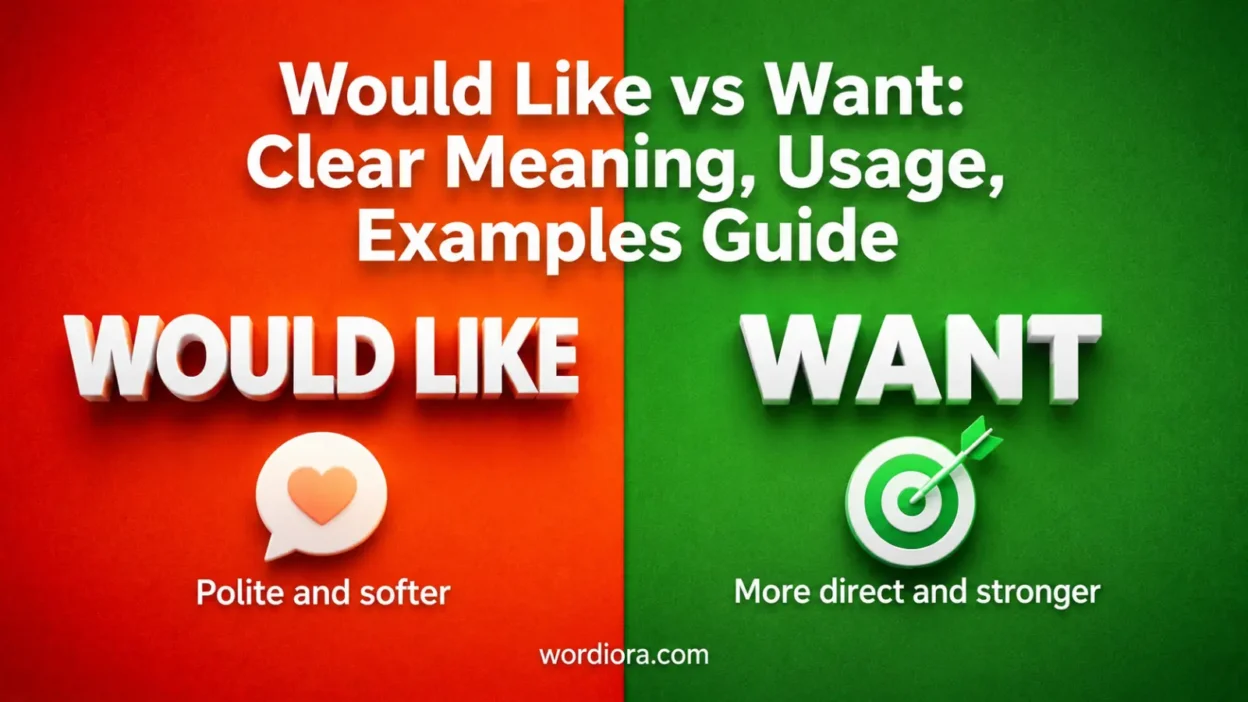
Both “would like” and “want” are correct in standard English, but they do not always create the same feeling. The main difference is tone. “Would like” sounds more polite, softer, and often more suitable for requests, offers, invitations, service situations, and formal messages. “Want” sounds more direct. It works well when you are stating a wish, need, goal, or choice clearly.
The choice is not about one being right and the other being wrong. It is about how direct you want to sound. In many everyday situations, especially in American English, “want” is normal with friends, family, and clear personal statements. In a restaurant, email, meeting, or polite request, “would like” often sounds smoother.
Quick Answer
Use “would like” when you want to sound polite, respectful, or a little more formal. Use “want” when you want to be clear, direct, casual, or strong.
A simple rule works most of the time: say “I’d like…” when asking someone for something politely. Say “I want…” when you are stating your own desire, need, goal, or preference directly.
Correct:
“I’d like a glass of water, please.”
Also correct:
“I want to learn Spanish this year.”
Why People Confuse Them
People confuse these two because both can express desire. “I’d like a coffee” and “I want a coffee” point to the same basic thing: the speaker wants coffee.
The difference is how the sentence lands on the listener. “I’d like a coffee, please” sounds like a polite request. “I want a coffee” sounds more direct. It may be fine with a close friend, but it can sound too blunt when talking to a server, receptionist, customer support agent, teacher, manager, or client.
That is why this comparison is more about register than meaning. The words often overlap in basic meaning, but they do not always fit the same social setting.
Key Differences At A Glance
| Context | Best Choice | Why |
|---|---|---|
| Ordering food or drinks | would like | Sounds polite and natural |
| Writing a professional email | would like | Keeps the tone respectful |
| Making an invitation | would like | Softens the question |
| Stating a personal goal | want | Sounds clear and direct |
| Talking with close friends | want | Sounds natural and casual |
| Making a strong request | want | Shows firmness |
| Asking a customer what they prefer | would like | Sounds service-friendly |
| Explaining a child’s wish | want | Sounds simple and natural |
Meaning and Usage Difference
“Would like” is a polite phrase used to say that someone wants something or wants to do something. It often appears in requests, offers, invitations, and formal statements.
Common patterns:
“I would like” + noun
“I would like a receipt.”
“I would like to” + verb
“I would like to schedule a call.”
“Would you like” + noun
“Would you like some water?”
“Would you like to” + verb
“Would you like to join us?”
“Want” is a direct verb. It can mean to wish for something, need something, or desire an action. It is more flexible and more direct than “would like.”
Common patterns:
“I want” + noun
“I want a better schedule.”
“I want to” + verb
“I want to finish this today.”
“I want someone to” + verb
“I want you to call me before you leave.”
Here is the main point: “would like” often works as a polite version of “want,” but “want” can sound stronger, clearer, or more casual depending on the situation.
Tone, Context, and Formality
“Would like” is usually safer when politeness matters. It works well in restaurants, stores, offices, interviews, customer service messages, and professional emails.
Examples:
“I’d like the chicken sandwich, please.”
“We would like to confirm the meeting time.”
“Would you like to review the report before Friday?”
“Want” is common and natural in everyday American English. It is not automatically rude. It becomes a problem only when the situation calls for a softer request.
Examples:
“I want to go home.”
“She wants a new laptop.”
“Do you want to watch a movie?”
In close relationships, “want” often sounds warmer and more honest than “would like.” Saying “I would like to see you this weekend” may sound formal. Saying “I want to see you this weekend” sounds more personal.
Which One Should You Use?
Use “would like” when the listener is doing something for you, when you are asking for service, or when your message needs a respectful tone.
Use “want” when you are simply saying what you desire, need, plan, or prefer.
| Feature | would like | want |
| Basic meaning | Polite desire | Direct desire |
| Tone | Soft, respectful | Clear, direct |
| Common setting | Requests, offers, invitations | Casual speech, goals, needs |
| Structure with verb | would like to go | want to go |
| Question form | Would you like…? | Do you want…? |
| Best for service settings | Yes | Sometimes too blunt |
A strong practical rule: if you are asking someone to give, do, send, bring, schedule, or prepare something for you, “would like” is usually the better first choice.
When One Choice Sounds Wrong
“I want” can sound wrong when the sentence is grammatically correct but socially too blunt.
Too blunt:
“I want a table by the window.”
Better:
“I’d like a table by the window, please.”
Too blunt:
“I want you to send the invoice today.”
Better:
“I’d like you to send the invoice today, please.”
But “would like” can also sound wrong if the moment needs directness or emotion.
Too stiff:
“I would like my phone back now.”
More direct:
“I want my phone back now.”
Too formal with a close friend:
“I would like to hang out later.”
More natural:
“I want to hang out later.”
The best choice depends on what you are doing: requesting politely, stating clearly, inviting warmly, or speaking firmly.
Common Mistakes and Quick Fixes
Mistake 1: Using “I want” for every request.
Weak:
“I want a refund.”
Better:
“I’d like a refund, please.”
Mistake 2: Forgetting “to” before a verb after “would like.”
Wrong:
“I would like go home.”
Correct:
“I would like to go home.”
Mistake 3: Adding “s” to “would like.”
Wrong:
“She would likes a new desk.”
Correct:
“She would like a new desk.”
Mistake 4: Using “would like” when direct speech is better.
Too soft:
“I would like everyone to stop talking.”
Clearer:
“I want everyone to stop talking.”
Mistake 5: Thinking “want” is always rude.
Not rude:
“I want to build a better routine.”
Possibly too blunt:
“I want you to fix this now.”
Quick fix: use “want” for your own wishes and goals. Use “would like” when making a polite request.
Everyday Examples
Restaurant:
“I’d like the grilled salmon, please.”
“Do you want fries with that?”
Work email:
“I would like to schedule a meeting for Thursday.”
“I want to make sure we finish the project on time.”
Customer service:
“I’d like to return this item.”
“I want a clear answer before I decide.”
Friends:
“Do you want to come over tonight?”
“I want to try that new pizza place.”
Family:
“She wants a bike for her birthday.”
“Would you like some help with dinner?”
School:
“I’d like to ask a question about the assignment.”
“I want to improve my writing this semester.”
Travel:
“We’d like two tickets to Chicago.”
“I want to leave early so we miss traffic.”
Dictionary-Style Word Details
Verb
• would like: A phrase built with “would” and “like.” It is used like a polite verb phrase to express wanting, requesting, offering, or inviting. Example: “I’d like to speak with the manager.”
• want: A standard verb. It can mean to desire, wish for, need, or lack something. Example: “I want to speak with the manager.”
The key grammar difference is simple: “would like” does not change form for he, she, or it. Say “She would like,” not “She would likes.” “Want” does change in the present tense: “She wants.”
Noun
• would like: Not commonly used as a noun in standard American English. It works as a phrase, not as a noun.
• want: Can be a noun, but this use is less common in everyday speech than the verb. It can mean a need, lack, or desire. Example: “The program helps families with basic wants and needs.”
For this comparison, the verb use of “want” is the one readers usually need.
Synonyms
• would like: Closest plain alternatives include “would prefer,” “would appreciate,” “would be interested in,” and sometimes “want.” These are not always exact matches. The right choice depends on the sentence.
• want: Closest plain alternatives include “wish for,” “desire,” “need,” “prefer,” and “hope for.” “Need” is stronger when something is necessary, not just desired.
Useful opposites are context-based. For “want,” the opposite is often “do not want,” “refuse,” or “decline.” For “would like,” the opposite in polite replies is often “No, thank you.”
Example Sentences
• would like: “I’d like a copy of the receipt, please.”
• want: “I want a copy of the receipt for my records.”
• would like: “Would you like to join the call?”
• want: “Do you want to join the call?”
• would like: “We would like to thank everyone who helped.”
• want: “We want to thank everyone who helped.”
• would like: “I’d like you to review this before noon.”
• want: “I want you to review this before noon.”
Word History
• would like: This phrase comes from the normal English pattern of using “would” to make a statement or question softer, more polite, or less direct. The exact history is not needed to choose it correctly.
• want: “Want” is a long-established English word used as both a verb and a noun. In modern everyday use, its verb meaning is the most important here: to wish for, need, or desire something.
The safe usage point is this: the history does not create a special hidden rule. Current tone and context matter more.
Phrases Containing
• would like: “I’d like…,” “would you like…,” “would like to,” “would like someone to,” “would like it if.”
Examples:
“I’d like a refill, please.”
“Would you like to sit outside?”
“We would like you to arrive early.”
• want: “want to,” “do you want,” “want someone to,” “want in,” “want out,” “want no part of,” “want it both ways.”
Examples:
“I want to leave soon.”
“Do you want me to drive?”
“She wants no part of the argument.”
FAQs
Is “would like” more polite than “want”?
Yes. “Would like” usually sounds more polite, softer, and more respectful than “want.” For example, “I’d like a glass of water, please” sounds smoother than “I want a glass of water.” Both can be correct, but “would like” is better in requests, restaurants, emails, and formal situations.
Is “want” rude?
No, “want” is not automatically rude. It is normal in everyday English when you are talking about wishes, goals, needs, or preferences. For example, “I want to learn French” is perfectly natural. It may sound rude only when used too directly in a polite request.
Can I say “I want” in a restaurant?
You can, but “I’d like” usually sounds better. Saying “I want the burger” is understandable, but “I’d like the burger, please” sounds more polite and natural when speaking to a server.
What is the difference between “I want” and “I would like”?
“I want” is direct. “I would like” is more polite and softer. Use “I want” for clear personal wishes or goals, such as “I want to get better at writing.” Use “I would like” for polite requests, such as “I would like a copy of the receipt.”
Is “would like” formal?
“Would like” is more formal than “want,” but it is not overly formal. It is common in everyday polite English. You can use it in emails, customer service, restaurants, meetings, invitations, and respectful conversations.
Which is better: “Do you want” or “Would you like”?
“Would you like” is usually more polite. “Do you want” is more casual and direct. Say “Would you like some coffee?” in a polite or service setting. Say “Do you want coffee?” when talking casually with a friend or family member.
Can “would like” and “want” mean the same thing?
Sometimes, yes. Both can express desire. “I’d like a coffee” and “I want a coffee” both mean the speaker wants coffee. The difference is tone. “Would like” sounds more polite, while “want” sounds more direct.
What verb form comes after “would like”?
Use “to” plus the base verb after “would like.” Correct: “I would like to go.” Incorrect: “I would like go.” You can also use “would like” before a noun, as in “I would like a refund.”
Should I use “would like” in professional emails?
Yes, “would like” is often a good choice in professional emails because it sounds respectful and clear. For example, “I would like to schedule a meeting” sounds more polished than “I want to schedule a meeting.”
When should I use “want” instead of “would like”?
Use “want” when you need to sound clear, casual, firm, or personal. For example, “I want to improve my grades” sounds natural. “I would like to improve my grades” is also correct, but it sounds more formal and less direct.
Conclusion
“Would like” and “want” are both correct, but they are not equal in tone. Use “would like” when you want a polite, smooth, respectful sentence, especially in requests, offers, invitations, service situations, and professional messages. Use “want” when you need direct, natural, or stronger wording. The simplest choice is this: “I’d like” sounds polite; “I want” sounds direct. Pick the one that matches the situation, the listener, and the level of firmness you need.