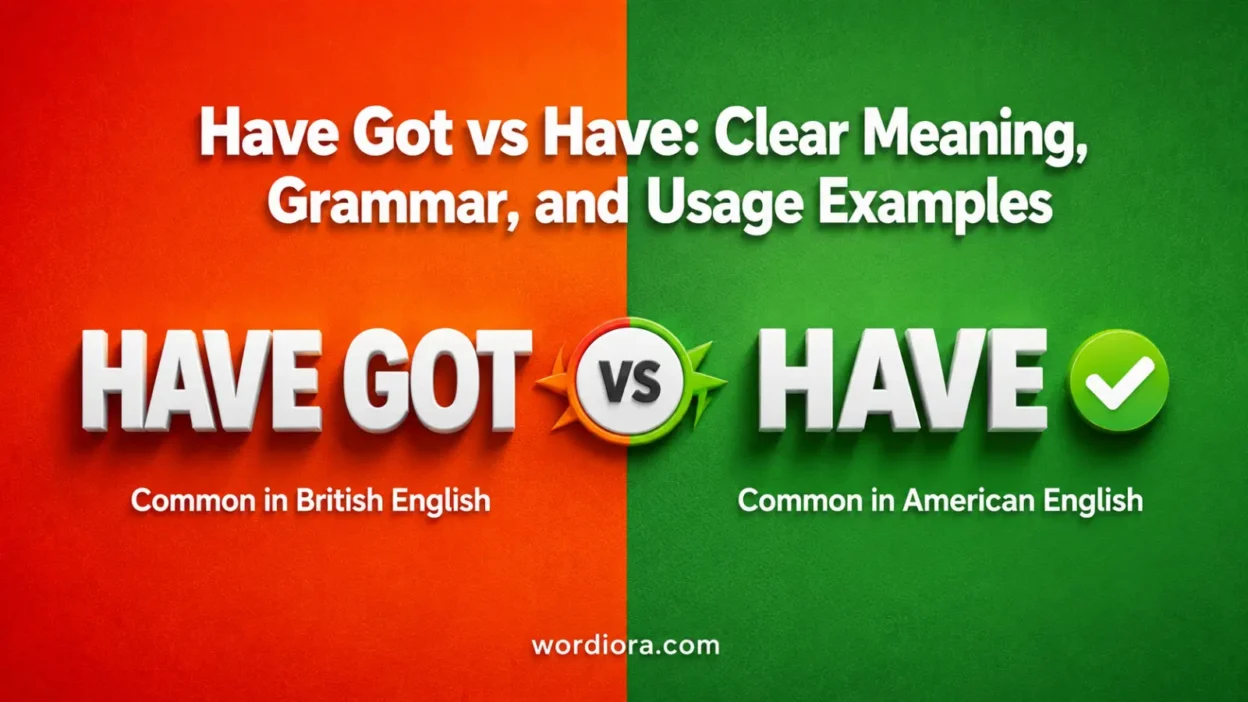
Have got vs have is a common grammar choice because both forms can point to the same basic idea: possession. You can say “I have a car” or “I’ve got a car,” and both can be correct.
The real difference is not usually meaning. It is grammar, tone, and flexibility. Have is the cleaner, more flexible choice. Have got is natural in conversation, especially when talking about something someone has right now.
The safest rule is simple: use have when you want the most standard, formal, and flexible wording. Use have got when the sentence is casual and present-time.
Quick Answer
Both have got and have can be correct.
Use have for general writing, formal sentences, past or future time, activities, experiences, and most professional contexts.
Use have got mainly in casual speech or informal writing when you mean “have” in the present.
Correct:
“I have two meetings today.”
“I’ve got two meetings today.”
Better for formal writing:
“I have two meetings today.”
Why People Confuse Them
People confuse these forms because have got often means the same thing as have.
“I have a problem.”
“I’ve got a problem.”
Both sentences mean the problem exists now. The confusion starts when people try to use have got everywhere they use have. That does not always work.
Have can stand alone in many structures. Have got is narrower. It works best for present possession, relationships, features, illnesses, appointments, and necessity when followed by “to.”
Key Differences At A Glance
| Context | Best Choice | Why |
|---|---|---|
| Formal writing | have | Cleaner and more standard |
| Casual speech | have got | Natural and conversational |
| Present possession | either | Both can mean the same thing |
| Past possession | have | Use “had,” not “had got,” for simple possession |
| Future possession | have | Use “will have,” not “will have got,” for simple possession |
| Activities | have | Say “have lunch,” not “have got lunch” when you mean eat lunch |
| Questions | have | “Do you have…?” is the standard US form |
| Informal emphasis | have got | “You’ve got to see this” sounds natural in speech |
Compact comparison:
• Have got: casual, present-time, often contracted, narrower use.
• Have: standard, flexible, works in more tenses and more sentence types.
Meaning and Usage Difference
Use have to mean own, possess, hold, contain, experience, or be connected with something.
Examples:
“She has a new laptop.”
“We have a deadline tomorrow.”
“I have a cold.”
“They have three kids.”
Use have got when you mean “have” in a present-time sense.
Examples:
“She’s got a new laptop.”
“We’ve got a deadline tomorrow.”
“I’ve got a cold.”
“They’ve got three kids.”
With to + verb, the meaning changes to necessity.
“I have to leave.”
“I’ve got to leave.”
Both mean leaving is necessary. The version with have got to sounds more conversational.
Tone, Context, and Formality
Have is the better choice for school essays, workplace writing, reports, instructions, formal emails, and polished articles.
Example:
“The company has three offices in Texas.”
Have got sounds more relaxed.
Example:
“The company’s got three offices in Texas.”
That second sentence is understandable, but it feels more casual. In American English, “Do you have…?” is usually the safer question form in everyday writing.
Better in most US writing:
“Do you have a copy?”
More conversational:
“Have you got a copy?”
Neither is automatically wrong. The choice depends on how formal and direct you want the sentence to sound.
Which One Should You Use?
Use have when you are unsure. It works in the widest range of situations.
Choose have for:
• formal writing
• schoolwork
• business messages
• past or future time
• activities and experiences
• clear American-style questions
Choose have got for:
• casual speech
• informal messages
• present-time possession
• natural contractions like “I’ve got” and “she’s got”
• strong conversational statements like “You’ve got to hear this”
For most US readers, have will almost always sound correct. Have got can sound friendly and natural, but it should not replace have in every sentence.
When One Choice Sounds Wrong
Have got sounds wrong when you use it for normal activities.
Wrong:
“I have got lunch at noon.”
Better:
“I have lunch at noon.”
Wrong:
“We have got a meeting yesterday.”
Better:
“We had a meeting yesterday.”
Wrong:
“She will have got a new office next month.”
Better:
“She will have a new office next month.”
Also avoid have got after another helping verb when you mean simple possession.
Awkward:
“They might have got more time next week.”
Better:
“They might have more time next week.”
Common Mistakes and Quick Fixes
Mistake 1: Using do with have got.
Wrong:
“Do you have got a pen?”
Correct:
“Do you have a pen?”
“Have you got a pen?”
Mistake 2: Using don’t with have got.
Wrong:
“I don’t have got time.”
Correct:
“I don’t have time.”
“I haven’t got time.”
Mistake 3: Using have got for past possession.
Wrong:
“When I was a kid, I had got a small bike.”
Correct:
“When I was a kid, I had a small bike.”
Mistake 4: Using have got for activities.
Wrong:
“We have got dinner at six.”
Correct:
“We have dinner at six.”
Everyday Examples
“I have a few minutes before the call.”
“I’ve got a few minutes before the call.”
“Do you have your ID?”
“Have you got your ID?”
“She has a dentist appointment today.”
“She’s got a dentist appointment today.”
“We don’t have enough chairs.”
“We haven’t got enough chairs.”
“I have to finish this before Friday.”
“I’ve got to finish this before Friday.”
For polished writing, choose the have version. For relaxed conversation, the have got version can sound natural.
Dictionary-Style Word Details
Verb
• have got: A verb phrase used mainly for present possession, present conditions, relationships, features, appointments, and necessity with “to.”
Example: “I’ve got a question.”
• have: A verb used for possession, relationships, experiences, actions, obligation, and as a helping verb in perfect tenses.
Example: “I have a question.”
Example: “I have finished the report.”
Noun
• have got: Not used as a noun in standard American English.
• have: Rare as a noun, mostly in fixed contrast with “have-nots,” meaning people who have wealth or advantages. This noun use is not important for the everyday choice between the two forms.
Synonyms
For possession, the closest plain alternatives for both are:
• own
• possess
• hold
• keep
• be equipped with
For necessity with have got to or have to, the closest plain alternatives are:
• must
• need to
• be required to
Clear opposites depend on context. For possession, possible opposites include lack or not have.
Example Sentences
• have got: “I’ve got a few questions about the schedule.”
• have: “I have a few questions about the schedule.”
• have got: “She’s got a great eye for design.”
• have: “She has a great eye for design.”
• have got: “We’ve got to leave by 7.”
• have: “We have to leave by 7.”
• have got: “They’ve got two extra tickets.”
• have: “They have two extra tickets.”
Word History
• have got: This phrase developed from the verbs “have” and “get.” In modern use, it often works as an idiomatic way to say “have” in present-time contexts.
• have: This is a core English verb with many uses, including possession, experience, obligation, and helping-verb use. Its full history is broad, but the practical choice today is about structure and tone, not origin.
Phrases Containing
• have got: have got to, have got a minute, have got your back, have got enough time, have got no idea
• have: have to, have a meeting, have lunch, have a cold, have a good time, have no idea
FAQs
Is “have got” correct English?
Yes, have got is correct English. It is commonly used in casual speech and informal writing, especially when talking about possession, relationships, features, illness, appointments, or necessity.
Example:
“I’ve got a question.”
Is “have” better than “have got”?
Have is usually the better choice in formal writing because it is cleaner, simpler, and more flexible. Have got is fine in casual conversation, but it does not work in as many grammar structures as have.
What is the main difference between “have got” and “have”?
The main difference is tone and flexibility. Have works in formal and informal English, past time, future time, questions, negatives, and many sentence types. Have got is more casual and mostly used for present-time meaning.
Can I use “have got” in American English?
Yes, Americans use have got, especially in speech. However, have is often the safer choice in American writing.
Example:
Casual: “I’ve got two tickets.”
More standard: “I have two tickets.”
Should I write “Do you have” or “Have you got”?
Both can be correct, but Do you have is usually more natural in American English.
Example:
“Do you have a pen?” sounds more common and direct.
“Have you got a pen?” sounds more conversational and slightly less typical in US writing.
Is “I don’t have got” correct?
No. I don’t have got is not correct.
Correct versions:
“I don’t have time.”
“I haven’t got time.”
Can “have got” be used in the past tense?
Usually, no. For normal past possession, use had, not had got.
Wrong: “I had got a bike when I was little.”
Correct: “I had a bike when I was little.”
What does “have got to” mean?
Have got to means have to or must. It shows necessity or obligation.
Example:
“I’ve got to leave now.”
Meaning: “I have to leave now.”
Is “have got” formal or informal?
Have got is mostly informal. It sounds natural in conversation, texts, and casual messages. For formal writing, use have.
Which one should I use in school or business writing?
Use have in school, business, and formal writing.
Better:
“We have several options.”
Less formal:
“We’ve got several options.”
Are “have got” and “have” always interchangeable?
No. They can mean the same thing in some present-time possession sentences, but they are not always interchangeable.
Correct:
“I have a meeting.”
“I’ve got a meeting.”
But for activities:
Correct: “I have lunch at noon.”
Wrong: “I have got lunch at noon.”
What is the easiest rule to remember?
Use have when you want the safest and most flexible choice. Use have got when the sentence is casual, present-time, and means that someone has something now.
Conclusion
Use have when you want the safest, clearest, and most flexible choice. It works in formal writing, everyday American English, past time, future time, activities, and many grammar structures. Use have got when you want a natural, conversational way to talk about something someone has right now. The two forms can match in meaning, but they do not match in every sentence. When in doubt, choose have.