Last Updated: July 27, 2026
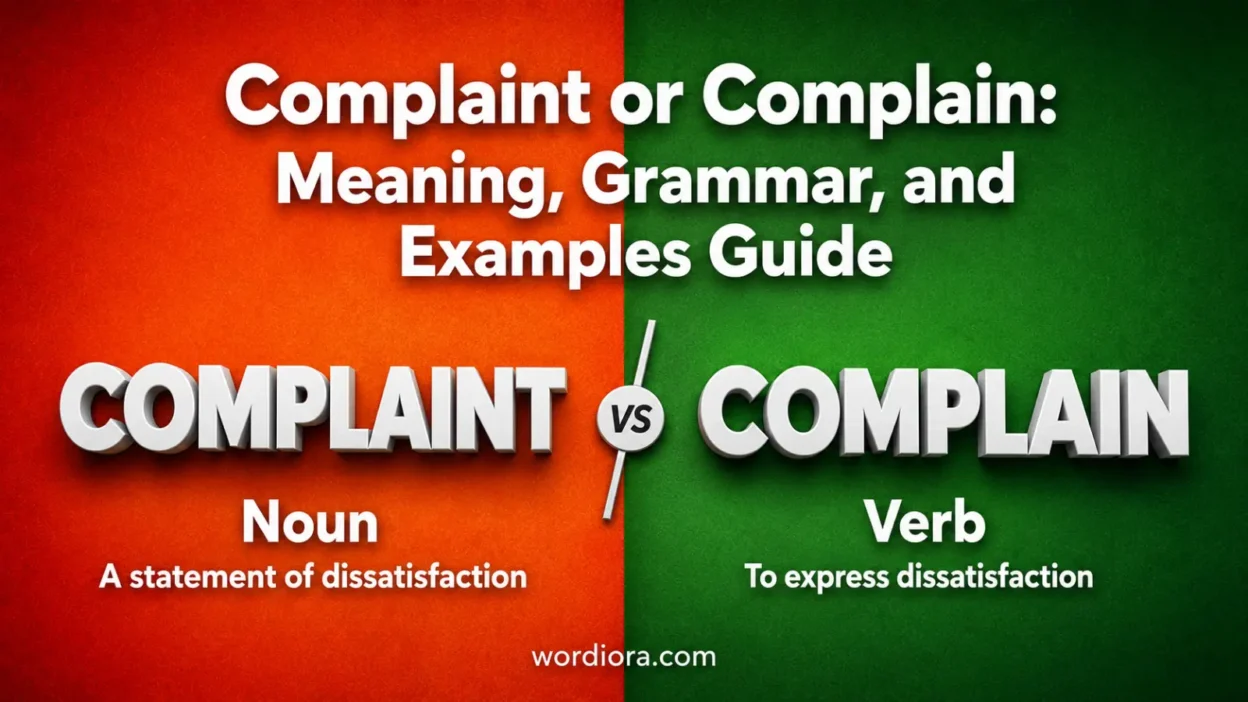
Complaint and complain are both correct words, but they do different jobs in a sentence. The difference is not just spelling. It is grammar.
Use complaint when you mean the problem, report, grievance, or statement itself.
Use complain when you mean the action of saying something is wrong.
That is why these sentences work differently:
Correct: I filed a complaint about the service.
Correct: I want to complain about the service.
Quick Answer
Use complaint as a noun. It names the thing.
Use complain as a verb. It shows the action.
A simple test helps: if you can put a, the, or my before the word, you probably need complaint.
Correct: I have a complaint.
Incorrect: I have a complain.
If the word comes after a person or subject doing an action, you probably need complain.
Correct: Customers complain about long wait times.
Incorrect: Customers complaint about long wait times.
Why People Confuse Them
People confuse these words because they look and sound similar. They also belong to the same word family. Both connect to dissatisfaction, problems, or speaking up when something is wrong.
The final t in complaint is the key clue. Complaint ends with a harder sound: “kum-PLAYNT.” Complain ends without that final t sound: “kum-PLAYN.”
The sound difference is small, but the grammar difference is big.
Key Differences At A Glance
- Complaint: noun; names a problem, grievance, formal report, symptom, or legal filing.
- Complain: verb; describes the action of saying or writing that something is wrong.
- Complaint often follows words like a, the, my, your, file, make, submit, or handle.
- Complain often follows a subject, such as I, we, customers, employees, or patients.
Meaning and Usage Difference
A complaint is something you make, file, submit, receive, review, or handle.
Examples:
I made a complaint about the broken heater.
The company received several complaints from customers.
Her main complaint was the late delivery.
Complain is what someone does when they express dissatisfaction.
Examples:
I need to complain about the broken heater.
Several customers complained about the delay.
She complained that the package arrived late.
In short, complaint is the message or issue. Complain is the act of giving that message or raising that issue.
Tone, Context, and Formality
Complaint often sounds more formal or professional, especially in business, customer service, legal, and medical writing.
A customer may file a complaint.
An employee may submit a complaint to HR.
A doctor may record a patient’s complaint of pain.
A lawyer may refer to a legal complaint.
Complain is common in everyday speech and writing. It can be neutral, but it can also sound negative when it suggests repeated or unnecessary dissatisfaction.
Neutral: Please contact support if you need to complain about a charge.
Negative: He complains about everything.
The word itself is not rude. The tone depends on context.
Which One Should You Use?
| Context | Best Choice | Why |
|---|---|---|
| Naming a problem | Complaint | It is a noun. |
| Describing someone speaking up | Complain | It is a verb. |
| Customer service email | Complaint | “Submit a complaint” sounds professional. |
| Everyday conversation | Complain | “I need to complain” sounds natural. |
| Legal writing | Complaint | It can mean a formal legal document. |
| Medical note | Complaint | It can refer to a symptom or reported health issue. |
| Talking about repeated dissatisfaction | Complain | It shows the action or habit. |
When One Choice Sounds Wrong
Use complaint when the sentence needs a noun.
Wrong: I sent a complain to the manager.
Right: I sent a complaint to the manager.
Wrong: The school received three complain.
Right: The school received three complaints.
Use complain when the sentence needs a verb.
Wrong: I will complaint about the charge.
Right: I will complain about the charge.
Wrong: She complaint to the front desk.
Right: She complained to the front desk.
Common Mistakes and Quick Fixes
Mistake: I have a complain.
Fix: I have a complaint.
Mistake: Please complaint to customer service.
Fix: Please complain to customer service.
Mistake: The complains were valid.
Fix: The complaints were valid.
Mistake: He made a complain about the noise.
Fix: He made a complaint about the noise.
Mistake: We complaint every month.
Fix: We complain every month.
The fastest fix is to ask: “Do I need a thing or an action?” If you need a thing, use complaint. If you need an action, use complain.
Everyday Examples
I have one complaint about the app: it crashes too often.
You can complain to the landlord if the heat stops working.
The restaurant handled my complaint quickly.
Employees should not be afraid to complain about unsafe conditions.
Her complaint was fair, but her tone was harsh.
Customers often complain when shipping is delayed.
The patient’s main complaint was back pain.
I do not want to complain, but the room is still dirty.
They submitted a complaint after the flight was canceled.
He complains whenever the Wi-Fi is slow.
Dictionary-Style Word Details
Verb
Complaint: Not commonly used as a verb in standard US English. Use complain for the action.
Incorrect: I will complaint tomorrow.
Correct: I will complain tomorrow.
Complain: A verb meaning to say or write that something is wrong, painful, unfair, or not satisfactory.
Example: Tenants complained about the noise.
Common forms include complain, complains, complained, and complaining.
Noun
Complaint: A noun. It can mean a statement of dissatisfaction, a reason for dissatisfaction, a formal report, a health symptom, or a legal filing.
Example: The company responded to my complaint.
Complain: Not commonly used as a noun in standard US English. Do not write “a complain.” Use a complaint.
Synonyms
Complaint: Closest plain alternatives include grievance, objection, problem, concern, criticism, and report. In casual speech, gripe can work, but it is less formal.
Helpful opposites include praise, compliment, and approval when the meaning is dissatisfaction.
Complain: Closest plain alternatives include object, protest, grumble, criticize, and raise a concern. These are not always exact matches. Grumble sounds more annoyed or informal. Protest can sound stronger or more public.
Helpful opposites include praise, approve, and accept in many contexts.
Example Sentences
Complaint:
My only complaint is that the instructions were unclear.
The office received a complaint about the parking lot.
She filed a complaint after the refund was denied.
The doctor asked about his chief complaint.
Complain:
I do not want to complain, but my order is missing.
Several neighbors complained about the loud music.
He complains when meetings start late.
You should complain to the company if the charge is wrong.
Word History
Complaint and complain are related words from the same older word family connected with lamenting, grief, and expressing dissatisfaction.
That history explains why their meanings feel connected. It does not make them interchangeable in modern US English. Today, the practical difference is simple: complaint is the noun, and complain is the verb.
Phrases Containing
Complaint:
make a complaint
file a complaint
submit a complaint
lodge a complaint
customer complaint
formal complaint
letter of complaint
complaint about something
complaint against someone
grounds for complaint
Complain:
complain about something
complain to someone
complain of pain
complain that something happened
can’t complain
stop complaining
keep complaining
nothing to complain about
FAQs
Both words are correct, but they are used differently. Complaint is a noun, and complain is a verb. Say “I have a complaint” but “I want to complain.”
A complaint is the problem, report, or statement of dissatisfaction. Complain means to speak or write about something that is wrong.
No. The correct sentence is “I have a complaint.” After words like a, the, or my, you need the noun complaint.
No. The correct sentence is “I want to complain.” After want to, use the verb complain.
The correct phrase is make a complaint. For example: “She made a complaint about the poor service.”
No, complaint is not commonly used as a verb in standard US English. Use complain when you need the action word.
No, complain is not normally used as a noun in standard US English. Use complaint for the noun form.
Complaint often sounds more formal because it is used in customer service, business, legal, and medical contexts. Complain is common in everyday speech.
Example: The customer filed a complaint about the delayed refund.
Here, complaint names the formal report or problem.
Example: The customer complained about the delayed refund.
Here, complained shows the action of speaking up about the problem.
Conclusion
Complaint and complain are both correct, but they are not interchangeable.
Use complaint when you need a noun: a problem, report, grievance, symptom, or formal statement.
Use complain when you need a verb: the action of saying something is wrong.
Correct: I made a complaint.
Correct: I need to complain.
Once you remember noun versus verb, the choice becomes much easier.