“Be able to” and “can” often point to the same basic idea: someone has the ability, chance, or permission to do something.
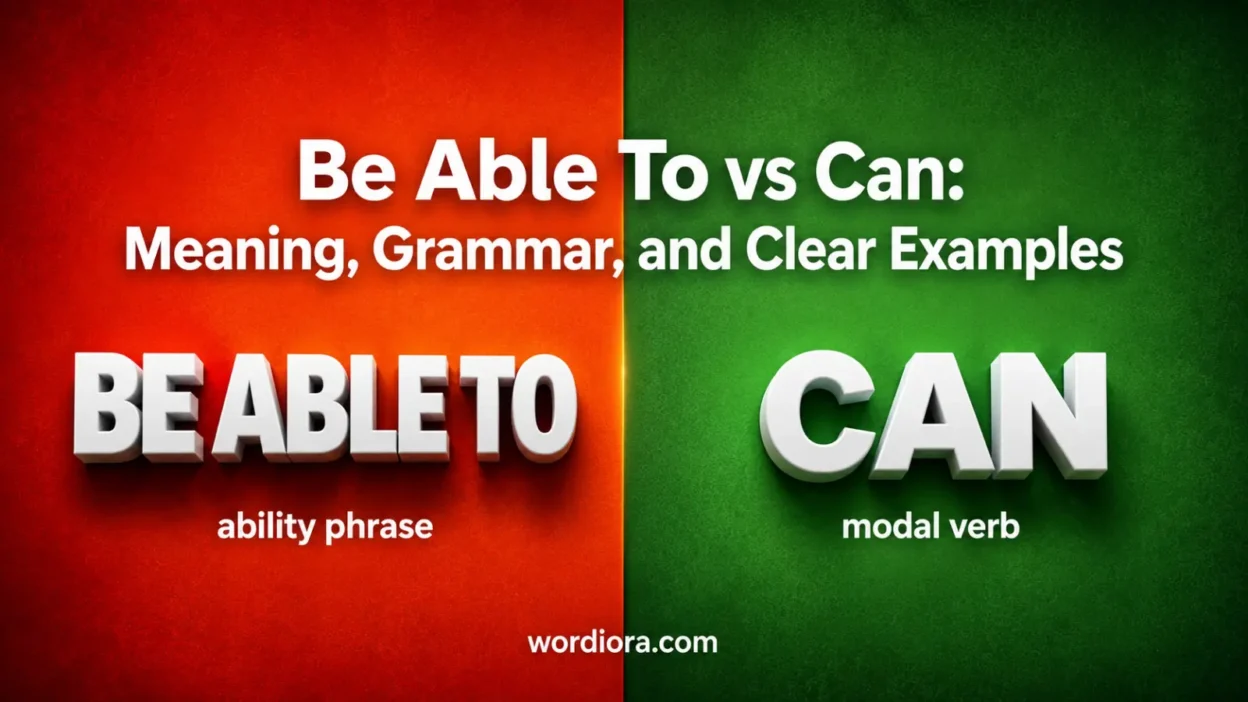
Still, they do not work the same way in every sentence. The main difference is grammar. “Can” is a modal verb, while “be able to” is a verb phrase made with a form of “be,” the adjective “able,” and “to” before another verb.
That small grammar difference matters when you write or speak.
Quick Answer
Use “can” for most everyday sentences about present ability, permission, or possibility.
Use “be able to” when “can” does not fit the sentence structure. This usually happens after another modal verb, with “will,” after “to,” after “being,” or in perfect forms.
Examples:
I can finish the report today.
I will be able to finish the report tomorrow.
Both sentences are correct, but they fit different grammar patterns.
Why People Confuse Them
People confuse “be able to” and “can” because they overlap in simple present sentences.
You can say:
I can drive.
I am able to drive.
Both mean that you have the ability to drive. However, the first sentence sounds more natural in normal US conversation. The second sentence is also correct, but it sounds more formal, careful, or slightly emphatic.
The problem begins when people try to use “can” in places where English grammar needs another form.
Wrong: I will can help you.
Correct: I will be able to help you.
Key Differences At A Glance
| Context | Best Choice | Why |
|---|---|---|
| Normal present ability | can | It is shorter and more natural. |
| Formal present ability | be able to | It can sound more official or careful. |
| After “will” | be able to | “Will can” is not standard English. |
| After another modal, such as “should” or “might” | be able to | Two modal verbs do not work together this way. |
| After “to” | be able to | “To can” is not standard for ability. |
| After “being” | be able to | “Being can” does not express ability. |
| Present perfect ability | be able to | “Have can” is not standard English. |
| Asking permission in everyday speech | can | It is the normal casual choice. |
Meaning and Usage Difference
The biggest overlap between “can” and “be able to” is ability.
In many everyday sentences, “can” means “be able to.”
She can speak Spanish.
She is able to speak Spanish.
The difference is not that one sentence is correct and the other is wrong. The real difference is how each form works in a sentence.
Here is the simple comparison:
• “Can” is a modal verb. It goes before the base verb: can help, can drive, can swim.
• “Be able to” is a verb phrase. The form of “be” changes: am able to, was able to, will be able to, have been able to.
• “Can” is usually better for short, direct statements.
• “Be able to” is better when the sentence needs a form that “can” does not have.
“Can” can also express permission or possibility.
Can I leave early?
This parking lot can fill up fast.
“Be able to” usually stays closer to ability, opportunity, or successful action.
Will you be able to join the call?
Tone, Context, and Formality
“Can” sounds normal, direct, and conversational.
I can meet at 3.
Can you send the file?
We can start after lunch.
“Be able to” sounds a little more formal or careful when it replaces “can” in a simple present sentence.
I am able to meet at 3.
Are you able to send the file?
We are able to start after lunch.
These sentences are correct, but they may sound more businesslike than needed. In everyday US English, “can” is usually smoother.
When grammar requires it, “be able to” sounds completely natural.
I should be able to meet at 3.
Will you be able to send the file?
We have been able to start earlier this week.
Which One Should You Use?
Use “can” when your sentence is simple and direct.
I can help.
She can work late.
They can pick us up.
Choose “be able to” after “will.”
I will be able to help after 5.
Use “be able to” after another modal verb.
You might be able to get a refund.
He should be able to answer that.
Choose “be able to” after “to.”
I want to be able to speak more clearly.
Use “be able to” after “being.”
I like being able to work from home.
Choose “be able to” in perfect forms.
She has been able to save more money this year.
When One Choice Sounds Wrong
Some choices sound wrong because “can” does not have all the forms that regular verbs have.
Wrong: I will can come tomorrow.
Correct: I will be able to come tomorrow.
Wrong: I want to can drive.
Correct: I want to be able to drive.
Wrong: She has can finish early.
Correct: She has been able to finish early.
Wrong: You should can see the update now.
Correct: You should be able to see the update now.
Wrong: I can to help.
Correct: I can help.
A simple rule helps: after “can,” use the base verb with no “to.”
Common Mistakes and Quick Fixes
Mistake: Using “can” after “will.”
Fix: Use “will be able to.”
Correct: I will be able to call you tonight.
Mistake: Using “to” after “can.”
Fix: Use “can” plus the base verb.
Correct: She can drive.
Mistake: Mixing both forms together.
Fix: Choose one form.
Wrong: I can be able to help.
Correct: I can help.
Correct: I am able to help.
Mistake: Using “be able to” when “can” sounds more natural.
Fix: In casual speech, prefer “can.”
Too stiff for casual speech: I am able to come over now.
More natural: I can come over now.
Everyday Examples
I can stop by the grocery store after work.
After my meeting, I will be able to stop by.
Can you help me move this weekend?
Would you be able to help me move this weekend?
My daughter can read short books by herself.
After a few more lessons, she will be able to read longer books.
We can take the 8:15 train.
If traffic is light, we might be able to take the 8:15 train.
I can’t open this jar.
All morning, I haven’t been able to open this jar.
Can I use your charger?
Will I be able to use the conference room at 2?
Dictionary-Style Word Details
Verb
• Be able to: Used as a verb phrase. The form of “be” changes to match tense and subject: am able to, is able to, were able to, will be able to, have been able to.
Example: We were able to find a cheaper flight.
• Can: Used as a modal auxiliary verb. It comes before the base form of another verb.
Example: We can find a cheaper flight.
Noun
• Be able to: Not commonly used as a noun in standard US English. It is a verb phrase, not a noun.
• Can: “Can” can be a noun meaning a container, as in “a can of soup.” That noun meaning is separate from “can” as an ability word.
Example: Please recycle the empty can.
Synonyms
• Be able to: Closest plain alternatives include “can,” “be capable of,” “have the ability to,” and “manage to” when the sentence means a successful action.
• Can: Closest plain alternatives include “be able to,” “know how to,” “be allowed to” when the meaning is permission, and “be possible” when the meaning is possibility.
Clear opposites include “cannot,” “can’t,” “be unable to,” and “be incapable of,” depending on the sentence.
Example Sentences
• Be able to: After lunch, I will be able to join the meeting.
• Be able to: Twice a week, she has been able to work from home.
• Be able to: By the end of the day, they should be able to finish the job.
• Can: I can join the meeting now.
• Can: On Fridays, she can work from home.
• Can: They can finish the job today if everything stays on schedule.
Word History
• Be able to: This phrase is made from “be,” “able,” and a following infinitive verb. For everyday writing, its sentence pattern matters more than its history.
• Can: “Can” is a long-established English modal verb. In this comparison, the important point is its modern role. It can express ability, permission, or possibility, but it does not have forms like “to can,” “will can,” or “have can.”
No first-use date is needed to choose correctly between these two forms.
Phrases Containing
• Be able to: be able to, not be able to, will be able to, should be able to, might be able to, being able to, have been able to, better able to.
• Can: can do, no can do, can’t, cannot, can be, can help, can I, can you, can we.
FAQs
Is “be able to” the same as “can”?
Sometimes, yes. Both can express ability. For example, “I can swim” and “I am able to swim” mean nearly the same thing. The difference is that “can” sounds more natural in everyday speech, while “be able to” is needed in sentence forms where “can” does not work.
Which is more natural: “can” or “be able to”?
“Can” is more natural in most casual US-English sentences. Say “I can help” instead of “I am able to help” unless you want a more formal or careful tone.
When should I use “be able to” instead of “can”?
Use “be able to” after words like “will,” “should,” “might,” and “to.”
Correct: I will be able to come.
Incorrect: I will can come.
Can I say “will can”?
No. “Will can” is not standard English. Use “will be able to” instead.
Correct: I will be able to call you tomorrow.
Incorrect: I will can call you tomorrow.
Is “can able to” correct?
No. Do not use “can” and “able to” together like that. Choose one form.
Correct: I can help.
Correct: I am able to help.
Incorrect: I can able to help.
Is “be able to” more formal than “can”?
Yes, often. “Be able to” can sound more formal, polite, or careful than “can.” In everyday conversation, “can” is usually the better choice.
Can I use “can” for permission?
Yes. “Can” is commonly used for permission in everyday English.
Example: Can I use your phone?
For very formal writing or speech, “may” can sound more traditional, but “can” is normal in modern conversation.
Can “be able to” be used in the past?
Yes. Use forms like “was able to,” “were able to,” and “have been able to.”
Example: She was able to finish the project early.
What is the difference between “could” and “was able to”?
“Could” often describes general past ability. “Was able to” often points to a specific successful action.
General ability: When I was younger, I could run five miles.
Specific success: I was able to finish the race yesterday.
What is the easiest rule to remember?
Use “can” when the sentence is simple and natural. Use “be able to” when the sentence needs a tense or structure that “can” cannot form.
Conclusion
“Can” and “be able to” are both correct, but they are not always interchangeable.
Use “can” for simple, natural sentences about ability, permission, or possibility.
Use “be able to” when the sentence needs a form that “can” does not have, such as after “will,” after another modal verb, after “to,” after “being,” or in perfect forms.
A good memory tip is this: use “can” when it fits easily; use “be able to” when the grammar needs more room.