
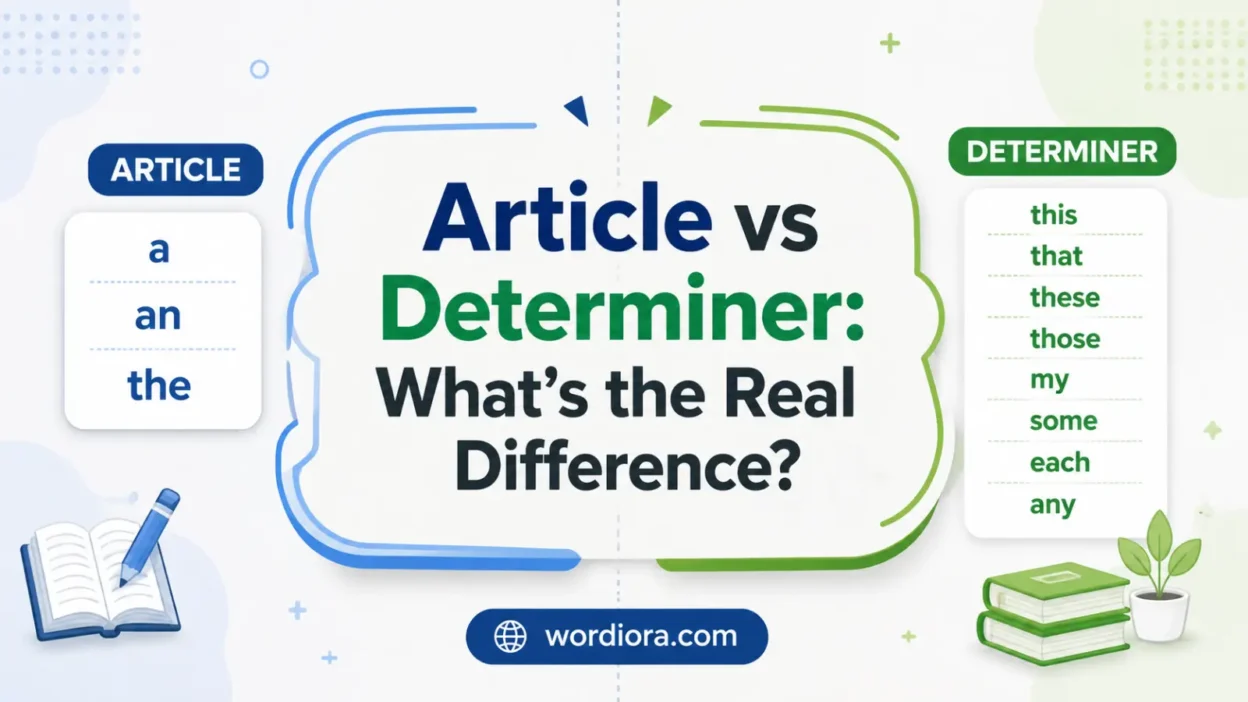
Many English learners see the terms article and determiner and assume they mean the same thing. That confusion is understandable because articles and determiners both appear before nouns.
However, they are not identical.
The easiest way to understand the difference is this:
Every article is a determiner, but not every determiner is an article.
Articles are a small subgroup within the larger category of determiners. Knowing the difference helps you understand English grammar more clearly and avoid common mistakes.
Quick Answer
An article is a specific type of determiner.
English has only three articles:
- a
- an
- the
A determiner is a broader category that includes:
- articles
- demonstratives (this, that, these, those)
- possessives (my, your, their)
- quantifiers (some, many, few)
- numbers (one, two, three)
So, if you use the book, the word the is both an article and a determiner.
If you use my book, the word my is a determiner but not an article.
Why People Confuse Them
People often confuse these terms because both appear before nouns and help identify what noun is being discussed.
Consider these examples:
- a car
- the car
- this car
- my car
- some car parts
The highlighted words all come before the noun car. Because they perform a similar job, many learners think they belong to the same category.
The difference is that articles are only one kind of determiner. Determiners include several other word groups beyond articles.
Key Differences At A Glance
| Context | Best Choice | Why |
|---|---|---|
| Referring to any singular item | Article | “a dog” or “an apple” introduces a noun generally |
| Referring to a specific known item | Article | “the dog” identifies a specific noun |
| Showing ownership | Determiner | “my dog” shows possession |
| Pointing to something | Determiner | “this dog” or “that dog” indicates location or reference |
| Showing quantity | Determiner | “many dogs” or “some dogs” expresses amount |
| Talking about one of the three article words | Article | Only a, an, and the are articles |
Meaning and Usage Difference
The core difference is one of scope.
Article
An article helps show whether a noun is specific or non-specific.
Examples:
- I saw a movie last night.
- She bought an umbrella.
- We visited the museum downtown.
English articles are limited to only three words:
- a
- an
- the
Determiner
A determiner introduces or limits a noun in various ways.
Examples:
- this book
- my car
- some water
- many people
- three tickets
Articles belong inside this larger group.
Quick Comparison
| Feature | Article | Determiner |
|---|---|---|
| Category size | Small | Large |
| Number in English | Three | Many |
| Includes a, an, the | Yes | Yes |
| Includes my, this, some | No | Yes |
| Appears before nouns | Yes | Yes |
Articles focus mainly on definiteness. Determiners can indicate definiteness, ownership, quantity, number, or reference.
Tone, Context, and Formality
There is usually no formality difference between articles and determiners.
Instead, the choice depends on what information you want to provide.
Compare:
- I bought a laptop.
- I bought this laptop.
- I bought my laptop.
- I bought three laptops.
Each sentence sounds natural. The determiner simply changes the information being communicated.
Articles tell us whether the noun is specific or general.
Other determiners tell us things such as:
- ownership
- quantity
- location
- number
Because of this, the choice is based on meaning rather than formality.
Which One Should You Use?
Use an article when you need one of the following:
- a
- an
- the
Examples:
- I need a pen.
- She adopted an animal.
- Pass me the remote.
Use another determiner when you need extra information.
Examples:
- my pen
- this animal
- those shoes
- many students
Remember that articles themselves are determiners.
The real question is not article or determiner.
The real question is whether your sentence needs an article specifically or another type of determiner.
When One Choice Sounds Wrong
Because articles are determiners, English usually does not allow multiple basic determiners before the same noun.
Incorrect:
- the my car
- a this book
- the some students
Correct:
- my car
- this book
- some students
- the car
Many grammar errors happen because learners try to combine articles with determiners that already perform the same introductory function.
Common Mistakes (and Quick Fixes)
Mistake 1: Treating Every Determiner As An Article
Incorrect:
- Some is an article.
Correct:
- Some is a determiner.
- A, an, and the are articles.
Mistake 2: Using Two Basic Determiners Together
Incorrect:
- the my phone
Correct:
- my phone
Mistake 3: Assuming Articles And Determiners Are Separate Systems
Incorrect understanding:
- Articles and determiners are unrelated categories.
Correct understanding:
- Articles belong to the determiner category.
Mistake 4: Thinking Determiners Are Adjectives
Older grammar materials sometimes classify certain words differently, but modern grammar generally treats determiners as a separate category from adjectives.
Correct:
- this house
- my friend
- several books
These words function as determiners rather than descriptive adjectives.
Everyday Examples
Here are practical examples showing how articles fit inside the determiner category.
| Sentence | Determiner Used | Type |
|---|---|---|
| I bought a phone. | a | Article |
| We visited the park. | the | Article |
| This phone is expensive. | this | Determiner |
| My brother called. | my | Determiner |
| Some people agreed. | some | Determiner |
| Three students arrived. | three | Determiner |
Notice that every example begins with a word helping identify the noun. The difference is simply which type of determiner is being used.
Dictionary-Style Word Details
Verb
Article:
Not commonly used as a verb in standard US English grammar discussions.
Determiner:
Not commonly used as a verb in standard US English grammar discussions.
Noun
Article:
A grammatical word such as a, an, or the used before a noun.
Determiner:
A grammatical category that introduces, identifies, limits, or specifies a noun.
Synonyms
Article:
- No exact synonym in grammar
- Closest plain alternative: grammatical article
Determiner:
- No exact synonym in grammar
- Closest plain alternatives: noun modifier category, noun-specifying word
These terms are technical grammar labels and generally do not have true interchangeable synonyms.
Example Sentences
Article:
- The word the is an article.
- We use an before a vowel sound.
- English has three articles.
Determiner:
- The word this is a determiner.
- My is a possessive determiner.
- Several is a determiner showing quantity.
Word History
Article:
The grammatical term has been used for centuries to describe words that mark definiteness or indefiniteness.
Determiner:
The term became widely used in modern linguistic descriptions to describe a broader category that includes articles and several related word types.
Phrases Containing
Article:
- definite article
- indefinite article
- article usage
- article system
Determiner:
- possessive determiner
- demonstrative determiner
- determiner phrase
- determiner system
FAQs
Is an article a determiner?
Yes. An article is a type of determiner. In English, the words a, an, and the are both articles and determiners.
What is the main difference between an article and a determiner?
The main difference is that articles are a small subgroup of determiners. Determiners include articles as well as words like this, that, my, some, and many.
How many articles are there in English?
There are only three articles in English:
- a
- an
- the
These are the only words classified as articles.
Are all determiners articles?
No. While all articles are determiners, most determiners are not articles. For example, my, this, those, and several are determiners but not articles.
Can a noun have a determiner without an article?
Yes. Many nouns are introduced by determiners that are not articles.
Examples:
- my phone
- this car
- some water
- three books
In each example, the noun has a determiner but no article.
Can articles and other determiners be used together?
Usually, no. English generally does not allow two basic determiners before the same noun.
Incorrect:
- the my car
- a this book
Correct:
- my car
- this book
- the car
Is “the” an article or a determiner?
It is both. The is a definite article, and since articles belong to the determiner category, it is also a determiner.
Are possessive words like “my” and “your” articles?
No. Words such as my, your, his, her, and their are possessive determiners, not articles.
Are determiners the same as adjectives?
No. Although both can appear before nouns, modern English grammar usually treats determiners as a separate grammatical category from adjectives.
Why is understanding articles and determiners important?
Understanding the difference helps you build grammatically correct sentences, avoid word-order mistakes, and describe nouns more clearly in both writing and speech.
What are some common examples of determiners?
Common determiners include:
- a
- an
- the
- this
- that
- these
- those
- my
- your
- some
- many
- few
- several
- one
- two
Only a, an, and the are articles.
Which term should I use in grammar discussions: article or determiner?
Use article when referring specifically to a, an, or the. Use determiner when discussing the broader category that includes articles, demonstratives, possessives, quantifiers, and numbers.
Conclusion
The difference between article and determiner is straightforward once you see the relationship between them.
An article is a specific type of determiner. English articles are only a, an, and the.
A determiner is the larger category that includes articles as well as words such as this, that, my, some, many, and three.
The easiest rule to remember is:
All articles are determiners, but not all determiners are articles. When you keep that distinction in mind, choosing the correct grammatical term becomes much easier.