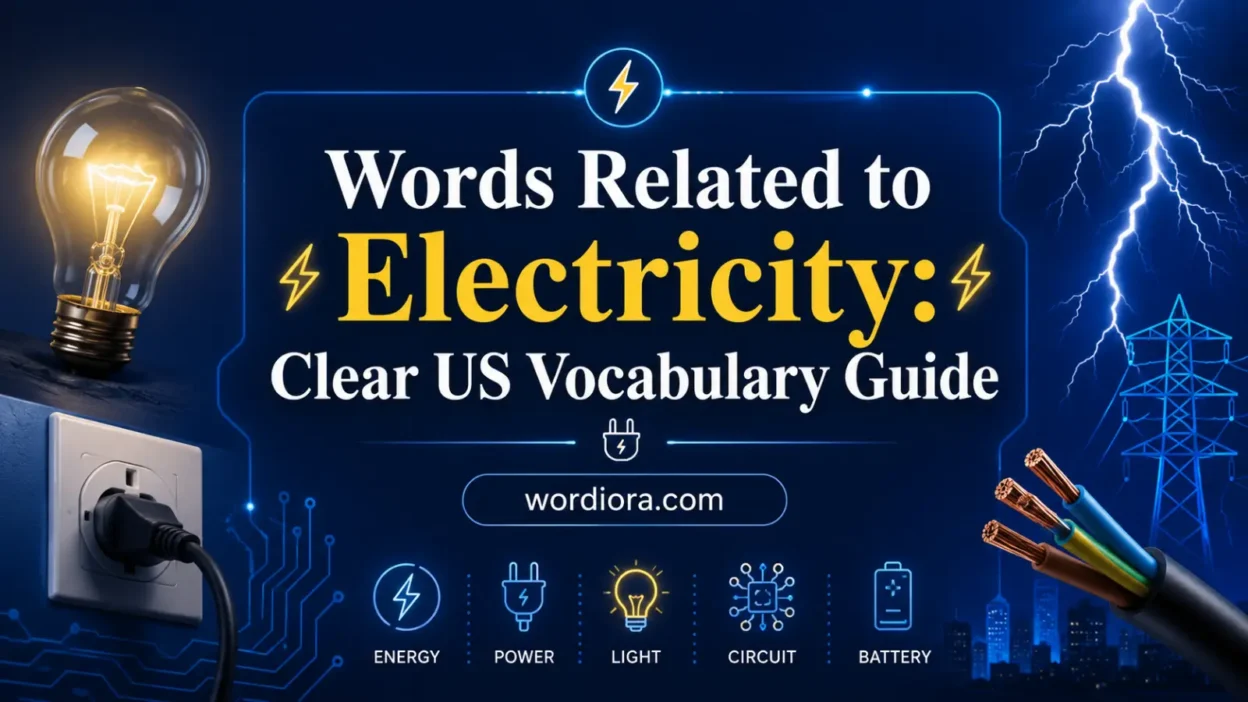
The correct topic is words related to electricity. The keyword “Electriity” appears to be a misspelling of electricity, which means the form of energy associated with electric charge, current, power, light, heat, machines, and electrical systems.
A good electricity word list should not treat every term as a synonym. Power, current, voltage, charge, circuit, and grid are all related to electricity, but they do not mean the same thing. This guide groups the most useful vocabulary by meaning so you can choose the right word for everyday writing, school assignments, science explanations, safety content, or energy-related articles.
Quick Answer
Common words related to electricity include power, energy, current, voltage, charge, circuit, wire, conductor, battery, outlet, switch, grid, generator, transformer, transmission, distribution, watt, volt, ampere, spark, shock, lightning, static, breaker, fuse, grounding, surge, and short circuit.
The closest everyday related word is usually power, especially in phrases like power outage, power bill, and power line. In science or technical writing, stronger choices include electric current, electric charge, voltage, circuit, and electrical energy.
What The Topic Means
Electricity is connected to several ideas at once: energy, movement, charge, power systems, home utilities, electronics, and safety. That is why related words fall into different groups.
Some words describe the science of electricity, such as electron, charge, current, and voltage. Some describe the path or equipment, such as wire, circuit, outlet, and switch. Others describe the power system, such as grid, generator, substation, transmission, and distribution.
The best word depends on what you are trying to say. For example, current is about the flow of electric charge, while voltage is about electrical pressure or potential. Power is useful in everyday language, but it is broader than electricity because it can also refer to strength, authority, or mechanical energy.
Core Related Words
| Word | How It Relates | Best Use |
|---|---|---|
| Power | Everyday word often used for usable electricity | Home, utility, and outage contexts |
| Energy | Broad term for the ability to do work or power devices | General science and everyday writing |
| Current | Flow of electric charge | Science, circuits, and wiring |
| Voltage | Electrical potential that pushes current | Technical and classroom explanations |
| Charge | Electrical property linked to positive and negative particles | Physics and static electricity |
| Circuit | Closed path that allows current to flow | Electronics, wiring, and school science |
| Wire | Conductor that carries electricity | Home wiring and equipment descriptions |
| Conductor | Material that allows electric current to pass through | Science and safety explanations |
| Insulator | Material that resists electric current | Safety and material descriptions |
| Battery | Device that stores chemical energy and supplies electricity | Devices, cars, and electronics |
| Outlet | Place where a plug connects to electrical power | Home and appliance contexts |
| Switch | Device that opens or closes a circuit | Lighting, appliances, and circuits |
| Grid | Network that delivers electricity to users | Energy systems and public utilities |
| Generator | Machine that produces electricity | Power plants and backup power |
| Transformer | Device that changes voltage levels | Power lines and distribution systems |
Related Words By Meaning Group
Energy and power words:
Power, energy, electrical energy, electric power, electricity supply, power source, power output, wattage, kilowatt-hour.
Use these when talking about electricity as something that runs homes, appliances, machines, or devices.
Flow and force words:
Current, voltage, charge, resistance, amperage, potential, flow, discharge, static, polarity.
Use these when explaining how electricity behaves in a circuit or system.
Circuit and wiring words:
Circuit, wire, cable, conductor, insulator, terminal, connector, outlet, plug, socket, switch, breaker, fuse.
Use these when describing electrical paths, home wiring, repairs, or devices.
Power system words:
Grid, power plant, generator, turbine, substation, transformer, transmission, distribution, utility, power line, load, demand.
Use these when writing about how electricity is produced and delivered.
Electronics words:
Electronic, device, component, circuit board, microchip, sensor, resistor, capacitor, diode, transistor.
Use these when the focus is on devices that control or use electric current.
Safety and problem words:
Shock, spark, surge, short circuit, outage, blackout, overload, grounding, live wire, high voltage, arc, electrocution.
Use these when discussing hazards, repairs, emergency situations, or electrical protection.
Close Synonyms Vs Broader Related Words
Electricity has few perfect synonyms in everyday English. The word power is often used as a practical substitute, but it is not always exact.
For example, you can say:
The power went out during the storm.
That sounds natural because people often use power to mean household electricity. But in a science sentence, power and electricity are not identical. Power can mean the rate at which energy is used or produced, while electricity refers to the energy or phenomena connected with electric charge.
Close related terms:
Electrical energy — a more technical way to refer to electricity as energy.
Electric power — electricity as usable power in a system.
Current — electricity in motion through a circuit.
Charge — the electrical property behind attraction, repulsion, static, and current.
Broader related terms:
Grid — the network that delivers electricity.
Battery — a source of electricity for devices.
Outlet — a connection point for electric power.
Lightning — a natural electrical discharge.
Electronics — devices and systems that control electric current.
The key point: power may work in casual writing, but words like current, voltage, charge, and circuit are better when precision matters.
Words By Context
For everyday home use:
Power, outlet, plug, switch, light, appliance, breaker, fuse, power bill, power outage, extension cord, socket.
Example: The outlet near the kitchen counter stopped working.
For science class:
Charge, electron, proton, current, voltage, resistance, circuit, conductor, insulator, static electricity, discharge.
Example: The wire acts as a conductor in the circuit.
For weather and nature:
Lightning, static, spark, discharge, thunderstorm, electric field, charge buildup.
Example: Lightning is a dramatic example of electrical discharge in nature.
For energy and utilities:
Grid, utility, generator, power plant, substation, transmission line, distribution line, transformer, load, demand.
Example: The transformer helps manage voltage before electricity reaches homes.
For electronics:
Circuit board, component, resistor, capacitor, transistor, diode, sensor, battery, charger, power supply.
Example: A small circuit board controls the device’s main functions.
For safety:
Shock, surge, short circuit, overload, grounding, live wire, high voltage, breaker, fuse, arc.
Example: A breaker can shut off power when a circuit is overloaded.
Example Sentences
Electricity powers the lights, refrigerator, and internet router in the house.
A current flows through the wire when the circuit is complete.
The phone battery needs more charge before we leave.
High voltage signs warn people to stay away from dangerous equipment.
The electrician replaced the damaged wire behind the outlet.
A rubber covering can act as an insulator around a cord.
Copper is commonly used as a conductor in electrical wiring.
The storm caused a power outage across several neighborhoods.
A generator can provide backup power during an outage.
The grid carries electricity from power sources to homes and businesses.
A fuse or breaker helps protect a circuit from overload.
A sudden surge can damage sensitive electronics.
The appliance stopped working because of a short circuit.
The child felt a tiny static shock after walking across the carpet.
The technician checked the transformer near the power line.
Common Mistakes When Choosing Related Words
One common mistake is using electricity and power as if they always mean the same thing. In casual home language, power often means electricity. In technical writing, however, power has a more specific meaning and can apply beyond electricity.
Another mistake is confusing electric, electrical, and electronic. Use electric for something powered by electricity, as in electric car or electric stove. Use electrical for things related to electricity or electrical systems, as in electrical wiring or electrical work. Use electronic for devices or systems that control electric current, often using components such as chips or circuits.
A third mistake is mixing up current and voltage. Current refers to flow. Voltage refers to electrical potential. They are related, but they are not interchangeable.
Writers also confuse shock, spark, and surge. A shock is what a person or animal may feel when electricity passes through the body. A spark is a small visible electrical discharge. A surge is a sudden increase in voltage or electrical power.
Finally, do not misspell electricity as electriity. The correct spelling is electricity.
Quick Reference List
Most useful everyday words:
Power, outlet, plug, switch, wire, cord, battery, charger, light, appliance, breaker, fuse.
Best science words:
Current, voltage, charge, electron, circuit, resistance, conductor, insulator, static, discharge.
Best energy-system words:
Grid, generator, transformer, substation, transmission, distribution, utility, power plant, power line, load.
Best safety words:
Shock, surge, short circuit, overload, grounding, live wire, high voltage, arc, blackout, outage.
Best electronics words:
Circuit board, component, resistor, capacitor, diode, transistor, sensor, microchip, power supply.
Best Picks for Everyday Use
For most general writing, the best related words for electricity are power, energy, current, voltage, charge, circuit, wire, outlet, battery, grid, generator, transformer, breaker, fuse, shock, spark, surge, and outage.
Use power when talking about homes, bills, outages, and utilities.
Use current when talking about electricity moving through a wire or circuit.
Use voltage when talking about electrical pressure, strength, or warning signs.
Use charge when talking about batteries, static electricity, or particles.
Use circuit when talking about the path electricity follows.
Use grid when talking about large-scale electricity delivery.
Use shock, surge, and short circuit when talking about safety or electrical problems.
FAQs
Electricity refers to the energy resulting from electric charge or current. Power is the rate at which that energy is used or produced. In everyday speech, “power” often means household electricity, but technically it is about energy over time.
Everyday home-related words include power, outlet, plug, switch, wire, breaker, fuse, battery, charger, appliance, light, and cord.
Current describes the flow of electric charge through a circuit. Voltage describes the electrical potential that pushes current through the circuit. They are related but not interchangeable.
Key safety words include shock, surge, short circuit, overload, grounding, live wire, high voltage, breaker, fuse, and outage.
No. Use electric for devices powered by electricity (e.g., electric car), electrical for things related to electricity systems (e.g., electrical wiring), and electronic for devices that control or process electric current (e.g., circuit board, transistor).
Not always. In casual contexts like “power outage,” it works. In scientific or technical writing, it’s more accurate to use electricity, electric current, or electrical energy depending on meaning.
Use precise terms such as current, voltage, charge, circuit, conductor, insulator, resistance, and electrical energy to ensure clarity and technical accuracy.
Conclusion
Words related to electricity should be chosen by meaning, not just by loose association. Power is the most common everyday related word, but it is not always a true synonym. For clearer writing, use more specific terms such as current, voltage, charge, circuit, wire, battery, grid, generator, transformer, breaker, and outage.
The best choice depends on context. Use home words for household electricity, science words for classroom explanations, grid words for energy systems, electronics words for devices, and safety words for hazards or repairs. That approach keeps your vocabulary accurate, natural, and useful.