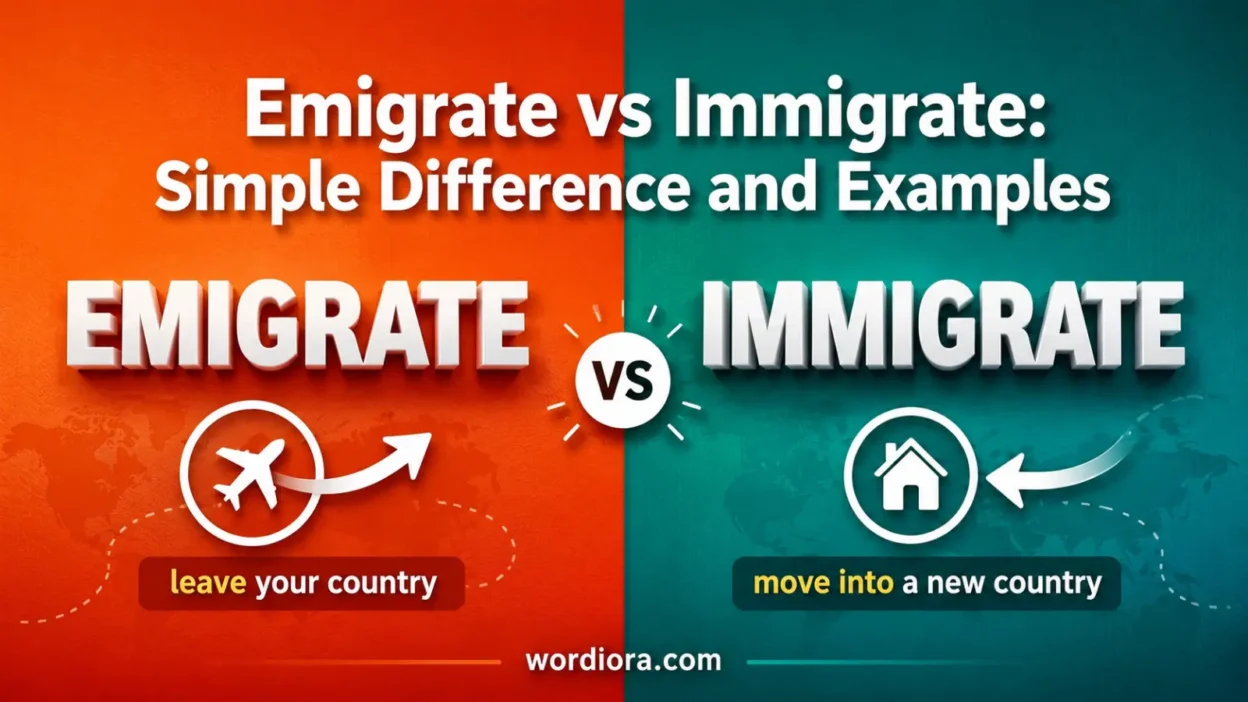
Emigrate and immigrate both describe moving from one country or place to another to live there. The difference is the point of view.
Use emigrate when you are focusing on the place someone leaves. Use immigrate when you are focusing on the place someone enters.
The same person can do both. A person may emigrate from Mexico and immigrate to the United States. The move is the same, but the sentence is looking at it from two different sides.
This guide explains the difference in plain English, shows when each word sounds right, and gives examples you can copy or adjust.
Quick Answer
Use emigrate when the sentence means “leave a country to live somewhere else.” Use immigrate when the sentence means “enter a new country to live there.”
Think of it this way:
- Emigrate from a place.
- Immigrate to a place.
Example: “She emigrated from Brazil and immigrated to Canada.”
Why People Confuse Them
People confuse these words because they describe the same life event. Someone leaves one country and arrives in another. That one move can be described from either side.
The words also look and sound similar. Both end in -migrate, and both often appear in serious writing about moving, citizenship, family history, jobs, and national policy.
The best way to avoid confusion is to ask one question: Am I focusing on the country left or the country entered?
If the sentence looks back at the old country, choose emigrate. If it looks forward to the new country, choose immigrate.
Key Differences At A Glance
| Context | Best Choice | Why |
|---|---|---|
| Leaving a home country | emigrate | The focus is departure. |
| Entering a new country | immigrate | The focus is arrival. |
| Talking about the old country | emigrate | It points away from that place. |
| Talking about the new country | immigrate | It points into that place. |
| Using “from” after the verb | emigrate | “From” often shows the place left. |
| Using “to” after the verb | immigrate | “To” often shows the destination. |
| Describing the same move from both sides | both | The word changes with the viewpoint. |
Meaning and Usage Difference
Emigrate means to leave your country or place of residence to live somewhere else. It usually points to the origin.
Example: “My grandparents emigrated from Italy.”
The sentence cares most about Italy as the place they left.
Immigrate means to come into a country where you were not born or did not previously live, usually to settle there. It points to the destination.
Example: “My grandparents immigrated to the United States.”
This sentence cares most about the United States as the place they entered.
A helpful memory trick is this: emigrate begins with e, like exit. Immigrate begins with im, which can remind you of moving in.
Tone, Context, and Formality
Both words are standard and serious. You can use them in school writing, news writing, legal-adjacent writing, family history, and formal reports.
They are less casual than “move.” In everyday speech, many people simply say, “My family moved to the U.S.” In more exact writing, immigrated to the U.S. is clearer.
Use emigrate when the old country matters:
“Her family emigrated from Ireland during a difficult period.”
Use immigrate when the new country matters:
“Her family immigrated to the United States and settled in Boston.”
Neither word by itself means the move was legal or illegal. Add clear words if legal status matters.
Which One Should You Use?
Choose emigrate when your sentence answers “Where did the person leave?”
Correct: “They emigrated from Vietnam in the 1980s.”
Choose immigrate when your sentence answers “Where did the person go to live?”
Correct: “They immigrated to California after the war.”
When both places appear, choose the word that matches your focus.
If the focus is departure:
“They emigrated from Cuba to Florida.”
If the focus is arrival:
“They immigrated to the United States from Cuba.”
Both can be correct, but they do not feel exactly the same. The first looks outward from Cuba. The second looks inward toward the United States.
When One Choice Sounds Wrong
The wrong choice usually points the reader in the wrong direction.
Awkward: “They immigrated from Poland in 1995.”
Better: “They emigrated from Poland in 1995.”
The word from makes the sentence focus on the place left, so emigrated fits better.
Awkward: “They emigrated to the United States in 1995.”
Better in many simple sentences: “They immigrated to the United States in 1995.”
The word to points toward the destination, so immigrated is usually the clearer choice.
There is some overlap in real use, especially when both countries are named. Still, for clean modern writing, match emigrate with leaving and immigrate with entering.
Common Mistakes and Quick Fixes
Mistake: Treating the words as different spellings of the same word.
Fix: They are different words with different viewpoints.
Mistake: Using immigrate for the country someone left.
Fix: Use emigrate when the sentence focuses on leaving.
Mistake: Using emigrate for the country someone entered.
Fix: Use immigrate when the sentence focuses on arrival.
Mistake: Saying the words describe different people.
Fix: The same person can be both. A person is an emigrant from one country and an immigrant to another.
Compact comparison:
- Emigrate: leave, exit, go from, origin-focused.
- Immigrate: enter, arrive, come to, destination-focused.
Everyday Examples
“My aunt emigrated from the Philippines when she was young.”
“My aunt immigrated to the United States when she was young.”
“Many families emigrated from Europe during hard economic times.”
“Many families immigrated to America looking for work and safety.”
“He plans to emigrate from his home country after graduation.”
“He hopes to immigrate to Canada for a new job.”
“They emigrated from South Korea and later opened a restaurant in Los Angeles.”
“They immigrated to the U.S. and built a new life in Los Angeles.”
“She wrote a school report about why people emigrate.”
“She interviewed neighbors who immigrated to the city from other countries.”
Dictionary-Style Word Details
Verb
Emigrate: Commonly used as an intransitive verb. It means to leave one country or place of residence to live elsewhere.
Example: “They emigrated from Chile.”
Immigrate: Commonly used as an intransitive verb. It means to enter another country to live there. It can also appear in a less common transitive use meaning to bring people in as immigrants.
Example: “They immigrated to Texas.”
Noun
Emigrate: Not commonly used as a noun in standard US English. The related nouns are emigration for the act and emigrant for the person.
Immigrate: Not commonly used as a noun in standard US English. The related nouns are immigration for the act or system and immigrant for the person.
Synonyms
Emigrate: Closest plain alternatives include leave, move away, and relocate from. These are not always exact because emigrate usually suggests moving away to live elsewhere.
Immigrate: Closest plain alternatives include enter, move to, and settle in. These are not always exact because immigrate usually suggests entering a country to live there.
Clear opposites depend on viewpoint. In a simple word-choice sense, emigrate and immigrate often work as opposite perspectives on the same move.
Example Sentences
Emigrate: “Her parents emigrated from Nigeria before she was born.”
Emigrate: “The family decided to emigrate after years of political unrest.”
Immigrate: “His grandparents immigrated to New York in the 1960s.”
Immigrate: “Many people immigrate for work, school, safety, or family.”
Word History
Emigrate: The word comes through Latin roots connected with moving out or away. The beginning e- is tied to the idea of “out.”
Immigrate: The word also comes through Latin roots connected with moving. The beginning im- comes from a form related to “in” or “into.”
The shared root helps explain why the words look similar. The prefixes explain why their direction is different.
Phrases Containing
Emigrate:
“emigrate from a country”
“emigrate to another country”
“decide to emigrate”
“families who emigrated”
Immigrate:
“immigrate to the United States”
“immigrate from another country”
“people who immigrated”
“immigrate permanently”
FAQs
What is the difference between emigrate and immigrate?
Emigrate means to leave a country or place to live somewhere else. Immigrate means to enter a new country or place to live there. The difference is the point of view: emigrate from the old place, immigrate to the new place.
Is it emigrate to or immigrate to?
Usually, use immigrate to when naming the country someone enters.
Example: “She immigrated to the United States.”
You may see “emigrate to,” but immigrate to is clearer when the focus is arrival.
Is it emigrate from or immigrate from?
Usually, use emigrate from when naming the country someone leaves.
Example: “He emigrated from India.”
You may see “immigrate from” in some sentences, but emigrate from is clearer when the focus is departure.
Can someone both emigrate and immigrate?
Yes. The same person can emigrate from one country and immigrate to another.
Example: “Maria emigrated from Mexico and immigrated to the United States.”
Which word should I use for moving to America?
Use immigrate if the focus is entering America.
Example: “My grandparents immigrated to America.”
Use emigrate only if the focus is leaving another country.
Example: “My grandparents emigrated from Italy.”
Is emigrate the same as immigrate?
No. They describe the same kind of move, but from different directions. Emigrate looks at leaving. Immigrate looks at entering.
What is a simple trick to remember emigrate vs immigrate?
Think emigrate = exit and immigrate = in.
If someone exits a country, they emigrate. If someone comes into a country, they immigrate.
Is “immigrated from Canada” wrong?
It can sound awkward if Canada is the place someone left. A clearer sentence is: “She emigrated from Canada.” Use immigrated to when the sentence names the new country.
Is “emigrated to Canada” wrong?
It is sometimes used, but immigrated to Canada is usually clearer because Canada is the destination. Use emigrated from when naming the place left.
What is the noun form of emigrate?
The noun forms are emigration and emigrant.
Example: “Emigration increased during that period.”
Example: “He was an emigrant from Ireland.”
What is the noun form of immigrate?
The noun forms are immigration and immigrant.
Example: “Immigration changed the city’s population.”
Example: “She is an immigrant to the United States.”
Are emigrate and immigrate formal words?
Yes, both are standard and slightly formal. In everyday speech, people often say “move.” In school, news, history, and official writing, emigrate and immigrate are more exact.
Conclusion
The difference is simple once you know the viewpoint. Emigrate focuses on leaving a place. Immigrate focuses on entering a new place.
Use emigrate from when the old country matters. Use immigrate to when the new country matters. For the clearest writing, let the direction of the sentence guide your word choice.