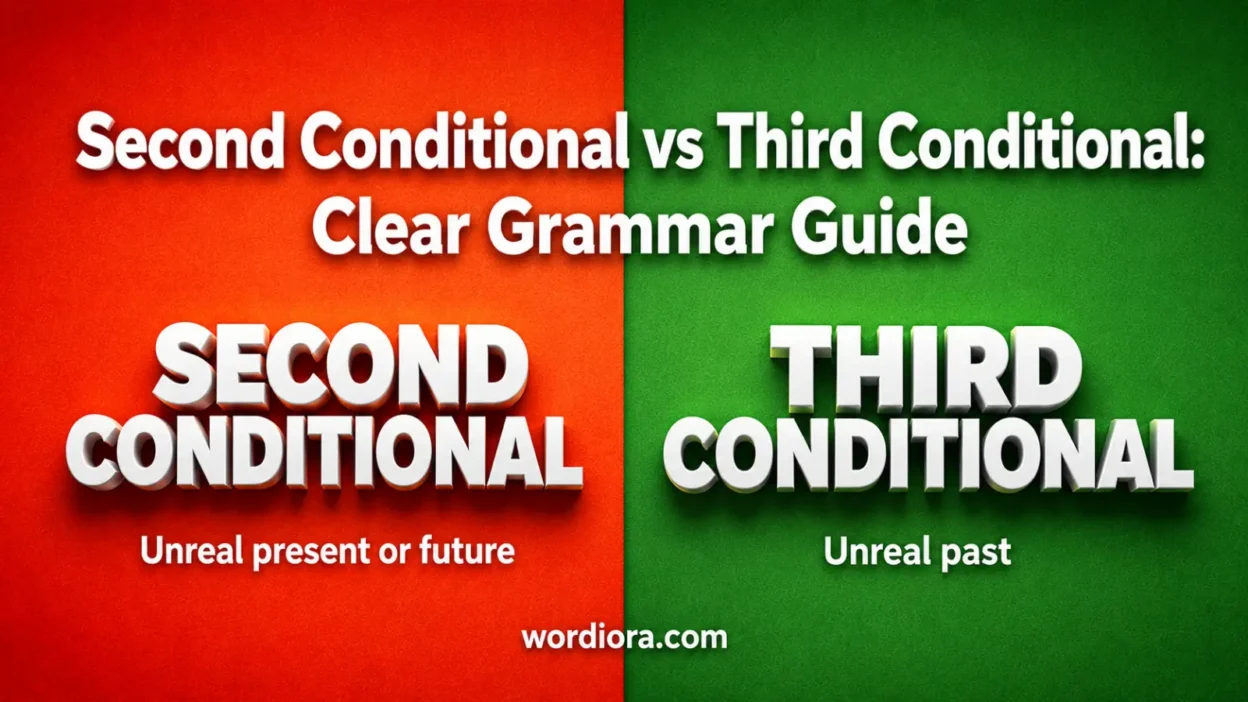
Second conditional vs third conditional is a common grammar confusion because both forms talk about unreal or imagined situations.
The difference is time.
Use the second conditional for an unreal, unlikely, or imagined situation in the present or future. Use the third conditional for an unreal situation in the past, usually something that did not happen.
So the choice is not about which form is “better.” It is about whether you are imagining now, later, or a different past.
Quick Answer
Use the second conditional when the situation is not real now or is unlikely in the future.
Example: If I had more time, I would exercise every day.
Use the third conditional when you are imagining a different past.
Example: If I had had more time yesterday, I would have exercised.
The second conditional uses this pattern: if + past simple, would + base verb.
The third conditional uses this pattern: if + past perfect, would have + past participle.
Why People Confuse Them
People confuse these two forms because both use past-looking verbs.
In the second conditional, the past simple does not always mean past time. It often shows distance from reality.
Example: If I lived closer, I would visit more often.
This does not mean the speaker lived closer in the past. It means the speaker does not live closer now.
In the third conditional, the past perfect really points to a past situation.
Example: If I had lived closer, I would have visited more often.
This means the speaker did not live closer in the past, so the visits did not happen.
Key Differences At A Glance
| Context | Best Choice | Why |
|---|---|---|
| Imagining a different present | Second conditional | The situation is unreal now. |
| Imagining an unlikely future | Second conditional | The future event is possible but not expected. |
| Giving advice with “If I were you” | Second conditional | The speaker imagines being in another person’s situation. |
| Imagining a different past | Third conditional | The past cannot be changed. |
| Talking about regret or missed chances | Third conditional | The sentence looks back at what did not happen. |
Meaning and Usage Difference
The second conditional talks about an unreal present or an unlikely future.
Examples:
If I knew her number, I would call her.
If we won the contract, we would hire more people.
If I were you, I would save the email.
The third conditional talks about an unreal past.
Examples:
If I had known her number, I would have called her.
If we had won the contract, we would have hired more people.
If I had been in your position, I would have saved the email.
Compact comparison:
• Second conditional: unreal now or unlikely later
• Third conditional: unreal before now
• Second conditional form: if + past simple, would + base verb
• Third conditional form: if + past perfect, would have + past participle
• Second conditional example: If I had a car, I would drive to work.
• Third conditional example: If I had had a car, I would have driven to work.
Tone, Context, and Formality
Both forms are standard in American English. They work in conversation, school writing, business writing, and everyday messages.
The second conditional often sounds imaginative, polite, or advisory.
Example: If I were you, I would ask for the deadline in writing.
The third conditional often sounds reflective. It can show regret, blame, relief, or simple hindsight.
Examples:
If I had left earlier, I would have avoided traffic.
If you had reminded me, I would have brought the forms.
If we had not checked the file, we would have missed the error.
Pronunciation usually does not need special attention here. The confusion is about grammar and time, not sound.
Which One Should You Use?
Choose the second conditional when the situation is unreal now or unlikely later.
Use it for dreams, advice, unlikely plans, and imagined present facts.
Examples:
If I had a bigger apartment, I would get a dog.
If she worked closer to home, she would bike to work.
If I were you, I would not post that yet.
Choose the third conditional when the situation belongs to the past and did not happen.
Use it for regrets, missed chances, past guesses, and different past outcomes.
Examples:
If I had seen your text, I would have replied sooner.
If they had booked earlier, they would have saved money.
If we had taken the other route, we would have arrived on time.
When One Choice Sounds Wrong
The second conditional sounds wrong when the sentence clearly talks about a missed past event.
Wrong: If I studied last night, I would have passed the quiz.
Better: If I had studied last night, I would have passed the quiz.
The third conditional sounds wrong when the sentence talks about an unreal present or future.
Wrong: If I had had more free time now, I would have joined you.
Better: If I had more free time now, I would join you.
Watch the time words. Words like yesterday, last week, earlier, and this morning often point to the third conditional when the event is already over.
Words like now, today, tomorrow, someday, and in the future often point to the second conditional when the situation is imagined or unlikely.
Common Mistakes and Quick Fixes
Mistake 1: Using “would” in the if-clause.
Wrong: If I would know the answer, I would tell you.
Correct: If I knew the answer, I would tell you.
Mistake 2: Forgetting “have” in the third conditional.
Wrong: If I had known, I would called you.
Correct: If I had known, I would have called you.
Mistake 3: Using the past simple for a past unreal condition.
Wrong: If she left earlier, she would have caught the train.
Correct: If she had left earlier, she would have caught the train.
Mistake 4: Treating every third conditional as emotional regret.
Not every third conditional sentence is dramatic. It can simply explain an unreal past result.
Example: If the store had been open, I would have picked up the order.
Everyday Examples
Second conditional:
If I had Fridays off, I would take longer weekend trips.
If gas were cheaper, we would drive to Denver.
If my laptop were faster, I would edit videos more often.
If I knew the answer, I would tell the group.
If they offered remote work, more people would apply.
Third conditional:
If I had had Fridays off last year, I would have traveled more.
If gas had been cheaper, we would have driven to Denver.
If my laptop had been faster, I would have finished the edit sooner.
If I had known the answer, I would have told the group.
If they had offered remote work, more people would have applied.
Notice the pattern. The second conditional imagines a different reality now or later. The third conditional rewrites a past event.
Dictionary-Style Word Details
Verb
Second conditional: Not commonly used as a verb in standard US English. It names a grammar pattern.
Third conditional: Not commonly used as a verb in standard US English. It also names a grammar pattern.
Noun
Second conditional: A noun phrase used for a conditional sentence pattern about an unreal present or unlikely future situation.
Example: The sentence “If I had more money, I would travel” uses the second conditional.
Third conditional: A noun phrase used for a conditional sentence pattern about an unreal past situation and its imagined past result.
Example: The sentence “If I had saved more money, I would have traveled” uses the third conditional.
Synonyms
Second conditional: Closest plain alternatives include unreal present conditional, unreal future conditional, and imagined present/future conditional.
Third conditional: Closest plain alternatives include past unreal conditional, unreal past conditional, and imagined past conditional.
Clear antonyms are not very useful here. These terms are grammar labels, not ordinary opposite words.
Example Sentences
Second conditional:
If I were less busy, I would join the meeting in person.
If the office were closer, I would commute by train.
If we had more staff, we could finish faster.
Third conditional:
If I had been less busy, I would have joined the meeting in person.
If the office had been closer, I would have commuted by train.
If we had had more staff, we could have finished faster.
Word History
Second conditional: This label comes from the classroom system that numbers common conditional patterns. The label describes the pattern’s place in that teaching sequence, not a deep hidden meaning of the word second.
Third conditional: This label also comes from the numbered teaching system for conditional patterns. The exact classroom history is not needed to use it correctly. What matters is that it points to unreal past conditions.
Phrases Containing
Second conditional:
If I were you
If I had more time
If I knew
If we lived closer
I would, could, or might + base verb
Third conditional:
If I had known
If we had left earlier
If they had called
Would have + past participle
Could have + past participle
Might have + past participle
FAQs
What is the main difference between the second conditional and third conditional?
The second conditional talks about an unreal present or unlikely future situation. The third conditional talks about an unreal past situation. Use the second conditional for something that is not true now or probably will not happen. Use the third conditional for something that did not happen in the past.
What is the formula for the second conditional?
The usual second conditional formula is: if + past simple, would + base verb.
Example:
If I had more money, I would buy a new laptop.
This does not mean you had more money in the past. It means you do not have more money now.
What is the formula for the third conditional?
The usual third conditional formula is: if + past perfect, would have + past participle.
Example:
If I had saved more money, I would have bought a new laptop.
This means you did not save enough money, so you did not buy the laptop.
Is “If I were you” second conditional?
Yes. “If I were you” is a common second conditional phrase used for advice.
Example:
If I were you, I would call the manager today.
It imagines an unreal present situation: the speaker is not actually the other person.
Can I use “was” instead of “were” in the second conditional?
In casual speech, many people say “If I was.” In more careful or formal writing, “If I were” is often preferred for unreal situations.
Casual:
If I was in charge, I would change the schedule.
More polished:
If I were in charge, I would change the schedule.
Does the third conditional always show regret?
No. The third conditional often shows regret, but not always. It can also express explanation, relief, blame, or a simple imagined past result.
Example:
If we had taken that road, we would have arrived earlier.
This sentence looks back at a different past, but it does not have to sound emotional.
Why does the second conditional use past tense for the present or future?
The past tense in the second conditional often shows that the situation is unreal, unlikely, or imagined. It does not always mean past time.
Example:
If I lived closer, I would visit more often.
The speaker does not live closer now. The past form “lived” shows an unreal present situation.
Can “could” or “might” replace “would” in conditionals?
Yes. “Could” and “might” can replace “would” when the meaning changes.
Second conditional:
If I had more time, I could help you.
Third conditional:
If I had had more time, I could have helped you.
“Could” suggests ability or possibility. “Might” suggests a less certain result.
Which conditional should I use with “yesterday” or “last week”?
Use the third conditional when the sentence talks about an unreal past event.
Example:
If I had studied yesterday, I would have passed the quiz.
Words like “yesterday,” “last week,” “earlier,” and “this morning” often point to the third conditional when the event is already finished.
Are second conditional and third conditional interchangeable?
No. They are not interchangeable. The second conditional imagines a different present or future. The third conditional imagines a different past.
Second conditional:
If I had time, I would help.
Third conditional:
If I had had time, I would have helped.
Conclusion
The second conditional and third conditional are both correct, but they are not interchangeable.
Use the second conditional for an unreal present or unlikely future: If I had more time, I would help.
Use the third conditional for an unreal past: If I had had more time, I would have helped.
The fastest test is simple: Are you imagining now or later, or are you rewriting the past? Now or later needs the second conditional. A different past needs the third conditional.