Farther vs further is confusing because both words can point to distance, progress, or extension. In everyday speech, many people use them loosely, and readers usually understand the meaning.
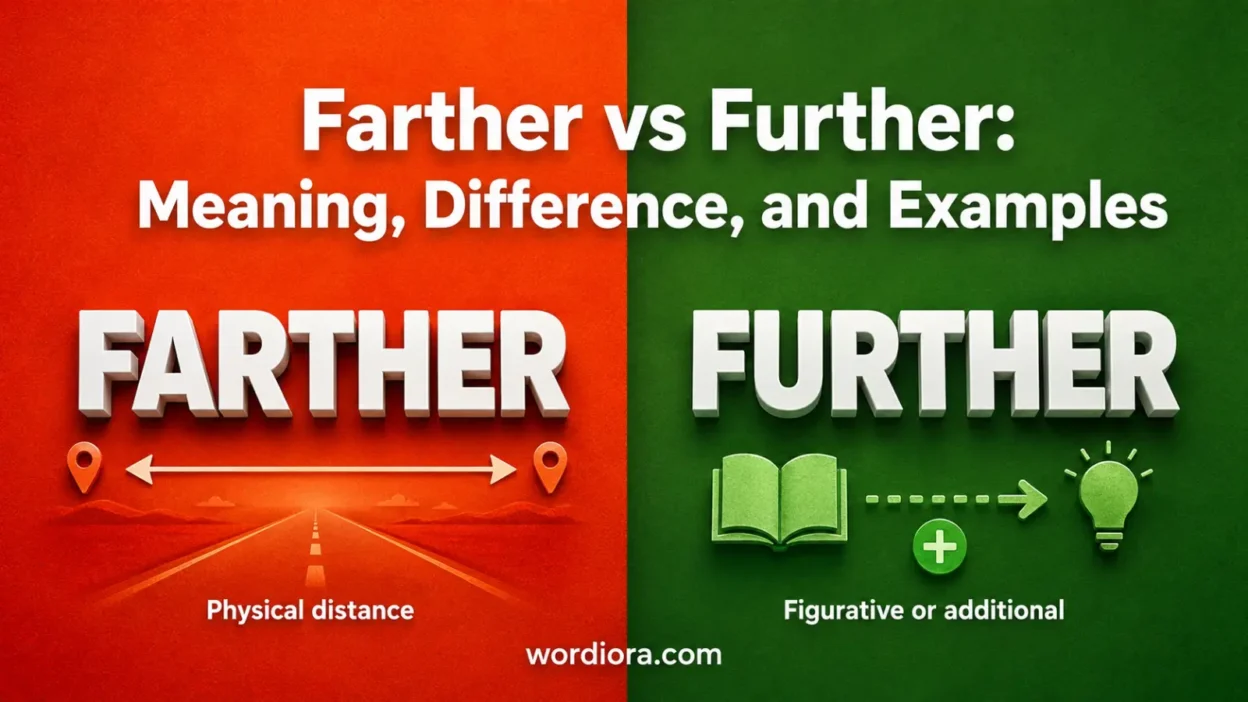
For careful US writing, though, the safest choice is simple: use farther for physical distance and further for nonphysical distance, added amount, more information, or advancement. That rule will help you sound clear in school, business, and edited writing.
Quick Answer
Use farther when you mean a measurable physical distance: “We drove farther than planned.” Use further when you mean more, additional, continued, or figurative distance: “We need further discussion.” In unclear cases, further often sounds natural, but farther is the safer choice for literal distance.
Why People Confuse Them
People confuse these words because they look similar, sound similar, and overlap in some distance uses. Both can describe going beyond a point, especially when the sentence involves movement or progress.
The problem is that further has more jobs than farther. It can mean “additional,” as in “further details.” It can also work as a verb, as in “further your career.” Farther is narrower and is most useful when the idea is physical distance.
That is why “drive farther” sounds right, but “farther details” sounds wrong.
Key Differences At A Glance
| Context | Best Choice | Why |
|---|---|---|
| Physical distance | farther | It points to measurable distance. |
| Figurative distance | further | It points to degree, extent, or progress. |
| Additional information | further | It means more or additional. |
| As a verb | further | It means to advance or promote. |
| Formal US writing | depends on meaning | Use farther for distance and further for everything else. |
Compact comparison:
• Farther: physical distance, often measurable.
• Further: figurative distance, added amount, more discussion, progress, or advancement.
• Overlap: both may appear with distance, but the careful US distinction is still useful.
Meaning and Usage Difference
Farther means “at or to a greater distance.” It works best when you can imagine miles, feet, blocks, steps, or another physical measure.
Example: “The gas station is farther down the highway.”
Further can also refer to distance, but its stronger modern use is “more,” “additional,” “to a greater extent,” or “continued.” It is the right word in phrases such as “further research,” “further questions,” and “discuss this further.”
Example: “The manager asked for further details before approving the plan.”
A helpful test: if you can ask “How many miles?” or “How many steps?” farther is usually best. If you mean “more” or “beyond this point in thought or action,” use further.
Tone, Context, and Formality
In casual speech, many people will not notice a switch between farther and further when the sentence is about distance. “We walked further” and “We walked farther” are both understandable.
In polished US writing, the distinction matters more. Teachers, editors, and careful readers often expect farther for physical distance. They also expect further for added information, added discussion, or progress.
Use further in professional phrases like:
• further notice
• further review
• further action
• further details
• further study
Use farther in distance phrases like:
• farther away
• farther down the road
• farther north
• farther from home
• farther across the field
Which One Should You Use?
Choose farther when the sentence is about literal movement or location.
Correct: “The airport is farther from downtown than I expected.”
Correct: “Move the chair farther from the wall.”
Choose further when the sentence is about more information, continued discussion, extra action, or progress.
Correct: “We need further instructions before we start.”
Correct: “The internship helped further her career.”
When the meaning is abstract, further usually sounds better.
Correct: “Let’s take the idea further.”
Awkward: “Let’s take the idea farther.”
When One Choice Sounds Wrong
Some sentences clearly need further, not farther.
Wrong: “Please send farther information.”
Right: “Please send further information.”
Wrong: “This course will farther your goals.”
Right: “This course will further your goals.”
Wrong: “No farther action is needed.”
Right: “No further action is needed.”
Some sentences strongly prefer farther because the meaning is physical distance.
Less careful: “The school is further away than the library.”
Better in formal US writing: “The school is farther away than the library.”
Less careful: “Run further past the cones.”
Better: “Run farther past the cones.”
Common Mistakes (and Quick Fixes)
Mistake 1: Using farther to mean “additional.”
Wrong: “Do you have any farther questions?”
Right: “Do you have any further questions?”
Mistake 2: Using farther as a verb.
Wrong: “The grant will farther the project.”
Right: “The grant will further the project.”
Mistake 3: Treating the rule as absolute in every sentence.
Some distance sentences are flexible in real use. Still, if you want the safest US choice, use farther for physical distance.
Mistake 4: Forgetting the “more” meaning of further.
Right: “We cannot comment further at this time.”
Here, further means “any more” or “to a greater extent.”
Everyday Examples
“I parked farther from the entrance to avoid the crowd.”
“We need further proof before we make a decision.”
“The hotel is farther from the beach than the listing suggested.”
“Please contact HR for further information.”
“She moved farther west after graduation.”
“The new training helped further his career.”
“We drove ten miles farther before stopping for gas.”
“I do not want to discuss the issue further tonight.”
“The second trail goes farther into the woods.”
“Further delays could affect the launch.”
Dictionary-Style Word Details
Verb
• Farther: Not commonly used as a verb in standard US English. Do not write “farther your career” or “farther the plan.”
• Further: Commonly used as a verb meaning to advance, promote, or help something develop. Example: “The program could further her education.”
Noun
• Farther: Not commonly used as a noun in standard US English.
• Further: Not commonly used as a noun in standard US English.
Synonyms
• Farther: closest plain alternatives include “more distant,” “farther away,” “beyond,” and “at a greater distance.” These fit physical distance best.
• Further: closest plain alternatives include “additional,” “more,” “extra,” “continued,” “to a greater extent,” “advance,” and “promote,” depending on the sentence.
Clear antonyms depend on context. For physical distance, the opposite of farther is often nearer or closer. For further meaning “additional,” the opposite may be less, fewer, or no more, but no single opposite fits every use.
Example Sentences
• Farther: “The grocery store is farther than I thought.”
• Farther: “Stand farther back from the platform edge.”
• Farther: “The trail continues farther up the hill.”
• Further: “Further review is required.”
• Further: “We should discuss the budget further.”
• Further: “The scholarship helped further her studies.”
Word History
• Farther: The history of farther is tied closely to further, and modern sources describe it as a later variant connected with distance use. It is safest to avoid claiming that it simply comes from the modern word far in a direct, simple way.
• Further: Further is the older form and has long carried ideas of onward movement, greater extent, and advancement.
The history is useful because it explains why the two words overlap. It does not erase the modern US preference: farther for physical distance, further for added amount, extent, and advancement.
Phrases Containing
• Farther: farther away, farther down the road, farther north, farther from home, farther along the trail, farther across town.
• Further: further information, further notice, further action, further review, further questions, further discussion, further your career, further your education.
FAQs
Is “farther” or “further” more correct in US English?
Both are correct, but they are used in different situations. Farther is preferred for physical distance, while further is used for additional amount, progress, or abstract ideas.
Can “further” be used for distance?
Yes, in modern English it sometimes is, but in careful US writing, farther is usually preferred when talking about measurable physical distance.
What is the simplest rule to remember?
Use farther for “how far (distance)” and further for “more or additional or continued meaning.”
Is there a difference in formal writing?
Yes. In formal US writing, editors often prefer farther for physical distance and further for everything non-physical, such as “further information” or “further discussion.”
Can “further” be used as a verb?
Yes. Further can be a verb meaning to help something advance or develop, like “further your career” or “further your education.”
Is “farther” ever used for abstract ideas?
Rarely. It can appear in some expressions, but it is not the standard choice for abstract meanings like progress or information.
Why do people mix up farther and further?
Because both words are closely related in meaning and sometimes overlap in distance contexts, especially in casual speech.
Which one should I use in emails or school writing?
Use farther for physical distance and further for everything else. That choice is safest and most widely accepted in US academic and professional writing.
Conclusion
The best rule for farther vs further is practical, not extreme. Use farther for physical distance: “The cabin is farther from town.” Use further for more, additional, continued, figurative, or verb uses: “We need further details.”
When distance is literal, farther is the cleanest formal US choice. When the idea is not physical distance, further is almost always the better word.