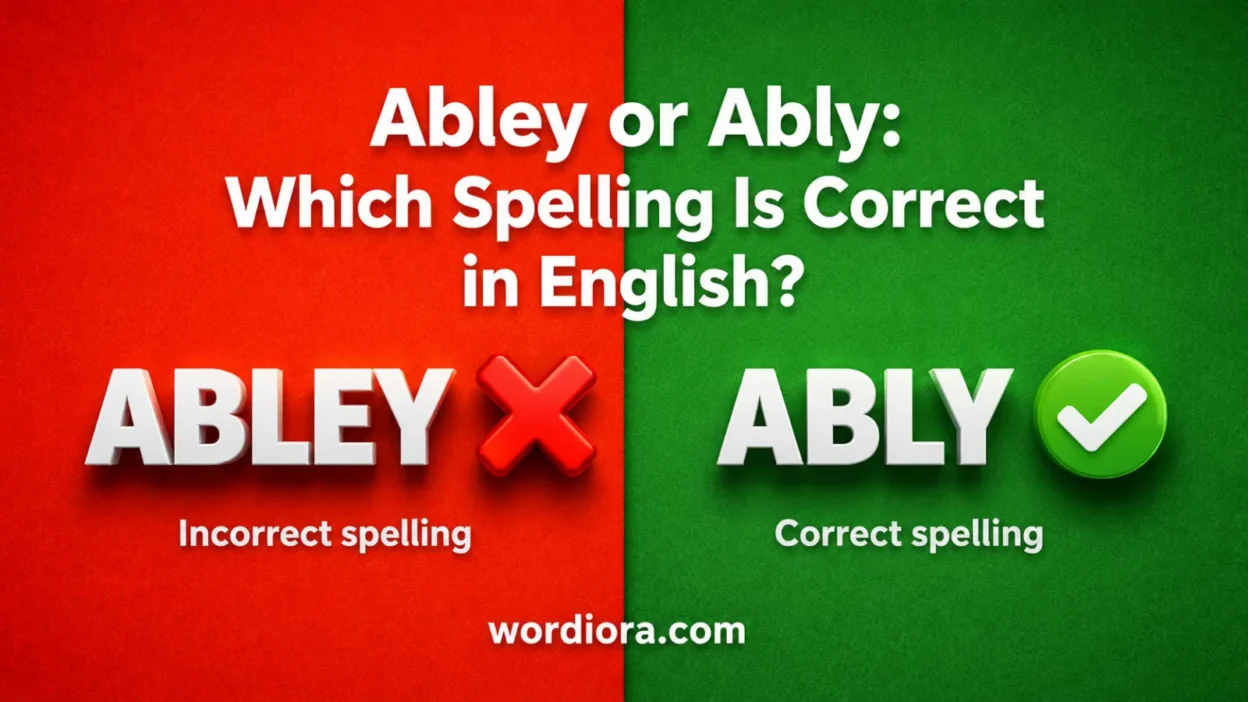
The correct word is ably. It is the standard English adverb used when someone does something with skill, ability, or competence. Abley is not the normal spelling in standard US English.
This confusion is easy to understand because able ends with -le, and many people expect the adverb to keep that full spelling before adding -y. However, English does not form this word as abley. The accepted form is ably, as in “She handled the project ably.”
Quick Answer
Use ably when you mean “skillfully,” “competently,” or “in an able way.” Do not use abley in regular writing. It is usually a misspelling of ably unless it appears as a name, brand, username, or other proper label.
Correct: “The team was ably led by its new manager.”
Incorrect: “The team was abley led by its new manager.”
Why People Confuse Them
People confuse abley and ably because the base word able is familiar. Since able already looks complete, writers may think they only need to add -y to make an adverb. That would seem logical, but English spelling does not always follow that simple pattern.
The word ably is formed by dropping the final e from able before adding the adverb ending. This same pattern appears in other words where the spelling changes before a suffix. The result looks shorter than some readers expect, but it is the correct form.
Another reason for the mistake is sound. Abley and ably would sound very similar if read aloud. Because the ear does not clearly reveal the spelling difference, the mistake often appears in typed messages, school assignments, emails, and informal posts.
Key Differences At A Glance
| Context | Best Choice | Why |
|---|---|---|
| Formal writing | ably | It is the standard spelling. |
| School essays | ably | Teachers expect the correct adverb form. |
| Business emails | ably | It sounds polished and professional. |
| Describing skilled work | ably | It means skillfully or competently. |
| Casual texting | ably | The spelling is still correct. |
| A surname or brand name | Abley | Use it only if it is a proper name. |
| General English adverb | ably | Abley is not the standard word. |
The main difference is simple: ably is the correct adverb, while abley is usually a spelling error.
Meaning and Usage Difference
Ably means “in a skillful, capable, or competent way.” It describes how an action is done. Since it is an adverb, it usually modifies a verb.
Examples:
“The lawyer argued the case ably.”
“She ably managed the busy front desk.”
“The volunteers were ably guided by the event coordinator.”
In each sentence, ably tells us how someone performed an action. The person did the work well, with skill, or with ability.
Abley, on the other hand, does not work as the standard adverb form. In normal English sentences, it should be corrected to ably.
Incorrect: “He abley explained the rules.”
Correct: “He ably explained the rules.”
The pronunciation of ably is simple: it sounds like AY-blee. Pronunciation matters here because the spoken word can make the misspelling feel believable. Still, the written form should be ably.
Tone, Context, and Formality
Ably is more common in polished, formal, or semi-formal writing than in everyday speech. You may see it in news articles, reviews, reports, letters of recommendation, academic writing, and professional descriptions.
For example, a manager might write, “Jordan ably handled client communication during a difficult week.” That sentence sounds professional and positive.
In casual conversation, many people would use well, skillfully, or competently instead. Those words are more direct for everyday speech.
Natural: “She did the job well.”
More polished: “She performed the job ably.”
Both sentences can be correct, but they do not have the exact same tone. Ably sounds a little more formal and deliberate. It often gives the sentence a professional or evaluative feel.
Abley does not have a separate tone in standard English because it is not the accepted spelling for this meaning. If it appears in a sentence, readers may see it as a typo.
Which One Should You Use?
Use ably in almost every normal sentence where you want the adverb form of able.
Choose ably when you mean:
Someone performed with skill.
Someone handled a task competently.
Someone completed a role well.
Someone supported, led, managed, or explained something effectively.
Examples:
“The assistant ably organized the schedule.”
“The coach ably prepared the team for the final game.”
“The writer ably explains a difficult idea in simple terms.”
Avoid abley unless it is part of a proper name. For example, if a person’s last name is Abley, you would keep that spelling because names do not follow the same correction rules as common words.
Correct as a name: “Dr. Abley spoke at the event.”
Incorrect as an adverb: “She spoke abley at the event.”
When One Choice Sounds Wrong
Abley sounds wrong in edited writing because it looks like an attempted adverb that has not been spelled correctly. Even if the meaning is clear, the spelling can distract the reader.
Wrong: “The technician abley repaired the system.”
Right: “The technician ably repaired the system.”
The sentence with abley may still be understandable, but it does not look polished. In school, business, and publishing, that matters. A small spelling error can weaken an otherwise strong sentence.
Ably can also sound stiff if the rest of the sentence is very casual. For example, “You ably fixed my phone” is correct, but many people would simply say, “You fixed my phone really well.”
So the spelling choice is clear, but the style choice depends on context. Use ably when you want a polished word. Use well when you want the simplest everyday option.
Common Mistakes And Quick Fixes
One common mistake is adding -y directly to able.
Incorrect: “The nurse abley cared for the patient.”
Correct: “The nurse ably cared for the patient.”
Another mistake is using ably when able is needed. These words do different jobs. Able is an adjective. Ably is an adverb.
Incorrect: “She is ably to finish the work.”
Correct: “She is able to finish the work.”
Correct: “She ably finished the work.”
A third mistake is using ably where a simpler word would sound more natural. The word is correct, but it may feel too formal in casual writing.
Formal: “He ably answered every question.”
Casual: “He answered every question well.”
Quick fix: If the word describes how an action was done, use ably. If the word describes whether someone can do something, use able.
Everyday Examples
Correct: “The new supervisor ably handled the transition.”
Correct: “She ably represented the company during the meeting.”
Correct: “The teacher ably explained the new assignment.”
Correct: “He ably defended his decision.”
Correct: “The staff ably managed the lunch rush.”
Correct: “The editor ably improved the article without changing its voice.”
Incorrect: “The new supervisor abley handled the transition.”
Incorrect: “She abley represented the company during the meeting.”
Incorrect: “The teacher abley explained the new assignment.”
Incorrect: “He abley defended his decision.”
Incorrect: “The staff abley managed the lunch rush.”
Incorrect: “The editor abley improved the article without changing its voice.”
Here is the easiest test: replace the word with skillfully or competently. If that meaning fits, the correct spelling is ably.
Example: “She ably led the team.”
Test: “She skillfully led the team.”
Because the test works, ably is correct.
Dictionary-Style Word Details
Verb
Abley: Not commonly used as a verb in standard US English.
Ably: Not used as a verb. It is an adverb, so it describes how an action is done.
Correct: “She ably completed the report.”
Not correct: “She ablied the report.”
Noun
Abley: Not commonly used as a common noun in standard US English. It may appear as a proper name, such as a surname.
Ably: Not used as a noun. It does not name a person, place, thing, or idea. It modifies an action.
Correct: “He spoke ably.”
Not correct: “His ably impressed the team.”
Synonyms
Abley: No standard synonyms apply when it is used as a misspelling of ably. The correction is ably.
Ably: Closest plain alternatives include skillfully, competently, capably, expertly, and well.
Useful antonyms include poorly, ineptly, incompetently, and unskillfully.
Example:
“She handled the matter ably.”
Similar meaning:
“She handled the matter skillfully.”
Opposite meaning:
“She handled the matter poorly.”
Example Sentences
Abley: In standard writing, use ably instead.
Incorrect: “The team abley solved the problem.”
Correct: “The team ably solved the problem.”
Ably: “The host ably kept the discussion moving.”
Ably: “The designer ably balanced style and function.”
Ably: “The principal ably guided the school through the change.”
Ably: “The attorney ably questioned the witness.”
Word History
Abley: No separate standard word history is needed for abley as an adverb because it is not the accepted spelling.
Ably: The word is connected to able, which means having the power, skill, or means to do something. The adverb form ably developed to express doing something in an able or skillful way. A safe way to remember it is simple: able becomes ably, not abley, when used as this adverb.
Phrases Containing
Abley: No common standard phrases use abley as an adverb.
Ably: Common patterns include:
“ably assisted”
“ably led”
“ably managed”
“ably handled”
“ably supported”
“ably performed”
“ably represented”
Examples:
“The speaker was ably assisted by the event team.”
“The project was ably managed from start to finish.”
“The company was ably represented at the hearing.”
FAQs
Is abley a correct word?
In normal US English, abley is not the correct spelling when you mean “skillfully” or “competently.” The correct spelling is ably. You may see Abley as a name, but that does not make it the standard adverb.
What does ably mean?
Ably means in a skillful, capable, or competent way. It describes how someone performs an action. For example, “She ably handled the interview” means she handled it well and with ability.
Why is it ably and not abley?
The final e in able is dropped before the adverb form is written as ably. That is why the correct spelling is not abley. The shorter spelling may look unusual at first, but it is the standard form.
Can I use ably in casual writing?
Yes, you can use ably in casual writing, but it often sounds more polished than everyday words like well. In a relaxed text message, “You did that well” may sound more natural than “You did that ably.”
Is ably the same as able?
No. Able is an adjective, and ably is an adverb. Use able when you mean someone can do something. Use ably when you mean someone did something skillfully.
Example:
“She is able to lead the team.”
“She ably led the team.”
What is the best replacement for ably?
The best replacement depends on the sentence. Good options include skillfully, competently, capably, expertly, or well. For simple everyday writing, well is often the most natural choice.
Should I correct abley to ably?
Yes. If abley is being used to mean “skillfully” or “competently,” correct it to ably. This is especially important in schoolwork, business writing, resumes, reports, and published content.
Conclusion
The correct choice is ably, not abley, when you need the adverb meaning “skillfully,” “competently,” or “in an able way.” Abley is usually a misspelling in this context.
Use ably in polished sentences such as “She ably managed the project” or “He ably explained the issue.” Use able only when describing whether someone can do something. Once you remember that able becomes ably, the choice is easy.