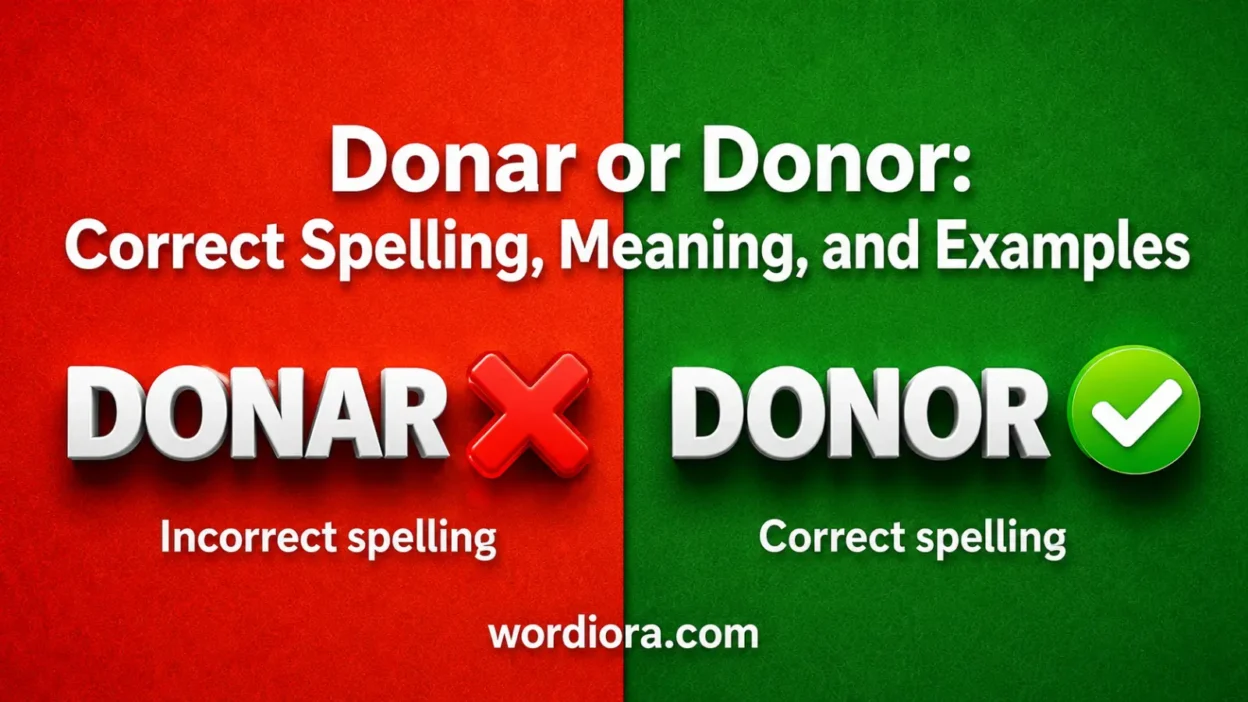
If you are choosing between donar and donor, the correct word in standard US English is donor. A donor is a person, group, or organization that gives something, such as money, blood, an organ, tissue, food, clothing, or another valuable item.
Donar is not the standard spelling for that meaning. In everyday English, writing “blood donar,” “organ donar,” or “charity donar” looks like a spelling mistake. However, Donar can appear as a proper noun in limited contexts, especially as a name connected with Germanic mythology or as a brand or organization name. That does not make it the right spelling when you mean a person who gives.
Quick Answer
Use donor when you mean someone who gives money, blood, organs, goods, or support. Use donar only when it is part of a proper name, such as a mythology name, organization name, product name, or brand name. In normal US English, donar is not the correct spelling for a giver.
Why People Confuse Them
People confuse donar and donor because the word is connected to donate. Since donate has an a in the middle, writers sometimes assume the related noun should be spelled donar. That guess feels logical, but English does not always build related words in the way people expect.
The standard noun is donor, not donar. The word also looks similar to donator, another word for a person who donates. Still, donor is the more natural and widely accepted choice in ordinary writing.
Another reason for the mistake is pronunciation. In American English, donor is usually pronounced like DOH-ner. Since the ending sounds like “ner,” not “nor,” some writers may not feel sure which vowel belongs in the final syllable.
The spelling mistake can also happen because people type quickly. In forms, captions, fundraising posts, and short messages, “donar” may appear when the writer means “donor.” That does not make it standard. It simply shows a common typo or spelling mix-up.
There is one more source of confusion: Donar does exist as a proper noun in some contexts. For example, it can refer to a Germanic thunder god. It can also appear in names of businesses, teams, or products. Because of that, saying “donar is never a word” is too broad. The safer answer is this: donar is not the correct common English word for a person who gives.
Key Differences At A Glance
| Context | Best Choice | Why |
|---|---|---|
| A person giving money to a charity | donor | This is the standard English noun for a giver. |
| Someone giving blood | donor | Medical and everyday English use blood donor. |
| Someone giving an organ | donor | Organ donor is the accepted phrase. |
| A nonprofit supporter | donor | Donor fits fundraising and nonprofit writing. |
| A company giving funds or goods | donor | Corporate donor is the normal phrase. |
| A proper name from mythology | Donar | Donar can be a proper noun in this limited sense. |
| A brand, team, or product name | Donar | Use the spelling chosen by the name owner. |
| A school paper, email, or form | donor | Donar would look like a spelling error. |
The biggest difference is simple: donor is the word most writers need. Donar is only correct when it is a proper name or part of a specific nonstandard label.
Meaning and Usage Difference
Donor means a person, organization, or source that gives something. In everyday US English, it usually appears in charity, medicine, education, politics, science, and nonprofit communication.
You can use donor for someone who gives money:
The museum thanked every donor after the fundraiser.
You can use donor for someone who gives blood:
The hospital needs more blood donors this week.
You can use donor for someone who gives an organ or tissue:
The patient was matched with a kidney donor.
You can also use donor for an organization that provides support:
A corporate donor helped fund the food drive.
In some technical fields, donor can refer to a source that gives or transfers something. For general readers, though, the most important meaning is “someone or something that gives.”
Donar, by contrast, does not mean “a person who donates” in standard US English. It is not the spelling you should use in normal sentences about giving. When Donar appears correctly, it is usually capitalized because it is a name.
For example:
Donar appears in Germanic mythology.
That use is very different from:
The donor gave $500 to the shelter.
These are not two equal choices for the same sentence. If you mean a giver, the correct choice is donor.
Pronunciation can also help. Donor is commonly said like DOH-ner in American English. Donar, when used as a mythology name, is closer to DOH-nahr. That sound difference matters only when you are discussing the proper name. For regular giving contexts, pronounce and spell the word as donor.
Tone, Context, and Formality
Donor works in casual, professional, academic, medical, and legal writing. It sounds normal in a text message, a school essay, a nonprofit report, a hospital form, or a business email.
You can write:
Thank you for being a donor.
The donor list will be updated on Friday.
Please bring your donor card.
The clinic is accepting new blood donors.
These sentences sound clear and professional. They also match what readers expect.
Donar does not fit those contexts when you mean a giver. In a formal document, it can make the writing look careless. In medical writing, it can cause confusion because words such as blood donor, organ donor, and tissue donor are standard phrases. In fundraising writing, donor is also the expected term.
Use Donar only when the exact name requires it. If a team, company, product, character, or mythology reference is officially called Donar, keep that spelling. Proper names follow their own spelling. That is not the same as choosing donar for the common noun.
| Feature | donar | donor |
| Standard word for a giver | No | Yes |
| Common in medical phrases | No | Yes |
| Common in charity writing | No | Yes |
| Proper-name use | Sometimes | Sometimes, but less relevant here |
| Best for US English writing | No | Yes |
In short, donor is the safe and correct choice in nearly every normal writing situation.
Which One Should You Use?
Use donor when your sentence is about giving, donating, supporting, funding, or providing something.
Choose donor in these situations:
You are writing about a charity supporter.
You are filling out a medical form.
You are describing someone who gives blood.
You are writing about organ donation.
You are thanking people who gave money.
You are naming a person or company that gave resources.
You are writing for a school, hospital, nonprofit, workplace, or public website.
Here are clear examples:
Correct: The donor gave blankets to the shelter.
Correct: She signed up as an organ donor.
Correct: We sent a thank-you note to every donor.
Correct: The blood donor arrived at 9 a.m.
Correct: A local donor paid for the new playground.
Do not use donar in those sentences.
Incorrect: The donar gave blankets to the shelter.
Incorrect: She signed up as an organ donar.
Incorrect: We sent a thank-you note to every donar.
Incorrect: The blood donar arrived at 9 a.m.
Incorrect: A local donar paid for the new playground.
Use Donar only if you are writing a name exactly as it appears. For example, if a basketball club, company, event, or mythology figure is named Donar, then keep that spelling and capitalization. In that case, Donar is not being used as the common noun meaning “giver.”
When One Choice Sounds Wrong
Donar sounds wrong when it appears before common donation-related nouns.
For example, these phrases look incorrect in standard English:
blood donar
organ donar
sperm donar
kidney donar
charity donar
major donar
anonymous donar
corporate donar
monthly donar
These should be:
blood donor
organ donor
sperm donor
kidney donor
charity donor
major donor
anonymous donor
corporate donor
monthly donor
The error becomes more noticeable in professional settings. A hospital form that says “organ donar” looks unreliable. A nonprofit page that says “major donar” looks unfinished. A school essay that says “blood donar” looks misspelled.
Donor can also sound wrong if you use it where a proper name needs Donar. If the official name is Donar, do not “correct” it to donor. Proper names should be copied exactly.
For example:
Correct: The article discussed Donar in Germanic mythology.
Incorrect: The article discussed Donor in Germanic mythology.
That is the rare case where Donar is right. Still, it is not the common use most writers need.
Common Mistakes (and Quick Fixes)
Mistake 1: Writing donar because of donate
Many writers see donate and assume the person must be a donar. The correct noun is donor.
Wrong: The food donar helped the pantry.
Right: The food donor helped the pantry.
Mistake 2: Using donar in medical writing
Medical phrases almost always use donor.
Wrong: The patient needs a liver donar.
Right: The patient needs a liver donor.
Mistake 3: Using donar in fundraising emails
Fundraising language should sound polished and trustworthy. Donor is the expected spelling.
Wrong: Dear donar, thank you for your support.
Right: Dear donor, thank you for your support.
Mistake 4: Treating donar and donor as interchangeable
They are not interchangeable in ordinary English. Donor means a giver. Donar is only correct in limited proper-name uses.
Wrong: Every donar will receive a receipt.
Right: Every donor will receive a receipt.
Mistake 5: Lowercasing Donar when it is a name
When Donar is used as a proper noun, capitalize it.
Wrong: The story mentions donar as a thunder god.
Right: The story mentions Donar as a thunder god.
Mistake 6: Correcting a brand or team name
If the official name uses Donar, keep it. Do not change proper names to match the common noun.
Wrong: Donor Groningen won the game.
Right: Donar Groningen won the game.
Mistake 7: Using donor when you mean the action
Donor is a person or source, not the action. The action is donation or donating.
Wrong: Her donor helped the charity.
Better, if you mean the act: Her donation helped the charity.
Right, if you mean the person: The donor helped the charity.
Everyday Examples
The easiest way to remember the difference is to test the sentence with the word giver. If “giver” makes sense, donor is probably the right word.
A donor gave $25 to the animal shelter.
The school thanked each donor after the book drive.
My driver’s license shows that I am an organ donor.
The Red Cross needs more blood donors during the summer.
The donor asked to remain anonymous.
A local business became the event’s main donor.
The clinic matched the patient with a tissue donor.
The nonprofit keeps donor records private.
The donor wrote a check after the community meeting.
We need one more donor for the fundraiser.
The family thanked the kidney donor.
A monthly donor helps the shelter plan ahead.
The hospital sent a reminder to registered donors.
The campaign reported thousands of small donors.
The museum wall lists major donors from the past year.
Now compare those with Donar:
Donar appears in Germanic mythology.
The team name includes Donar, so keep the capital D.
The company name is spelled Donar in its official materials.
These examples show the difference clearly. Donor belongs in normal giving contexts. Donar belongs only in specific names or references where that spelling is part of the name.
Dictionary-Style Word Details
Verb
donar: Not commonly used as a verb in standard US English. Do not write “to donar” when you mean “to donate.” The correct verb is donate.
Incorrect: I want to donar blood.
Correct: I want to donate blood.
donor: Not commonly used as a verb in standard US English. Donor is mainly a noun. Do not write “I will donor money.” Use donate, give, or contribute instead.
Incorrect: I will donor $20.
Correct: I will donate $20.
Noun
donar: Not the standard common noun for a person who gives in US English. It may appear as a proper noun, especially as a mythology name or as part of an official name. When used this way, it is usually capitalized as Donar.
Example: Donar is mentioned in Germanic mythology.
donor: A standard countable noun. It means a person, organization, or source that gives something. It can refer to someone who gives money, blood, organs, tissue, food, clothes, or support.
Example: The donor helped pay for the new community center.
Plural form: donors.
Example: The nonprofit thanked all donors after the event.
Synonyms
donar: No true synonym applies when donar is used as a misspelling of donor. If Donar is a proper noun, it should not be replaced with a synonym unless you are explaining the reference in context.
Closest plain alternative for the mythology use: Germanic thunder god.
donor: Closest plain alternatives include giver, contributor, benefactor, supporter, patron, and sponsor. These words are not always exact replacements.
Use giver in simple everyday language.
Use contributor when someone gives money, work, ideas, or support.
Use benefactor when someone gives generous help, often financial.
Use supporter when the giving may include money, time, advocacy, or public backing.
Use patron in arts, education, culture, or long-term support.
Use sponsor when the support is tied to an event, project, person, or organization, often with public credit.
Clear antonyms are limited. In some contexts, recipient is the opposite because it means the person or group receiving the gift. In medical, legal, and donation contexts, donee may also appear, but it is more formal and less common in everyday writing.
Example Sentences
donar:
Donar is not the correct spelling when you mean a person who gives.
The word Donar may appear as a proper name.
Do not write “blood donar” on a medical form.
The article used Donar as a mythology reference, not as a donation word.
If the official brand name is Donar, copy it exactly.
donor:
A donor gave money to the children’s hospital.
She became a blood donor after her brother needed surgery.
The nonprofit sent receipts to all donors.
He registered as an organ donor.
An anonymous donor paid for the school supplies.
The museum recognized its major donors at the event.
The patient is waiting for a matching kidney donor.
The food bank depends on local donors.
Word History
donar: The word Donar is linked to Germanic mythology and can refer to a thunder god associated with Thor. In that use, it is a proper noun, not the ordinary English word for a person who gives. The history of this proper noun should not be mixed with the history of donor in modern donation language.
donor: The English word donor comes through older European forms connected with the idea of giving. For everyday writers, the useful point is not the exact historical path but the modern result: donor is the accepted English noun for a giver in charity, medical, legal, and general contexts.
No special US-only spelling difference applies here. The standard form is donor.
Phrases Containing
donar:
No standard everyday US English donation phrases use donar. These are incorrect when they mean a giver:
blood donar
organ donar
money donar
charity donar
anonymous donar
major donar
monthly donar
Only use Donar in proper names or direct references where that spelling is official.
donor:
Common phrases include:
blood donor
organ donor
tissue donor
kidney donor
sperm donor
egg donor
anonymous donor
major donor
monthly donor
corporate donor
individual donor
donor card
donor list
donor record
donor database
donor support
donor recognition
donor wall
These phrases are standard and natural in US English.
FAQs
Is it donar or donor?
The correct standard English spelling is donor when you mean a person, group, or organization that gives something. Donar is usually a misspelling in that context.
Is donar a real word?
Donar can appear as a proper noun, especially in mythology or names. However, it is not the standard common English word for someone who gives money, blood, organs, or support.
What does donor mean?
A donor is someone or something that gives. The word is often used for a charity supporter, blood donor, organ donor, corporate donor, or anonymous donor.
Can I write blood donar?
No. The correct phrase is blood donor. “Blood donar” is a spelling mistake in standard US English.
Can I write organ donar?
No. The correct phrase is organ donor. Use donor in medical writing and on forms.
Why is donor spelled with “or” at the end?
English word forms do not always follow the spelling people expect from related words. Even though the verb is donate, the standard noun is donor.
Is donor formal or casual?
Donor works in both formal and casual writing. It is normal in hospital forms, nonprofit emails, school writing, news reports, and everyday speech.
What is the plural of donor?
The plural is donors. Example: The nonprofit thanked all donors at the annual dinner.
Is donator the same as donor?
Donator can mean someone who donates, but donor is usually the more natural and common choice, especially in phrases like blood donor, organ donor, and major donor.
How can I remember the correct spelling?
Remember this sentence: A donor donates. The person is the donor, and the action is donate.
Conclusion
The correct choice is donor when you mean someone who gives money, blood, organs, goods, or support. It is the standard spelling in US English and the expected word in medical, charity, nonprofit, school, legal, and everyday contexts.
Donar is not the right spelling for that meaning. Use Donar only when it is part of a proper name, such as a mythology reference, business name, team name, product name, or official title. For nearly every normal sentence about giving, choose donor.