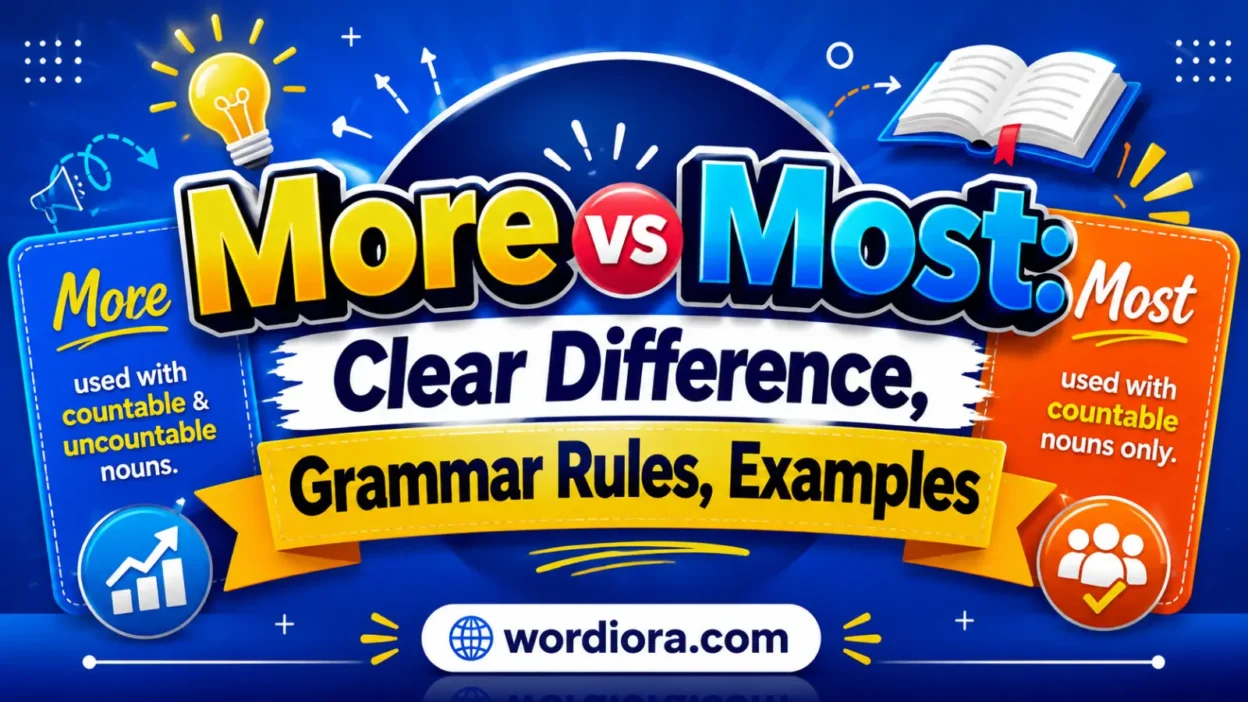
More and most are both correct English words, but they are not used the same way. Use more when you compare a larger amount, number, or degree. Use most when you mean the greatest amount, number, or degree in a group.
The confusion usually happens because both words deal with comparison. The difference is simple once you look at the structure of the sentence. More usually points to “greater than before” or “greater than another thing.” Most points to “greater than all the others.”
Quick Answer
Use more for a comparative idea: one thing has a greater amount or degree than another. Use most for a superlative idea: one thing has the greatest amount or degree in a group. For example, “This route is more convenient than that one,” but “This is the most convenient route.”
Why People Confuse Them
People confuse more and most because both words can describe quantity, degree, and comparison. They also appear before adjectives and adverbs, especially longer ones.
For example, you can say more careful and the most careful. The first compares one thing with another. The second identifies the top choice in a group.
Another reason is that most has more than one common use. It can mean “the greatest,” as in the most time, but it can also mean “the majority of,” as in most people. That second use does not need the.
Key Differences At A Glance
| Context | Best Choice | Why |
|---|---|---|
| Comparing two things | More | It shows a greater amount or degree than another thing. |
| Choosing the top item in a group | Most | It shows the greatest amount or degree. |
| Talking about a larger quantity | More | It means additional or greater in number or amount. |
| Talking about the majority | Most | It means almost all or the greater part of a group. |
| Before long comparative adjectives | More | Use it in forms like more useful or more expensive. |
| Before long superlative adjectives | Most | Use it in forms like the most useful or the most expensive. |
Meaning and Usage Difference
More means “a greater amount, number, or degree.” It often appears with than because it compares one thing to another.
Examples:
- We need more time than we expected.
- This app is more helpful than the old one.
- She speaks more clearly now.
Most means “the greatest amount, number, or degree.” It often appears with the when it forms a superlative.
Examples:
- This project took the most time.
- She gave the most helpful answer.
- He explained the topic most clearly.
Compact comparison:
- More: greater than another amount, person, thing, or earlier point.
- Most: greatest among all people, things, amounts, or choices in the group.
Tone, Context, and Formality
More and most are both neutral. You can use them in everyday speech, school writing, workplace emails, and formal writing.
The structure matters more than the tone. More often appears with than: more useful than, more quickly than, more money than. Most often appears with the when it means “greatest”: the most useful, the most quickly, the most money.
Most can also mean “the majority of.” In that use, do not add the before a general plural noun.
Correct: Most students submitted the form.
Incorrect: The most students submitted the form.
A phrase like “a most pleasant evening” can sound formal or old-fashioned in everyday US English. It means “a very pleasant evening,” not “the most pleasant evening.”
Which One Should You Use?
Use more when your sentence compares two things or shows an increase.
Correct:
- This plan is more realistic than the first one.
- We need more chairs for the meeting.
- She is more confident this year.
Use most when your sentence chooses the highest, largest, strongest, or greatest item in a group.
Correct:
- This is the most realistic plan.
- This room has the most chairs.
- She is the most confident speaker on the team.
Here is the easiest test: if you can add than naturally, more is probably right. If you mean “number one in the group,” most is probably right.
When One Choice Sounds Wrong
More sounds wrong when the sentence needs the highest point in a group.
Wrong: This is the more popular restaurant in town.
Better: This is the most popular restaurant in town.
Most sounds wrong when the sentence compares only one thing directly with another.
Wrong: This laptop is most expensive than mine.
Better: This laptop is more expensive than mine.
Be careful with two-person comparisons. In careful writing, use more when comparing exactly two choices.
Better: Of the two options, this one is more practical.
Natural in casual speech but less precise: Of the two options, this one is the most practical.
Common Mistakes (and Quick Fixes)
Mistake 1: Using most with than
Wrong: This class is most difficult than the last one.
Correct: This class is more difficult than the last one.
Mistake 2: Using more with a superlative ending
Wrong: That was the more easiest solution.
Correct: That was the easiest solution.
Mistake 3: Using most with a superlative ending
Wrong: She is the most smartest student in class.
Correct: She is the smartest student in class.
Mistake 4: Adding the before most when it means “the majority of”
Wrong: The most people like clear instructions.
Correct: Most people like clear instructions.
Mistake 5: Forgetting the before most in many superlative adjective phrases
Weak: This is most useful guide on the topic.
Correct: This is the most useful guide on the topic.
Everyday Examples
More:
- I need more coffee before the meeting.
- This route is more direct than the highway.
- Your second draft is more focused.
- The new plan gives us more flexibility.
- She answered more politely this time.
Most:
- This is the most direct route.
- He has the most experience on the team.
- Most employees prefer clear deadlines.
- The final chapter was the most interesting.
- She helped the most during the move.
Both in one sentence:
- This version is more detailed than the first one, but the final version is the most detailed of all.
- I saved more money in May, but I saved the most money in June.
- Most people want more time, but few use it well.
Dictionary-Style Word Details
Verb
More: Not commonly used as a verb in standard US English.
Most: Not commonly used as a verb in standard US English.
Use both words mainly as comparison words, quantity words, pronouns, nouns in limited uses, or adverbs. Do not try to turn them into action verbs.
Noun
More: Can work as a noun meaning a greater or additional amount.
Example: I wanted more, but the store was sold out.
Most: Can work as a noun in phrases that mean the greatest amount.
Example: That is the most we can offer right now.
In everyday writing, both noun uses are common in short phrases, but they are not usually treated like ordinary count nouns.
Synonyms
More: closest plain alternatives include additional, extra, greater, further, and a larger amount.
Most: closest plain alternatives include greatest, maximum, largest amount, majority, and nearly all, depending on the sentence.
Helpful opposites:
- More often contrasts with less.
- Most often contrasts with least when showing the highest and lowest degree.
Do not use these alternatives blindly. For example, majority fits most people, but it does not fit the most expensive phone.
Example Sentences
More:
- We need more information before we decide.
- This chair is more comfortable than the old one.
- She works more efficiently with a clear schedule.
- I have two more questions.
Most:
- This is the most comfortable chair in the office.
- Most customers want a simple return policy.
- She handled the complaint most professionally.
- He spent the most time on the design.
Word History
More and most are long-established English comparison words. In modern use, the practical difference matters more than the deep history: more works as the comparative form connected with much and many, while most works as the superlative form.
That means more points to a greater amount or degree, while most points to the greatest amount or degree.
Phrases Containing
More:
- more than
- no more than
- any more
- once more
- more or less
- more and more
- more of
Most:
- the most
- most of
- at most
- for the most part
- make the most of
- most likely
- most people
These phrases are useful, but the main choice stays the same. More compares or adds. Most shows the greatest amount or the majority.
FAQs
Is “more” always comparative?
Yes. “More” is used to compare one thing with another. It shows a greater amount, degree, or number.
Is “most” always superlative?
Yes. “Most” is used to show the highest amount or degree in a group or category.
Can I use “most” without “the”?
Yes, in some cases. For example: “Most people agree.” Here it means “the majority of.” But for superlatives, you usually need “the”: “the most interesting part.”
Is it wrong to say “more better”?
Yes. It is incorrect because “better” already shows comparison. You should say “better,” not “more better.”
When comparing two things, should I use “more” or “most”?
Use “more.” For example: “This phone is more expensive than that one.” “Most” is for three or more or a whole group.
Can “most” mean “very”?
Yes, in formal or old-fashioned style, “most” can mean “very,” like “a most unusual idea.” In modern US English, this is less common.
What’s the easiest way to remember the difference?
Use “more” when you compare. Use “most” when something is number one or the highest in a group.
Conclusion
More and most are both standard, useful words. The correct choice depends on what your sentence is doing.
Use more when you compare one thing with another or mean an additional amount. Use most when you mean the greatest amount, the highest degree, or the majority of a group.
A simple test can help: more usually answers “greater than what?” Most usually answers “greatest among whom or what?” Once you see that difference, the choice becomes much easier.