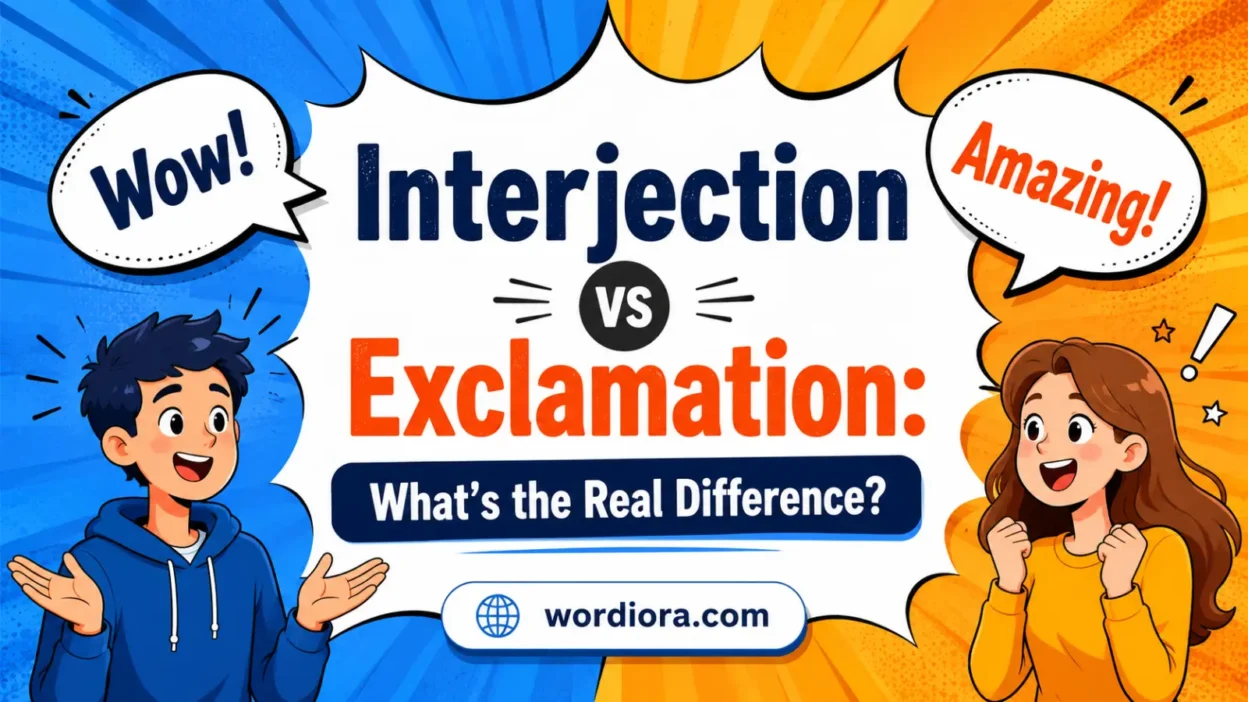
Many English learners see words like wow!, ouch!, and hey! and assume that interjection and exclamation mean the same thing.
They are closely related, but they are not identical.
The key difference is simple:
- An interjection is a part of speech.
- An exclamation is an expression of strong feeling or emotion.
Understanding that distinction makes it much easier to identify each one correctly.
Quick Answer
If you must choose between interjection and exclamation, remember this:
- Interjection refers to a word or phrase that expresses emotion and stands apart grammatically.
- Exclamation refers to the emotional statement, utterance, or expression itself.
For example:
Wow!
- As a word, wow is an interjection.
- The entire emotional outburst Wow! is an exclamation.
An interjection can create an exclamation, but not every exclamation is an interjection.
Why People Confuse Them
The confusion happens because the two terms often appear together.
Consider these examples:
- Wow!
- Ouch!
- Oh no!
- Hooray!
Each contains an interjection and also functions as an exclamation.
Because they frequently occur in the same sentence, many people treat the terms as synonyms.
In grammar, however, they describe different things.
Key Differences At A Glance
| Context | Best Choice | Why |
|---|---|---|
| Referring to a part of speech | Interjection | It is a grammatical category |
| Referring to an emotional outburst | Exclamation | It describes the expression |
| Discussing words like “wow” or “ouch” | Interjection | These are classified as interjections |
| Discussing excited statements | Exclamation | The focus is on emotional expression |
| Grammar lessons about parts of speech | Interjection | It belongs to traditional grammar categories |
| Describing a reaction of surprise or joy | Exclamation | The emphasis is on the reaction |
Meaning and Usage Difference
An interjection is a word or short phrase that expresses a sudden feeling, reaction, or response.
Examples:
- Wow!
- Oops!
- Hey!
- Ugh!
- Ouch!
These words are usually independent of the sentence around them.
An exclamation is a broader concept. It refers to an utterance or statement that shows strong emotion.
Examples:
- What a beautiful sunset!
- That’s incredible!
- How amazing!
- I can’t believe it!
Notice something important.
The sentence:
“What a beautiful sunset!”
is an exclamation, but it contains no interjection.
That is why the two terms are not interchangeable.
Compact Comparison
| Feature | Interjection | Exclamation |
|---|---|---|
| Type | Part of speech | Expression or utterance |
| Main purpose | Express immediate reaction | Express strong emotion |
| Usually short? | Yes | Not always |
| Can be a full sentence? | Sometimes | Yes |
| Examples | Wow, Ouch, Hey | What a day!, That’s amazing! |
Tone, Context, and Formality
Both interjections and exclamations are most common in speech, texting, fiction, and informal writing.
Interjections often sound spontaneous.
Examples:
- Wow!
- Uh-oh!
- Oops!
Exclamations can be short or long.
Examples:
- What a fantastic game!
- I never expected that!
- How wonderful!
In formal business or academic writing, both are generally used more sparingly because they can sound emotional or conversational.
Which One Should You Use?
Use interjection when talking about grammar.
Examples:
- Wow is an interjection.
- Oops functions as an interjection.
- Hey is commonly used as an interjection.
Use exclamation when talking about emotional expressions.
Examples:
- The audience responded with an exclamation of surprise.
- Her statement was an exclamation of joy.
- The sentence is an exclamation.
A simple test helps:
Ask yourself whether you are talking about a specific word or an emotional expression.
- Word category → Interjection
- Emotional expression → Exclamation
When One Choice Sounds Wrong
Incorrect:
- Wow is an exclamation part of speech.
Better:
- Wow is an interjection.
Incorrect:
- Interjection marks are used at the end of sentences.
Better:
- Exclamation marks are used at the end of exclamations.
Incorrect:
- What a great day is an interjection.
Better:
- What a great day is an exclamation.
These mistakes happen when the grammatical category and the emotional expression are confused.
Common Mistakes and Quick Fixes
Mistake 1: Treating the words as exact synonyms
Wrong:
- Interjection and exclamation mean the same thing.
Fix:
- An interjection is often used in an exclamation, but they are not identical.
Mistake 2: Calling every exclamation an interjection
Wrong:
- What a beautiful house! = interjection
Fix:
- It is an exclamation, not an interjection.
Mistake 3: Calling every interjection a sentence
Wrong:
- Every interjection is a complete sentence.
Fix:
- Some stand alone, while others appear within larger sentences.
Mistake 4: Confusing punctuation with grammar
Wrong:
- An exclamation mark creates an interjection.
Fix:
- An interjection is a word category. Punctuation does not determine the category.
Everyday Examples
Here are common real-life examples.
Interjection Examples
- Wow! That’s fast.
- Ouch! My ankle hurts.
- Hey! Over here.
- Oops! I forgot my keys.
- Ugh! This traffic is awful.
Exclamation Examples
- What a beautiful morning!
- That’s amazing!
- How exciting!
- I can’t believe we won!
- What a surprise!
Both Together
- Wow! That’s amazing!
- Oh no! We missed the train.
- Hooray! We did it.
In these examples, the first word is an interjection, and the overall reaction is an exclamation.
Dictionary-Style Word Details
Verb
Interjection:
- Not commonly used as a verb in standard US English.
Exclamation:
- Not commonly used as a verb in standard US English.
Noun
Interjection:
- A word or phrase expressing sudden emotion or reaction.
Exclamation:
- A sudden expression or statement showing strong feeling.
Synonyms
Interjection:
- Closest plain alternatives: exclamatory word, emotional utterance, reaction word.
Exclamation:
- Closest plain alternatives: outcry, cry, shout, emotional expression.
Antonyms:
- No direct antonyms clearly apply to either term in ordinary grammar usage.
Example Sentences
Interjection:
- “Wow” is an interjection showing surprise.
- “Oops” is an interjection used after a mistake.
Exclamation:
- “What a wonderful day!” is an exclamation.
- His loud “Amazing!” was an exclamation of excitement.
Word History
Interjection:
- The term comes from a Latin word meaning “to throw between,” reflecting how such words are inserted into speech.
Exclamation:
- The term comes from Latin roots relating to calling or crying out loudly.
Phrases Containing
Interjection:
- interjection phrase
- primary interjection
- secondary interjection
Exclamation:
- exclamation mark
- exclamation of surprise
- exclamation of joy
FAQs
Is an interjection the same as an exclamation?
No. An interjection is a part of speech, while an exclamation is an expression of strong emotion. An interjection can be used in an exclamation, but the two terms are not identical.
Can an interjection be an exclamation?
Yes. Words like wow!, ouch!, and hooray! are interjections that can also function as exclamations when used to express strong feelings.
Can an exclamation exist without an interjection?
Yes. A sentence such as “What a beautiful day!” is an exclamation, even though it does not contain an interjection.
What is the main difference between interjection and exclamation?
The main difference is that interjection refers to a grammatical category of words, while exclamation refers to the emotional expression or statement itself.
Is “Wow!” an interjection or an exclamation?
It can be viewed as both. The word wow is an interjection, and when it is used alone to express surprise, the utterance “Wow!” is also an exclamation.
Are interjections always followed by an exclamation mark?
No. Interjections are often followed by an exclamation mark, but they can also be followed by commas or periods depending on the tone and context.
What are common examples of interjections?
Common interjections include:
- Wow!
- Ouch!
- Hey!
- Oops!
- Hooray!
- Ugh!
- Oh!
What are common examples of exclamations?
Common exclamations include:
- What a great game!
- How exciting!
- That’s incredible!
- I can’t believe it!
- What a surprise!
Is an exclamation a part of speech?
No. Unlike nouns, verbs, adjectives, and interjections, an exclamation is not considered a part of speech. It is a type of expression or sentence.
Why do people confuse interjections and exclamations?
People often confuse them because many interjections are used as exclamations. Since they frequently appear together, the distinction between the grammatical term and the emotional expression is easy to miss.
Which term should I use in grammar class?
Use interjection when identifying a word category and exclamation when discussing an emotional statement or reaction.
Can a complete sentence be an exclamation?
Yes. Sentences such as “What an amazing performance!” and “That’s fantastic!” are complete exclamations that express strong emotion.
Conclusion
The difference between interjection and exclamation comes down to grammar versus expression.
An interjection is a specific type of word or phrase that expresses emotion and often stands apart from the sentence structure.
An exclamation is the emotional statement, reaction, or utterance itself.
Remember this simple rule:
- Interjection = word category
- Exclamation = emotional expression
Once you make that distinction, choosing the correct term becomes much easier.