You’re typing a sentence, you get to the word “fly,” and suddenly you freeze. Is it flys or flies? This mix-up trips up native speakers just as often as English learners. The good news is that the rule behind it is simple once you see it clearly, and this guide walks through exactly when and why one spelling wins every time.
Quick Answer
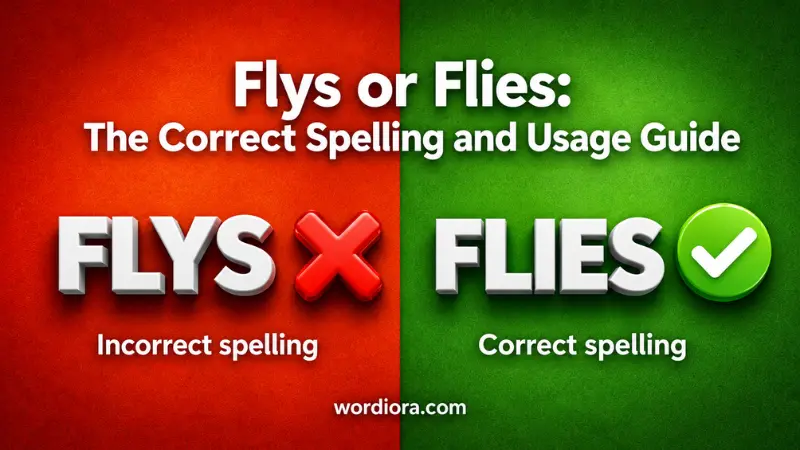
Flies is correct. Flys is not a standard English word. Whether you’re talking about a plural insect, the verb form of “to fly,” or a common idiom, the spelling is always flies. There is one narrow exception involving a specific historical noun, which is covered further down, but for everyday writing, flies is the answer you want.
Why People Confuse Them
The confusion makes sense. In English, most verbs just take an added “s” for the third-person singular form: talk becomes talks, walk becomes walks, run becomes runs. Following that pattern, “fly” would logically become “flys.” That instinct is reasonable, but it runs into a different spelling rule that overrides it.
The same thing happens with plural nouns. Most nouns simply add “s”: cat becomes cats, dog becomes dogs. So it feels natural to guess that fly becomes flys. Both guesses are wrong, and both fail for the same underlying reason.
Key Differences At A Glance
| Feature | Flys | Flies |
|---|---|---|
| Standard spelling | No | Yes |
| Correct as a plural noun | No | Yes |
| Correct as a verb form | No | Yes |
| Acceptable in formal or casual writing | No | Yes |
| Only valid use | Rare proper nouns (surnames, brand names) | All standard contexts |
Meaning and Usage Difference
There isn’t a meaning difference between flys and flies, because flys isn’t a recognized word in modern standard English. It’s a spelling error, not an alternate form with its own definition.
Flies, on the other hand, carries two connected jobs:
- As a noun, flies is the plural of fly, the small winged insect. “There are flies on the porch” describes more than one insect.
- As a verb, flies is the third-person singular present tense of “to fly.” “The plane flies at dawn” describes one subject performing the action right now.
The reason both land on the same spelling comes down to a basic English spelling rule: when a word ends in a consonant followed by “y,” you drop the “y” and add “ies” to form the plural or the third-person verb form. Fly ends in “l” plus “y,” a consonant plus “y,” so it becomes flies, not flys. Compare this to a word like “day,” which ends in a vowel plus “y.” Words like that just add an “s” (days, not “daies”), which is part of why the confusion happens in the first place. People sometimes borrow that rule for the wrong type of word.
Tone, Context, and Formality
Flies works the same way across every register of American English. There’s no casual version where flys becomes acceptable, and no formal version where flies changes shape. Text messages, emails, essays, news articles, and technical writing all use flies exclusively.
This is different from word pairs where one form is more formal and the other more casual (like “kids” versus “children”). With flys and flies, there’s no tone spectrum to navigate. One is simply the standard spelling, and the other is a mistake, regardless of how informal the writing is.
Which One Should You Use?
Use flies every time you need the plural of the insect or the present-tense verb form. There’s no situation in everyday writing where flys is the better or more appropriate choice. If you’re ever unsure while typing quickly, flies is the safe default.
The only real exception involves proper nouns. If flys appears as part of someone’s last name, a business name, or a stylized brand, that specific spelling stands because proper nouns follow their own rules, not standard spelling conventions. That’s a naming choice, not a grammar exception, so it doesn’t apply to normal sentences.
When One Choice Sounds Wrong
“Flys” will almost always look and sound off to a careful reader, because it breaks a spelling pattern most people learned early on: words ending in a consonant plus “y” swap the “y” for “ies” in these forms. A sentence like “The bird flys south for the winter” reads as a typo, not a stylistic choice, and most readers will notice it immediately.
Flies never sounds wrong in these contexts, because it’s the only form that matches how English handles this specific word ending.
Common Mistakes
Mistake: “There were three flys buzzing around the trash can.” Fix: “There were three flies buzzing around the trash can.”
Mistake: “She flys to Chicago every other week for work.” Fix: “She flies to Chicago every other week for work.”
Mistake: “Time flys when you’re having fun.” Fix: “Time flies when you’re having fun.”
Mistake: Assuming an added “s” always makes a plural or a verb form. Fix: Remember the consonant-plus-y rule. Words like fly, try, and cry all swap the “y” for “ies” (flies, tries, cries), while words like day, boy, and key just add an “s” (days, boys, keys) because they end in a vowel plus “y.”
Everyday Examples
- The kitchen window was left open, and now flies keep getting in.
- My uncle flies small planes as a weekend hobby.
- She flies out of the city every Friday to visit her parents.
- Fruit flies love overripe bananas left on the counter.
- Time flies when you’re deep into a good book.
- The airline flies direct routes between Dallas and Denver.
- Horseflies and houseflies are both common backyard pests in the summer.
Dictionary-Style Word Details
Verb
Flies: the third-person singular present tense of “to fly,” used with he, she, it, or a singular noun. Example: “The kite flies higher when the wind picks up.”
Flys: not a standard verb form in modern English. Any appearance of “flys” as a verb is a spelling error.
Noun
Flies: the plural of fly, referring to more than one winged insect, or to multiple instances of the action of flying (such as fly balls in baseball). Example: “The outfielder caught two fly balls, or flies, in one inning.”
Flys: not a standard noun in current usage. It appears only in the historical sense covered under Word History, and in proper nouns.
Synonyms
Exact synonyms for flies depend on which meaning is intended.
- For the insect (noun): closest plain alternatives include gnats, midges, and houseflies, though none of these are true one-to-one synonyms since they refer to specific species or types rather than the general word fly.
- For the verb (moves through the air): soars, glides, and travels by air are closest plain alternatives, though none carry the exact same simplicity as flies.
There is no meaningful synonym for flys, since it isn’t a standard word with its own definition.
Closest antonym for the verb sense: lands, or in a broader sense, stays grounded — though these describe the opposite action rather than a true one-word opposite.
Example Sentences
- The dog watched the flies buzzing near the picnic table.
- He flies to Miami twice a year to see his grandparents.
- Time flies whenever the weekend finally arrives.
- The company flies cargo shipments overnight to reduce delays.
- Swat those flies before they land on the food.
Word History
The verb “fly” comes from Old English “fleogan,” and its shift to “flies” in the third-person singular follows a well-established pattern in English spelling for verbs ending in a consonant plus “y.”
There is one documented historical exception worth noting honestly: in 19th-century England, “fly” was also used as a noun for a light, horse-drawn carriage. In that specific historical context, some sources note the plural was written as “flys” rather than “flies.” This is a narrow, dated usage tied to a specific object that has fallen out of common use, and it does not apply to the modern insect or verb senses. Beyond this, there’s no strong evidence of “flys” ever being a broadly accepted standard spelling in modern usage.
Phrases Containing
- Time flies: used to say that time seems to pass quickly, especially when enjoying something.
- Fly on the wall: an unnoticed observer; the plural, “flies on the wall,” describes multiple silent observers.
- Fruit flies: small flies commonly found around ripening produce.
- As the crow flies: describes the shortest, most direct distance between two points.
- Fly ball: in baseball, a ball hit high into the air; the plural is fly balls or simply flies.
FAQs
No. In standard modern English, flys is not a recognized word for either the plural noun or the verb form. The only time you’ll see it is inside a proper noun, such as a surname or a brand name that has deliberately chosen that spelling.
Think of the pattern: a consonant right before the final “y” means you drop the “y” and add “ies.” Fly, try, and cry all follow this pattern, becoming flies, tries, and cries. If a vowel comes right before the final “y,” like in day or boy, you just add an “s” instead.
Yes. Flies is the plural form of the noun fly (the insect), and it’s also the third-person singular present tense of the verb “to fly.” The spelling stays identical in both roles, which is part of why the word can feel tricky at first glance.
No. Both American and British English use flies as the correct plural and verb form. There’s no regional split on this particular spelling.
It usually comes from applying the more common English pattern of just adding “s” to form a plural or verb, which works for the vast majority of words. Fly happens to fall into a smaller category of words that behave differently, so the mistake is understandable even though it’s incorrect.
Historically, yes, in one narrow case. That older use is explained in the Word History section below, but it doesn’t apply to how the word functions in everyday modern writing.
Conclusion
The rule behind flys or flies isn’t complicated once it clicks: fly ends in a consonant plus “y,” so both the plural noun and the third-person verb form swap that “y” for “ies,” landing on flies every time. Flys isn’t a real word in standard writing, aside from the rare proper noun or a narrow, dated historical use tied to old-fashioned carriages. Whenever you’re unsure mid-sentence, flies is the spelling that will always hold up, in any context, at any level of formality.