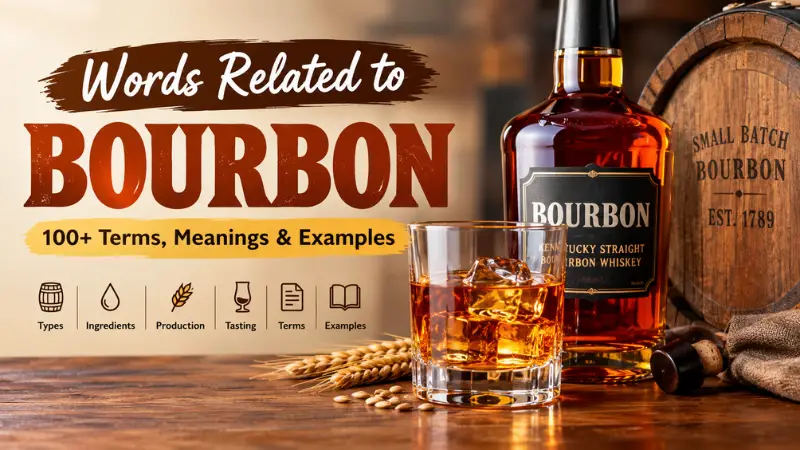
If you’re looking for words related to bourbon, you’ll find a rich vocabulary covering whiskey production, barrels, aging, tasting, flavors, cocktails, and American whiskey culture. Common terms include whiskey, rye, corn, mash bill, distillery, barrel, char, proof, straight bourbon, small batch, single barrel, oak, vanilla, caramel, and smoky.
Whether you’re writing about bourbon, learning how to describe its flavor, studying whiskey terminology, or simply expanding your vocabulary, this guide provides 100+ bourbon-related words and phrases with simple meanings and examples.
What Is Bourbon?
Bourbon is a type of American whiskey made from a grain mixture containing at least 51% corn and aged in new, charred oak containers. It is strongly associated with Kentucky, although bourbon can legally be produced elsewhere in the United States.
Bourbon vocabulary often falls into several categories:
- Production and distilling
- Ingredients and mash bills
- Barrels and aging
- Flavor and tasting notes
- Bourbon styles
- Cocktails and serving
- Distilleries and whiskey culture
100+ Words Related to Bourbon
Here is a quick reference list of useful bourbon-related vocabulary.
| # | Word or Term | Meaning |
|---|---|---|
| 1 | Bourbon | American whiskey meeting specific legal requirements |
| 2 | Whiskey | A distilled spirit made from fermented grain |
| 3 | American whiskey | Whiskey produced in the United States |
| 4 | Corn | The primary grain in bourbon |
| 5 | Rye | A grain often used to add spice |
| 6 | Wheat | A grain that can create softer flavors |
| 7 | Barley | A grain sometimes used in bourbon mash bills |
| 8 | Mash | The grain mixture used during production |
| 9 | Mash bill | The recipe of grains used to make whiskey |
| 10 | Distillery | A facility where spirits are produced |
| 11 | Distiller | A person or company that makes distilled spirits |
| 12 | Fermentation | The process that converts sugars into alcohol |
| 13 | Yeast | Microorganisms used for fermentation |
| 14 | Distillation | Separating alcohol and other compounds through heating |
| 15 | Still | Equipment used for distillation |
| 16 | Copper still | A still made partly or entirely from copper |
| 17 | Spirit | Alcoholic liquid produced through distillation |
| 18 | White dog | Unaged whiskey straight from the still |
| 19 | New make | Freshly distilled spirit before aging |
| 20 | Barrel | A wooden container used for aging whiskey |
| 21 | Cask | Another term for a barrel or aging vessel |
| 22 | Oak | Wood used to mature bourbon |
| 23 | Char | Burned interior surface of a barrel |
| 24 | Barrel char | The carbonized layer inside a new oak barrel |
| 25 | Toast | Controlled heating of barrel wood |
| 26 | Aging | Maturing whiskey over time |
| 27 | Maturation | Development of whiskey characteristics during aging |
| 28 | Warehouse | Building where whiskey barrels are stored |
| 29 | Rickhouse | A warehouse specifically associated with aging whiskey |
| 30 | Barrel proof | Whiskey bottled without dilution after aging |
| 31 | Cask strength | Whiskey bottled close to its natural barrel strength |
| 32 | Proof | A measure of alcohol strength |
| 33 | ABV | Alcohol by volume |
| 34 | Bottling | Filling and sealing whiskey bottles |
| 35 | Bottled-in-Bond | A regulated designation for qualifying American whiskey |
| 36 | Straight bourbon | Bourbon meeting requirements for the “straight” designation |
| 37 | Kentucky bourbon | Bourbon produced in Kentucky |
| 38 | Small batch | A marketing term generally indicating a limited production batch |
| 39 | Single barrel | Whiskey bottled from one barrel |
| 40 | Blended whiskey | Whiskey combining spirits from multiple sources or types |
| 41 | High rye | Bourbon with a relatively higher rye percentage |
| 42 | Wheated bourbon | Bourbon using wheat instead of rye as the secondary grain |
| 43 | Low rye | Bourbon with a comparatively lower rye content |
| 44 | Corn whiskey | American whiskey with a high corn content |
| 45 | Grain whiskey | Whiskey made from cereal grains |
| 46 | Oak-aged | Matured in oak |
| 47 | Barrel-aged | Matured in a wooden barrel |
| 48 | New oak | Previously unused oak used for aging |
| 49 | American oak | Oak commonly used for American whiskey barrels |
| 50 | Rick | Wooden structure used to hold barrels |
| 51 | Barrel entry proof | Proof at which whiskey enters a barrel |
| 52 | Angel’s share | Alcohol and water lost through evaporation during aging |
| 53 | Barrel loss | Liquid lost during maturation |
| 54 | Evaporation | Natural loss of liquid during aging |
| 55 | Bottling proof | Alcohol strength at bottling |
| 56 | Nose | Aroma of the whiskey |
| 57 | Palate | Flavor experienced while tasting |
| 58 | Finish | Flavors that remain after swallowing |
| 59 | Tasting notes | Descriptions of aroma, flavor, and finish |
| 60 | Aroma | The smell of the bourbon |
| 61 | Bouquet | Overall aromatic character |
| 62 | Sweet | A common bourbon flavor characteristic |
| 63 | Spicy | A flavor sensation often associated with rye |
| 64 | Oaky | Flavor associated with oak maturation |
| 65 | Vanilla | A common aroma or flavor in bourbon |
| 66 | Caramel | A sweet, cooked-sugar flavor |
| 67 | Toffee | Rich sweet flavor resembling buttery caramel |
| 68 | Butterscotch | Sweet, buttery confection-like note |
| 69 | Brown sugar | Sweet molasses-like flavor |
| 70 | Molasses | Dark, rich sweet flavor |
| 71 | Cinnamon | Warm spice note |
| 72 | Nutmeg | Aromatic baking-spice note |
| 73 | Clove | Strong warm spice note |
| 74 | Pepper | Sharp spicy sensation |
| 75 | Oak | Woody or tannic characteristic |
| 76 | Toasted | Flavor suggesting toasted wood or grain |
| 77 | Charred | Smoky or roasted characteristic |
| 78 | Smoky | Flavor associated with smoke or char |
| 79 | Fruity | General fruit-like character |
| 80 | Cherry | Common fruit tasting note |
| 81 | Apple | Fresh or cooked fruit note |
| 82 | Dried fruit | Raisin, date, or similar flavors |
| 83 | Raisin | Sweet dried-fruit note |
| 84 | Plum | Dark fruit characteristic |
| 85 | Nutty | Flavor resembling nuts |
| 86 | Almond | Nut-like tasting note |
| 87 | Walnut | Rich nutty characteristic |
| 88 | Cocoa | Chocolate-like flavor |
| 89 | Chocolate | Sweet, roasted tasting note |
| 90 | Coffee | Roasted flavor note |
| 91 | Caramelized | Rich cooked-sugar characteristic |
| 92 | Creamy | Smooth, rich mouthfeel |
| 93 | Rich | Full and pronounced flavor |
| 94 | Smooth | Pleasant, rounded drinking character |
| 95 | Full-bodied | Strong, substantial mouthfeel |
| 96 | Dry | Less sweet or moisture-like sensation |
| 97 | Tannic | Drying sensation often associated with oak |
| 98 | Finish | Lingering aftertaste |
| 99 | Neat | Bourbon served without ice or mixer |
| 100 | On the rocks | Bourbon served over ice |
| 101 | Splash | Small amount of water added to whiskey |
| 102 | Bourbon cocktail | Mixed drink featuring bourbon |
| 103 | Old Fashioned | Classic whiskey cocktail |
| 104 | Manhattan | Classic cocktail commonly made with whiskey |
| 105 | Mint Julep | Classic bourbon cocktail associated with the Kentucky Derby |
| 106 | Whiskey Sour | Cocktail combining whiskey, citrus, and sweetener |
| 107 | Bitters | Concentrated botanical ingredient used in cocktails |
| 108 | Simple syrup | Sugar-and-water sweetener used in drinks |
| 109 | Cocktail bitters | Aromatic ingredient used to add complexity |
| 110 | Bourbon lover | Person who enjoys bourbon |
Bourbon Production Terms
Understanding how bourbon is made makes many of these words easier to remember.
Mash Bill
A mash bill is the recipe of grains used to make a whiskey. Bourbon must contain at least 51% corn, while the remaining grains can include rye, wheat, and malted barley.
For example:
- Corn → sweetness
- Rye → spice and pepper
- Wheat → softer, sweeter character
- Malted barley → helps provide enzymes needed for fermentation
The exact recipe can have a significant influence on a bourbon’s character.
Fermentation
During fermentation, yeast converts sugars in the grain mixture into alcohol and other compounds.
Terms associated with this stage include:
- Yeast
- Fermentation
- Mash
- Distiller’s beer
- Fermentation tank
Distillation
Distillation concentrates alcohol and separates different compounds from the fermented liquid.
Important related terms include:
- Still
- Copper still
- Column still
- Pot still
- Distillate
- Spirit
- New make
White Dog
White dog is a common American whiskey term for newly distilled, unaged spirit. It is clear because it has not yet developed the color and many of the flavors associated with barrel aging.
Bourbon Barrel and Aging Vocabulary
Barrels are central to bourbon’s identity.
New Charred Oak
Bourbon must be aged in new, charred oak containers. The interaction between whiskey and oak contributes many characteristics commonly associated with bourbon.
Common barrel-related words include:
- Oak
- New oak
- Char
- Barrel
- Cask
- Rickhouse
- Aging
- Maturation
- Warehouse
- Evaporation
- Angel’s share
Angel’s Share
The angel’s share refers to whiskey lost naturally through evaporation while it ages in a barrel.
The amount lost can vary depending on factors such as:
- Aging conditions
- Warehouse environment
- Temperature
- Barrel location
- Length of maturation
Bourbon Tasting Words
If you’re trying to describe bourbon, tasting vocabulary is especially useful.
Nose
The nose refers to the aromas you detect before tasting.
You might describe a bourbon’s nose as:
- Vanilla
- Caramel
- Cherry
- Oak
- Cinnamon
- Toasted grain
- Brown sugar
- Dried fruit
Palate
The palate describes the flavors and sensations experienced while drinking.
For example:
“The palate is rich and sweet, with vanilla, caramel, toasted oak, and cinnamon.”
Finish
The finish is what remains after you swallow.
A bourbon may have a:
- Short finish
- Medium finish
- Long finish
- Sweet finish
- Spicy finish
- Oaky finish
- Warm finish
Flavor Words Related to Bourbon
Bourbon is frequently described using food, spice, fruit, and wood-related vocabulary.
Sweet Bourbon Words
Common sweet descriptors include:
- Caramel
- Vanilla
- Toffee
- Butterscotch
- Brown sugar
- Honey
- Molasses
- Maple
- Chocolate
- Cocoa
Fruity Bourbon Words
Fruit-related tasting notes can include:
- Cherry
- Apple
- Peach
- Plum
- Raisin
- Date
- Orange
- Dried fruit
Spicy Bourbon Words
Spice-related vocabulary includes:
- Rye
- Cinnamon
- Black pepper
- Nutmeg
- Clove
- Baking spice
- Ginger
Wood and Toasted Notes
These terms describe characteristics often associated with barrel maturation:
- Oak
- Toasted oak
- Char
- Cedar
- Woody
- Smoky
- Roasted
- Tannic
Types and Styles of Bourbon
Several terms are commonly used to describe bourbon styles or categories.
Straight Bourbon
Straight bourbon is bourbon that satisfies the legal requirements for the “straight” designation, including aging requirements and other applicable standards.
Small Batch Bourbon
Small batch is commonly used to describe bourbon produced or selected in relatively limited quantities. However, the term does not have one universally applicable legal production-size definition.
Single Barrel Bourbon
Single barrel bourbon is bottled from an individual barrel rather than being blended from multiple barrels.
Because individual barrels can differ, two barrels from the same whiskey program may not taste exactly alike.
Wheated Bourbon
Wheated bourbon uses wheat as the secondary grain instead of rye. It is often associated with softer, sweeter flavor profiles, although the final character depends on the entire production and maturation process.
High-Rye Bourbon
A high-rye bourbon uses a comparatively higher proportion of rye in its mash bill. Rye can contribute noticeable spice and pepper characteristics.
Bourbon Proof and Alcohol Terms
You will frequently see proof on bourbon labels.
In the United States, proof is twice the alcohol-by-volume percentage.
For example:
- 80 proof = 40% ABV
- 90 proof = 45% ABV
- 100 proof = 50% ABV
- 120 proof = 60% ABV
Cask Strength and Barrel Proof
These terms generally indicate bourbon bottled at or near the strength at which it comes from the barrel, although exact labeling terminology can depend on the producer and applicable standards.
Higher proof does not automatically mean better bourbon. It simply means the whiskey contains more alcohol by volume.
Bourbon Serving Terms
If you’re talking about how bourbon is served, these are useful terms to know.
Neat
Neat means bourbon is served by itself, without ice or a mixer.
On the Rocks
On the rocks means bourbon is served over ice.
With Water
Some drinkers add a small amount of water to bourbon. This can change the aroma and how certain flavors are perceived.
Highball
A highball is a mixed drink consisting of a spirit and a larger quantity of a carbonated or non-carbonated mixer, usually served over ice.
Bourbon Cocktail Vocabulary
Bourbon is used in many classic American cocktails.
Some common bourbon-related cocktail terms include:
- Old Fashioned
- Manhattan
- Mint Julep
- Whiskey Sour
- Boulevardier
- Bourbon Smash
- Highball
- Bitters
- Simple syrup
- Cocktail shaker
- Mixing glass
- Garnish
- Orange peel
- Maraschino cherry
Example
An Old Fashioned commonly combines whiskey with sugar and bitters and is traditionally served with ice and an orange garnish.
Words to Describe Bourbon
If you’re writing a review, article, menu, product description, or tasting note, these adjectives can help.
Positive Bourbon Descriptors
- Smooth
- Rich
- Complex
- Balanced
- Bold
- Robust
- Full-bodied
- Aromatic
- Fruity
- Spicy
- Sweet
- Warm
- Velvety
- Creamy
- Refined
- Well-rounded
- Long-finished
Neutral or Technical Descriptors
- Oaky
- Tannic
- Dry
- High-proof
- Barrel-aged
- Charred
- Toasted
- Fruity
- Spicy
- Grain-forward
Remember that tasting descriptions are subjective. A word such as “oaky” can be positive in one context and excessive in another.
Bourbon Synonyms and Closely Related Words
Strictly speaking, bourbon does not have a perfect synonym because bourbon is a specific category of American whiskey.
However, closely related terms include:
- American whiskey
- American bourbon whiskey
- Bourbon whiskey
- Whiskey
- Straight bourbon
- Kentucky bourbon
- Corn whiskey (related but not synonymous)
- Rye whiskey (related but not synonymous)
- Tennessee whiskey (related American whiskey category, not bourbon)
It’s important not to treat every type of whiskey as bourbon. Bourbon is a specific type of American whiskey with its own requirements.
Bourbon vs. Whiskey: What’s the Difference?
The terms bourbon and whiskey are related but not interchangeable.
| Term | General Meaning |
|---|---|
| Whiskey | Broad category of distilled grain spirits |
| American whiskey | Whiskey produced in the United States |
| Bourbon | Specific American whiskey category |
| Rye whiskey | Whiskey characterized by a rye-based mash requirement |
| Tennessee whiskey | American whiskey associated with Tennessee production and specific requirements |
So, all bourbon is whiskey, but not all whiskey is bourbon.
Bourbon Vocabulary for Writing and SEO
If you’re creating content about bourbon, these related keywords can be useful when they genuinely fit the topic:
- words related to bourbon
- bourbon vocabulary
- bourbon terminology
- bourbon terms
- bourbon tasting terms
- bourbon flavor words
- bourbon-related words
- whiskey vocabulary
- bourbon glossary
- bourbon slang
- bourbon tasting notes
- bourbon production terms
- bourbon barrel terms
- bourbon whiskey terms
- bourbon flavor descriptors
- types of bourbon
- bourbon cocktail terms
- words to describe bourbon
- bourbon synonyms
- bourbon words and meanings
Use these phrases naturally rather than repeating the same keyword throughout an article.
How to Describe Bourbon Like a Taster
You don’t need to be a professional whiskey critic to describe bourbon effectively.
Try this simple four-step approach:
1. Describe the Appearance
Look at the color and clarity.
Examples:
- Amber
- Golden
- Deep copper
- Mahogany
2. Describe the Nose
Smell the bourbon and identify the first aromas.
Ask yourself:
- Is it sweet?
- Fruity?
- Spicy?
- Oaky?
- Toasted?
- Vanilla-forward?
3. Describe the Palate
Take a small sip and consider:
- Sweetness
- Spice
- Fruit
- Oak
- Texture
- Alcohol warmth
4. Describe the Finish
Pay attention to what remains after swallowing.
For example:
“The bourbon begins with vanilla and caramel, develops into cinnamon and toasted oak, and finishes with lingering baking spice.”
This type of description is much more useful than simply saying that a bourbon is “good” or “strong.”
Quick Bourbon Word List
For a quick vocabulary reference, here are some of the most useful terms:
Bourbon, whiskey, corn, rye, wheat, barley, mash, mash bill, yeast, fermentation, distillery, distillation, still, white dog, barrel, cask, oak, char, aging, maturation, warehouse, rickhouse, proof, ABV, barrel proof, cask strength, straight bourbon, small batch, single barrel, wheated bourbon, high rye, nose, palate, finish, aroma, vanilla, caramel, toffee, butterscotch, brown sugar, cherry, apple, raisin, cinnamon, nutmeg, clove, pepper, oak, toasted, smoky, tannic, neat, rocks, bitters, Old Fashioned, Manhattan, Mint Julep, Whiskey Sour, and bourbon cocktail.
FAQs
Common bourbon-related words include whiskey, corn, rye, wheat, mash bill, distillery, barrel, oak, char, proof, aging, vanilla, caramel, cinnamon, palate, nose, finish, and Old Fashioned.
Useful descriptive words include smooth, rich, sweet, spicy, oaky, fruity, complex, bold, creamy, warm, balanced, full-bodied, aromatic, and robust.
Common tasting terms include nose, palate, finish, aroma, mouthfeel, sweet, spicy, oaky, fruity, smoky, tannic, vanilla, caramel, cinnamon, and toasted.
No. Bourbon is a type of American whiskey, but whiskey is a much broader category that includes different styles from the United States and other countries.
Bourbon must use a mash containing at least 51% corn. Other grains can include rye, wheat, and malted barley.
A bourbon barrel can also be called a cask. Bourbon is traditionally aged in new, charred oak containers.
Neat means bourbon is served by itself, without ice, water, or another mixer.
In the United States, proof is twice the alcohol-by-volume percentage. For example, a 100-proof bourbon contains 50% ABV.
Conclusion
The world of bourbon has a surprisingly broad vocabulary. From mash bill, fermentation, and distillation to barrel, char, proof, nose, palate, and finish, these terms make it easier to understand how bourbon is produced and how its flavors are described.
If you’re learning bourbon terminology, start with the basics—corn, mash bill, barrel, oak, proof, nose, palate, and finish—and gradually add more specialized terms. For writers and content creators, using precise words such as vanilla, caramel, cinnamon, toasted oak, rye spice, and dried fruit can also make bourbon descriptions more informative and engaging.
Use this glossary as a reference whenever you need words related to bourbon, bourbon vocabulary, tasting terms, or bourbon-related expressions.
SEO Meta Title
Words Related to Bourbon: 100+ Terms & Meanings
Meta Description
Discover 100+ words related to bourbon, including tasting terms, barrel vocabulary, flavors, types, cocktails, and whiskey terminology.
Suggested URL Slug
/words-related-to-bourbon/