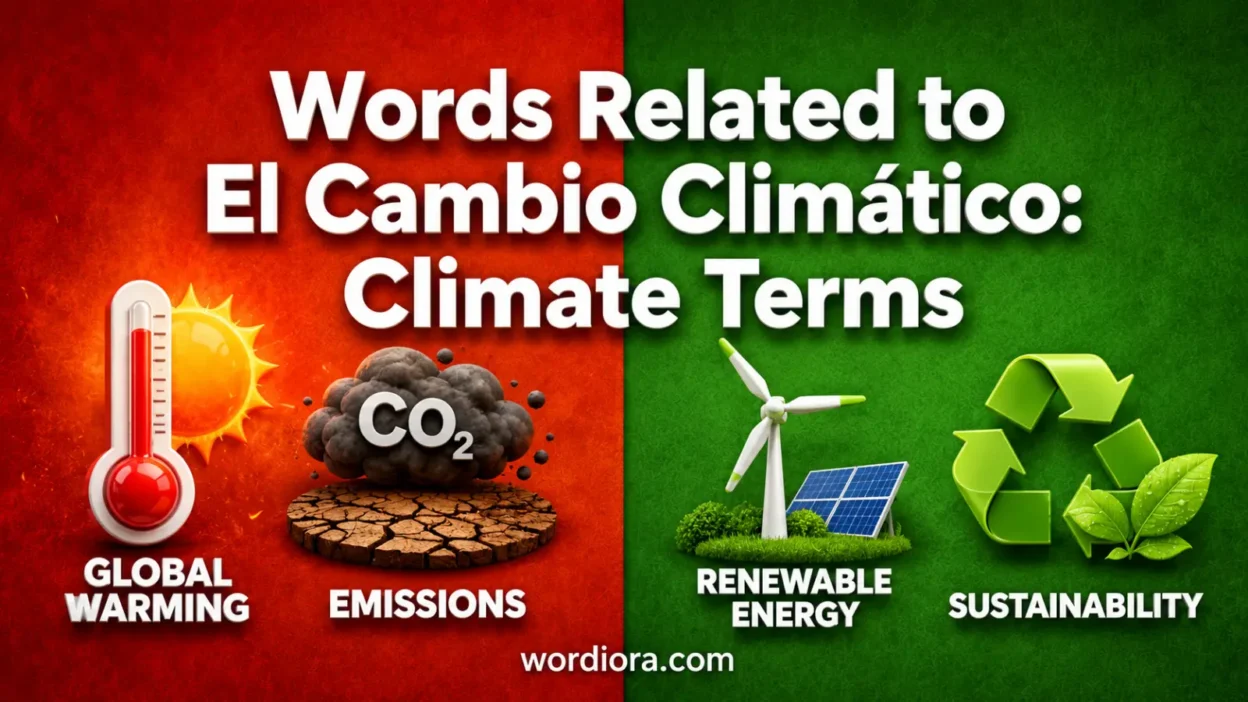
El cambio climático means climate change in English. So the real target topic is vocabulary related to climate change: words about rising temperatures, greenhouse gases, weather shifts, environmental effects, and possible solutions.
Not every related word is a synonym. Some words, such as global warming, are closely connected. Others, such as drought, emissions, or renewable energy, are broader climate-related terms.
Quick Answer
Words related to el cambio climático include climate change, global warming, greenhouse gases, carbon emissions, fossil fuels, rising temperatures, extreme weather, drought, flooding, sea level rise, melting ice, climate action, adaptation, mitigation, sustainability, renewable energy, conservation, and resilience.
The best everyday English term is climate change. Use global warming when you specifically mean the long-term rise in Earth’s average temperature.
What The Topic Means
El cambio climático refers to long-term changes in climate patterns, especially changes connected to warming temperatures, shifting rainfall, stronger storms, rising seas, and environmental stress.
In English, the phrase is usually translated as climate change. It is broader than global warming because it includes not only warming but also the effects of warming on weather, oceans, ecosystems, and communities.
Core Related Words
| Word | How It Relates | Best Use |
|---|---|---|
| Climate change | Main English translation of el cambio climático | General use |
| Global warming | A major part of climate change | Temperature-focused writing |
| Greenhouse gases | Gases that trap heat in the atmosphere | Causes |
| Carbon emissions | Released carbon dioxide and related pollution | Human activity |
| Fossil fuels | Coal, oil, and gas linked to emissions | Energy causes |
| Rising temperatures | One major sign of climate change | Effects |
| Extreme weather | Stronger or unusual weather events | Impacts |
| Drought | Long dry period connected to climate stress | Weather effects |
| Flooding | Overflow of water linked to heavy rain or sea rise | Climate impacts |
| Sea level rise | Higher ocean levels over time | Coastal impacts |
| Melting ice | Loss of glaciers, ice sheets, or sea ice | Polar and mountain impacts |
| Heat wave | Period of unusually hot weather | Local impacts |
| Mitigation | Reducing the causes of climate change | Solutions |
| Adaptation | Adjusting to climate impacts | Planning and resilience |
| Renewable energy | Energy from sources such as wind or solar | Solutions |
Related Words By Meaning Group
Main terms
Climate change is the clearest and most accurate English phrase for el cambio climático. It works in school, news, science, and everyday conversation.
Global warming is closely related, but it is narrower. It focuses on the warming of the planet, while climate change includes warming plus changes in storms, rainfall, oceans, and ecosystems.
Climate crisis is more urgent and emotional. Use it when the tone is serious or persuasive.
Climate emergency is even stronger. It suggests that immediate action is needed.
Causes
Important cause-related words include greenhouse gases, carbon dioxide, methane, emissions, pollution, fossil fuels, coal, oil, natural gas, deforestation, and industrial activity.
These words are not synonyms for climate change. They describe factors that contribute to it.
Effects
Effect-related words include rising temperatures, heat waves, drought, wildfires, flooding, stronger storms, sea level rise, melting glaciers, ocean warming, crop loss, and habitat loss.
These terms are useful when describing what climate change can cause or worsen.
Solutions
Solution-related words include climate action, mitigation, adaptation, renewable energy, solar power, wind power, energy efficiency, conservation, reforestation, sustainability, and resilience.
These words are useful when the focus is on response, planning, or prevention.
Close Synonyms Vs Broader Related Words
Close synonyms or near-synonyms include climate change, global climate change, climate crisis, and climate emergency. These phrases can often appear in the same discussion, but they do not always carry the same tone.
Global warming is closely related, but it is not a perfect synonym. It refers mainly to rising global temperatures.
Broader related words include emissions, drought, flooding, renewable energy, carbon footprint, sustainability, and conservation. These belong to the climate change topic, but they should not replace the phrase climate change in a sentence unless the meaning changes.
For example, drought is an effect, not another name for climate change. Renewable energy is a solution, not a synonym.
Words By Context
Science and climate data
Use temperature rise, atmosphere, greenhouse effect, carbon dioxide, methane, climate patterns, weather patterns, ocean warming, and sea level rise.
Example: “Scientists study climate patterns to understand long-term environmental change.”
Weather and natural disasters
Use extreme weather, heat wave, drought, wildfire, flood, storm surge, hurricane, heavy rainfall, and longer dry season.
Example: “The region is preparing for more heat waves and drought conditions.”
Environment and wildlife
Use ecosystem, biodiversity, habitat loss, species migration, coral bleaching, forest loss, melting glaciers, and ocean acidification.
Example: “Habitat loss can put more pressure on wildlife already affected by climate change.”
Human life and communities
Use public health, food security, water shortage, coastal communities, infrastructure, climate risk, displacement, and resilience.
Example: “Coastal communities are investing in resilience plans because of sea level rise.”
Policy and solutions
Use climate action, emissions reduction, clean energy, renewable energy, energy efficiency, carbon reduction, adaptation, mitigation, and sustainability.
Example: “The city’s climate action plan focuses on clean energy and lower emissions.”
Example Sentences
Climate change is affecting weather patterns across many regions.
Global warming refers to the long-term rise in Earth’s average temperature.
Greenhouse gases trap heat in the atmosphere.
Many cities are working to reduce carbon emissions.
Burning fossil fuels releases gases linked to warming.
A severe drought can damage crops and reduce water supplies.
Sea level rise creates risks for coastal neighborhoods.
Renewable energy can help reduce dependence on coal, oil, and gas.
Communities use adaptation strategies to prepare for climate impacts.
Mitigation focuses on reducing the causes of climate change.
Common Mistakes When Choosing Related Words
One common mistake is treating global warming and climate change as exactly the same. They are closely related, but climate change is broader.
Another mistake is using effect words as synonyms. Flooding, drought, and wildfires are climate-related impacts, not alternate names for climate change.
A third mistake is mixing cause words with solution words. Fossil fuels and carbon emissions describe causes, while renewable energy and conservation describe responses.
Also avoid vague words such as nature, weather, or earth by themselves. They are connected to the topic, but they are too broad unless paired with clearer terms.
Quick Reference List
Best main term: climate change
Spanish topic: el cambio climático
Close related term: global warming
Urgent tone: climate crisis, climate emergency
Cause words: greenhouse gases, carbon emissions, fossil fuels, deforestation, methane
Effect words: rising temperatures, drought, flooding, sea level rise, heat waves, wildfires
Solution words: climate action, mitigation, adaptation, renewable energy, sustainability, conservation
Community words: resilience, public health, food security, water shortage, coastal risk
Best Picks for Everyday Use
For most everyday writing, use climate change as the main phrase.
Use global warming when the sentence is specifically about rising temperatures.
Use greenhouse gases or carbon emissions when explaining causes.
Use extreme weather, drought, flooding, or sea level rise when describing effects.
Use climate action, renewable energy, mitigation, and adaptation when discussing solutions.
FAQs
What does “el cambio climático” mean in English?
El cambio climático means climate change in English. It refers to long-term changes in climate patterns, including rising temperatures, changing rainfall, stronger storms, drought, flooding, and sea level rise.
What are the best words related to el cambio climático?
The best related words are climate change, global warming, greenhouse gases, carbon emissions, fossil fuels, extreme weather, drought, flooding, sea level rise, renewable energy, mitigation, adaptation, sustainability, and climate action.
Is global warming the same as climate change?
Not exactly. Global warming refers mainly to the long-term rise in Earth’s average temperature. Climate change is broader because it includes warming plus changes in weather, oceans, ecosystems, and communities.
What are common cause-related words for climate change?
Common cause-related words include greenhouse gases, carbon dioxide, methane, fossil fuels, emissions, pollution, deforestation, coal, oil, natural gas, and industrial activity.
What are common effect-related words for climate change?
Common effect-related words include rising temperatures, heat waves, drought, wildfires, flooding, stronger storms, melting glaciers, sea level rise, ocean warming, crop loss, and habitat loss.
What are solution-related words for climate change?
Solution-related words include renewable energy, solar power, wind power, conservation, reforestation, energy efficiency, climate action, mitigation, adaptation, sustainability, and resilience.
Can “drought” be used as a synonym for climate change?
No. Drought is not a synonym for climate change. It is an effect or climate-related condition that can become more severe or more common in some regions because of climate change.
What is the most natural word to use in everyday English?
The most natural everyday term is climate change. It is clear, accurate, and widely used in schools, news, science, and normal conversation.
What is a stronger phrase than climate change?
Stronger phrases include climate crisis and climate emergency. These phrases suggest urgency and are often used in persuasive writing, speeches, and environmental discussions.
What words should I avoid in a climate change word list?
Avoid vague or weak words such as earth, nature, weather, or environment by themselves. They are related in a broad way, but they are not specific enough unless paired with clearer terms like extreme weather, natural environment, or climate patterns.
Conclusion
The best English phrase for el cambio climático is climate change. Strong related words include global warming, greenhouse gases, carbon emissions, fossil fuels, extreme weather, sea level rise, drought, mitigation, adaptation, and renewable energy.
The key is to separate true near-synonyms from broader related terms. Climate change names the topic, global warming describes a major part of it, and words like emissions, flooding, and renewable energy explain its causes, effects, and solutions.