
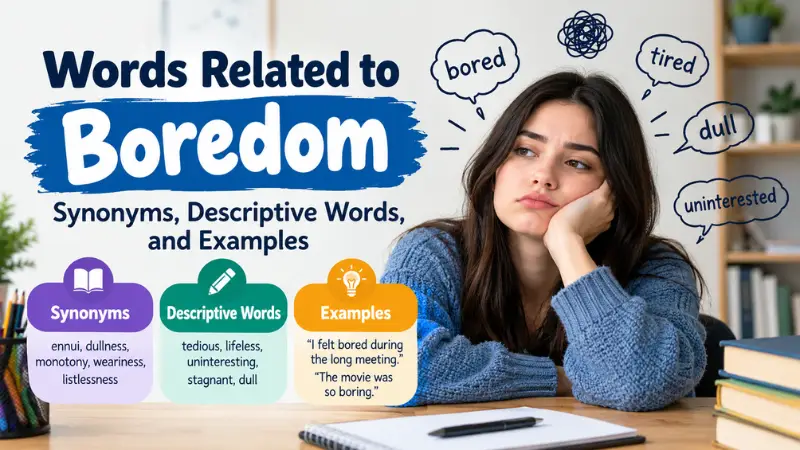
If you’re looking for words related to boredom, there are many options beyond simply saying “bored.” Common words include ennui, tedium, monotony, dullness, restlessness, weariness, inactivity, disinterest, and apathy. The best word depends on what kind of boredom you want to describe—whether it’s caused by repetition, a lack of activity, an uninteresting situation, or a feeling of emotional disengagement.
This guide explores words related to boredom, their meanings, synonyms, examples, and differences. It can help you find the right vocabulary for everyday conversation, school assignments, creative writing, professional communication, or simply expanding your English vocabulary.
What Are Words Related to Boredom?
Words related to boredom describe feelings, situations, activities, or experiences that lack interest, excitement, stimulation, or variety.
For example:
- Boredom — the feeling of having nothing interesting to do or experiencing a lack of stimulation.
- Tedium — boredom caused by something repetitive or tiresome.
- Monotony — a lack of variety that makes something feel dull.
- Ennui — a deeper feeling of dissatisfaction or weariness caused by a lack of excitement or meaning.
- Dullness — a quality of being uninteresting or lacking excitement.
- Restlessness — an inability to relax because you want something more stimulating to happen.
The words aren’t always exact synonyms. Each one can communicate a slightly different type or intensity of boredom.
Common Words Related to Boredom
Here are some of the most useful words associated with boredom:
| Word | Meaning | Example |
|---|---|---|
| Boredom | Lack of interest or stimulation | Boredom made the afternoon feel longer. |
| Tedium | Boring repetition or routine | He struggled with the tedium of the daily paperwork. |
| Monotony | Lack of variety | The monotony of the routine became exhausting. |
| Ennui | Deep dissatisfaction or weariness | She felt a sense of ennui after months of the same routine. |
| Dullness | Lack of excitement or interest | The dullness of the lecture made it difficult to focus. |
| Apathy | Lack of interest or enthusiasm | His apathy toward the project concerned his manager. |
| Restlessness | Desire for activity or change | Restlessness made it difficult for her to sit still. |
| Disinterest | Lack of interest | His disinterest in the topic was obvious. |
| Weariness | Tiredness or exhaustion | Mental weariness made the activity feel tedious. |
| Inactivity | Lack of activity | Long periods of inactivity can feel boring. |
| Repetition | Doing the same thing repeatedly | Repetition can make even a useful task boring. |
| Routine | Regular, repeated pattern | The same routine every day eventually felt dull. |
Synonyms for Boredom
If you need a synonym for boredom, the following words can work depending on the context.
1. Tedium
Tedium refers to boredom caused by something repetitive, lengthy, or tiresome.
Example:
The tedium of entering the same information into spreadsheets became frustrating.
Tedium is especially useful when describing boring work, repetitive tasks, or lengthy activities.
2. Monotony
Monotony describes a lack of variation or change.
Example:
The monotony of the daily commute made him wish for a change.
Unlike “boredom,” monotony often emphasizes the repetitive nature of the situation causing the feeling.
3. Ennui
Ennui is a more sophisticated word that describes a feeling of dissatisfaction, weariness, or lack of excitement.
Example:
After months without any new challenges, she experienced a growing sense of ennui.
This word is common in literary or formal writing and may suggest something deeper than ordinary boredom.
4. Dullness
Dullness means a lack of excitement, interest, or stimulation.
Example:
The dullness of the presentation caused several people to lose focus.
5. Apathy
Apathy means a lack of interest, enthusiasm, or concern.
Example:
His apathy toward the assignment was clear from the beginning.
Apathy is not exactly the same as boredom. Someone can be bored without being apathetic, and apathy can involve a broader lack of emotional interest.
6. Listlessness
Listlessness describes a lack of energy, enthusiasm, or motivation.
Example:
She spent the afternoon in a state of listlessness.
It can be useful when boredom is accompanied by low energy or motivation.
7. Restlessness
Restlessness describes an uncomfortable desire to move, change activities, or do something different.
Example:
After sitting through the long meeting, he became increasingly restless.
Restlessness is often associated with boredom but isn’t a direct synonym in every situation.
Words That Describe Feeling Bored
Sometimes you don’t need a noun like “boredom.” You may want an adjective or descriptive phrase that explains how someone feels.
Useful words include:
- Bored
- Restless
- Uninterested
- Disengaged
- Unstimulated
- Unenthusiastic
- Listless
- Weary
- Indifferent
- Apathetic
- Distracted
- Impatient
- Unoccupied
- Understimulated
Examples
- I was bored during the long presentation.
- She felt restless after spending the entire day indoors.
- The students became disengaged during the repetitive lesson.
- He seemed uninterested in the conversation.
- The lack of activities left everyone feeling unstimulated.
- After completing the same task for hours, she became weary.
Words Related to “Bored”
If you’re searching for words related to bored, these alternatives can help you avoid repetition.
Common alternatives
- Uninterested
- Restless
- Unengaged
- Unstimulated
- Disengaged
- Listless
- Apathetic
- Indifferent
- Unenthusiastic
- Impatient
- Distracted
- Unoccupied
Example
Instead of:
I was bored during the meeting.
You could write:
I felt restless during the meeting.
Or:
I became disengaged during the repetitive discussion.
Or:
The meeting left me feeling unstimulated.
The best choice depends on the exact feeling you want to communicate.
Words Related to “Boring”
The word boring can also be replaced with more specific descriptive words.
Alternatives to boring
- Dull
- Tedious
- Monotonous
- Repetitive
- Uninteresting
- Tiresome
- Predictable
- Mundane
- Lifeless
- Dry
- Uneventful
- Lackluster
- Uninspiring
- Routine
Examples
Instead of:
The movie was boring.
You could say:
The movie was predictable.
The presentation was dry.
The lecture was tedious.
The routine became monotonous.
The conversation was uninteresting.
These alternatives make your writing more precise because they explain why something feels boring.
Strong Words for Boredom
If you want to describe intense or prolonged boredom, consider these words and phrases:
- Deep ennui
- Extreme tedium
- Complete disinterest
- Persistent restlessness
- Emotional disengagement
- Total lack of stimulation
- Monotonous routine
- Endless repetition
- Weariness
- Listlessness
Example
After weeks of performing the same repetitive task, he experienced extreme tedium.
Or:
The endless routine created a persistent sense of restlessness.
These phrases are particularly useful in essays, stories, articles, and descriptive writing.
Casual and Everyday Words for Boredom
In everyday American English, people often use simple expressions instead of formal synonyms.
Some common phrases include:
- “I’m bored.”
- “This is boring.”
- “There’s nothing to do.”
- “I’m so over this.”
- “This is getting old.”
- “I’m tired of this.”
- “I’m losing interest.”
- “This is dragging.”
- “This is taking forever.”
- “I need something to do.”
- “I’m just sitting around.”
- “I’m getting restless.”
For casual conversation, these expressions usually sound more natural than formal words such as “ennui” or “tedium.”
Words Related to Boredom by Context
The right vocabulary can change depending on the situation.
Boredom at Work
When describing workplace boredom, useful terms include:
- Monotony
- Repetition
- Tedium
- Routine
- Disengagement
- Lack of stimulation
- Lack of challenge
- Unfulfilling work
Example:
The repetitive nature of the job created a sense of monotony.
Boredom at School
For school-related boredom, you might use:
- Disinterest
- Disengagement
- Unstimulating
- Repetitive
- Tedious
- Distracted
- Lack of engagement
Example:
Students became disengaged when the lesson relied too heavily on repetition.
Boredom in Everyday Life
For everyday situations, simple words usually work best:
- Bored
- Restless
- Uninterested
- Unoccupied
- Tired of it
- Nothing to do
- Looking for something to do
Example:
I was feeling restless because I had nothing planned for the weekend.
Boredom in Creative Writing
Creative writing gives you more freedom to describe boredom indirectly.
You could use phrases such as:
- The hours dragged on.
- Time seemed to stand still.
- The silence became unbearable.
- Every minute felt longer than the last.
- The routine had lost its appeal.
- The endless repetition drained his enthusiasm.
- She longed for something different.
- Nothing seemed to hold her attention.
These expressions can create a stronger image than simply writing “he was bored.”
Positive and Negative Words Associated With Boredom
Not every word related to boredom has the same emotional meaning.
| More Neutral | More Negative | More Descriptive |
|---|---|---|
| Routine | Tedium | Restlessness |
| Inactivity | Ennui | Listlessness |
| Repetition | Dullness | Disengagement |
| Unoccupied | Apathy | Unstimulated |
| Quiet | Tiresome | Monotonous |
For example, routine is not necessarily negative. A routine can be comforting and productive. However, a repetitive routine can eventually create monotony or tedium.
Boredom vs. Tedium vs. Monotony vs. Ennui
These words are related, but they aren’t interchangeable in every sentence.
Boredom
Boredom is the broadest term. It describes a general feeling of having little interest or stimulation.
Example:
I felt boredom while waiting for the appointment.
Tedium
Tedium emphasizes something tiring because it is repetitive or lengthy.
Example:
The tedium of filling out forms made the task unpleasant.
Monotony
Monotony emphasizes repetition and lack of variety.
Example:
The monotony of doing the same task every day became frustrating.
Ennui
Ennui suggests a deeper feeling of dissatisfaction, weariness, or lack of excitement.
Example:
The character struggled with ennui after achieving everything he wanted.
Quick comparison
Boredom = lack of interest
Tedium = tiring repetition
Monotony = lack of variety
Ennui = deeper dissatisfaction or weariness
Example Sentences Using Words Related to Boredom
Here are examples showing how different terms can be used naturally:
- Boredom:
Boredom quickly set in when the activity was canceled. - Tedium:
The tedium of the repetitive assignment made it difficult to stay focused. - Monotony:
She wanted to escape the monotony of her daily routine. - Ennui:
He experienced a sense of ennui after years of doing the same thing. - Restlessness:
Restlessness grew as the passengers waited for the delayed flight. - Apathy:
His apathy toward the project surprised his coworkers. - Listlessness:
The long, uneventful afternoon left everyone feeling listless. - Dullness:
The dullness of the presentation made the information difficult to remember. - Disengagement:
The teacher noticed signs of disengagement among the students. - Repetition:
Excessive repetition can make an otherwise useful task feel boring.
How to Choose the Right Word for Boredom
When choosing a synonym, first identify what kind of boredom you’re describing.
If you mean “nothing is interesting”
Use:
- Boredom
- Disinterest
- Uninterested
- Unstimulated
If you mean “doing the same thing repeatedly”
Use:
- Monotony
- Repetition
- Tedium
- Routine
If you mean “I want something to happen”
Use:
- Restlessness
- Impatience
- Unfulfilled
- Understimulated
If you mean “I don’t care anymore”
Use:
- Apathy
- Indifference
- Disengagement
- Lack of enthusiasm
If you mean “deep dissatisfaction”
Use:
- Ennui
- Weariness
- Listlessness
Choosing a precise word makes your writing clearer and more expressive.
How to Avoid Repeating the Word “Bored”
If you’re writing an essay, story, blog post, or article, repeatedly using “bored” can make your writing feel repetitive. Instead, describe the specific experience.
For example:
Basic:
Sarah was bored. She was bored at home and bored with her routine.
More descriptive:
Sarah had grown restless at home. The same routine had become monotonous, and she desperately wanted something new to break up the afternoon.
The second version gives the reader more information about the character’s experience.
Boredom-Related Vocabulary for Writing
If you’re building vocabulary, this group of words can be especially useful:
Feelings:
- Boredom
- Restlessness
- Apathy
- Ennui
- Listlessness
- Weariness
- Disinterest
Causes:
- Repetition
- Routine
- Inactivity
- Monotony
- Lack of stimulation
- Lack of variety
- Predictability
Descriptions:
- Dull
- Tedious
- Mundane
- Monotonous
- Tiresome
- Uninteresting
- Uneventful
- Lackluster
Actions or responses:
- Fidgeting
- Daydreaming
- Distracting yourself
- Looking for entertainment
- Checking the time
- Changing activities
- Seeking stimulation
What Can You Do When You’re Bored?
Understanding boredom is useful, but sometimes the simplest solution is to change what you’re doing.
If you’re bored, consider:
- Taking a walk
- Reading something new
- Learning a skill
- Trying a new hobby
- Calling a friend
- Organizing your space
- Exercising
- Cooking a new recipe
- Visiting a local place you’ve never explored
- Working on a creative project
- Listening to a podcast
- Taking a break from your usual routine
If your boredom comes from repetition, introducing variety or a new challenge can make an activity more engaging.
FAQs
Common alternatives for boredom include tedium, ennui, monotony, dullness, listlessness, and disinterest. The best synonym depends on the specific type of boredom you’re describing.
Ennui is a strong and sophisticated word associated with a deeper sense of dissatisfaction or weariness. Tedium can also describe intense boredom caused by repetitive or tiresome activities.
Five useful synonyms or closely related terms are tedium, ennui, monotony, dullness, and listlessness.
Depending on the context, you could use utterly bored, deeply bored, restless, listless, weary, or experiencing intense ennui. “Tedium” is also useful when the boredom comes from prolonged repetition.
Depending on the context, possible opposites include excitement, interest, enthusiasm, engagement, stimulation, enjoyment, and curiosity.
Not exactly. Ennui is related to boredom but often suggests a deeper feeling of dissatisfaction, weariness, or lack of fulfillment. Ordinary boredom can simply mean that something isn’t interesting.
Monotony is closely related to boredom but technically refers to a lack of variety or repetition. Monotony can cause boredom, but the two words don’t have exactly the same meaning.
Ennui is probably the most commonly recognized sophisticated word associated with boredom. Tedium is another useful formal term, particularly for repetitive or tiresome activities.
Conclusion
There are many words related to boredom, and each one can communicate a slightly different idea. Boredom is the general feeling, while tedium emphasizes tiresome repetition, monotony focuses on a lack of variety, and ennui suggests a deeper sense of dissatisfaction or weariness. Other useful terms include restlessness, apathy, listlessness, dullness, disinterest, and disengagement.
When choosing the right word, think about why someone is bored and how that boredom feels. A precise word can make your conversation, essay, story, or professional writing much more natural and expressive.
Whether you’re looking for a synonym, expanding your vocabulary, or trying to make your writing less repetitive, this list gives you plenty of alternatives to the simple word “boredom.”
SEO Metadata
Meta Title: Words Related to Boredom: Synonyms & Examples
Meta Description: Explore words related to boredom, including synonyms, meanings, descriptive terms, examples, and differences between tedium, monotony, and ennui.
URL Slug: words-related-to-boredom