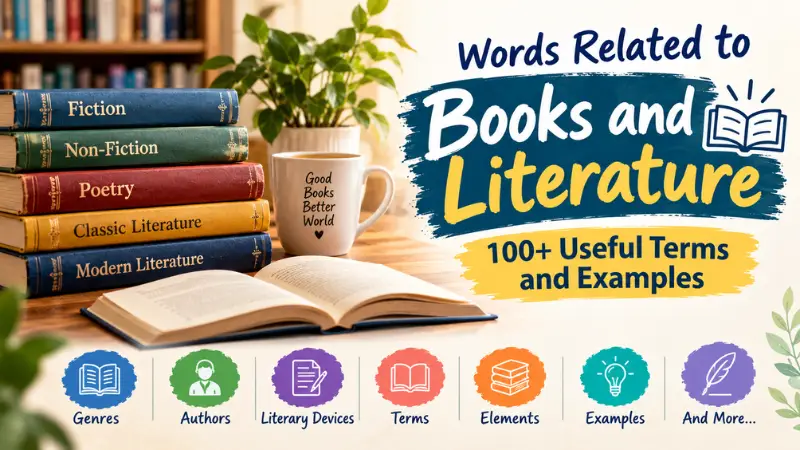
If you’re looking for words related to books and literature, you have plenty of options beyond simple terms such as book, novel, and author. Literary vocabulary includes words for reading, writing, storytelling, genres, characters, publishing, book structure, and literary analysis.
Whether you’re a student, writer, teacher, avid reader, or simply trying to expand your vocabulary, this guide provides 100+ words related to books and literature, with simple definitions and examples.
What Are Words Related to Books and Literature?
Words related to books and literature are terms commonly associated with reading, writing, storytelling, publishing, literary works, and the study of literature.
For example:
- Author — a person who writes a book or other written work.
- Novel — a long fictional prose narrative.
- Poetry — literary writing that often uses rhythm, imagery, and carefully chosen language.
- Character — a person, animal, or figure appearing in a story.
- Plot — the sequence of events that forms a story.
- Genre — a category or type of literary work.
- Chapter — a major section of a book.
- Narrator — the voice or character that tells a story.
- Publisher — a person or company involved in producing and distributing books.
The right word depends on what aspect of books or literature you are describing.
100+ Words Related to Books and Literature
Here is a broad vocabulary list organized by category.
| Word | Meaning |
|---|---|
| Author | Person who writes a literary work |
| Book | A written or printed work |
| Novel | A long fictional prose work |
| Novella | A fictional work shorter than a novel |
| Short story | A brief work of fiction |
| Poetry | Literary writing often using rhythm and imagery |
| Poem | A single piece of poetry |
| Play | A literary work written for performance |
| Drama | Literature intended for dramatic performance |
| Essay | A short piece of nonfiction writing |
| Biography | Account of another person’s life |
| Autobiography | Account of the author’s own life |
| Memoir | Personal account of experiences or events |
| Fiction | Imaginative or invented literature |
| Nonfiction | Writing based primarily on factual information |
| Anthology | Collection of selected literary works |
| Collection | Group of related written works |
| Manuscript | Original or unpublished written work |
| Publication | A work that has been published |
| Volume | A book or part of a larger series |
| Edition | A particular published version of a book |
| Series | Books connected by characters, setting, or theme |
| Sequel | Work that continues an earlier story |
| Prequel | Story set before an existing story |
| Prologue | Introductory section of a literary work |
| Epilogue | Concluding section after the main story |
| Chapter | Major division of a book |
| Paragraph | Group of related sentences |
| Page | One side of a sheet in a book |
| Cover | Outer protective part of a book |
| Title | Name of a book or literary work |
| Subtitle | Secondary title explaining or expanding the main title |
| Foreword | Introductory remarks often written by someone other than the author |
| Preface | Introduction written by the author or editor |
| Introduction | Opening section presenting a work or subject |
| Afterword | Closing remarks about a book |
| Appendix | Additional material placed at the end |
| Index | Alphabetical list of subjects or terms with page references |
| Glossary | List explaining specialized words |
| Footnote | Note placed at the bottom of a page |
| Bibliography | List of sources or works consulted |
| Reader | Person who reads |
| Reading | Activity of interpreting written language |
| Narrator | Voice telling a story |
| Character | Figure who appears in a story |
| Protagonist | Main character |
| Antagonist | Character or force opposing the protagonist |
| Plot | Sequence of events in a story |
| Setting | Time and place of a story |
| Theme | Central idea or message |
| Conflict | Struggle between opposing forces |
| Climax | Major turning point or highest tension |
| Resolution | Part where major conflicts are settled |
| Scene | A distinct part of a story or play |
| Chapter | A structural section of a book |
| Dialogue | Conversation between characters |
| Monologue | Extended speech by one character |
| Soliloquy | Speech expressing a character’s thoughts, traditionally while alone |
| Narration | Act of telling a story |
| Perspective | Position from which a story is presented |
| Point of view | Narrative perspective |
| First-person | Narration using “I” or “we” |
| Third-person | Narration referring to characters as “he,” “she,” or “they” |
| Imagery | Descriptive language creating sensory impressions |
| Metaphor | Comparison without using “like” or “as” |
| Simile | Comparison using “like” or “as” |
| Symbolism | Use of symbols to represent ideas |
| Irony | Contrast between expectation and reality |
| Foreshadowing | Hints about future events |
| Flashback | Narrative shift to an earlier event |
| Allusion | Reference to another work, person, or event |
| Satire | Writing that uses humor or criticism to expose problems |
| Allegory | Story with a deeper symbolic meaning |
| Motif | Recurring element associated with an idea |
| Tone | Author’s attitude toward the subject |
| Mood | Emotional atmosphere created for the reader |
| Style | Distinctive way an author uses language |
| Diction | Author’s choice of words |
| Syntax | Arrangement of words and sentences |
| Rhyme | Correspondence of sounds, especially at line endings |
| Rhythm | Pattern of beats or stresses in language |
| Stanza | Group of lines in a poem |
| Verse | A line or group of lines in poetry |
| Sonnet | Traditionally a 14-line poem |
| Haiku | Traditional Japanese poetic form |
| Epic | Long narrative poem or literary work |
| Fable | Short story conveying a moral |
| Myth | Traditional story involving cultural or supernatural elements |
| Folktale | Traditional story passed through generations |
| Fairy tale | Traditional or imaginative story often involving magical elements |
| Mystery | Genre centered on solving an unknown or crime |
| Romance | Genre focused on romantic relationships |
| Fantasy | Fiction involving magical or impossible elements |
| Science fiction | Fiction exploring science, technology, or speculative futures |
| Horror | Fiction intended to create fear or dread |
| Thriller | Story designed to create suspense and excitement |
| Historical fiction | Fiction set in a historical period |
| Adventure | Story involving journeys, challenges, or exciting experiences |
| Detective fiction | Fiction centered on investigation and solving crimes |
| Publisher | Person or company that publishes books |
| Editor | Person who reviews and improves written content |
| Proofreader | Person who checks text for errors |
| Illustrator | Person who creates illustrations |
| Translator | Person who converts writing from one language to another |
| Librarian | Professional who manages library resources |
| Bookstore | Store that sells books |
| Library | Place or institution providing access to books and other resources |
| Bestseller | Book that sells in very large numbers |
| Paperback | Book with a flexible paper-based cover |
| Hardcover | Book with a rigid cover |
| E-book | Digital version of a book |
| Audiobook | Recorded version of a book |
| ISBN | International Standard Book Number used to identify books |
Words Related to Books
If your goal is specifically to find words associated with books, these are some of the most useful terms:
Book, novel, novella, volume, edition, chapter, page, cover, title, author, reader, publisher, editor, manuscript, publication, paperback, hardcover, e-book, audiobook, bibliography, index, glossary, preface, foreword, introduction, appendix, and afterword.
Example Sentences
- I bought a new novel from the bookstore.
- The author released a revised edition.
- The book contains twelve chapters.
- I prefer reading paperback books while traveling.
- The publisher released the book in several countries.
- The audiobook is narrated by a professional actor.
Words Related to Literature
Literature has its own specialized vocabulary. These words are especially useful for students, teachers, reviewers, and writers.
Important Literary Terms
- Theme
- Plot
- Character
- Setting
- Conflict
- Narrator
- Point of view
- Symbolism
- Imagery
- Metaphor
- Simile
- Irony
- Foreshadowing
- Allusion
- Allegory
- Satire
- Motif
- Tone
- Mood
- Diction
- Style
- Narrative
- Dialogue
- Climax
- Resolution
These terms help readers explain how a literary work is constructed and what it means.
Words Related to Readin
If you’re looking for vocabulary connected to the act of reading, consider these words:
- Read
- Reading
- Reader
- Reread
- Browse
- Study
- Analyze
- Interpret
- Review
- Explore
- Examine
- Understand
- Comprehend
- Annotate
- Highlight
- Skim
- Scan
- Discuss
- Reflect
- Recommend
Example
Instead of saying:
“I read the book and liked it.”
You could write:
“I analyzed the novel’s themes and found its character development particularly compelling.”
This kind of vocabulary can make academic and professional writing more precise.
Words Related to Authors and Writing
Authors use many different terms to describe the process of creating literature.
| Word | Meaning |
|---|---|
| Author | Person who creates a written work |
| Writer | Person who writes |
| Novelist | Writer of novels |
| Poet | Writer of poetry |
| Playwright | Writer of plays |
| Screenwriter | Writer of scripts for film or television |
| Essayist | Writer of essays |
| Biographer | Writer of biographies |
| Editor | Person who revises and prepares text |
| Draft | Preliminary version of a written work |
| Manuscript | Author’s original written work |
| Revision | Process of improving a draft |
| Proofreading | Checking writing for errors |
| Publishing | Process of making a work available to readers |
Common Writing Terms
Authors may also work with:
- Plot
- Characterization
- Dialogue
- Narrative
- Setting
- Conflict
- Theme
- Structure
- Voice
- Style
- Perspective
- Description
- Pacing
Words for Different Book Genres
One of the easiest ways to expand your book-related vocabulary is to learn common literary genres.
Fiction Genres
- Fantasy
- Science fiction
- Mystery
- Thriller
- Horror
- Romance
- Adventure
- Historical fiction
- Literary fiction
- Crime fiction
- Dystopian fiction
- Young adult fiction
- Children’s fiction
Nonfiction Genres
- Biography
- Autobiography
- Memoir
- History
- Self-help
- Travel writing
- Essays
- Journalism
- Philosophy
- Psychology
- Science writing
- Reference books
A single book can sometimes fit into multiple genres. For example, a novel could be both historical fiction and romance.
Words to Describe a Book
If you’re writing a book review, recommendation, blog post, or social media caption, descriptive vocabulary can help.
Positive Words
- Engaging
- Compelling
- Captivating
- Thought-provoking
- Informative
- Insightful
- Entertaining
- Imaginative
- Original
- Memorable
- Moving
- Powerful
- Inspiring
- Suspenseful
- Emotional
- Well-written
- Absorbing
- Fascinating
Neutral or Analytical Words
- Complex
- Detailed
- Character-driven
- Plot-driven
- Fast-paced
- Slow-paced
- Descriptive
- Symbolic
- Historical
- Academic
- Narrative
- Experimental
- Philosophical
- Reflective
Example
Instead of:
“It is a good book.”
Try:
“It is a compelling, character-driven novel with a carefully developed plot and thought-provoking themes.”
Words Related to Book Parts
Understanding the parts of a book is useful when discussing its structure.
| Part | What It Does |
|---|---|
| Cover | Protects and identifies the book |
| Title page | Displays the title and publication information |
| Table of contents | Lists chapters or sections |
| Preface | Provides introductory remarks |
| Introduction | Introduces the subject or work |
| Chapter | Divides the main content |
| Footnote | Provides additional information or citations |
| Appendix | Contains supplementary information |
| Glossary | Defines specialized terms |
| Bibliography | Lists sources or related works |
| Index | Helps readers locate topics |
| Afterword | Provides concluding commentary |
Words Related to Storytelling
Storytelling vocabulary is particularly useful for writers and literature students.
Core Story Elements
- Plot — what happens in the story.
- Character — who participates in the story.
- Setting — where and when the story takes place.
- Conflict — the central struggle.
- Theme — the deeper idea or message.
- Narrator — who tells the story.
- Point of view — the perspective used to tell it.
- Climax — the major turning point.
- Resolution — how the main conflict ends.
For example, in a mystery novel, the plot may revolve around a crime, the protagonist may be a detective, and the conflict may involve discovering the identity of the culprit.
Literary Devices and Their Meanings
Literary devices make writing more expressive and meaningful.
| Literary Device | Simple Definition | Example |
|---|---|---|
| Metaphor | Direct comparison | “Time is a thief.” |
| Simile | Comparison using “like” or “as” | “Her voice was like music.” |
| Personification | Giving human qualities to nonhuman things | “The wind whispered.” |
| Hyperbole | Deliberate exaggeration | “I’ve told you a million times.” |
| Alliteration | Repetition of initial sounds | “Wild winds whispered.” |
| Imagery | Language appealing to the senses | Description of a warm, fragrant bakery |
| Symbolism | Object representing a larger idea | A dove representing peace |
| Foreshadowing | Hint about something later | A warning before a dangerous event |
| Irony | Contrast between expectation and reality | A fire station catching fire |
| Allusion | Indirect reference | Referring to a famous historical event |
Words Related to Poetry
Poetry has specialized vocabulary that differs somewhat from ordinary prose.
Common poetry terms include:
- Poem
- Poet
- Verse
- Stanza
- Line
- Meter
- Rhythm
- Rhyme
- Rhyme scheme
- Sonnet
- Haiku
- Ode
- Elegy
- Ballad
- Free verse
- Imagery
- Metaphor
- Simile
- Symbolism
- Alliteration
Example
A stanza is a group of lines in a poem, somewhat similar to a paragraph in prose.
A sonnet is traditionally a 14-line poem, although different sonnet traditions use different rhyme schemes and structures.
Words Related to Publishing
Publishing vocabulary is useful if you’re interested in how a manuscript becomes a finished book.
Important terms include:
- Manuscript
- Publisher
- Publishing house
- Editor
- Copy editor
- Proofreader
- Book designer
- Illustrator
- ISBN
- Copyright
- Edition
- Print run
- Paperback
- Hardcover
- Distribution
- Bookstore
- Bestseller
- Self-publishing
- E-book
- Audiobook
Traditional vs. Self-Publishing
Traditional publishing generally involves submitting a manuscript to a publisher, while self-publishing allows an author to publish a book independently using available publishing platforms and services.
Words Related to Book Reviews
If you’re writing a review, these terms can help you explain your opinion more accurately:
- Review
- Critique
- Analysis
- Evaluation
- Recommendation
- Rating
- Plot
- Characterization
- Pacing
- Writing style
- Theme
- Setting
- Narrative
- Strength
- Weakness
- Perspective
Useful Review Phrases
- “The novel explores…”
- “The author develops…”
- “The central theme is…”
- “The narrative focuses on…”
- “The character development is…”
- “The pacing becomes faster when…”
- “The book offers an insightful perspective on…”
Book and Literature Vocabulary by Category
For quick reference, here is a simplified word family.
| Category | Related Words |
|---|---|
| Books | novel, volume, edition, chapter, paperback |
| Reading | reader, reading, comprehension, annotation |
| Writing | author, writer, draft, revision, manuscript |
| Literature | fiction, poetry, drama, prose, narrative |
| Storytelling | plot, character, setting, conflict, theme |
| Poetry | verse, stanza, meter, rhyme, sonnet |
| Publishing | publisher, editor, ISBN, edition, distribution |
| Analysis | symbolism, imagery, tone, mood, theme |
| Genres | fantasy, mystery, romance, horror, thriller |
| Book parts | cover, title page, preface, appendix, index |
How to Choose the Right Literary Word
When writing about books, avoid using the same general words repeatedly.
For example, instead of repeatedly writing “book,” choose a more specific term when appropriate:
- Novel for a long fictional prose work
- Memoir for a personal account
- Biography for an account of someone’s life
- Anthology for a collection of works
- Poetry collection for a book containing poems
- Textbook for an educational book
- Monograph for a detailed scholarly work on a specific subject
Likewise, instead of repeatedly saying “story,” consider:
- Narrative
- Tale
- Plot
- Account
- Fiction
- Literary work
The key is accuracy rather than simply using more complicated vocabulary.
Why Learning Book and Literature Vocabulary Matters
Knowing literature-related vocabulary can make communication clearer and more precise.
It can help you:
- Write stronger book reviews.
- Understand literary criticism.
- Discuss novels and poems more effectively.
- Improve academic writing.
- Expand your English vocabulary.
- Describe books accurately.
- Analyze stories and characters.
- Communicate with other readers and writers.
- Better understand publishing terminology.
For students, learning these terms can also make it easier to understand literature assignments and classroom discussions.
FAQs
Words related to books and literature include author, novel, reader, chapter, plot, character, setting, theme, poetry, fiction, nonfiction, narrator, genre, publisher, manuscript, and symbolism. The appropriate term depends on whether you are discussing a book, its content, its author, or literary analysis.
Common words associated with books include novel, chapter, author, reader, cover, title, edition, publisher, library, bookstore, paperback, hardcover, e-book, audiobook, and manuscript.
Some of the most important literary terms are plot, character, setting, conflict, theme, narrator, point of view, imagery, symbolism, metaphor, simile, irony, tone, mood, and foreshadowing.
A person who writes books can be called an author or writer. More specific terms include novelist for someone who writes novels, poet for poetry, playwright for plays, and biographer for biographies.
Major types of literature include fiction, nonfiction, poetry, and drama. These broad categories contain many genres, including fantasy, mystery, romance, science fiction, historical fiction, biography, memoir, essays, and others.
Fiction generally presents invented characters, events, or worlds, while nonfiction is primarily based on factual information, real people, or real events. Some works can blend factual and fictional techniques.
Words that can describe a good book include engaging, compelling, captivating, insightful, thought-provoking, memorable, imaginative, powerful, informative, absorbing, and well-written.
A novel is a longer fictional prose work, while a novella is generally shorter than a novel but longer than a short story. There is no single universal word-count boundary that applies to every publishing or literary context.
Conclusion
There are hundreds of words related to books and literature, ranging from basic vocabulary such as book, author, and reader to specialized literary terms such as foreshadowing, symbolism, allegory, diction, and narrative perspective.
Learning these words can help you talk about books more precisely, write better reviews, understand literary analysis, and expand your English vocabulary.
Start with the most useful terms—author, novel, genre, plot, character, setting, theme, narrator, symbolism, and publisher—and gradually add more specialized vocabulary as you read.
Which literature-related words do you use most often? Save this list as a reference and share it with other readers, writers, and students who want to build their vocabulary.
SEO Meta Title
Words Related to Books and Literature: 100+ Terms
Meta Description
Explore 100+ words related to books and literature, including literary terms, genres, book parts, reading, writing, publishing, and examples.
Suggested URL Slug
/words-related-to-books-and-literature/