
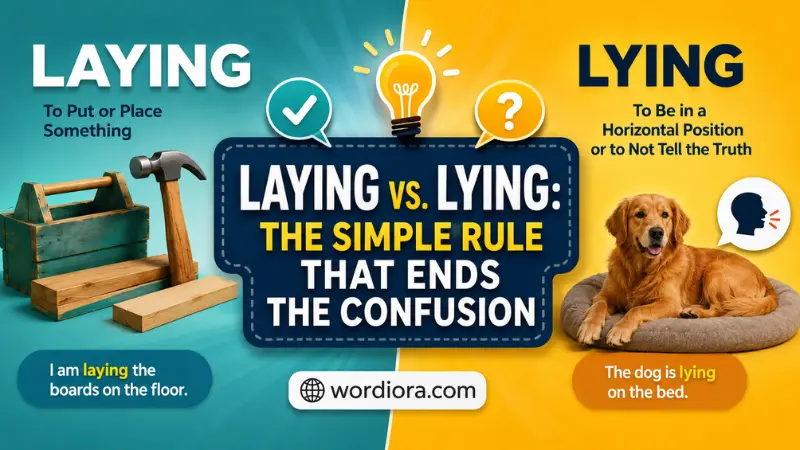
Laying” and “lying” trip up even careful writers. They sound almost identical, they both describe something in a horizontal position, and English never bothered to make the rule obvious. This guide clears it up in plain terms, with real examples you can use today.
Quick Answer
Use laying when someone puts something down. Use lying when someone or something is resting, reclining, or staying in place on its own — or when someone is telling an untruth.
- She is laying the napkins on the table.
- The dog is lying on the porch.
- He got caught lying about the accident.
Why People Confuse Them
The confusion comes from three things stacking on top of each other. First, “lay” and “lie” sound similar and look similar in print. Second, “lay” is also the past tense of “lie” (“Yesterday I lay in bed all morning”), which makes the whole pair feel unstable. Third, “lying” carries two completely separate meanings — reclining and not telling the truth — so the same word can mean two different things depending on context.
Key Differences At A Glance
| Feature | Laying | Lying |
|---|---|---|
| Base verb | lay | lie |
| Needs an object? | Yes | No |
| Meaning | putting something down | resting in place / telling an untruth |
| Example | laying a blanket down | lying on the couch |
Meaning and Usage Difference
The core grammar difference is simple once you see it clearly: lay is transitive and requires an object to act upon, while lie is intransitive and describes something moving on its own or already in position. Reader’s Digest
Laying always needs something to place. You’re laying a book, laying bricks, laying groundwork, or a hen is laying eggs. If you can’t name the thing being placed, “laying” is the wrong word.
Lying never takes an object in this sense. The recline sense of lie is commonly used in the phrase “lie down,” and using “lay down” for the same meaning is considered nonstandard, though very common in casual speech. “Lying” also covers the separate meaning of saying something false — “He’s lying about where he was.” GrammarBrain
A fast mental test: if you can swap the word for “placing,” you want laying. If you can swap it for “resting” or “reclining,” you want lying.
Tone, Context, and Formality
Both words are standard in everyday American English, spoken and written. Neither one is formal or informal on its own — the confusion is grammatical, not stylistic.
That said, “lay down” (instead of “lie down”) shows up constantly in casual speech and song lyrics. It’s widely understood, but in formal writing, resumes, essays, or professional emails, stick to “lying down” for the reclining sense. Save “laying” strictly for sentences with a direct object.
Which One Should You Use?
- Talking about a person or animal resting? Use lying.
- Talking about placing an object somewhere? Use laying.
- Talking about someone telling an untruth? Use lying.
- Talking about a hen producing eggs? Use laying.
If you’re mid-sentence and unsure, ask: “Is there a thing being placed down?” If yes, laying. If no, lying.
When One Choice Sounds Wrong
- “The cat is laying on the bed” sounds wrong to careful readers because there’s no object — it should be lying.
- “She is lying the plates on the table” sounds wrong because plates need to be placed by someone — it should be laying.
- “I’ve been lieing to myself” is simply misspelled — the correct spelling is always lying, never “lieing.”
Common Mistakes
| Mistake | Fix |
|---|---|
| “I’m laying down for a nap.” | “I’m lying down for a nap.” |
| “The tiles are lying themselves.” | “The tiles are being laid.” |
| “She was laying in the sun.” | “She was lying in the sun.” |
| “He’s laying eggs” (about a hen — correct!) | Keep laying, since eggs are the object. |
Everyday Examples
- The painter is laying the drop cloth before starting.
- The dog has been lying by the door all afternoon.
- Workers are laying new pipes under the street.
- The toddler is lying on the rug, watching cartoons.
- Stop lying to me about the schedule.
- The construction crew is laying the foundation this week.
Dictionary-Style Word Details
Verb
- Laying: the present participle of “lay,” a transitive verb meaning to put or place something down. Example role: “She is laying the tools on the workbench.”
- Lying: the present participle of “lie,” an intransitive verb meaning to be in a horizontal position, or to make an untrue statement. Example role: “He is lying on the grass” / “He is lying about his age.”
Noun
Neither “laying” nor “lying” is commonly used as a standalone noun in standard US English. Both function almost exclusively as verb forms (gerunds can act noun-like, as in “Laying tile takes patience” or “Lying is never worth it,” but these aren’t standard dictionary nouns).
Synonyms
- Laying: placing, setting down, positioning (closest plain alternatives — not exact one-word matches in every context)
- Lying (reclining): reclining, resting, stretched out
- Lying (untruth): fibbing, deceiving
- Antonym note: for the untruth sense, a fitting antonym is “telling the truth”; for the reclining sense, “standing” or “sitting up” work as situational opposites, though they aren’t true grammatical antonyms.
Example Sentences
- Laying: “The crew spent the morning laying cable along the road.”
- Lying (recline): “The cat has been lying in that same spot for hours.”
- Lying (untruth): “It became obvious he was lying during the interview.”
Word History
Both words trace back to related but distinct Old English verbs — “lecgan” (to lay) and “licgan” (to lie) — which is part of why they’ve stayed confusingly similar for centuries. Beyond that shared root, clear, verified details about how the confusion evolved over time are limited in current public sources, so this guide won’t speculate further.
Phrases Containing
- Laying: laying down the law, laying groundwork, laying it on thick, laying eggs
- Lying: lying in wait, lying low, lying through your teeth, lying in state
FAQs
“Lying down” is correct in standard usage since no object is involved. “Laying down” is common in casual speech but is considered nonstandard unless you add an object, as in “laying the baby down.”
It’s an extremely common casual shortcut, and most listeners won’t blink at it. In formal writing, though, “lying down” is the accepted form.
Yes. Here, “the law” is the object being placed, so “laying” fits the grammar rule.
Yes. There’s no object — someone is simply staying in position — so “lying” is right.
Lay becomes laid (“She laid the book down”). Lie becomes lay for the reclining sense (“He lay on the couch”) and lied for the untruth sense (“He lied about it”).
No — the grammar rule is identical in both. The only difference is that “lying” tends to show up more often in relaxed American speech.
Conclusion
The rule behind laying vs. lying isn’t complicated once it’s isolated: laying always needs something to place, lying never does. Keep that one test in mind, and the rest of the confusion falls away.