
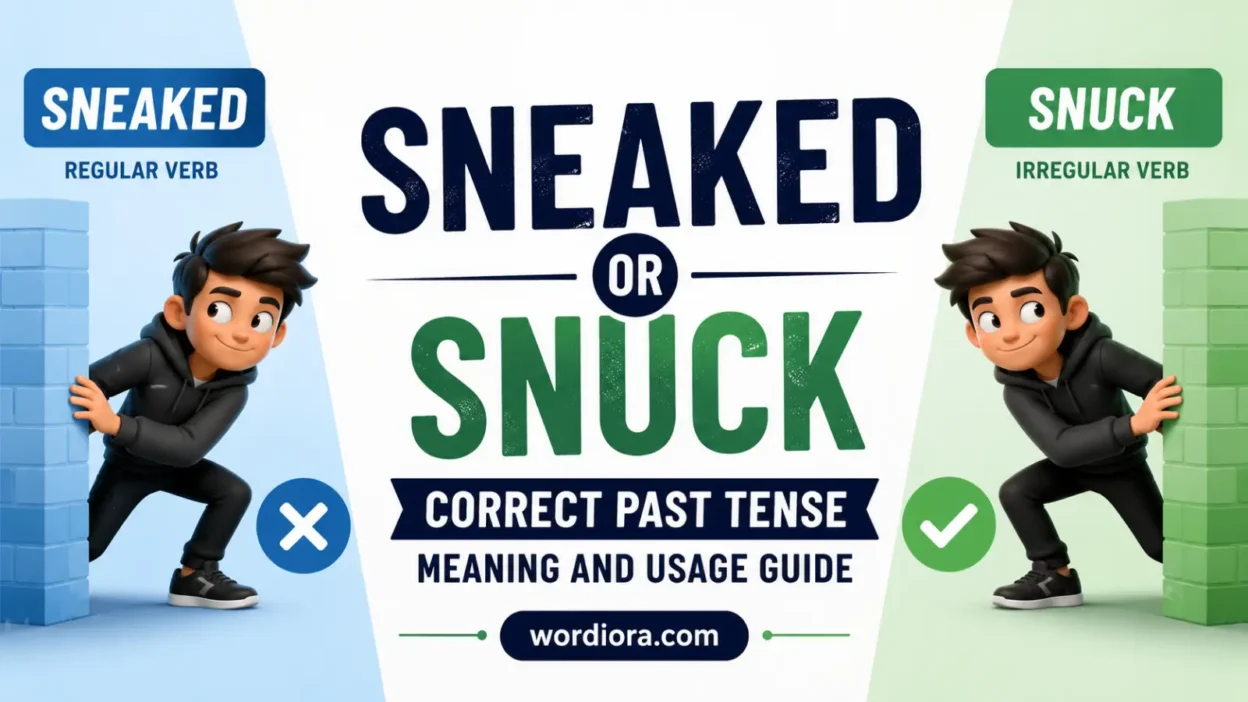
Sneaked or snuck is a common word-choice question because both forms are used as the past tense of sneak. You may hear “I snuck out early” in everyday speech, but you may also see “I sneaked out early” in edited writing.
The good news is simple: both forms can be correct in modern US English. However, they do not carry the same tone. Sneaked sounds more traditional and safer in formal writing. Snuck sounds natural, casual, and common in American conversation.
Quick Answer
Use sneaked when you want the safest choice, especially in formal, academic, business, or edited writing. Use snuck when you want a natural American sound in casual writing or dialogue. Both mean the same thing: moved, entered, left, took, or did something secretly.
Why People Confuse Them
People confuse sneaked and snuck because English has both regular and irregular past tense forms. A regular verb usually adds -ed, as in walk/walked or talk/talked. By that pattern, sneak becomes sneaked.
However, English also has irregular forms like stick/stuck and strike/struck. Because snuck follows that kind of pattern, many speakers treat it as a natural past form. As a result, both forms now exist side by side.
The confusion gets stronger because some teachers, editors, and style guides still prefer sneaked, while many Americans say snuck without thinking twice.
Key Differences At A Glance
| Context | Best Choice | Why |
|---|---|---|
| Formal essay | sneaked | It is the more traditional and safest form. |
| Business writing | sneaked | It avoids distracting readers who dislike snuck. |
| News-style writing | sneaked | Many edited styles still favor the regular form. |
| Casual conversation | snuck | It sounds natural in American speech. |
| Fiction dialogue | snuck | It can sound more realistic and conversational. |
| Past perfect tense | sneaked or snuck | Both can work after “had” in US English. |
| Unsure audience | sneaked | It is least likely to be questioned. |
Meaning and Usage Difference
Sneaked and snuck have the same basic meaning. Both are past tense and past participle forms of sneak.
Use either form when someone moved secretly:
“I sneaked through the side door.”
“I snuck through the side door.”
Both sentences mean the same thing.
You can also use either form when someone did, took, or moved something secretly:
“She sneaked a look at the answer key.”
“She snuck a look at the answer key.”
The difference is not meaning. The real difference is form and tone. Sneaked is the regular past form. Snuck is the irregular past form. In US English, both are common, but sneaked feels more formal and less likely to bother strict readers.
Pronunciation is simple. Sneaked sounds like “sneekt.” Snuck rhymes with “truck.”
Tone, Context, and Formality
Sneaked fits careful writing. It sounds polished, traditional, and neutral. For school papers, workplace reports, formal emails, and edited articles, sneaked is usually the better choice.
Snuck fits relaxed writing. It sounds direct, casual, and very American. In dialogue, personal stories, social captions, and everyday messages, snuck often feels more natural.
This does not mean snuck is wrong. It means some readers still see it as less formal. When tone matters, choose the form that matches the setting.
Extra comparison:
| Feature | sneaked | snuck |
|---|---|---|
| Verb pattern | Regular | Irregular |
| Tone | More formal | More casual |
| US use | Standard | Standard and common |
| Safest for strict readers | Yes | Not always |
| Best for dialogue | Sometimes | Often |
Which One Should You Use?
Choose sneaked when your reader expects polished language. It is the safer option for assignments, workplace writing, formal articles, and any sentence where you do not want the verb form to draw attention.
Choose snuck when the sentence needs a natural spoken feel. It works well in casual stories, character dialogue, texts, captions, and informal posts.
If you are editing for a broad US audience and have no special style rule, either form can work. Still, consistency matters. Do not switch between sneaked and snuck in the same piece unless you have a clear reason, such as dialogue from different characters.
When One Choice Sounds Wrong
Snuck can sound too casual in a serious sentence:
“The employee snuck confidential files out of the office.”
That sentence is understandable, but sneaked may sound better in a formal report:
“The employee sneaked confidential files out of the office.”
On the other hand, sneaked can sound a little stiff in casual dialogue:
“I sneaked out after midnight.”
Many Americans would naturally say:
“I snuck out after midnight.”
Neither version changes the meaning. The better choice depends on the voice of the sentence.
Common Mistakes (and Quick Fixes)
Mistake: Treating snuck as always wrong.
Fix: In modern US English, snuck is widely accepted, especially in casual contexts.
Mistake: Using snuck in very formal writing without checking the tone.
Fix: Use sneaked when you want the safest, most traditional choice.
Mistake: Writing “had sneak” instead of a past participle.
Fix: Use had sneaked or had snuck.
Incorrect: “They had sneak into the room.”
Correct: “They had sneaked into the room.”
Correct: “They had snuck into the room.”
Mistake: Switching forms for no reason.
Fix: Pick one style and stay consistent.
Mistake: Thinking the two words have different meanings.
Fix: They mean the same thing. The difference is grammar pattern and tone.
Everyday Examples
“She sneaked into the meeting five minutes late.”
“He snuck into the kitchen for another slice of cake.”
“The cat sneaked under the bed during the thunderstorm.”
“My brother snuck my charger into his backpack.”
“We sneaked out before traffic got worse.”
“They snuck past the crowd and found better seats.”
“The student sneaked a glance at the clock.”
“She snuck a note into his lunch bag.”
“The dog sneaked through the open gate.”
“He had snuck into the garage before anyone noticed.”
“They had sneaked away from the party early.”
“I snuck a peek at the surprise gift.”
Dictionary-Style Word Details
Verb
Sneaked: A past tense and past participle form of the verb sneak. It follows the regular verb pattern by adding -ed.
Example: “The kids sneaked into the backyard.”
Snuck: A past tense and past participle form of the verb sneak. It follows an irregular pattern and is common in US English.
Example: “The kids snuck into the backyard.”
Noun
Sneaked: Not commonly used as a noun in standard US English. It is normally a verb form.
Snuck: Not commonly used as a noun in standard US English. It is normally a verb form.
Synonyms
Sneaked: Closest plain alternatives include crept, slipped, stole, tiptoed, and moved quietly, depending on the sentence.
Snuck: Closest plain alternatives are the same: crept, slipped, stole, tiptoed, and moved quietly.
Clear antonyms are not always exact because the meaning depends on context. In some sentences, plain opposites include entered openly, left openly, announced, or revealed.
Example Sentences
Sneaked: “She sneaked out of the office after the last meeting ended.”
Sneaked: “The player sneaked past the defender and scored.”
Sneaked: “A typo sneaked into the final draft.”
Snuck: “He snuck into the movie after the previews started.”
Snuck: “The cat snuck behind the couch.”
Snuck: “I had snuck a snack into my bag.”
Word History
Sneaked: This is the older, regular past tense form of sneak. It follows the normal -ed pattern.
Snuck: This is a newer irregular form. Its exact development is not fully certain, but it became common in American use and is now widely accepted in modern US English.
Phrases Containing
Sneaked:
• sneaked out
• sneaked in
• sneaked away
• sneaked past
• sneaked a look
• had sneaked
Snuck:
• snuck out
• snuck in
• snuck away
• snuck past
• snuck a peek
• had snuck
FAQs
Is snuck a real word?
Yes, snuck is a real word. In modern US English, it is widely accepted as a past tense and past participle form of sneak. For example, “He snuck out early” sounds natural in casual American speech. However, some formal editors still prefer sneaked, especially in academic or professional writing.
Is sneaked or snuck correct?
Both sneaked and snuck are correct in modern US English. They mean the same thing, but they do not always fit the same tone. Sneaked is more traditional and formal, while snuck is more conversational. When writing for school, work, or a formal audience, sneaked is usually the safer choice.
Should I use sneaked or snuck in formal writing?
Use sneaked in formal writing. It sounds more polished and is less likely to distract strict readers. For example, “The employee sneaked into the restricted area” sounds better in a report than “The employee snuck into the restricted area.” The meaning is the same, but the tone is more professional.
Is snuck only American English?
Snuck is especially common in American English. Many US speakers use it naturally in conversation. It may appear in other English varieties too, but some readers outside the US may still prefer sneaked. For a broad or formal audience, sneaked remains the safer form.
Can I say had snuck?
Yes, you can say had snuck in modern US English. For example, “She had snuck into the room before anyone noticed” is understandable and common. Still, had sneaked is more formal and traditional, so it may work better in careful writing.
Do sneaked and snuck mean different things?
No, sneaked and snuck do not have different meanings. Both describe moving, entering, leaving, taking, or doing something secretly. The real difference is tone: sneaked is more formal, while snuck sounds more casual and natural in everyday American speech.
Conclusion
Sneaked and snuck are both correct past tense and past participle forms of sneak in modern US English. They do not have different meanings, but they do have different tones.
For formal writing, choose sneaked. For casual American speech, dialogue, and relaxed writing, snuck is natural and acceptable. When you want the least risky choice, sneaked is the better answer.