
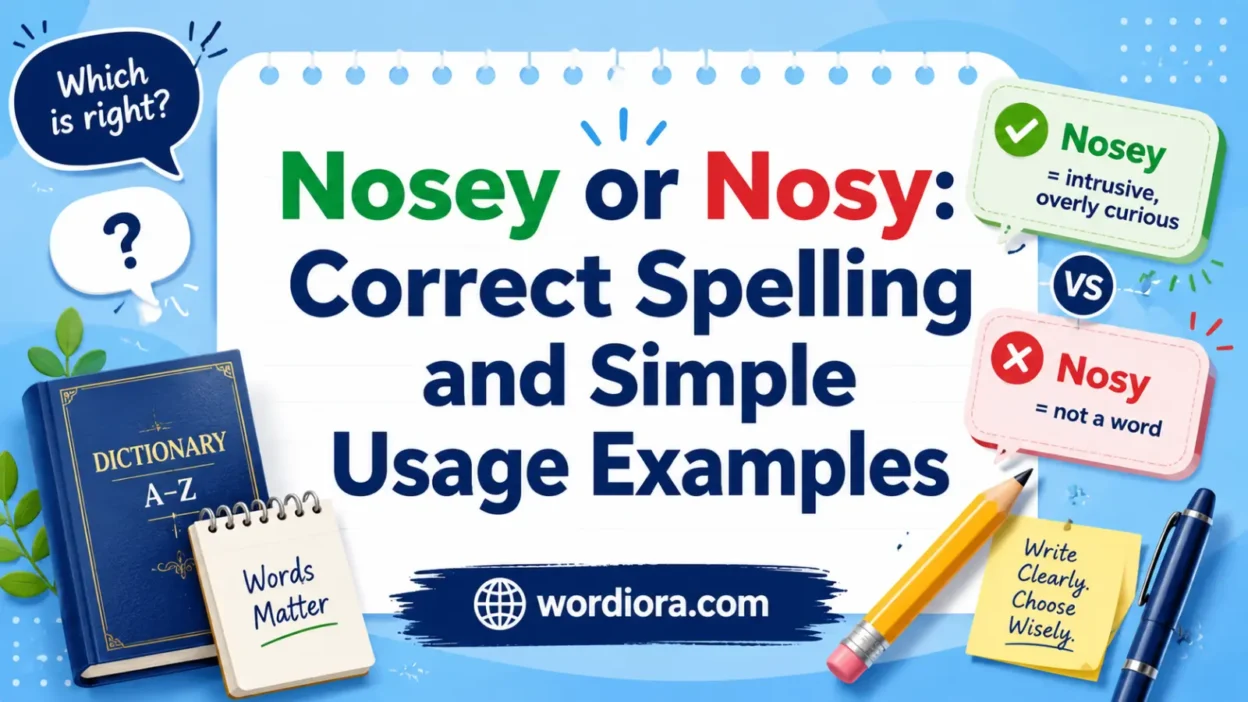
Should you write nosey or nosy? In modern US English, nosy is the better default spelling. It is the form most readers expect in schoolwork, emails, articles, and professional writing.
Nosey is not usually wrong. It is an accepted variant spelling of the same adjective. Still, it can look less standard to many US readers. The meaning does not change, but the spelling choice can affect how polished your sentence feels.
Quick Answer
Use nosy in almost all modern US writing. It means too interested in other people’s private business. Nosey means the same thing, but it is a less common variant spelling. For clear, standard, professional writing, choose nosy.
Example:
Correct: My neighbor is nosy about everyone’s weekend plans.
Also possible: My neighbor is nosey about everyone’s weekend plans.
Why People Confuse Them
People confuse nosey and nosy because both forms make sense visually. The word comes from the idea of putting your “nose” into someone else’s business, so many writers expect the spelling to keep the e from nose.
That logic makes nosey feel natural. However, English spelling often drops a final e before adding y. That pattern helps explain why nosy became the cleaner standard form.
Another reason is simple exposure. People see both spellings online, in comments, captions, and casual posts. Because both forms appear in real writing, it is easy to wonder whether one is wrong.
Key Differences At A Glance
| Context | Best Choice | Why |
|---|---|---|
| School writing | nosy | It is the standard spelling. |
| Professional emails | nosy | It looks cleaner and more expected. |
| Blog posts | nosy | It fits modern US usage. |
| Dialogue or casual tone | nosy | Still the safest spelling. |
| Quoting someone’s spelling | nosey | Keep the original form if accuracy matters. |
| Informal creative writing | nosey | Acceptable if you want that look, but less standard. |
| Describing intrusive questions | nosy | The meaning is clear and familiar. |
Meaning and Usage Difference
Nosy means overly curious about private matters. A nosy person asks questions, checks details, or tries to learn things that are not really their business.
Nosey has the same meaning. The difference is not meaning, grammar, or pronunciation. The difference is spelling preference.
Use nosy when you want the standard form:
Correct: Stop asking nosy questions about my salary.
Correct: The reporter sounded nosy, not helpful.
Correct: Our dog gets nosy whenever we open a grocery bag.
Use nosey only when you are comfortable with a less common variant:
Acceptable: My aunt can be a little nosey at family dinners.
Acceptable: That was a nosey question.
Both forms are adjectives. They describe a person, question, habit, attitude, or behavior.
Tone, Context, and Formality
Both nosy and nosey usually carry a negative tone. They suggest that someone is crossing a boundary.
For example, a curious person wants to learn. A nosy person wants to know things that may be private. That is why nosy often sounds critical.
Compare these sentences:
Curious: She asked thoughtful questions about the project.
Nosy: She asked nosy questions about my personal life.
In formal or edited US writing, nosy is the stronger choice. Nosey can look more casual, old-fashioned, or less polished, even though readers will understand it.
Pronunciation is not a major issue here. Both forms are said the same way: NOH-zee.
Which One Should You Use?
Choose nosy unless you have a specific reason to use nosey.
That simple choice works for most writing:
• Use nosy in essays.
• Use nosy in business writing.
• Use nosy in articles and captions.
• Use nosy when correcting someone’s spelling.
• Use nosy when you want the safest US-English form.
Choose nosey only if you are quoting a title, copying someone’s exact wording, or using a more informal spelling on purpose.
Small comparison:
| Feature | Nosey | Nosy |
|---|---|---|
| Meaning | Too interested in private matters | Too interested in private matters |
| Grammar | Adjective | Adjective |
| Standard US choice | Less common variant | Preferred spelling |
| Best for formal writing | Not the best choice | Yes |
| Pronunciation | NOH-zee | NOH-zee |
When One Choice Sounds Wrong
Nosey may sound or look wrong in formal writing because many readers expect nosy. Even if it is accepted, it can distract readers.
Less polished: The manager asked a nosey question about my vacation.
Better: The manager asked a nosy question about my vacation.
Nosy rarely sounds wrong when the meaning is “too interested in private business.” It is the safer spelling in nearly every normal sentence.
However, do not use nosy when you mean noisy. These are different words.
Wrong: The restaurant was too nosy to hear the music.
Correct: The restaurant was too noisy to hear the music.
Nosy is about private business. Noisy is about sound.
Common Mistakes (and Quick Fixes)
Mistake 1: Using nosey in formal writing
Less polished: Please do not be nosey about the client’s records.
Better: Please do not be nosy about the client’s records.
Mistake 2: Treating nosey and nosy as different meanings
Wrong idea: Nosey means curious, and nosy means rude.
Better: Both mean the same thing, but nosy is the standard spelling.
Mistake 3: Confusing nosy with noisy
Wrong: The kids were nosy during the movie.
Correct: The kids were noisy during the movie.
Mistake 4: Using nosy when you mean interested
Too harsh: Thanks for being nosy about my new job.
Better: Thanks for being interested in my new job.
Mistake 5: Overusing the word in polite situations
Blunt: Why are you so nosy?
Softer: I’d rather keep that private.
Everyday Examples
My sister is nosy about every package that arrives.
The neighbor asked a nosy question about our rent.
I do not want to sound nosy, but are you okay?
That was too personal and a little nosy.
The kids got nosy when they saw the birthday gifts.
A nosy coworker kept asking about my interview.
Please stop reading my messages. That is nosy.
His nosey comment made the room feel awkward.
The host gave a polite answer to a nosy question.
Our cat gets nosy whenever we bring home a new box.
Dictionary-Style Word Details
Verb
• Nosey: Not commonly used as a verb in standard US English. Use pry, snoop, or poke around instead.
Example: Do not snoop through my desk.
• Nosy: Not commonly used as a verb in standard US English. It is normally an adjective.
Example: She is nosy about other people’s plans.
Noun
• Nosey: Not normally used as a common noun in standard US English. However, it can appear in names, titles, nicknames, or fixed expressions.
• Nosy: Not normally used as a common noun. The noun form is nosiness, which means intrusive curiosity.
Example: His nosiness annoyed the whole team.
Synonyms
• Nosey: Closest plain alternatives: nosy, prying, snoopy, intrusive, meddlesome, overly curious.
• Nosy: Closest plain alternatives: prying, snoopy, intrusive, inquisitive, meddlesome, curious in a negative way.
Helpful antonyms: respectful, discreet, private, uninterested, detached.
Use care with curious. It can be positive or neutral. Nosy is usually negative.
Example Sentences
• Nosey: Her nosey cousin kept asking how much the house cost.
• Nosey: I ignored the nosey comment and changed the subject.
• Nosy: A nosy reporter followed the family outside.
• Nosy: He sounded nosy when he asked about my bank account.
• Nosy: Try not to be nosy when someone says they need space.
Word History
• Nosey: This spelling likely feels natural because it keeps the word nose visible. It is best treated as a variant spelling, not a separate word with a different meaning.
• Nosy: This is the standard spelling used as the main form in modern dictionaries. It connects to the idea of putting one’s nose into someone else’s affairs. Avoid making stronger history claims unless a source clearly supports them.
Phrases Containing
• Nosey: Nosey parker is a phrase meaning a person who is too interested in other people’s private business. It is not the most common phrase in everyday US speech, but readers may still recognize it.
• Nosy: Common phrases include nosy neighbor, nosy coworker, nosy question, nosy reporter, and nosy person.
FAQs
Is nosey or nosy correct?
Both spellings are accepted, but nosy is the better standard choice in modern US English.
Is nosey wrong?
No. Nosey is a variant spelling. Still, it may look less polished in formal writing.
Do nosey and nosy mean the same thing?
Yes. Both mean too interested in other people’s private business.
Which spelling should I use in an essay?
Use nosy. It is the safest and most expected spelling for school and formal writing.
Is nosy rude?
The word often sounds critical. It suggests that someone is crossing a privacy boundary.
What is the difference between nosy and noisy?
Nosy means intrusive or too curious. Noisy means loud.
Conclusion
For US English, nosy is the best spelling to use. It is clear, standard, and widely accepted in formal and everyday writing.
Nosey means the same thing, but it is a less common variant. It is not usually wrong, yet it can look less polished. When you want the safest choice, write nosy.