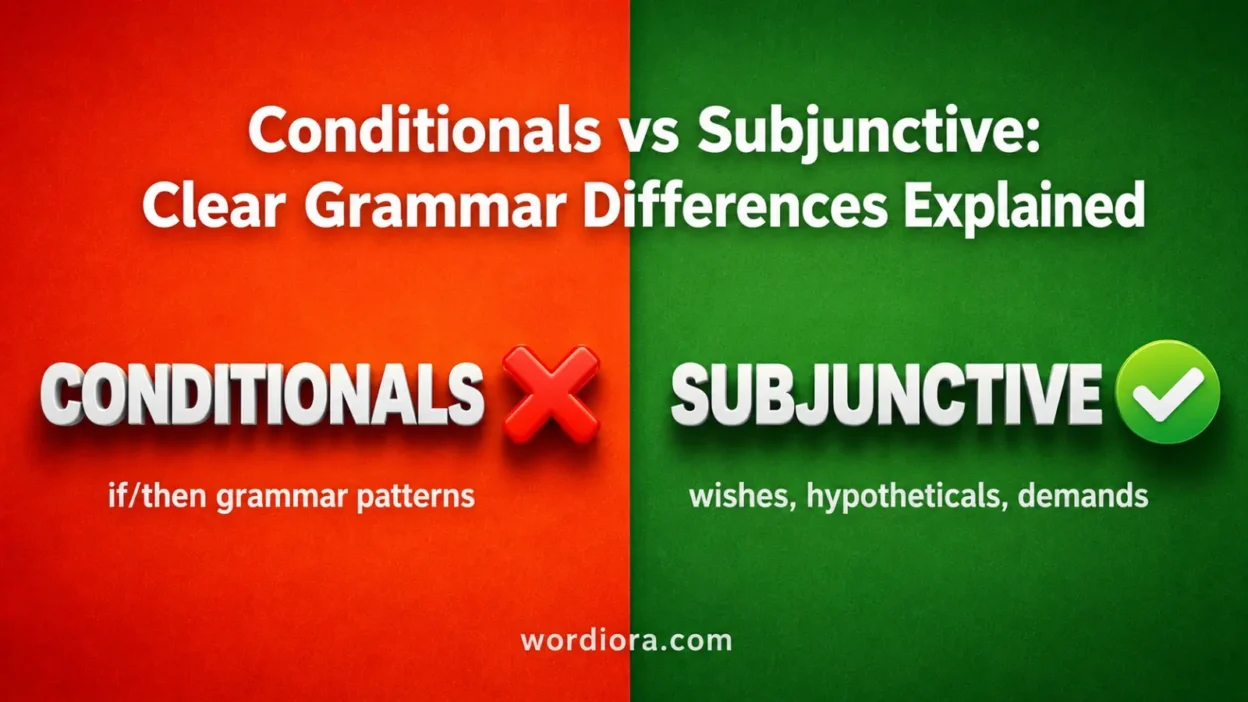
Conditionals vs subjunctive is confusing because both can appear in sentences about imagined, possible, or unreal situations. The key point is simple: conditionals are usually sentence patterns based on a condition and a result, while the subjunctive is a verb mood or verb form used for wishes, demands, suggestions, and unreal ideas.
Both can be correct. They are not the same thing.
A sentence can be conditional without being clearly subjunctive:
If it rains, we will cancel the picnic.
A sentence can also use the subjunctive inside a conditional pattern:
If I were you, I would call first.
That overlap is why people mix them up.
Quick Answer
Use conditionals when you are talking about an “if this, then that” structure.
Use subjunctive when the verb shows something unreal, wished for, required, suggested, or contrary to fact.
In plain terms:
- Conditionals answer: “What happens if this condition is true?”
- Subjunctive answers: “Is this verb showing something unreal, wished, required, or not stated as fact?”
Correct:
If she studies tonight, she will pass.
Correct:
I recommend that she study tonight.
Correct:
If I were taller, I would reach the shelf.
The first sentence is a conditional. The second uses the subjunctive. The third is both conditional in structure and subjunctive in the “were” form.
Why People Confuse Them
People confuse conditionals and subjunctive because both often deal with non-real situations.
A conditional sentence often uses if:
If we leave now, we will get there on time.
The subjunctive can also appear after if, especially with unreal situations:
If I were in charge, I would change the rule.
That does not mean every if-sentence is subjunctive. It also does not mean every subjunctive sentence uses if.
This sentence is subjunctive but not an if-conditional:
The manager insisted that he be on time.
The confusion comes from overlap, not from sameness.
Key Differences At A Glance
| Context | Best Choice | Why |
|---|---|---|
| You mean an if-then sentence | conditionals | The sentence has a condition and a result. |
| You mean a verb form for wishes, demands, or unreal ideas | subjunctive | The focus is the mood or form of the verb. |
| You are explaining “If it rains, we’ll stay home” | conditionals | This is a real possible condition and result. |
| You are explaining “If I were you” | subjunctive | “Were” marks an unreal situation. |
| You are explaining “I suggest that he go” | subjunctive | “Go” is the plain verb form after a suggestion. |
| You are comparing sentence types | conditionals | Conditionals are usually taught as sentence patterns. |
| You are comparing verb moods | subjunctive | Subjunctive is about how the verb presents the action. |
Meaning and Usage Difference
Conditionals are about dependency. One thing depends on another thing.
If the store is open, I’ll grab milk.
The condition is “if the store is open.” The result is “I’ll grab milk.”
Conditionals can show facts, real possibilities, unlikely situations, or past regrets:
If water freezes, it expands.
If I finish early, I’ll text you.
If I had more time, I would help.
If we had left sooner, we would have made the train.
The subjunctive is different. It is not mainly about if-then structure. It is about how the verb presents an idea: not as a simple fact, but as something wished, required, suggested, imagined, or contrary to reality.
I wish I were home.
The board recommended that she remain in the role.
It is important that every file be reviewed.
A helpful way to see the difference:
- Conditionals deal with the relationship between a condition and a result.
- Subjunctive deals with the verb form used for unreal, desired, required, or proposed actions.
Tone, Context, and Formality
Conditionals are common in everyday speech and writing. You use them constantly:
If you want coffee, I’ll make some.
If the meeting runs late, we can reschedule.
Subjunctive forms can sound more formal, especially in sentences like:
I recommend that he be allowed to respond.
It is essential that she arrive on time.
In casual speech, many people use simpler forms:
I recommend that he gets a chance to respond.
It’s important that she arrives on time.
Those casual versions are common, but in edited US English, the subjunctive often sounds cleaner and more precise after words like recommend, suggest, insist, require, and essential.
With if I were, the subjunctive is still the safest choice when the situation is clearly unreal:
If I were you, I would wait.
“If I was you” is common in casual speech, but it sounds less polished in edited writing.
Which One Should You Use?
Use conditionals when naming or explaining a sentence pattern.
Correct:
This is a first conditional sentence.
Correct:
The paragraph uses several conditionals to explain possible outcomes.
Use subjunctive when naming or explaining the verb mood or form.
Correct:
“Were” is subjunctive in “If I were you.”
Correct:
“Be” is subjunctive in “I ask that he be honest.”
Use both terms if both ideas are present.
Correct:
“If I were you, I would apologize” is a conditional sentence that uses the subjunctive “were.”
That is the cleanest answer for many confusing examples. The sentence can have a conditional structure and a subjunctive verb form at the same time.
When One Choice Sounds Wrong
Calling every if-sentence “subjunctive” sounds wrong.
Not this:
“If it rains, we’ll stay inside” is subjunctive.
Better:
“If it rains, we’ll stay inside” is conditional.
The sentence talks about a real possibility. It does not need a special subjunctive verb form.
Calling every unreal sentence “conditional” can also be wrong.
Not this:
“I wish I were home” is a conditional.
Better:
“I wish I were home” uses the subjunctive.
There is no if-condition and result pair. The sentence expresses a wish.
The tricky cases are sentences like:
If I were rich, I would donate more.
This is a conditional sentence because it has a condition and a result. It also uses the subjunctive because “were” marks an unreal situation.
Common Mistakes and Quick Fixes
Mistake: Treating the terms as interchangeable.
Wrong:
Subjunctive and conditional mean the same thing.
Fix:
They overlap, but they are different grammar ideas.
Mistake: Using “would” in the if-clause when standard English needs a past or past perfect form.
Less polished:
If I would have known, I would have called.
Better:
If I had known, I would have called.
Mistake: Using “was” in a clearly unreal “if I were” sentence in formal writing.
Casual:
If I was you, I’d ask for a receipt.
Better:
If I were you, I’d ask for a receipt.
Mistake: Missing the subjunctive after a recommendation or requirement.
Less polished:
The policy requires that each employee is notified.
Better:
The policy requires that each employee be notified.
Mistake: Calling “I suggest that she go” a conditional.
Fix:
It is subjunctive, but it is not conditional. There is no if-condition.
Everyday Examples
Here are natural examples that show the difference.
Conditional:
If the package arrives today, I’ll bring it inside.
Subjunctive:
I suggest that the package be signed for at the front desk.
Conditional:
If you need a ride, I can pick you up.
Subjunctive:
I wish I were closer so I could pick you up.
Conditional:
If we lower the price, more people may sign up.
Subjunctive:
The owner requested that the price remain the same.
Both conditional and subjunctive:
If she were available, she would join the call.
Both conditional and subjunctive:
If I were in your position, I would save the receipt.
Compact comparison:
- Conditionals often use if, unless, when, or a similar condition word.
- Subjunctive often appears after wish, suggest, recommend, insist, require, or phrases like it is important that.
- Conditionals focus on the whole sentence pattern.
- Subjunctive focuses on the verb form.
- Some sentences use both.
Dictionary-Style Word Details
Verb
- conditionals: Not commonly used as a verb in standard US English. The related verb is condition, as in “The offer was conditioned on approval,” but conditionals itself is not a verb.
- subjunctive: Not commonly used as a verb in standard US English. It is usually a noun or adjective related to verb mood.
Noun
- conditionals: A plural noun. It usually means conditional sentences, clauses, or forms. Example: “We practiced conditionals in English class.”
- subjunctive: A noun when it names the mood or a verb form in that mood. Example: “The sentence uses the subjunctive.”
Synonyms
- conditionals: Closest plain alternatives: if-sentences, conditional sentences, conditional clauses, if-then structures. These are not always exact synonyms, but they are useful in grammar explanations.
- subjunctive: Closest plain alternatives: subjunctive mood, unreal mood, wish form, mandative form. These depend on the exact sentence. No single plain synonym fits every use.
Clear antonyms are limited. For subjunctive, indicative is the usual contrast when comparing mood because the indicative states facts or direct claims. For conditionals, there is no simple everyday antonym that works in all grammar contexts.
Example Sentences
- conditionals: “Zero and first conditionals are often easier than third conditionals.”
- conditionals: “The lesson explains how conditionals show possible results.”
- subjunctive: “The phrase ‘if I were’ uses the subjunctive.”
- subjunctive: “The editor changed ‘was’ to ‘were’ to keep the subjunctive form.”
Word History
- conditionals: The word is related to condition, meaning something that must be true or happen before something else can happen. In grammar, it came to refer to words, clauses, forms, and sentences built around that idea.
- subjunctive: The word has long been used in grammar for a verb mood connected with non-factual, wished, proposed, or dependent ideas. Exact historical details vary by source and grammar tradition, so the safest point is this: in modern English, the term refers to a recognized verb mood or verb form pattern.
Phrases Containing
- conditionals: conditional sentence, conditional clause, first conditional, second conditional, third conditional, mixed conditional, real conditional, unreal conditional.
- subjunctive: subjunctive mood, present subjunctive, past subjunctive, subjunctive verb, subjunctive clause, mandative subjunctive.
FAQs
What is the difference between conditionals and subjunctive?
Conditionals are sentence patterns that show a condition and a result, such as “If it rains, we will stay home.” The subjunctive is a verb mood or form used for wishes, demands, suggestions, or unreal situations, such as “I wish I were there.”
Are conditionals and subjunctive the same thing?
No. They are related, but they are not the same. A conditional is usually about the structure of a sentence. The subjunctive is about the form or mood of the verb.
Can a sentence be both conditional and subjunctive?
Yes. “If I were you, I would wait” is both. It is conditional because it has an if-condition and a result. It is subjunctive because “were” shows an unreal situation.
Is “if I were” conditional or subjunctive?
“If I were” is usually subjunctive inside a conditional sentence. The word “if” creates the condition, while “were” shows that the situation is unreal or imagined.
Is “if I was” wrong?
Not always. “If I was” can be correct when talking about a real past possibility, as in “If I was rude, I apologize.” But for unreal situations, especially in polished writing, “if I were” is usually better: “If I were rich, I would travel more.”
What is an example of a conditional sentence?
A simple conditional sentence is: “If you call me, I will answer.” The first part gives the condition, and the second part gives the result.
What is an example of the subjunctive?
A clear example is: “I suggest that he be honest.” The verb “be” is subjunctive because it follows a suggestion, not a statement of fact.
Do all conditional sentences use the subjunctive?
No. Many conditional sentences do not use the subjunctive. For example, “If it snows tomorrow, school may close” is conditional, but it does not use a special subjunctive form.
When should I use the subjunctive?
Use the subjunctive for wishes, demands, recommendations, requirements, and unreal situations. Common examples include “I wish I were,” “I recommend that she go,” and “It is important that he be ready.”
Which is more common in everyday English?
Conditionals are more common in everyday conversation because people often talk about possibilities and results. The subjunctive is also used, but it often appears in formal, careful, or edited writing.
Conclusion
Conditionals and subjunctive are both correct grammar terms, but they do different jobs.
Use conditionals when you mean sentences built around a condition and a result:
If it rains, we’ll stay home.
Use subjunctive when you mean a verb mood or form used for wishes, demands, suggestions, or unreal situations:
I wish I were home.
The easiest rule is this: conditionals describe the if-then structure; subjunctive describes the verb’s mood or form. Some sentences, like “If I were you, I would wait,” are both.