If your sentence means “on the way,” in-route is not the standard choice.
The better form is usually en route, written as two words with no hyphen. The exact form en-route can also appear, but mainly when it works as a modifier before a noun, as in en-route delay or en-route assistance.
So the choice is not just “which spelling looks nicer.” The real issue is sentence role. In-route is usually a mistake. En-route has limited use. En route is the normal phrase most writers need.
Quick Answer
Use en-route only when it comes before a noun and describes something that happens during travel.
Use en route when the phrase means “on the way” in a normal sentence.
Do not use in-route for this meaning.
Correct: The package is en route to Chicago.
Correct: The airline reported an en-route delay.
Incorrect: The driver is in-route to the office.
Between in-route and en-route, en-route is the better choice only in modifier use. For everyday writing, the best answer is usually en route, not either hyphenated form.
Why People Confuse Them
People confuse these forms because en route is borrowed from French, but English speakers often pronounce it like “ahn root” or “on root.”
That sound can make writers think the phrase should be in route, on route, or in-route. The mistake is understandable, but it still looks wrong in polished US English.
The hyphen adds another layer of confusion. Writers see compounds like in-store pickup or on-site visit and assume in-route must work the same way. It usually does not.
Key Differences At A Glance
| Context | Best Choice | Why |
|---|---|---|
| Saying someone is on the way | en route | Standard phrase after a verb |
| Saying a package is traveling | en route | Natural for shipping and delivery updates |
| Describing a delay during travel | en-route | Works as a compound modifier before a noun |
| Describing time spent traveling | en-route | Common in technical phrases like “en-route time” |
| Writing a casual text | en route | Clear and natural |
| Writing “in-route to work” | en route | “In-route” is not standard for this meaning |
| Writing before a noun in a technical context | en-route | The hyphen helps connect the modifier to the noun |
Meaning and Usage Difference
In-route is not commonly used as a standard US-English phrase for “on the way.” In most cases, it is a mistaken spelling of en route.
En-route means “on the way” or “during travel” when it is used before a noun. It acts like a compound modifier.
Compact comparison:
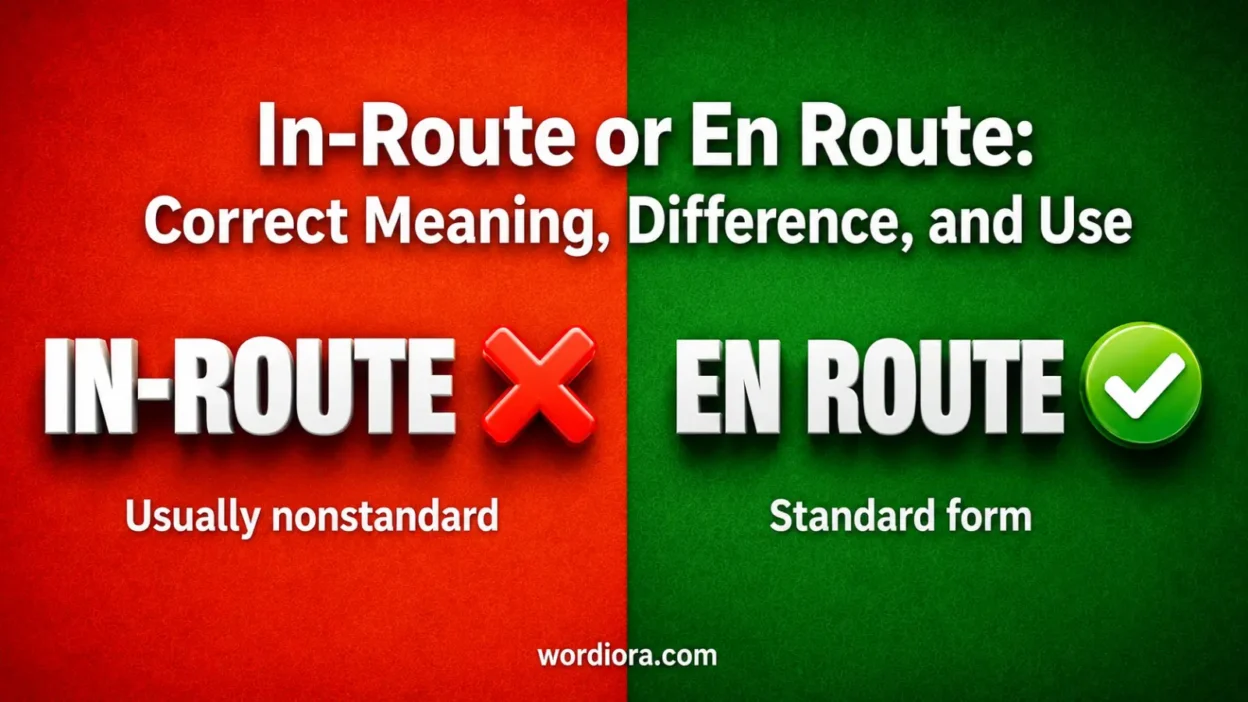
- in-route: usually a nonstandard form when the intended meaning is “on the way.”
- en-route: a limited compound modifier, mainly before nouns.
- Best everyday phrase: en route, with no hyphen.
The pronunciation matters because it causes the mistake. In US speech, en route is commonly said like “ahn ROOT.” Some speakers may also hear it close to “in ROOT,” which helps explain why in-route appears in informal writing.
Tone, Context, and Formality
In-route looks unedited in standard writing. It can make a sentence feel rushed, informal, or mistaken.
En-route sounds more formal or technical because it usually appears in phrases about travel systems, delivery, aviation, emergency response, or transportation.
Examples:
The dispatcher reported an en-route ambulance.
The software calculates en-route travel time.
The team handled several en-route service calls.
In everyday writing, though, the hyphen often feels unnecessary. Most people would write:
I’m en route now.
The crew is en route to the site.
Your order is en route.
Not:
I’m en-route now.
That hyphenated form is easier to defend before a noun than after a verb.
Which One Should You Use?
Use en route if the phrase follows a verb such as is, are, was, were, be, left, traveling, or headed.
Use en route if the phrase follows a verb such as is, are, was, were, be, left, traveling, or headed.
The driver is en route.
We were en route to the airport.
The documents are en route by courier.
Use en-route when the phrase comes before a noun and works like an adjective.
For example, an airline might report an en-route delay. A company could improve its en-route tracking system. In research or logistics writing, you may also see phrases like en-route travel time.
Avoid in-route unless it is part of a very specific name, code, or quoted wording. For normal sentences, it is not the right choice.
When One Choice Sounds Wrong
In-route sounds wrong when you mean “on the way.”
Wrong: I’m in-route to your house.
Better: I’m en route to your house.
Wrong: The package is in-route to Dallas.
Better: The package is en route to Dallas.
En-route can also sound wrong when it appears after a verb in ordinary writing.
Awkward: The nurse is en-route to the patient.
Better: The nurse is en route to the patient.
But en-route can sound natural before a noun.
Natural: The nurse gave an en-route update.
Natural: The team reviewed the en-route report.
Common Mistakes and Quick Fixes
Mistake 1: Writing in-route because it sounds like the spoken phrase.
Quick fix: Write en route when you mean “on the way.”
Mistake 2: Hyphenating the phrase after a verb.
Quick fix: Remove the hyphen after verbs like is, are, was, and were.
Mistake 3: Using en-route everywhere because it looks formal.
Quick fix: Save en-route for modifier use before a noun.
Mistake 4: Treating route alone as if it completes the phrase.
Quick fix: Use en route to when naming the destination.
Correct: We are en route to Phoenix.
Incorrect: We are in-route Phoenix.
Everyday Examples
The delivery truck is en route to your address.
Our sales team is en route to the conference in Denver.
The ambulance was en route within two minutes.
The airline blamed the late arrival on an en-route delay.
The app now shows en-route driver updates.
We stopped for coffee en route to the beach.
The package is still en route, so it has not reached the warehouse yet.
The company reviewed en-route safety procedures for its drivers.
I’m en route now, but traffic is heavy.
The pilot reported an en-route weather issue.
Dictionary-Style Word Details
Verb
in-route: Not commonly used as a verb in standard US English.
en-route: Not commonly used as a verb in standard US English. In normal writing, it does not mean “to send by route.” Use route as the verb for that meaning.
Example: The calls were routed to the support team.
Noun
in-route: Not commonly used as a noun in standard US English.
en-route: Not commonly used as a noun in standard US English. It is mainly seen as part of a modifier before a noun, such as en-route delay or en-route tracking.
Synonyms
in-route: No exact standard synonyms, because the form itself is usually not standard for “on the way.” The intended plain alternative is usually en route or on the way.
en-route: Closest plain alternatives include in-transit, during-travel, on-the-way, and travel-related, depending on the noun it modifies.
Antonyms are context-based rather than exact. In some sentences, stationary, at the destination, or not in transit may fit.
Example Sentences
in-route: The phrase is usually corrected in standard writing.
Incorrect: The technician is in-route.
Correct: The technician is en route.
en-route: The hyphenated form can work before a noun.
Correct: The dispatcher sent an en-route status update.
Correct: The system tracks en-route delivery changes.
Word History
in-route: This form does not have a strong separate word history in standard English. It is best understood as a mistaken or nonstandard form when the intended meaning is “on the way.”
en-route: This form is connected to en route, a phrase borrowed from French. The history of the main phrase is clear enough for practical use: it entered English as a travel expression meaning “on the way.” The hyphenated form developed as a modifier in certain contexts, especially before nouns.
Phrases Containing
in-route:
“in-route to” is usually a mistake for en route to.
“in-route update” is usually better as en-route update if it means an update during travel.
en-route:
en-route delay
en-route time
en-route tracking
en-route assistance
en-route status update
For ordinary sentence use, write en route to:
We are en route to the meeting.
FAQs
The correct choice is usually en route, not in-route. The form in-route is usually a mistake when you mean “on the way.” En-route can work before a noun, as in en-route delay.
En route means “on the way” or “while traveling to a place.” Example: The package is en route to New York.
In-route is not commonly accepted as standard US English for “on the way.” In most sentences, it should be replaced with en route.
En-route can be correct when it works as a modifier before a noun. Example: The airline reported an en-route delay. In most regular sentences, use en route without the hyphen.
Write I am en route. When the phrase comes after a verb like am, is, or are, the standard form is usually en route without a hyphen.
Yes. En route to is correct when naming the destination. Example: We are en route to the airport.
People often write in-route because en route can sound like “in route” or “on route” when spoken. The sound causes the spelling mistake.
A simple synonym for en route is on the way. Example: The driver is en route means The driver is on the way.
Use en route after a verb: Your order is en route. Use en-route before a noun: en-route tracking or en-route delivery update.
Use en route when you mean “on the way.” Use en-route only before a noun. Avoid in-route in standard writing.
Conclusion
For the word-choice question in-route-or-en-route, the safest answer is clear: avoid in-route when you mean “on the way.”
Use en-route only when it comes before a noun, as in en-route delay or en-route tracking.
For most everyday US writing, the form you really want is en route, with no hyphen.
Use it this way:
Correct: I’m en route.
The package is also correctly described as en route.
For modifier use, write: The system shows en-route driver updates.
Avoid this form: I’m in-route.