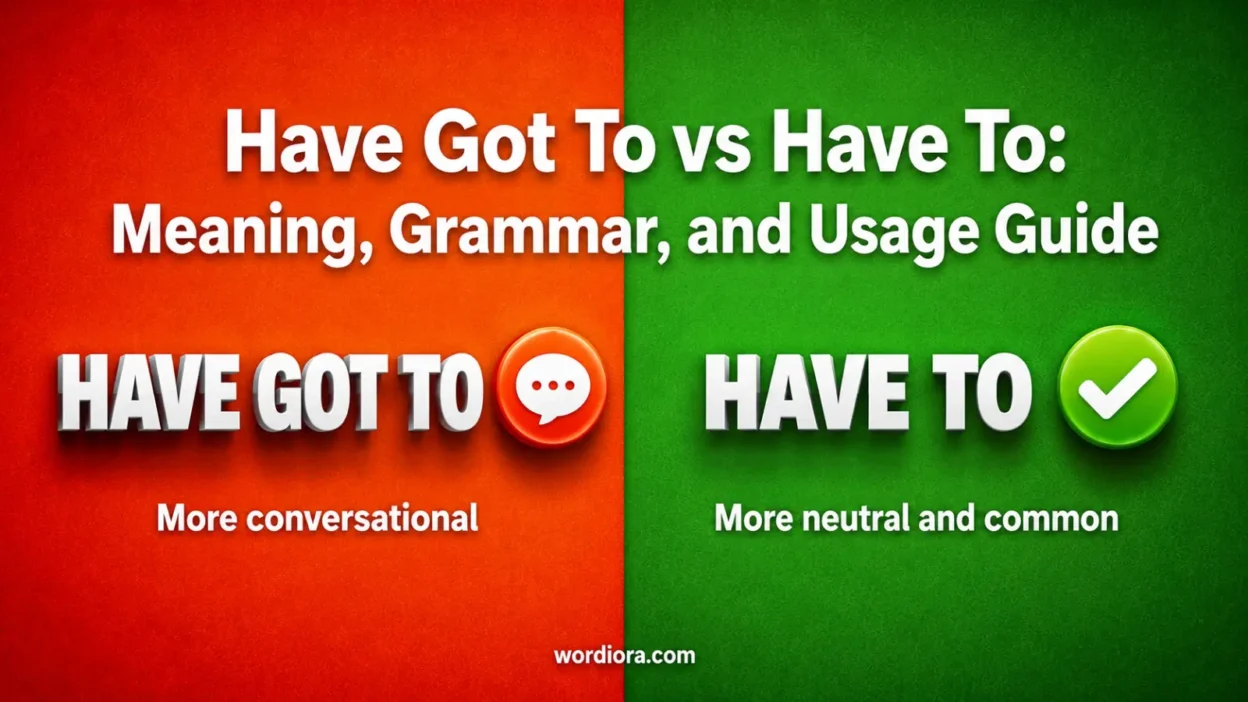
Both have got to and have to are correct in standard English. In many sentences, they mean the same thing: something is necessary, required, or strongly recommended.
The real difference is not usually meaning. It is grammar, tone, and flexibility. Have to works in more situations. It sounds natural in speech, school writing, workplace writing, and formal instructions. Have got to is more casual and is mainly used for present or near-future needs.
So, if you want the safest choice, use have to. If you want a natural spoken tone, especially with a current need, have got to can sound perfectly normal.
Quick Answer
Use have to as your default choice. It is correct, clear, and flexible.
Use have got to when you want a more casual or spoken sound.
Both can mean “must” or “need to”:
I have to leave now.
I have got to leave now.
The second sentence sounds more conversational. In everyday US speech, many people shorten it to “I’ve got to leave” or even “I gotta leave.” That last form is very casual and should usually stay out of formal writing.
Why People Confuse Them
People confuse these phrases because they often point to the same idea: obligation.
If your boss says, “You have to submit the report today,” the meaning is clear. If a friend says, “You’ve got to submit that report today,” the meaning is also clear. In both cases, the report needs to be submitted.
The confusion starts because the two phrases do not behave exactly the same in grammar. Have to can move easily into the past, future, questions, and negatives. Have got to is more limited and sounds more casual.
The word “got” also makes the phrase feel more spoken. That does not make it wrong. It just makes it less formal.
Key Differences At A Glance
| Context | Best Choice | Why |
|---|---|---|
| Formal writing | have to | It sounds cleaner and more standard. |
| Workplace instructions | have to | It fits rules, steps, and policies. |
| Casual speech | have got to | It sounds natural and conversational. |
| Past obligation | have to | Use “had to,” not “had got to.” |
| Future obligation | have to | Use “will have to,” not “will have got to.” |
| Repeated obligation | have to | It sounds better with always, usually, often, and every day. |
| Strong spoken emphasis | have got to | It can add urgency or emotion in casual speech. |
| Questions | have to | “Do you have to…?” is the smoother US choice. |
| Negatives | have to | “Don’t have to” is the normal US form. |
Meaning and Usage Difference
The basic meaning is usually the same. Both phrases can show that something is necessary.
I have to renew my license.
I have got to renew my license.
Both mean the license needs to be renewed. The second version sounds more like casual speech.
Both phrases can also show strong advice or recommendation:
You have to try this pizza.
You have got to try this pizza.
Here, the speaker does not mean there is a law about pizza. The phrase means “I strongly recommend it.”
Both can also show certainty:
There has to be a better way.
There has got to be a better way.
Again, the meaning is close. The difference is tone. There has got to be sounds more emotional or conversational.
Pronunciation can also affect how readers hear the phrase. In everyday US speech, have to often sounds like “haf-tuh.” Have got to often becomes “I’ve got to” or the very casual “gotta.” Use the full written form when clarity matters.
| Feature | have got to | have to |
| Main meaning | necessity or obligation | necessity or obligation |
| Tone | casual, spoken | neutral, flexible |
| Best tense | present or near future | present, past, and future |
| Formal writing | usually less suitable | usually better |
| Common short form | I’ve got to | I have to |
Tone, Context, and Formality
Have to is neutral. You can use it almost anywhere.
Employees have to wear ID badges.
Students have to submit the form by Friday.
I have to call the dentist.
These sentences sound normal in US English. They are clear without sounding stiff.
Have got to is more conversational.
I’ve got to call the dentist.
You’ve got to see this movie.
We’ve got to figure this out tonight.
These examples sound natural in speech, texts, casual emails, and friendly writing. They may sound too informal in policies, contracts, academic writing, or official instructions.
For a polished tone, choose have to. For a relaxed spoken tone, have got to is fine.
Which One Should You Use?
Use have to when you want the safest answer.
It works for rules:
You have to show your ticket at the gate.
It works for routines:
I have to take medication every morning.
It works for the past:
We had to leave early.
It works for the future:
They will have to reschedule the meeting.
Use have got to when the sentence is casual and present-focused:
I’ve got to get gas before work.
You’ve got to hear this story.
We’ve got to clean the kitchen before guests arrive.
A simple rule helps: when in doubt, use have to. Use have got to when you want the sentence to sound like natural conversation.
When One Choice Sounds Wrong
Have got to can sound wrong when you force it into forms where have to works better.
For the past, use had to:
Wrong: I had got to finish the project last night.
Better: I had to finish the project last night.
For the future, use will have to:
Wrong: She will have got to call the office tomorrow.
Better: She will have to call the office tomorrow.
For repeated duties, use have to:
Awkward: I always have got to wake up at six.
Better: I always have to wake up at six.
For US questions, do/does/did + have to usually sounds more natural:
Do we have to sign in?
Did you have to pay a fee?
“Have we got to sign in?” is understandable, but it sounds less typical in everyday US English.
Common Mistakes (and Quick Fixes)
Mistake: I don’t have got to go.
Fix: I don’t have to go.
Use don’t have to when something is not necessary.
Mistake: He will have got to study tonight.
Fix: He will have to study tonight.
Use will have to for future necessity.
Mistake: We had got to wait outside.
Fix: We had to wait outside.
Use had to for past necessity.
Mistake: You have got to can finish it.
Fix: You have got to finish it.
After either phrase, use the base verb: go, call, leave, study, finish, pay.
Mistake: She have to leave.
Fix: She has to leave.
With he, she, it, or one singular noun, use has to.
Everyday Examples
I have to pick up my prescription after work.
I’ve got to pick up my prescription after work.
You have to be at the airport by 6 a.m.
You’ve got to be at the airport by 6 a.m.
We have to check the weather before the drive.
We’ve got to check the weather before the drive.
He has to finish his homework before practice.
He’s got to finish his homework before practice.
They have to update their address online.
They’ve got to update their address online.
I don’t have to work this Saturday.
Do you have to bring your laptop?
We had to cancel the appointment.
They will have to choose another date.
There has to be a reason the order was delayed.
There has got to be a reason the order was delayed.
Dictionary-Style Word Details
Verb
have got to: This is a modal-like verb phrase used before a base verb. It shows necessity, obligation, strong advice, or certainty. It is most natural in present or near-future casual speech.
Example: I’ve got to leave soon.
have to: This is also a modal-like verb phrase used before a base verb. It shows necessity, obligation, strong advice, or certainty. It works in present, past, and future forms.
Example: I have to leave soon.
Noun
have got to: Not commonly used as a noun in standard US English.
have to: Not commonly used as a noun in standard US English when used in this comparison. The phrase functions as part of the verb structure.
Synonyms
have got to: Closest plain alternatives include must, need to, be required to, and be supposed to, depending on context.
have to: Closest plain alternatives include must, need to, be required to, and be obligated to, depending on context.
Useful opposite idea: do not have to means something is not necessary.
Be careful: must not does not mean the same thing as do not have to. “Must not” means something is not allowed. “Do not have to” means it is optional.
Example Sentences
have got to: I’ve got to send that email before lunch.
have got to: You’ve got to try the new taco place downtown.
have got to: There has got to be a simpler way to fix this.
have to: I have to send that email before lunch.
have to: You have to show your ID at the front desk.
have to: We will have to move the meeting to Monday.
Word History
have got to: The phrase is connected to the older and still common use of have got with a present meaning. Modern dictionaries and grammar references treat have got to as a standard phrase, especially in ordinary speech and informal writing. Its exact development is not needed for choosing between the two phrases.
have to: This phrase uses have with to before a base verb to express necessity, duty, advice, or certainty. It is the more flexible modern form because it works smoothly across tense, question, and negative structures.
Phrases Containing
have got to:
I’ve got to go.
You’ve got to be kidding me.
There has got to be a reason.
You’ve got to hand it to her.
have to:
I have to go.
You have to admit it was funny.
There has to be a reason.
Do we have to leave now?
FAQs
Is “have got to” correct English?
Yes. Have got to is correct, especially in casual speech and informal writing. It usually means something is necessary or required. Example: “I’ve got to leave soon.” For formal writing, have to is usually the better choice.
What is the difference between “have got to” and “have to”?
Both can mean “must” or “need to.” The main difference is tone and flexibility. Have to is neutral and works in more situations. Have got to sounds more casual and is mostly used for present or near-future needs.
Which is better: “have got to” or “have to”?
Have to is better as a default choice because it works in formal writing, casual speech, past tense, future tense, questions, and negatives. Have got to is best for relaxed, conversational sentences.
Can I use “have got to” in formal writing?
It is better to avoid have got to in formal writing. Use have to instead. For example, write “Employees have to submit the form” instead of “Employees have got to submit the form.”
Is “I’ve got to go” the same as “I have to go”?
Yes, the meaning is almost the same. I’ve got to go sounds more casual and spoken. I have to go sounds more neutral and can fit both casual and formal situations.
Can “have got to” be used in the past tense?
Usually, no. For past necessity, use had to.
Incorrect: “I had got to work late.”
Correct: “I had to work late.”
Can “have got to” be used in the future tense?
Usually, no. For future necessity, use will have to.
Incorrect: “She will have got to call tomorrow.”
Correct: “She will have to call tomorrow.”
Is “gotta” the same as “have got to”?
Gotta is a very casual spoken form of have got to or got to. It is common in speech, texting, dialogue, and informal writing, but it should not be used in formal writing.
Is “don’t have got to” correct?
No. The correct form is don’t have to.
Incorrect: “You don’t have got to come.”
Correct: “You don’t have to come.”
Should I say “Do you have to?” or “Have you got to?”
In US English, Do you have to? is usually more natural and more common. “Have you got to?” is understandable, but it can sound less natural to many US speakers.
Does “have got to” sound stronger than “have to”?
Sometimes it can sound stronger or more emotional in casual speech. For example, “You’ve got to see this!” may sound more excited than “You have to see this.” But the main difference is still tone, not a strict grammar rule.
What is the safest rule to remember?
Use have to when you are unsure. It is correct in almost every situation. Use have got to when you want a casual, spoken style and the sentence is about a present or near-future need.
Conclusion
Both have got to and have to are correct, and they often mean the same thing. The best choice depends on tone and grammar. Use have to when you want a clear, flexible, polished phrase that works in almost any context. Use have got to when the sentence is casual, spoken, and focused on a present need. For past tense, future tense, questions, negatives, and repeated duties, have to is usually the better choice.