The difference between determiner vs adjective confuses many English learners because both appear before nouns. In sentences like “the blue car” or “my new phone,” the words before the noun seem similar at first.
But they do different jobs.
A determiner helps identify or limit a noun. An adjective describes the noun’s qualities or characteristics.
Understanding that difference makes sentence structure much easier to follow.
Quick Answer
A determiner identifies, limits, or points to a noun.
An adjective describes a noun.
For example:
- “the car” → “the” is a determiner
- “red car” → “red” is an adjective
- “my new car” → “my” is a determiner, “new” is an adjective
In standard English word order, determiners usually come before adjectives.
| Context | Best Choice | Why |
|---|---|---|
| Showing ownership | Determiner | Words like “my” and “their” identify the noun |
| Describing appearance | Adjective | Words like “blue” or “large” describe qualities |
| Pointing to a specific noun | Determiner | Words like “this” and “those” specify which noun |
| Adding details or characteristics | Adjective | Adjectives explain what the noun is like |
| Showing quantity | Determiner | Words like “many” or “some” limit amount |
Why People Confuse Them
People confuse determiners and adjectives because both often appear before nouns.
Compare these:
- “that movie”
- “funny movie”
Both words come before “movie,” but their functions are different.
“That” points to a specific movie.
“Funny” describes the movie.
The confusion becomes even stronger with words like:
- my
- some
- few
- this
Older grammar books sometimes called these “adjectives.” Modern grammar usually classifies them as determiners because they identify or limit nouns instead of describing qualities.
Key Differences At A Glance
| Feature | Determiner | Adjective |
|---|---|---|
| Main job | Identifies or limits a noun | Describes a noun |
| Common examples | the, my, this, some | happy, tall, expensive |
| Usually comes before | Adjectives and nouns | Nouns |
| Shows quantity or ownership | Often yes | Usually no |
| Describes qualities | No | Yes |
Meaning and Usage Difference
A determiner answers questions like:
- Which one?
- Whose?
- How many?
- How much?
Examples:
- “this laptop”
- “her jacket”
- “many people”
An adjective answers questions like:
- What kind?
- What does it look like?
- What is it like?
Examples:
- “fast laptop”
- “warm jacket”
- “friendly people”
Determiners and adjectives can appear together in the same noun phrase:
- “the small house”
- “my old backpack”
- “those expensive tickets”
The determiner normally comes first.
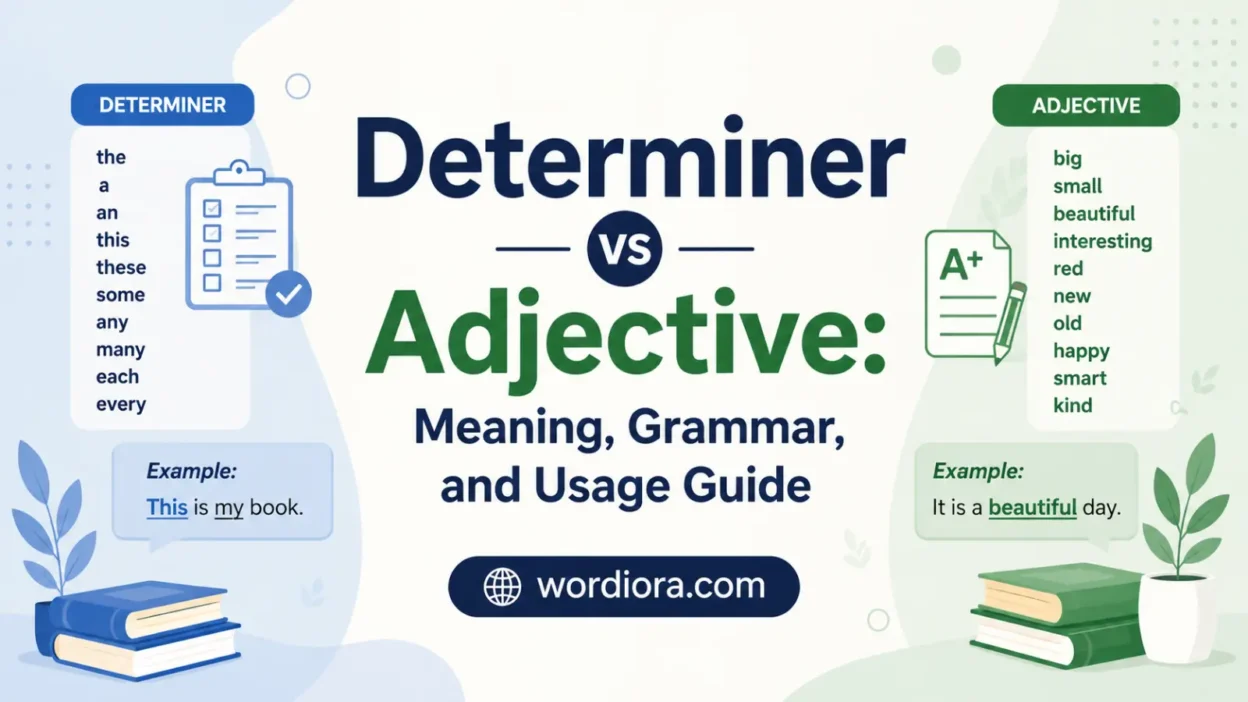
Common Types of Determiners
Determiners include:
- Articles: a, an, the
- Demonstratives: this, that, these, those
- Possessives: my, your, their
- Quantifiers: some, many, few, several
Common Types of Adjectives
Adjectives include words describing:
- Color: blue, green
- Size: large, tiny
- Opinion: beautiful, boring
- Age: old, modern
- Shape: round, square
Tone, Context, and Formality
The difference between determiners and adjectives is grammatical, not about formality.
Both appear in casual and formal English.
For example:
- “this report” works in business writing
- “great report” also works in business writing
Still, the choice changes meaning.
Compare:
- “that employee” → identifies a person
- “helpful employee” → describes the person
Some grammar discussions use terms like “possessive adjective” for words such as “my” or “your.” In many modern grammar references, those words are treated as determiners instead.
That difference is mostly about grammar labeling, not everyday communication.
Which One Should You Use?
Use a determiner when you need to identify, limit, or point to a noun.
Use an adjective when you want to describe the noun.
Examples:
- “the restaurant” → determiner
- “popular restaurant” → adjective
- “our favorite restaurant” → both
A quick test helps:
If the word tells you which noun or how many, it is probably a determiner.
If the word tells you what the noun is like, it is probably an adjective.
When One Choice Sounds Wrong
Some sentences sound incomplete without a determiner.
For example:
- “I bought car.” ❌
- “I bought a car.” ✔️
English often requires a determiner before singular countable nouns.
Other times, replacing an adjective with a determiner changes the meaning completely.
Compare:
- “that teacher” → identifies the teacher
- “strict teacher” → describes the teacher
Using the wrong type may confuse the listener about whether you are identifying something or describing it.
Common Mistakes and Quick Fixes
Mistake 1: Treating Every Word Before a Noun as an Adjective
Incorrect:
- “The word ‘my’ is always an adjective.”
Better:
- “‘My’ is commonly treated as a determiner in modern grammar.”
Mistake 2: Forgetting Determiners With Singular Nouns
Incorrect:
- “She adopted cat.”
Correct:
- “She adopted a cat.”
Mistake 3: Wrong Word Order
Incorrect:
- “Blue the car”
Correct:
- “The blue car”
Determiners usually come before adjectives.
Mistake 4: Confusing Quantity With Description
Incorrect thinking:
- “Many” describes people.
Better explanation:
- “Many” limits quantity, so it functions as a determiner.
Everyday Examples
Here are simple sentence comparisons:
- “this coffee” → determiner
- “hot coffee” → adjective
- “their apartment” → determiner
- “spacious apartment” → adjective
- “some cookies” → determiner
- “delicious cookies” → adjective
- “those sneakers” → determiner
- “comfortable sneakers” → adjective
You can also combine them:
- “those comfortable sneakers”
- “their delicious cookies”
- “this spacious apartment”
Dictionary-Style Word Details
Verb
Determiner:
Not commonly used as a verb in standard US English.
Adjective:
Not commonly used as a verb in standard US English.
Noun
Determiner:
A word placed before a noun to identify, limit, or specify it.
Adjective:
A word that describes or modifies a noun by giving more information about it.
Synonyms
Determiner:
Closest plain alternatives: identifier, limiter, noun marker
No exact everyday synonym fully matches the grammar meaning.
Adjective:
Closest plain alternatives: descriptive word, modifier
Related opposites may include:
- non-descriptive
- neutral
Example Sentences
Determiner:
- “Those kids are waiting outside.”
- “Her backpack is on the chair.”
- “Several students missed class.”
Adjective:
- “The kids were noisy.”
- “She carried a heavy backpack.”
- “The classroom felt quiet.”
Word History
Determiner:
The grammar term became more common in modern linguistic descriptions to separate identifying words from descriptive adjectives.
Adjective:
The term has been used in English grammar for centuries to describe words that modify nouns through description.
Phrases Containing
Determiner:
- definite determiner
- possessive determiner
- demonstrative determiner
- determiner phrase
Adjective:
- descriptive adjective
- comparative adjective
- adjective clause
- adjective order
FAQs
Is a determiner the same as an adjective?
No. A determiner and an adjective perform different jobs. A determiner identifies, limits, or points to a noun, while an adjective describes a noun’s qualities or characteristics.
What is the main difference between a determiner and an adjective?
The main difference is function. Determiners tell us which noun, whose noun, or how many nouns. Adjectives tell us what the noun is like.
Example:
- this car → “this” is a determiner
- red car → “red” is an adjective
Can a determiner and an adjective appear together?
Yes. They often appear together in the same noun phrase.
Examples:
- the beautiful garden
- my new laptop
- those expensive shoes
In most cases, the determiner comes before the adjective.
Is “my” a determiner or an adjective?
In modern grammar, my is usually classified as a possessive determiner because it identifies ownership rather than describing a quality.
Example:
- My phone is on the table.
Are articles considered determiners?
Yes. The articles a, an, and the are determiners because they identify or specify nouns.
Examples:
- a book
- an apple
- the movie
Can a noun have an adjective without a determiner?
Yes, in some situations.
Examples:
- Beautiful flowers filled the garden.
- Fresh coffee smells amazing.
However, singular countable nouns often need a determiner.
Correct: I bought a car.
Incorrect: I bought car.
What questions do determiners answer?
Determiners often answer questions such as:
- Which one?
- Whose?
- How many?
- How much?
Examples:
- this house
- her jacket
- several students
What questions do adjectives answer?
Adjectives usually answer questions such as:
- What kind?
- What color?
- What size?
- What is it like?
Examples:
- blue shirt
- large building
- friendly neighbor
Is “many” a determiner or an adjective?
In modern grammar, many is commonly treated as a determiner when it indicates quantity.
Example:
- Many people attended the event.
Why do some grammar books call determiners adjectives?
Older grammar traditions often grouped words like this, my, and some under adjectives because they appear before nouns. Modern grammar usually separates them into the determiner category because they identify or limit nouns rather than describe them.
What comes first, a determiner or an adjective?
A determiner usually comes before an adjective.
Correct: the red car
Correct: my new phone
Incorrect: red the car
How can I quickly tell whether a word is a determiner or an adjective?
Use this simple test:
- If the word identifies, points to, owns, or limits a noun, it is likely a determiner.
- If the word describes the noun’s qualities, it is likely an adjective.
Examples:
- those students → determiner
- intelligent students → adjective
- those intelligent students → both together in the same phrase.
Conclusion
The simplest way to understand determiner vs adjective is this:
Determiners identify nouns.
Adjectives describe nouns.
A determiner points to which noun, whose noun, or how many. An adjective explains what the noun is like.
In phrases such as “the big house” or “my new phone,” both can appear together, but they perform different grammar jobs.
Once you focus on identification versus description, the difference becomes much easier to recognize in everyday English.