Many English learners and writers mix up coordinating conjunctions and subordinating conjunctions because both connect ideas in a sentence. But they do not do the same job.
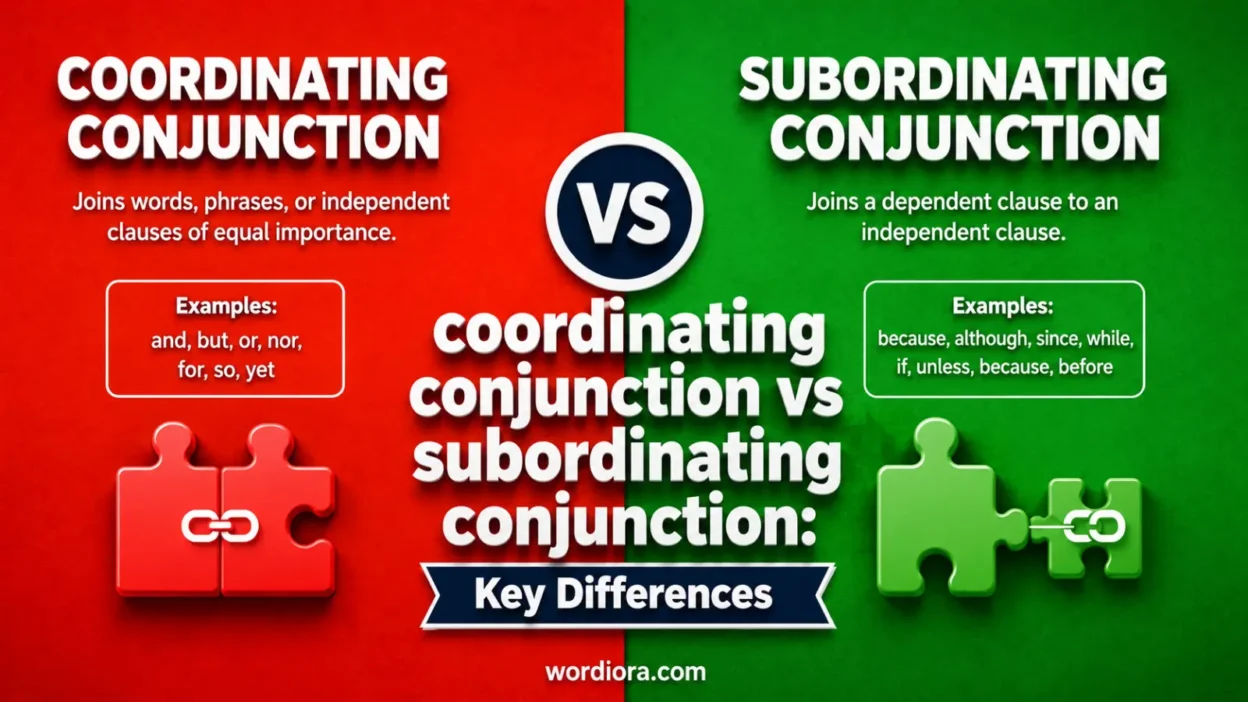
A coordinating conjunction joins equal parts of a sentence. A subordinating conjunction connects ideas where one part depends on the other.
Understanding the difference helps your writing sound clearer, smoother, and more natural in American English.
Quick Answer
Use a coordinating conjunction when two ideas have equal importance.
Use a subordinating conjunction when one idea depends on another idea.
For example:
- “I stayed home, and I watched a movie.”
→ Both ideas are equal. - “I stayed home because it was raining.”
→ One idea explains the other.
Why People Confuse Them
Both types of conjunctions connect words, phrases, or clauses. That is why they often seem similar at first.
The confusion usually happens because:
- both appear in compound or complex sentences
- both improve sentence flow
- both connect ideas logically
- some sentences can be rewritten using either type
For example:
- “I was tired, so I went to bed.”
- “I went to bed because I was tired.”
These sentences are related in meaning, but the structure changes.
Key Differences At A Glance
| Context | Best Choice | Why |
|---|---|---|
| Joining equal ideas | Coordinating conjunction | Both clauses have equal weight |
| Showing cause or reason | Subordinating conjunction | One clause depends on the other |
| Connecting two independent clauses | Coordinating conjunction | Each clause can stand alone |
| Introducing dependent clauses | Subordinating conjunction | One clause cannot stand alone |
| Showing time, condition, or contrast | Subordinating conjunction | Creates a relationship between ideas |
Quick Comparison
| Feature | coordinating conjunction | subordinating conjunction |
|---|---|---|
| Clause relationship | Equal | Unequal |
| Connects independent clauses | Yes | Sometimes |
| Creates dependent clauses | No | Yes |
| Common examples | and, but, or, so | because, although, while, if |
| Sentence type | Compound sentence | Complex sentence |
Meaning and Usage Difference
A coordinating conjunction joins sentence parts that are grammatically equal.
Common coordinating conjunctions include:
- and
- but
- or
- so
- yet
- for
- nor
These are often remembered with the acronym FANBOYS.
Examples:
- “She wanted coffee, but the café was closed.”
- “We can stay here, or we can leave now.”
Each side of the conjunction can usually stand alone as a complete sentence.
A subordinating conjunction introduces a dependent clause. The dependent clause cannot stand alone.
Common subordinating conjunctions include:
- because
- although
- since
- while
- if
- unless
- after
- before
Examples:
- “We stayed inside because the storm got worse.”
- “Although he was tired, he finished the project.”
The subordinate clause adds extra meaning such as:
- reason
- time
- contrast
- condition
- purpose
Parts of speech matter here because both terms refer to types of conjunctions, which are connecting words in grammar.
Tone, Context, and Formality
Coordinating conjunctions often sound more direct and conversational.
Example:
- “I called him, but he didn’t answer.”
Subordinating conjunctions can sound more detailed or formal because they show relationships more clearly.
Example:
- “Although I called him several times, he didn’t answer.”
In academic or professional writing, subordinating conjunctions are often useful because they explain connections precisely.
In casual conversation, coordinating conjunctions appear more often because they create shorter, simpler sentence patterns.
Neither type is “better.” The right choice depends on what relationship you want to show.
Which One Should You Use?
Choose a coordinating conjunction when:
- both ideas are equally important
- you want a smoother conversational flow
- each clause can stand alone
Examples:
- “The game ended, and everyone went home.”
- “She studied hard, yet she felt nervous.”
Choose a subordinating conjunction when:
- one idea explains another
- one clause depends on another
- you need to show time, cause, condition, or contrast
Examples:
- “She felt nervous because the exam was difficult.”
- “If traffic gets worse, we’ll take another route.”
A simple test helps:
If both sides work as complete sentences, a coordinating conjunction may fit best.
If one side feels incomplete alone, a subordinating conjunction is probably involved.
When One Choice Sounds Wrong
Sometimes using the wrong type changes the meaning or makes the sentence awkward.
Incorrect:
- “Because I was hungry, and I made lunch.”
Better:
- “Because I was hungry, I made lunch.”
- “I was hungry, so I made lunch.”
Incorrect:
- “I finished the report although I submitted it.”
Better:
- “I finished the report, and I submitted it.”
- “Although I finished the report, I didn’t submit it.”
The problem usually happens when the sentence relationship does not match the conjunction.
Common Mistakes (and Quick Fixes)
Using a subordinating conjunction without a complete sentence
Incorrect:
- “Because the store was closed.”
Quick fix:
- “Because the store was closed, we went home.”
Joining clauses incorrectly with commas
Incorrect:
- “I wanted pizza, because I was hungry.”
Better:
- “I wanted pizza because I was hungry.”
Confusing equal and dependent ideas
Incorrect:
- “Although I was late, but I still joined the meeting.”
Better:
- “Although I was late, I still joined the meeting.”
- “I was late, but I still joined the meeting.”
Do not combine both conjunction types unnecessarily.
Everyday Examples
Here are realistic examples from modern American English.
Coordinating conjunction examples
- “We ordered tacos, and we watched a movie.”
- “He wanted the blue sneakers, but they were sold out.”
- “You can text me, or you can call later.”
- “The weather looked bad, so the concert moved indoors.”
Subordinating conjunction examples
- “We ordered takeout because nobody wanted to cook.”
- “Although the traffic was heavy, we arrived on time.”
- “If you need help, send me a message.”
- “While she was driving, her phone rang.”
Dictionary-Style Word Details
Verb
- coordinating conjunction: Not commonly used as a verb in standard US English.
- subordinating conjunction: Not commonly used as a verb in standard US English.
These terms are grammar labels, not action words.
Noun
- coordinating conjunction: A type of conjunction that joins equal sentence elements.
- subordinating conjunction: A type of conjunction that introduces a dependent clause.
Both are grammatical noun terms used in language study and writing instruction.
Synonyms
- coordinating conjunction: closest plain alternatives include “equal connector” or “linking conjunction”
- subordinating conjunction: closest plain alternatives include “dependent connector” or “subordinate linker”
Exact synonyms are limited because these are technical grammar terms.
Helpful related contrasts:
- equal clauses vs dependent clauses
- compound sentences vs complex sentences
Example Sentences
- “The teacher explained how a coordinating conjunction connects equal ideas.”
- “Because introduces a subordinating conjunction in that sentence.”
- “We used but to contrast two independent clauses.”
- “Although sounds natural because the second idea depends on the first.”
Word History
- coordinating conjunction: The term comes from traditional grammar study and refers to coordination between equal sentence parts.
- subordinating conjunction: The term developed from grammatical descriptions of subordinate, or dependent, clauses.
Specific first-use dates are unclear across sources.
Phrases Containing
- coordinating conjunction examples
- coordinating conjunction list
- subordinating conjunction examples
- subordinating conjunction words
- compound sentence with coordinating conjunction
- complex sentence with subordinating conjunction
FAQs
What is the main difference between coordinating conjunction and subordinating conjunction?
A coordinating conjunction joins two equal ideas or independent clauses. A subordinating conjunction connects a dependent clause to an independent clause and shows a relationship like cause, time, or condition.
What are examples of coordinating conjunctions?
Common coordinating conjunctions include:
- and
- but
- or
- so
- yet
- for
- nor
Example:
- “I was tired, so I went to bed.”
What are examples of subordinating conjunctions?
Common subordinating conjunctions include:
- because
- although
- while
- if
- since
- unless
- after
Example:
- “I stayed home because it was raining.”
Can a sentence start with a subordinating conjunction?
Yes. Starting a sentence with a subordinating conjunction is correct when the sentence includes a complete independent clause.
Example:
- “Although the store was crowded, we found what we needed.”
Can a sentence start with a coordinating conjunction?
Yes. In modern American English, starting a sentence with words like “and” or “but” is acceptable in casual and professional writing when used carefully.
Example:
- “But I still disagree with that decision.”
Is “because” a coordinating or subordinating conjunction?
“Because” is a subordinating conjunction because it introduces a dependent clause that explains a reason.
Example:
- “We left early because traffic was getting worse.”
Is “but” a coordinating conjunction?
Yes. “But” is a coordinating conjunction because it connects equal ideas while showing contrast.
Example:
- “She studied hard, but the test was difficult.”
How can I quickly identify a subordinating conjunction?
Look for a clause that cannot stand alone as a complete sentence.
Example:
- “Because I missed the bus” is incomplete by itself.
That usually signals a subordinating conjunction.
Do coordinating conjunctions always need a comma?
Not always. A comma is usually needed when joining two independent clauses.
Example:
- “I called her, but she didn’t answer.”
A comma is often unnecessary when joining shorter sentence parts.
Why are subordinating conjunctions important in writing?
They help explain relationships between ideas clearly, including time, cause, contrast, and condition. This makes writing more detailed and organized.
Conclusion
The difference between coordinating conjunction vs subordinating conjunction comes down to sentence balance.
A coordinating conjunction joins equal ideas.
A subordinating conjunction connects ideas where one depends on the other.
If both parts of the sentence can stand alone, a coordinating conjunction often works best. If one part explains, limits, or depends on another, a subordinating conjunction is usually the correct choice.
Once you focus on the relationship between the clauses, choosing the right conjunction becomes much easier.