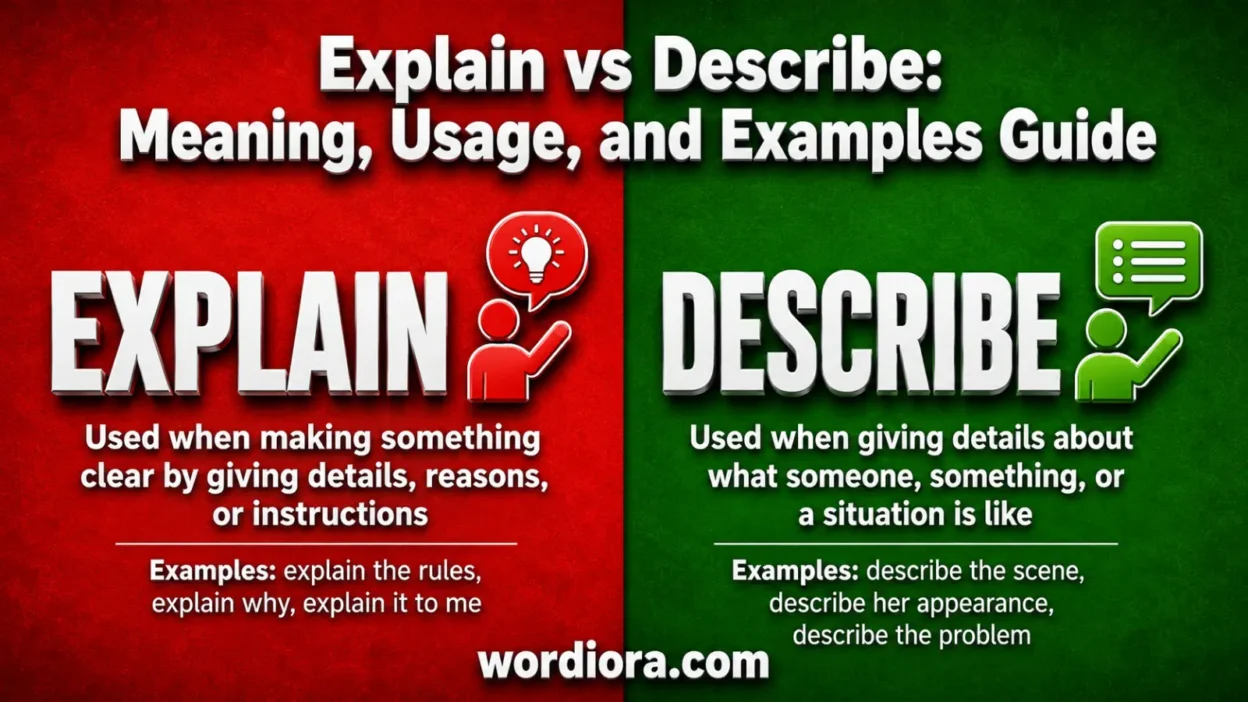
Explain vs describe is a common word-choice question because both words involve giving information. The difference is in the goal.
Use explain when you want to make something clear, show how it works, or give a reason.
Use describe when you want to tell what someone or something is like, what happened, or what details can be seen, heard, felt, or known.
Both words are correct. The best choice depends on what your listener or reader needs.
Quick Answer
Choose explain when the person needs understanding.
Choose describe when the person needs details.
For example:
“Can you describe the car?” asks for details such as color, size, model, or damage.
“Can you explain why the car stopped?” asks for a reason or cause.
A simple way to remember it: describe gives the picture; explain gives the reason or meaning.
Why People Confuse Them
People confuse explain and describe because both can answer questions and both can include details.
A teacher may say, “Describe what happened.” That asks for an account of events.
The same teacher may say, “Explain why it happened.” That asks for causes, reasons, or logic.
The confusion grows because an explanation often includes some description. You may need to describe a problem before you can explain it. But the main purpose is still different.
A description can be rich and detailed without giving a reason. An explanation can be short and still make the idea clear.
Key Differences At A Glance
| Context | Best Choice | Why |
|---|---|---|
| Giving features of a person, place, object, or scene | describe | It tells what something is like. |
| Giving reasons, causes, or logic | explain | It makes the meaning clear. |
| Reporting what happened | describe | It gives an account of events. |
| Showing how something works | explain | It connects steps or parts. |
| Talking about color, shape, size, sound, or feeling | describe | It focuses on qualities and details. |
| Helping someone understand a rule, choice, or problem | explain | It clarifies the point. |
| Writing a police report, product note, or scene setting | describe | It records what can be observed or stated. |
| Teaching a process or defending a decision | explain | It gives support, reasons, or steps. |
Meaning and Usage Difference
Explain means to make something clear or easy to understand. It often answers why, how, or what does this mean?
You might explain a rule, a delay, a math problem, a decision, or a process.
Example: “Can you explain why the meeting was moved?”
Here, the listener does not just want the fact that the meeting moved. They want the reason.
Describe means to say or write what someone or something is like. It often answers what is it like?, what happened?, or what did you notice?
You might describe a room, a person, a symptom, a product, a vacation, or an accident.
Example: “Can you describe the noise your car made?”
Here, the listener wants details about the sound, not necessarily the cause yet.
Compact comparison:
• explain: makes an idea clear by giving reasons, steps, meaning, or context.
• describe: gives an account by naming details, qualities, features, or events.
Tone, Context, and Formality
Both words are standard in casual, school, work, and formal writing.
Explain often sounds more direct when someone needs help understanding. It is common in teaching, training, support, meetings, and problem-solving.
Example: “Please explain how the refund process works.”
Describe often sounds better when the focus is on details or observation. It is common in reports, reviews, stories, medical visits, interviews, and forms.
Example: “Please describe your symptoms.”
Neither word is more formal by itself. The formality depends on the sentence around it.
“Could you explain the policy?” sounds professional.
“Could you describe the issue you’re seeing?” also sounds professional.
The pronunciation is simple and usually not the source of confusion. In US English, explain sounds like “ik-SPLAYN,” and describe sounds like “di-SKRYBE.”
Which One Should You Use?
Use explain when your sentence asks for understanding.
Say: “Explain the rule.”
This means the person should make the rule clear, often with reasons or examples.
Use describe when your sentence asks for details.
Say: “Describe the rule.”
This means the person should say what the rule is like, what it says, or what parts it has. It may not require a reason.
In school or work writing, look at the task verb closely.
“Describe the chart” means report what the chart shows.
“Explain the chart” means tell what the chart means, why the pattern matters, or how the parts connect.
When One Choice Sounds Wrong
Explain can sound wrong when the listener only needs a picture or details.
Awkward: “Explain what your new apartment looks like.”
Better: “Describe what your new apartment looks like.”
The person is asking about appearance, layout, or features.
Describe can sound wrong when the listener needs a reason.
Awkward: “Describe why you were late.”
Better: “Explain why you were late.”
The person is asking for the cause, not a picture of the situation.
One important grammar point: in standard US English, do not say “explain me the problem.”
Say: “Explain the problem to me.”
You can say “describe the problem to me” because describe works naturally with that pattern.
Common Mistakes (and Quick Fixes)
Mistake: “Explain me how it works.”
Fix: “Explain how it works to me.” Better: “Explain to me how it works.”
Mistake: “Describe why the battery died.”
Fix: “Explain why the battery died.”
Mistake: “Explain the suspect’s appearance.”
Fix: “Describe the suspect’s appearance.”
Mistake: “Describe your decision to cancel the order.”
Fix: “Explain your decision to cancel the order.”
Mistake: “Explain the room.”
Fix: “Describe the room,” unless you mean why the room is arranged a certain way.
The safest question is this: Am I asking for details or understanding?
If you need details, choose describe.
If you need understanding, choose explain.
Everyday Examples
“Describe your ideal weekend.”
This asks for details: where you go, what you do, who is there, and what it feels like.
“Explain why you prefer weekends at home.”
This asks for reasons.
“Describe the problem you’re having with the app.”
This asks what is happening on the screen or what the user notices.
“Explain what caused the problem.”
This asks for the reason behind it.
“Describe the dog you saw.”
This asks for size, color, breed, or behavior.
“Explain why the dog was barking.”
This asks for a cause.
“Describe the new restaurant.”
This asks about the place, food, service, and atmosphere.
“Explain why the restaurant became popular.”
This asks for reasons such as location, prices, reviews, or food quality.
Dictionary-Style Word Details
Verb
• explain: Used as a verb. It means to make something clear, give a reason, or show how parts connect. Example: “The coach explained the play before practice.”
• describe: Used as a verb. It means to give an account of what someone or something is like. Example: “She described the painting in detail.”
Noun
• explain: Not commonly used as a noun in standard US English. The noun form is explanation. Example: “Her explanation made sense.”
• describe: Not commonly used as a noun in standard US English. The noun form is description. Example: “The description matched the missing bike.”
Synonyms
• explain: Closest plain alternatives include clarify, spell out, make clear, show why, and give reasons for.
• describe: Closest plain alternatives include portray, depict, detail, tell about, and give an account of.
No single antonym works perfectly for every use. For explain, close opposites can include confuse or obscure. For describe, close opposites depend on the sentence; omit, hide, or misrepresent may fit in some contexts.
Example Sentences
• explain: “Can you explain how the new schedule works?”
• explain: “She explained why the invoice changed.”
• explain: “The video explains the steps in plain language.”
• describe: “Please describe the package that arrived.”
• describe: “He described the traffic as worse than usual.”
• describe: “The report describes what happened before the outage.”
Word History
• explain: The word comes through older English and Latin roots tied to the idea of making something plain or level. That history matches the modern sense of making an idea clear.
• describe: The word comes through older English and Latin roots tied to writing down or marking out. That history fits the modern sense of giving an account or outlining details.
These histories are useful background, but they are not the main reason to choose one word today. Current meaning and sentence purpose matter more.
Phrases Containing
• explain: Common phrases include explain why, explain how, explain the difference, explain yourself, and explain away.
• describe: Common phrases include describe what happened, describe in detail, describe as, describe to me, and can’t begin to describe.
If you want to understand the difference between describing and defining something clearly, read our guide on Describe vs Define
FAQs
Is “explain” or “describe” correct?
Both are correct. Use explain when you want to make something clear or give a reason. Use describe when you want to give details about what something is like or what happened.
What is the main difference between explain and describe?
Explain helps someone understand. Describe helps someone picture or identify something.
Example: “Describe the car” asks for details. “Explain why the car stopped” asks for a reason.
Can explain and describe mean the same thing?
Not exactly. They can overlap, but they do not mean the same thing. An explanation may include description, but its main job is to clarify meaning, reasons, or causes.
When should I use explain?
Use explain when you are giving a reason, cause, process, or meaning.
Examples:
“Explain why you were late.”
“Explain how the system works.”
“Explain the difference between the two plans.”
When should I use describe?
Use describe when you are giving details about a person, place, object, event, feeling, or situation.
Examples:
“Describe your symptoms.”
“Describe the house.”
“Describe what happened at the meeting.”
Is “explain me” correct?
No, “explain me” is usually not correct in standard US English.
Say: “Explain it to me.”
Say: “Explain the rule to me.”
Say: “Can you explain this to me?”
Is “describe me” correct?
It can be correct, but it means “say what I am like.”
Example: “How would you describe me?”
This asks someone to talk about your qualities, personality, appearance, or behavior.
Do I say “describe why” or “explain why”?
Use explain why. The word why asks for a reason, so explain is the better choice.
Correct: “Explain why the order was canceled.”
Awkward: “Describe why the order was canceled.”
Do I say “explain what happened” or “describe what happened”?
Both can be correct, but they ask for different things.
“Describe what happened” means give the details of the event.
“Explain what happened” means make the event clear, often including causes or reasons.
What is an easy way to remember explain vs describe?
Use this simple rule: describe gives details; explain gives understanding.
Conclusion
Use explain when your goal is to make something clear. It usually gives a reason, cause, process, meaning, or connection.
Use describe when your goal is to give details. It tells what something is like, what happened, or what can be noticed.
The clearest rule is this: describe tells the reader what they would notice; explain tells the reader what they should understand.