You’ve typed the word, paused, and stared at it. Does it end in a “z” or an “s”? You’re not imagining things — both spellings exist, and both show up online constantly. The good news: this isn’t a grammar trap. It’s a regional spelling choice, and once you know the rule, you’ll never second-guess it again.
Quick Answer
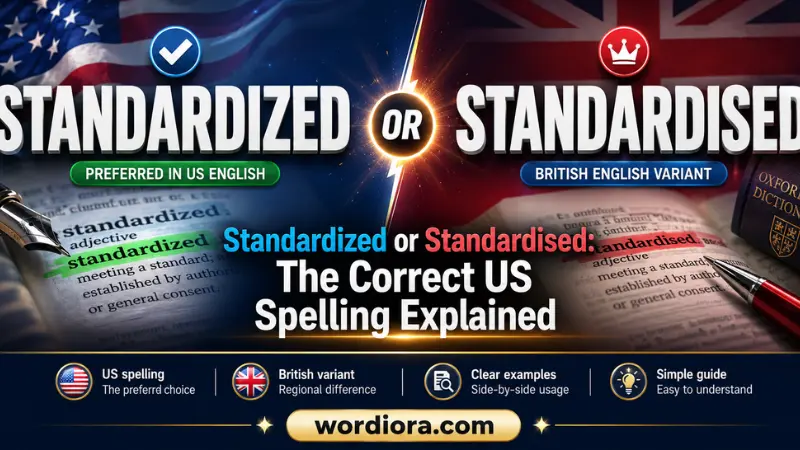
If you’re writing for a US audience, use standardized. That’s the spelling American dictionaries, schools, and style guides expect. Standardised is the British English version, used across the UK, Australia, and most Commonwealth countries. Same word, same meaning — different regional spelling.
Why People Confuse Them
The confusion comes from exposure. US readers see “standardised” in British news sites, academic papers, or software from UK-based companies, and it starts to look normal. Add spell-checkers that sometimes default to different regions, and the lines blur fast. But the core issue is simple: American English favors “-ize” endings, while British English traditionally favors “-ise.”
Key Differences At A Glance
| Feature | Standardised | Standardized |
|---|---|---|
| Region | British/Commonwealth English | American English |
| Ending | -ise | -ize |
| Preferred in US writing | No | Yes |
| Meaning | Made consistent to a standard | Made consistent to a standard |
Meaning and Usage Difference
There’s no difference in meaning at all. Both words describe the same action: making something consistent with a set rule, format, or benchmark. A process, a test, a product line, or a document can be “standardized” (or “standardised”) in exactly the same sense. The only thing that shifts is the letter before the ending — everything else about the word’s job in a sentence stays identical.
Tone, Context, and Formality
Neither spelling is more formal or more casual than the other. The difference is purely geographic. In a US business report, academic paper, or news article, “standardized” is the expected form. In a UK newspaper or Australian government document, “standardised” is the expected form. Using the wrong one for your audience won’t confuse meaning, but it can look inconsistent or out of place, especially in polished writing.
Which One Should You Use?
Use standardized if:
- You’re writing for a US audience
- You’re following AP style or most American editorial guides
- Your document mixes with other American spellings (like “color,” “organize,” “realize”)
Use standardised if:
- You’re writing for a UK, Australian, or Commonwealth audience
- Your publication or client follows British English conventions
- The rest of your document already uses British spellings (like “colour,” “organise”)
When One Choice Sounds Wrong
“Standardised” will look like a typo or an inconsistency in a US-facing article, resume, or report, especially if the rest of the piece uses American spelling elsewhere. The reverse is also true: dropping “standardized” into a British publication that otherwise uses “-ise” endings will stand out. The fix isn’t picking a “better” word. It’s matching your audience.
Common Mistakes
Mistake: Mixing both spellings in the same document.
Fix: Pick one region’s convention and use it throughout, including in related words like “standardization/standardisation.”
Mistake: Assuming British English never uses “-ize.”
Fix: Some British style guides (including certain Oxford-affiliated publishers) do accept “-ize” spellings, but “standardised” remains the far more common British choice in everyday writing.
Mistake: Treating this as a grammar error rather than a spelling variant.
Fix: Both forms are correct English — just tied to different regions.
Everyday Examples
- US: “The lab standardized its testing procedure across every location.”
- UK: “The lab standardised its testing procedure across every location.”
- US: “Standardized testing shapes how American students are evaluated.”
- UK: “Standardised assessments are used throughout UK secondary schools.”
Dictionary-Style Word Details
Verb
Both terms function as verbs, past tense and past participle of “standardize” or “standardise” — meaning to make something conform to a standard.
- Standardised: “The recipe was standardised for home kitchens.”
- Standardized: “The recipe was standardized for home kitchens.”
Noun
Neither term is itself a noun. The related noun forms are “standardisation” (British) and “standardization” (American), referring to the process or result of making something uniform.
Synonyms
Closest plain alternatives for both spellings: unified, normalized/normalised, regulated, uniformed (in the sense of “made uniform”), consistent-ized (informal). No exact one-word synonym carries the identical technical meaning, so these are approximate matches rather than perfect substitutes. A rough antonym pair: varied or diversified, since these describe the opposite of making something consistent.
Example Sentences
- “The airline standardized its boarding process at every gate.” (US)
- “The airline standardised its boarding process at every gate.” (UK)
- “New rules standardized safety checks across the factory floor.” (US)
- “New rules standardised safety checks across the factory floor.” (UK)
Word History
Both spellings trace back to the noun “standard,” meaning a fixed level or model to be followed. The “-ize” versus “-ise” split reflects a broader pattern in English spelling history, where American English settled on “-ize” endings while British English commonly favors “-ise,” though usage on both sides has some exceptions. Exact dates for when each spelling became dominant aren’t clearly documented, so this guide won’t guess at specifics.
Phrases Containing
- Standardized testing / Standardised testing
- Standardized process / Standardised process
- Standardized format / Standardised format
- Standardized units / Standardised units
FAQs
Is “standardised” ever correct in the US?
Not in standard American writing. US style guides and dictionaries use “standardized.” You might see “standardised” in quoted British sources, but it shouldn’t appear in original American content.
Do standardized and standardised mean different things?
No. The meaning is identical — only the spelling changes based on regional English.
Which spelling do US schools and standardized tests use?
“Standardized,” as in “standardized testing,” is the form used throughout US education and testing systems like the SAT or ACT.
Is “standardization” spelled with a “z” or an “s”?
It follows the same rule: “standardization” in American English, “standardisation” in British English.
Can I mix both spellings in one document?
It’s best not to. Pick one regional spelling and stay consistent throughout, including in related word forms.
How are the two words pronounced?
Pronunciation is essentially the same for both; the spelling difference doesn’t change how the word sounds.
Conclusion
Same word, same meaning, two regional spellings. If you’re writing for American readers, go with “standardized.” If you’re writing for a British or Commonwealth audience, “standardised” is your form. The only real mistake is switching between the two inside a single piece of writing.