
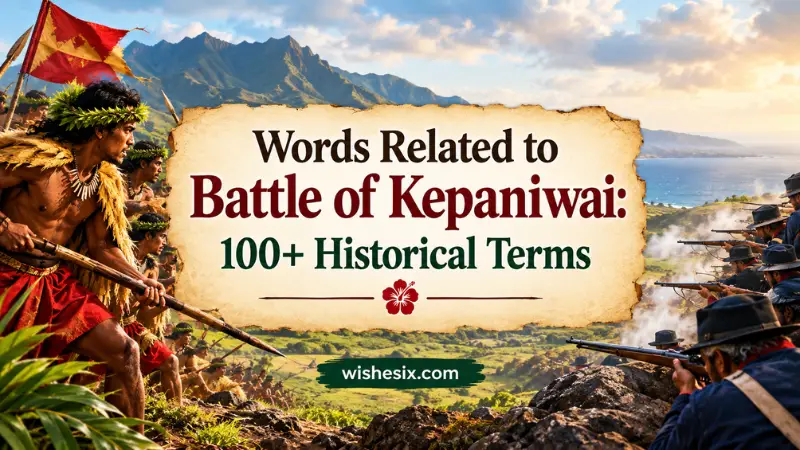
If you are looking for words related to the Battle of Kepaniwai, the most useful terms connect the 1790 conflict to Kamehameha I, Maui, ʻĪao Valley, Hawaiian warfare, traditional weapons, Western firearms, and the unification of the Hawaiian Islands. The Battle of Kepaniwai was fought on Maui in 1790 between forces led by Kamehameha I of Hawaiʻi Island and Maui forces commanded by Kalanikūpule, son of the Maui ruler Kahekili II. The battle became closely associated with ʻĪao Valley and the phrase Kepaniwai, commonly translated as “the damming of the waters.”
This guide provides more than 100 related words and phrases, organized by topic, so you can use them for historical research, school assignments, vocabulary building, content writing, or learning about Hawaiian history.
What Was the Battle of Kepaniwai?
The Battle of Kepaniwai took place in 1790 in the ʻĪao Valley area of Maui. Kamehameha I, then the ruler of Hawaiʻi Island, sent forces to Maui while Kahekili II was away on Oʻahu. Kahekili had left his son Kalanikūpule in charge of Maui. Kamehameha’s forces eventually pushed the Maui defenders toward ʻĪao Valley.
The battle is especially significant because Kamehameha’s forces had access to Western firearms and cannon, including weapons associated with the sailors John Young and Isaac Davis. Hawaiian traditional weapons and fighting skills remained important, but the use of firearms changed the battlefield.
The name Kepaniwai is commonly explained as referring to the “damming of the waters,” a reference to the traditional account that the large number of fallen warriors blocked the flow of the stream.
100+ Words Related to the Battle of Kepaniwai
Here is a quick vocabulary list covering the people, places, weapons, events, and concepts associated with the battle.
| Category | Related Words |
|---|---|
| Battle | conflict, battle, warfare, campaign, invasion |
| People | Kamehameha I, Kalanikūpule, Kahekili II |
| Place | Maui, ʻĪao Valley, Wailuku, Kahului |
| Hawaiian history | aliʻi, chiefs, kingdom, islands, unification |
| Military | warriors, army, fleet, strategy, defense |
| Weapons | cannon, musket, spear, club, shark-tooth weapon |
| Geography | valley, cliffs, stream, mountains, coast |
| Culture | Hawaiian, Native Hawaiian, tradition, genealogy, kapu |
| Related events | conquest, resistance, campaign, unification |
| Language | Kepaniwai, ʻĪao, Wailuku, Hawaiʻi, Maui |
1. Key People Related to Kepaniwai
Kamehameha I
Kamehameha I was the ruler of Hawaiʻi Island whose military campaigns eventually contributed to the unification of the Hawaiian Islands. He led the Hawaiʻi Island forces during the Battle of Kepaniwai.
Kalanikūpule
Kalanikūpule was the son of Kahekili II and commanded the Maui forces during the conflict. He was one of the principal leaders opposing Kamehameha at ʻĪao Valley.
Kahekili II
Kahekili II was the powerful ruler of Maui. He was on Oʻahu when Kamehameha’s forces attacked Maui in 1790, leaving Kalanikūpule responsible for the island’s defense.
John Young
John Young was a British sailor who became an important adviser to Kamehameha. He was involved in the use of Western weapons during Kamehameha’s military campaigns.
Isaac Davis
Isaac Davis, another Western adviser to Kamehameha, was associated with the operation of firearms and artillery during the campaign. Historical accounts emphasize the importance of Western weapons in the fighting.
Related people terms
Other useful people-related words include:
- aliʻi
- chief
- ruler
- warrior
- commander
- adviser
- royal family
- Maui chiefs
- Hawaiʻi Island chiefs
- Hawaiian leaders
- Kamehameha
- Kalanikūpule
- Kahekili
- John Young
- Isaac Davis
2. Places Related to the Battle of Kepaniwai
ʻĪao Valley
ʻĪao Valley is the most important geographic term associated with the battle. The valley became the setting for the final stages of the conflict and remains an important cultural and historical location on Maui. The Hawaiʻi Department of Land and Natural Resources identifies the valley as the site of the 1790 Battle of Kepaniwai.
Wailuku
Wailuku is the district associated with ʻĪao Valley and the battle. Historical accounts describe fighting around Wailuku before the Maui defenders were driven toward the valley.
Kahului
Kamehameha’s forces landed at or near Kahului during the campaign. From there, his army advanced toward the Wailuku and ʻĪao Valley area.
Kukaʻemoku
Kukaʻemoku, commonly called the ʻĪao Needle, is a prominent natural feature in ʻĪao Valley. The State Parks description notes that it rises about 1,200 feet above the valley floor.
More geographic terms
- Maui
- Hawaiʻi Island
- ʻĪao Valley
- Wailuku
- Kahului
- Wailuku River
- ʻĪao Stream
- West Maui Mountains
- valley
- cliffs
- ridges
- stream
- coastline
- mountains
- battlefield
- valley floor
- Kahului Bay
3. Hawaiian Historical Terms Related to Kepaniwai
Understanding a few Hawaiian historical terms makes descriptions of the battle easier to follow.
Aliʻi
Aliʻi refers broadly to the Hawaiian chiefly class or chiefs. Many historical accounts of eighteenth-century Hawaiʻi involve competing aliʻi and their territories.
Pūʻali koa
Pūʻali koa is a Hawaiian term associated with warriors or military forces. It is useful when discussing Hawaiian armies and warfare.
Kapu
Kapu refers to a system of restrictions, prohibitions, or sacred rules that played an important role in traditional Hawaiian society.
Ahupuaʻa
An ahupuaʻa was a traditional Hawaiian land division extending from upland areas toward the sea. The concept is important when studying how land and resources were organized in traditional Hawaiʻi.
Other useful historical terms
- aliʻi
- chiefdom
- chiefly class
- warrior
- genealogy
- ancestry
- territory
- land division
- ahupuaʻa
- kapu
- Hawaiian society
- traditional authority
- royal lineage
- political alliance
- succession
- sovereignty
4. Military Words Related to the Battle
The Battle of Kepaniwai is particularly useful for studying the transition between traditional Hawaiian warfare and warfare influenced by Western technology.
Traditional weapons
Historical descriptions of Hawaiian warfare include weapons such as:
- spear
- club
- war club
- pālau
- lei manō
- stone weapons
- hand-to-hand combat
- defensive weapons
The exact terminology and descriptions vary among historical sources, so traditional weapon names should be checked against authoritative Hawaiian-language or historical references when used in academic work.
Western firearms
The campaign also involved Western firearms, including:
- cannon
- musket
- ammunition
- gunpowder
- artillery
- firearms
- Western weapons
Historical research from Hawaiʻi sources describes cannon and muskets as important factors during the battle.
Military strategy terms
Useful related vocabulary includes:
- invasion
- defense
- attack
- advance
- retreat
- campaign
- battlefield
- commander
- army
- warriors
- fleet
- war canoes
- artillery
- firearms
- ammunition
- military technology
- tactical advantage
- resistance
- victory
- defeat
5. Words Related to Hawaiian Warfare
The Battle of Kepaniwai belongs to a broader period of warfare among competing Hawaiian chiefs.
Useful terms include:
- Hawaiian warfare
- traditional warfare
- warrior culture
- military campaign
- island conflict
- chiefly warfare
- territorial expansion
- resistance
- invasion
- battle strategy
- military leadership
- war canoe
- fleet
- warriors
- chiefs
- battlefield
- weapons
- artillery
- firearms
- hand-to-hand combat
These terms help place Kepaniwai within the larger history of political and military competition in eighteenth-century Hawaiʻi.
6. Words Related to Kamehameha I
Because the battle formed part of Kamehameha’s broader campaign, these terms are closely related:
- Kamehameha I
- Kamehameha the Great
- Hawaiʻi Island
- unification
- Hawaiian Islands
- kingdom
- conquest
- military campaign
- aliʻi
- warriors
- Maui
- Oʻahu
- Kauaʻi
- Molokaʻi
- political alliances
- Western weapons
- cannon
- John Young
- Isaac Davis
- Nuʻuanu
- Puʻukoholā Heiau
The Battle of Kepaniwai was one stage in a much larger process. Kamehameha did not complete the political unification of the Hawaiian Islands in 1790; the process continued for years and culminated in 1810. Hawaiʻi’s official tourism history lists 1790 as the year of the Battle of Kepaniwai and 1810 as the year Kamehameha united the islands.
7. Words Related to Maui
For content about the battle, these Maui-related terms are useful:
- Maui
- Wailuku
- ʻĪao Valley
- Kahului
- West Maui Mountains
- Maui chiefs
- Kahekili II
- Kalanikūpule
- Wailuku River
- ʻĪao Stream
- Maui warriors
- Maui kingdom
- Maui history
- traditional Maui
- Hawaiian culture
- Maui heritage
- Maui archaeology
- Maui geography
These terms can help connect the battle to the island’s broader historical and cultural landscape.
8. Words Related to the Meaning of “Kepaniwai”
One of the most important related phrases is:
Kepaniwai — “the damming of the waters.”
Historical descriptions connect the name with the large number of casualties during the fighting and the traditional account that bodies blocked the stream. Hawaiʻi state documentation describes Kepaniwai as meaning “the damming of the waters.”
Related words include:
- water
- damming
- stream
- ʻĪao Stream
- Wailuku
- valley
- battlefield
- bodies
- warriors
- casualties
- cliffs
- escape
- retreat
- battle
- conflict
Another historical name associated with the battle is Kauwaʻupali, described in Hawaiʻi documentation in connection with the steep cliffs and the efforts of Maui warriors to escape through the valley.
9. Words Related to Hawaiian Geography
Geography played an important role in how the conflict unfolded.
Useful terms include:
- valley
- mountain
- cliff
- ridge
- stream
- river
- coast
- shoreline
- bay
- island
- upland
- lowland
- valley floor
- narrow valley
- steep slopes
- West Maui Mountains
- Kahului Bay
- ʻĪao Valley
- Wailuku
The narrow terrain of ʻĪao Valley is frequently mentioned in historical accounts of the battle, making geographic vocabulary especially relevant when researching Kepaniwai.
10. Words Related to Hawaiian Unification
The Battle of Kepaniwai is often studied in connection with Kamehameha’s efforts to bring the Hawaiian Islands under a unified political authority.
Related terms include:
- unification
- Hawaiian Islands
- Kamehameha I
- kingdom
- political power
- rival chiefs
- island kingdoms
- conquest
- alliance
- succession
- sovereignty
- territory
- leadership
- campaign
- Maui
- Oʻahu
- Hawaiʻi Island
- Kauaʻi
- Nuʻuanu
- 1810
The official Hawaiʻi tourism history places Kepaniwai within the larger chronology leading to the eventual unification of Hawaiʻi under Kamehameha.
11. Long-Tail Keywords Related to the Battle of Kepaniwai
If you are researching this subject online, these longer phrases may match common informational searches:
- words related to Battle of Kepaniwai
- Battle of Kepaniwai related words
- Battle of Kepaniwai vocabulary
- Battle of Kepaniwai meaning
- what does Kepaniwai mean
- where was the Battle of Kepaniwai fought
- when was the Battle of Kepaniwai
- who fought in the Battle of Kepaniwai
- Battle of Kepaniwai Maui
- Battle of Kepaniwai ʻĪao Valley
- Kamehameha Battle of Kepaniwai
- Kalanikūpule Battle of Kepaniwai
- Kahekili and Battle of Kepaniwai
- Hawaiian weapons used at Kepaniwai
- Hawaiian history Battle of Kepaniwai
- Kepaniwai damming of the waters
- ʻĪao Valley battle history
- Kamehameha Maui invasion 1790
- Maui warriors Kamehameha 1790
- Kepaniwai and Hawaiian unification
12. Quick Reference: 100+ Related Words
Here is a compact list you can use for vocabulary research, topical organization, or related-keyword brainstorming:
Kepaniwai, Battle, Maui, Hawaiʻi, Kamehameha, Kalanikūpule, Kahekili, ʻĪao Valley, Wailuku, Kahului, Wailuku River, ʻĪao Stream, Kukaʻemoku, warriors, army, chiefs, aliʻi, campaign, invasion, defense, attack, retreat, victory, defeat, conflict, warfare, battlefield, strategy, tactics, fleet, war canoes, cannon, musket, firearms, ammunition, artillery, spear, club, pālau, lei manō, weapons, warriors, commander, ruler, kingdom, unification, conquest, territory, alliance, sovereignty, leadership, resistance, genealogy, kapu, ahupuaʻa, Hawaiian history, Maui history, island history, traditional warfare, Western weapons, military technology, gunpowder, valley, cliffs, mountains, stream, river, coast, bay, shoreline, valley floor, ridge, upland, lowland, Kahului Bay, West Maui Mountains, Hawaiian Islands, Hawaiʻi Island, Oʻahu, Kauaʻi, Molokaʻi, Nuʻūanu, Puʻukoholā Heiau, John Young, Isaac Davis, Keōua Kūʻahuʻula, Kalola, Keōpūolani, political power, chiefly authority, land, culture, heritage, tradition, Native Hawaiian history, historical battle, 1790, eighteenth century, island conflict, military campaign, battlefield history, Hawaiian kingdom, Hawaiian leaders, traditional weapons, firearms, artillery, damming of the waters, water, casualties, resistance, escape, cliffs, historical site, cultural site, ʻĪao Valley State Monument, Kepaniwai Park, Hawaiian language, place name, historical vocabulary, unification of Hawaiʻi.
13. Why These Related Words Matter
The vocabulary surrounding Kepaniwai is useful because the battle cannot be understood through one name alone.
For example, Kamehameha, Kalanikūpule, and Kahekili II identify the principal political figures. Maui, Wailuku, Kahului, and ʻĪao Valley establish the geographic setting. Cannon, musket, and traditional weapons explain the military technology involved.
Meanwhile, Kepaniwai, damming of the waters, and ʻĪao Stream help explain the name and historical memory of the battle.
Finally, unification, kingdom, campaign, and alliances connect the battle to the larger political history of Hawaiʻi.
One important historical detail is that descriptions of the battle’s immediate outcome can differ depending on the source and the meaning of “conquered.” Hawaiʻi’s Division of State Parks describes Kamehameha’s forces as conquering the Maui army in 1790, while Hawaiʻi state archaeological documentation notes that Maui was only briefly under Kamehameha’s control and that Kahekili and allied forces reoccupied Maui in 1791.
That distinction matters when writing an accurate article: Kepaniwai was a major 1790 victory for Kamehameha’s forces, but it did not by itself complete Kamehameha’s permanent political control of Maui or the Hawaiian Islands.
FAQs
What does Kepaniwai mean?
Kepaniwai is commonly translated as “the damming of the waters.” The name is traditionally associated with accounts that the large number of fallen warriors blocked the stream in ʻĪao Valley.
Where did the Battle of Kepaniwai take place?
The battle took place on Maui, particularly around ʻĪao Valley and Wailuku. Hawaiʻi’s Division of State Parks identifies ʻĪao Valley as the site of the 1790 battle.
When was the Battle of Kepaniwai?
The Battle of Kepaniwai occurred in 1790. It formed part of Kamehameha I’s broader military and political campaign during the period of Hawaiian unification.
Who fought in the Battle of Kepaniwai?
Kamehameha I led forces from Hawaiʻi Island, while Maui forces were commanded by Kalanikūpule, the son of Kahekili II.
What weapons were used at Kepaniwai?
The fighting involved traditional Hawaiian weapons as well as Western firearms. Historical documentation specifically discusses cannon and muskets used by Kamehameha’s forces.
Why is the Battle of Kepaniwai important?
It is important because it was a major conflict in Kamehameha I’s campaign to expand his authority beyond Hawaiʻi Island. It also illustrates the increasing role of Western firearms in Hawaiian warfare during the late eighteenth century.
Is Kepaniwai connected to ʻĪao Valley?
Yes. ʻĪao Valley is directly associated with the battle, and the area remains an important cultural and historical landscape on Maui.
Did the Battle of Kepaniwai unify Hawaiʻi?
No, not by itself. The battle was one part of a longer process. Hawaiʻi’s official historical timeline places the Battle of Kepaniwai in 1790 and the eventual unification of the Hawaiian Islands under Kamehameha in 1810.
Conclusion
The best way to understand words related to the Battle of Kepaniwai is to connect the battle’s name with its people, places, weapons, language, geography, and wider historical context.
The most important terms to remember are Kamehameha I, Kalanikūpule, Kahekili II, Maui, ʻĪao Valley, Wailuku, Kahului, cannon, muskets, Hawaiian warriors, aliʻi, unification, and “damming of the waters.”
Together, these words provide a clearer picture of the 1790 conflict and its place in the history of Hawaiʻi. For further research, compare historical accounts and Hawaiʻi state cultural resources, especially when studying traditional Hawaiian place names, translations, and oral-history traditions.
If you’re researching Hawaiian history, use this vocabulary list as a starting point and explore each person, place, and term individually for a deeper understanding of the Battle of Kepaniwai.
SEO Meta Title
Words Related to Battle of Kepaniwai: 100+ Terms
SEO Meta Description
Explore 100+ words related to the Battle of Kepaniwai, including Hawaiian history, key people, places, weapons, warfare, and cultural terms.
URL Slug
words-related-to-battle-of-kepaniwai


