
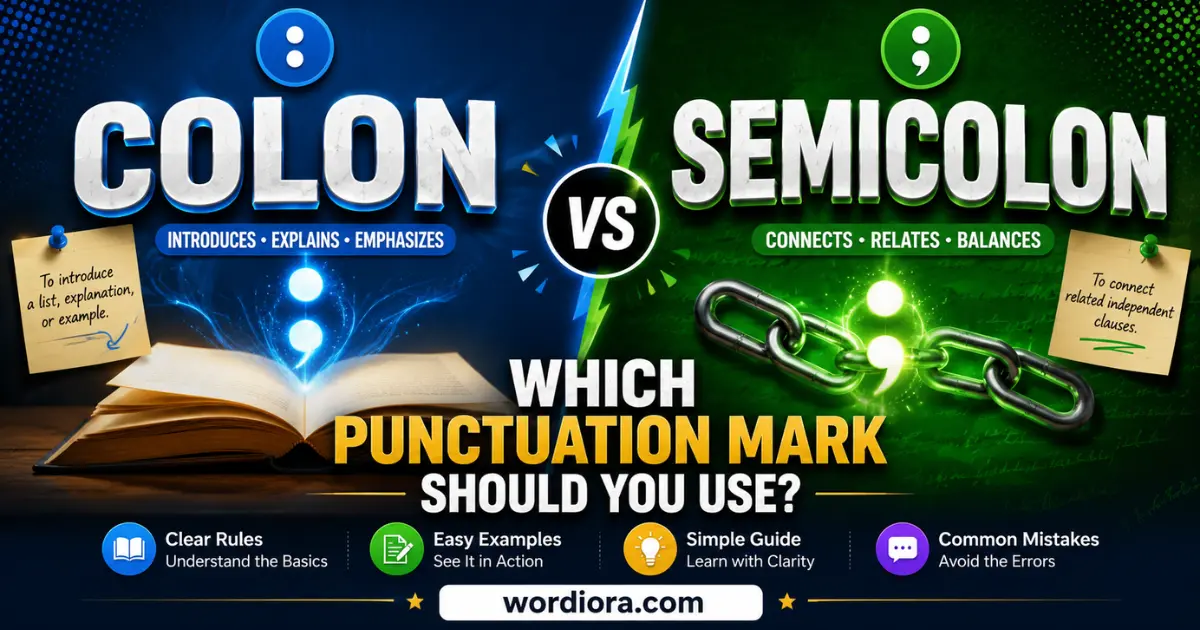
Choosing between a colon or semicolon depends on the relationship you want to show.
A colon (:) points forward. It introduces something that explains, identifies, illustrates, or develops what came before.
A semicolon (;) connects or separates. It can join closely related independent clauses without a coordinating conjunction, or divide complicated list items that already contain commas. marks look similar, they are not interchangeable.
Quick Answer
Use a colon when the words after it introduce or explain something set up before it, such as a list, example, clarification, or elaboration. Use a semicolon to join two closely related independent clauses or to separate complex list items containing commas. When both sides are complete sentences, focus on the relationship: a colon introduces an explanation, while a semicolon links ideas of roughly equal grammatical weight. Confuse Them
Colons and semicolons are easy to mix up because both appear inside sentences and both can connect related ideas.
The confusion becomes stronger because each mark can appear around lists. However, they do different jobs.
A colon normally introduces a list:
We need three supplies: paper, markers, and tape.
Semicolons can separate items within a complex list:
The guests came from Austin, Texas; Denver, Colorado; and Phoenix, Arizona.
The marks can also both appear between complete clauses. The difference is the relationship being expressed. A colon signals that the second part explains, sharpens, illustrates, or develops the first. A semicolon connects complete thoughts that are closely related without making the second one simply an introduced explanation. ences At A Glance
- Colon (:): Points forward to an explanation, list, example, quotation, restatement, or other information introduced by what comes before it.
- Semicolon (;): Links closely related independent clauses or separates complicated items in a series.
A useful test is to ask what the second part is doing.
If it answers something like “What exactly?”, “Which ones?”, or “Here is the explanation,” a colon may fit.
If both sides could stand as sentences and you mainly want to show that they are closely connected, a semicolon may fit. d Usage Difference
The colon is mainly an introducing mark.
Consider:
There was one problem: the office was already closed.
The first clause creates an expectation. The words after the colon explain what the problem was.
A colon may also introduce a list:
She packed everything she needed: a laptop, headphones, a charger, and a notebook.
In standard running prose, the material before a colon should normally form a complete grammatical thought. That is why a colon is usually wrong when it interrupts words that naturally belong together.
Incorrect: The available colors are: black, blue, and silver.
Better: The available colors are black, blue, and silver.
Or:
Better: Three colors are available: black, blue, and silver.
The semicolon has a different role.
It can connect two independent clauses:
The store closes at eight; we should leave now.
Each side could stand as a complete sentence:
The store closes at eight.
We should leave now.
The semicolon shows that the writer wants readers to see a close connection between those thoughts. It can also separate complicated list items, especially when commas already appear inside them. ext, and Formality
Both colons and semicolons are standard punctuation in American English. Neither belongs only to formal writing.
Still, they create different effects.
A colon often feels direct and anticipatory because it tells the reader that something specific is coming next:
The team had one goal: finish before Friday.
A semicolon often creates a balanced, deliberate connection between two thoughts:
The deadline is Friday; the team still has plenty of work to do.
In casual writing, a period may sometimes feel simpler than a semicolon:
The deadline is Friday. The team still has plenty of work to do.
Both versions can be correct. Choosing the semicolon emphasizes the connection within one sentence, while the period gives each thought more separation. n after a colon can depend on the style being followed when a complete clause comes next. Some styles allow or prefer capitalization in certain situations, while others use lowercase. Consistency matters. Should You Use?
Use the grammatical structure and the relationship between ideas to decide.
| Context | Best Choice | Why |
|---|---|---|
| Introducing a simple list after a complete setup | Colon | The second part supplies the items being introduced |
| Introducing an explanation or clarification | Colon | The second part develops or explains the first |
| Joining two closely related independent clauses | Semicolon | Both clauses can stand alone and have closely connected ideas |
| Separating list items that contain commas | Semicolon | It makes the boundaries between complex items clear |
| Connecting clauses when the second directly explains the first | Colon | The second clause functions as an explanation or elaboration |
| Before a transition such as “however” between independent clauses | Semicolon | The semicolon separates the complete clauses correctly |
For example:
The meeting was canceled for one reason: the manager was sick.
Here, the second clause explains the reason, so a colon works naturally.
Compare:
The manager was sick; the meeting was canceled.
Here, both statements have equal grammatical status and are closely related, so a semicolon works naturally. hoice Sounds Wrong
A semicolon sounds wrong when it is used simply to introduce a basic list.
Incorrect:
I bought three things; bread, milk, and eggs.
Correct:
I bought three things: bread, milk, and eggs.
The colon introduces what the “three things” are. s also usually wrong when one side cannot stand as an independent clause.
Incorrect:
Because the weather got worse; we canceled the picnic.
“Because the weather got worse” is not a complete sentence by itself, so the semicolon does not properly join two independent clauses.
A colon sounds wrong when it unnecessarily separates a verb or preposition from what completes its meaning.
Incorrect:
Her favorite activities include: hiking, swimming, and cycling.
Correct:
Her favorite activities include hiking, swimming, and cycling.
A colon can work after a rewritten complete setup:
She has three favorite activities: hiking, swimming, and cycling. takes (and Quick Fixes)
One common mistake is treating the two marks as interchangeable before a list.
Use a colon to introduce the list:
The recipe requires four ingredients: flour, butter, sugar, and eggs.
Use semicolons only when the list itself needs stronger separators:
We visited Portland, Maine; Boston, Massachusetts; and Providence, Rhode Island.
Another mistake is joining independent clauses with a semicolon when a coordinating conjunction already does the basic joining work.
Natural:
I wanted to go, but I had to work.
Also natural:
I wanted to go; I had to work.
The structures express the relationship differently.
Writers also sometimes put only a comma between complete clauses before words such as however:
Incorrect:
The train was delayed, however, we arrived on time.
A standard correction is:
The train was delayed; however, we arrived on time.
The semicolon separates the independent clauses, while the transition remains part of the second clause. xamples
Colon introducing a list
Please bring three documents: your ID, your application, and your receipt.
Semicolon joining related clauses
The parking lot is full; we will have to park across the street.
Colon introducing an explanation
I knew why she was late: her flight had been delayed.
Semicolon with a transition
The apartment looked perfect; however, the rent was above our budget.
Colon introducing a specific answer
He had one priority: getting home before the storm.
Semicolons in a complex list
The conference has offices in Seattle, Washington; Dallas, Texas; Miami, Florida; and Albany, New York.
Different punctuation, different relationship
The project failed: we never received the required funding.
The project lost its funding; it eventually failed.
In the first sentence, the colon presents the second clause as the explanation of the failure. In the second, the semicolon connects two closely related events without using the same direct introducing relationship. -Style Word Details
Verb
colon: Not commonly used as a verb when referring to standard English punctuation. In this comparison, colon is the name of a punctuation mark.
semicolon: Not commonly used as a verb in standard punctuation terminology. Here, semicolon functions as the name of the mark (;).
Noun
colon: A countable noun naming the punctuation mark (:). In writing, it commonly introduces a list, explanation, quotation, example, or other material set up by what comes before it. * A countable noun naming the punctuation mark (;). It commonly separates closely related independent parts of a sentence or separates items in a complex list.
Neither punctuation term has a true exact synonym in standard usage.
colon: Closest plain description: introducing punctuation mark or two-dot punctuation mark. These are descriptions, not exact replacements for the word colon.
semicolon: Closest plain description: clause-linking punctuation mark or, in the context of complex lists, strong list separator. These are functional descriptions rather than exact synonyms.
Neither term has a meaningful antonym in ordinary punctuation terminology.
Example Sentences
colon:
Use a colon to introduce the explanation in this sentence.
The announcement contained one surprise: the office would close early.
semicolon:
A semicolon can connect two independent clauses that are closely related.
The restaurant was crowded; we decided to order takeout instead.
Word History
colon: The punctuation term has a long history connected with Latin and Greek grammatical terminology referring to a section or part of discourse. The modern punctuation mark developed through changing manuscript and printing practices. * The term combines the idea of semi- with colon and became associated with a punctuation mark positioned functionally between lighter and stronger sentence divisions. Historical references differ on exactly how to date its earliest printed appearance, so assigning one unquestioned invention date would oversimplify the record. iters, the historical details do not change the practical distinction: the colon introduces or develops what follows, while the semicolon primarily links related clauses or separates complex list items. ontaining
colon:
- use a colon
- colon before a list
- colon before an explanation
- colon between clauses
- colon after an independent clause
semicolon:
- use a semicolon
- semicolon between independent clauses
- semicolon before however
- semicolon-separated list
- semicolon in a complex list
These phrases describe common situations in which writers discuss or apply the two punctuation marks.
FAQs
What is the main difference between a colon and a semicolon?
A colon introduces information that explains, identifies, or expands on what comes before it. A semicolon usually connects two closely related independent clauses or separates complex list items. Think of a colon as pointing forward and a semicolon as linking related ideas.
When should I use a colon instead of a semicolon?
Use a colon when the second part of the sentence provides an explanation, example, list, or clarification. For example: “She needed three things: patience, practice, and time.” The words after the colon explain what the three things are.
Can a semicolon connect two complete sentences?
Yes. A semicolon can connect two independent clauses when their ideas are closely related. For example: “The weather was getting worse; we decided to drive home.” Each side could stand as a complete sentence, but the semicolon highlights their close connection.
Can I use a semicolon before a list?
A semicolon does not normally introduce a simple list. Use a colon for that purpose. However, semicolons are useful for separating complex list items that already contain commas, such as: “We visited Austin, Texas; Denver, Colorado; and Phoenix, Arizona.”
Can a colon connect two complete sentences?
Yes, when the second sentence explains, clarifies, or develops the first. For example: “She knew the real problem: the deadline was impossible to meet.” The second clause directly explains what the problem was, making the colon appropriate.
What is the easiest way to remember colon vs semicolon?
Remember this simple distinction: a colon introduces, while a semicolon connects or separates. Choose a colon when something specific is coming next, such as an explanation or list. Choose a semicolon when linking closely related complete thoughts or organizing complicated list items.
Conclusion
The choice between a colon or semicolon becomes easier once you focus on the relationship between the ideas.
Use a colon when the second part is being introduced by the first. It may provide a list, explanation, example, clarification, quotation, or elaboration.
Use a semicolon when two complete clauses are closely related but remain grammatically balanced, or when complicated list items need clearer separation.


