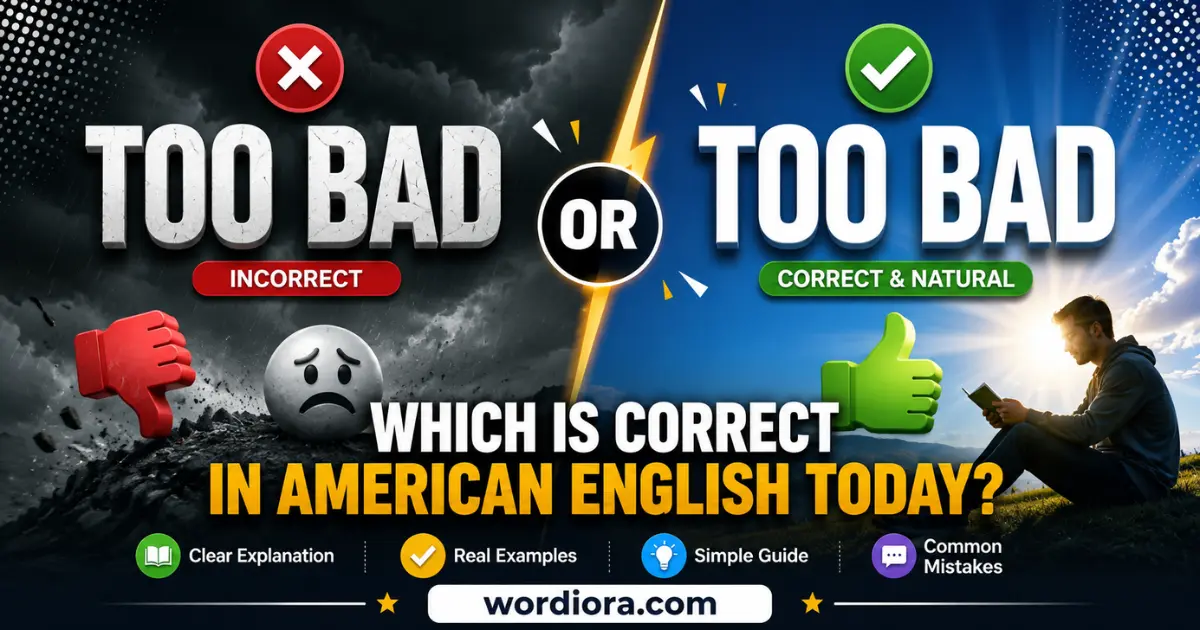
Too bad is the correct expression when you mean that something is unfortunate, disappointing, regrettable, or worse than acceptable.
For example:
“That’s too bad you missed the concert.”
Writing “That’s to bad” is incorrect because to cannot replace too in this expression.
There is one useful nuance: the words to bad can sometimes appear next to each other inside a larger structure, such as “from good to bad.” In that case, they do not form the expression too bad.
Quick Answer
Use too bad when expressing sympathy, disappointment, regret, or an excessive degree of badness.
Correct: “It’s too bad the game was canceled.”
Incorrect: “It’s to bad the game was canceled.”
The form to bad is not an alternative spelling of too bad. It is possible only when to has its own grammatical job in a larger sentence, as in “Things went from good to bad.”
Why People Confuse Them
The confusion comes mainly from to and too sounding the same in normal speech.
Because listeners cannot hear the extra o, someone may know the expression perfectly when speaking but choose the wrong spelling when writing.
The words also have different grammatical jobs. In too bad, too modifies bad. It can express excessive degree, or the two words can work together as an established expression.
By contrast, to commonly shows direction, connection, range, or introduces an infinitive. Those functions do not fit a sentence such as “That’s to bad.”
Key Differences At A Glance
- too bad: Standard expression; can mean unfortunate, regrettable, or excessively bad.
- to bad: Not a substitute for too bad; may occur only when to belongs to a separate grammatical structure.
- That’s too bad: Correct.
- That’s to bad: Incorrect.
- From good to bad: Correct, because to marks movement or change between two states.
Meaning and Usage Difference
The main difference is grammatical.
In too bad, too is an adverb. Before the adjective bad, it can indicate an excessive degree:
“The roads are too bad to drive on.”
Here, the roads are worse than is acceptable or safe for driving.
Too bad also works as an established expression meaning that a situation is unfortunate:
“It’s too bad Maya can’t join us.”
It can also stand alone:
“Your flight was canceled? That’s too bad.”
To bad, by itself, does not have that meaning. The word to cannot simply replace the adverb too.
However, a larger construction may place the two words together:
“The situation went from good to bad.”
Here, to marks a change toward the state described by bad. This is a different grammatical structure, not a competing version of too bad.
Tone, Context, and Formality
Too bad is especially common in conversation and everyday writing.
When said sincerely, it can express sympathy:
“You didn’t get the job? That’s too bad.”
Tone can change the effect. A flat or sharp “Too bad” may instead sound dismissive:
“You still want an extension? Too bad. The deadline has passed.”
Because the same words can communicate sympathy or indifference, context matters.
In more formal writing, a more precise word such as unfortunate, regrettable, or disappointing may sometimes fit better. Still, too bad is grammatically standard.
To bad has no separate formal or informal status as an alternative expression. In “That’s to bad,” it is simply the wrong choice.
Which One Should You Use?
Use this comparison:
| Context | Best Choice | Why |
|---|---|---|
| Expressing sympathy | too bad | It is the established expression |
| Saying something is unfortunate | too bad | It conveys regret or disappointment |
| Describing an excessive degree of badness | too bad | Too modifies the adjective bad |
| Writing “That’s ___” about bad news | too bad | To cannot replace too here |
| Showing change from one condition to another | to bad | Possible in a larger structure such as “from good to bad” |
A simple check is to ask what you mean.
If you could replace the idea with unfortunate, regrettable, or excessively bad, choose too bad.
If to is linking two points or conditions in a larger construction, the sequence to bad may be correct for a completely different reason.
When One Choice Sounds Wrong
To bad sounds wrong when a writer intends the familiar expression.
Incorrect:
“That’s to bad about your car.”
Correct:
“That’s too bad about your car.”
Incorrect:
“The weather is to bad for the picnic.”
Correct:
“The weather is too bad for the picnic.”
However, do not automatically “correct” every visible occurrence of to bad:
“The mood changed from good to bad.”
That sentence is grammatical because to is part of the pattern from X to Y.
The key question is not whether the two words happen to sit together. It is whether the writer is trying to use the expression too bad.
Common Mistakes (and Quick Fixes)
One common mistake is dropping the second o:
Incorrect: “It’s to bad we missed them.”
Correct: “It’s too bad we missed them.”
Another mistake is assuming that too bad always means “extremely bad.” It can also function as a reaction to unfortunate news:
“That’s too bad. I hope you feel better soon.”
Tone creates another possible problem. A speaker may intend sympathy, but a very brief “Too bad” can sound cold. Adding context can make the meaning warmer:
“That’s too bad. I’m sorry you had to cancel.”
Finally, do not treat every to bad sequence as an error. In “from good to bad,” to is doing a different grammatical job.
Everyday Examples
Here are natural examples of too bad:
“It’s too bad the outdoor concert was rained out.”
“That’s too bad about your laptop. Can it be repaired?”
“The traffic was too bad for us to arrive on time.”
“Too bad you can’t stay for dinner.”
“Our seats weren’t too bad, even though we bought the tickets late.”
The first, second, and fourth examples express disappointment or sympathy.
The third uses too to show excessive degree.
The fifth shows another familiar pattern: not too bad, meaning fairly good, acceptable, or satisfactory.
A correct example containing to bad is:
“The team’s performance went from promising to bad in the second half.”
Here, to belongs to the movement from one condition to another. It does not mean the same thing as too bad.
Dictionary-Style Word Details
Verb
too bad: Not used as a verb. It is an expression built around the adverb too and adjective bad, and it can function as an idiomatic reaction.
to bad: Not commonly used as a verb or as a fixed verbal expression in standard US English.
Noun
too bad: Not normally a noun. The expression can stand alone as a response, but that does not make it a regular noun.
to bad: Not a standard noun or fixed noun phrase. In a structure such as “from good to bad,” bad describes a state or condition within the larger construction.
Synonyms
too bad: Depending on context, closest plain alternatives include unfortunate, regrettable, what a shame, and disappointing.
When too bad means excessively bad, closer alternatives include unacceptably bad or so bad that it causes a problem.
No single synonym works in every context because tone changes the meaning.
to bad: It has no synonym as a competing fixed expression because it is not an alternative form of too bad.
Example Sentences
too bad:
“It’s too bad Jordan has to work this weekend.”
“The snow became too bad for safe driving.”
“That’s too bad. I know how much you wanted to go.”
“Too bad—the registration period has already closed.”
to bad:
“The situation shifted from good to bad after the power failed.”
This example is correct only because to is part of a larger grammatical pattern.
Word History
too bad: The expression has long been established in English. Its structure reflects the adverb too used with the adjective bad, while dictionaries also recognize too bad as an idiomatic expression.
to bad: There is no separate word history for to bad as a competing expression because it is not an established alternative to too bad. When the words occur together, they normally belong to a larger grammatical structure.
Phrases Containing
too bad:
- that’s too bad
- it’s too bad
- not too bad
- too bad that
- too bad to
- too bad for
Examples:
“It’s too bad that the store closed early.”
“The road was too bad to use.”
“The result wasn’t too bad.”
to bad:
There are no common fixed expressions in which to bad replaces too bad. The sequence can appear within broader patterns such as:
- from good to bad
- go from okay to bad
- change from better to bad
In these cases, to marks a transition or endpoint.
FAQs
Is “too bad” or “to bad” correct?
“Too bad” is correct when you mean that something is unfortunate, disappointing, regrettable, or excessively bad. For example, “It’s too bad the event was canceled.” Writing “to bad” in this sentence is incorrect because “too” is the adverb that modifies “bad.”
Can “to bad” ever be correct?
Yes, but only when “to” has its own grammatical role in a larger sentence. For example, “The situation went from good to bad.” Here, “to” shows a change from one condition to another. It is not an alternative spelling of “too bad.”
What does “too bad” mean?
“Too bad” can mean unfortunate or regrettable, as in “That’s too bad about your trip.” It can also mean excessively bad, as in “The weather was too bad to drive in.” The exact meaning depends on the sentence and context.
Is “that’s to bad” ever correct?
No. When reacting to disappointing or unfortunate news, the correct expression is “That’s too bad.” The word “too” is required because it forms the standard expression with “bad.” “That’s to bad” is a spelling and grammar error.
Is “too bad” rude?
Not always. “That’s too bad” can sound sympathetic when spoken kindly. However, a short “Too bad” may sound dismissive or sarcastic depending on tone and context. Adding a caring sentence can make the meaning clearer, such as, “That’s too bad. I’m sorry that happened.”
How can I remember “too bad”?
Remember that “too” can mean “excessively” or “more than acceptable.” If something is “too bad,” it may be worse than desired or simply unfortunate. The extra “o” in “too” helps distinguish it from “to,” which usually shows direction, connection, or introduces an infinitive. This simple distinction makes the correct form much easier to remember in writing.
Conclusion
When choosing between too bad or to bad, use too bad when you mean unfortunate, regrettable, or excessively bad.
“That’s too bad” is correct. “That’s to bad” is not.
The only important exception is structural: to bad can appear when to has its own role in a larger sentence, such as “from good to bad.” That does not make it another spelling of too bad.
Remember the core distinction: too can modify bad; to cannot replace it in the expression too bad.