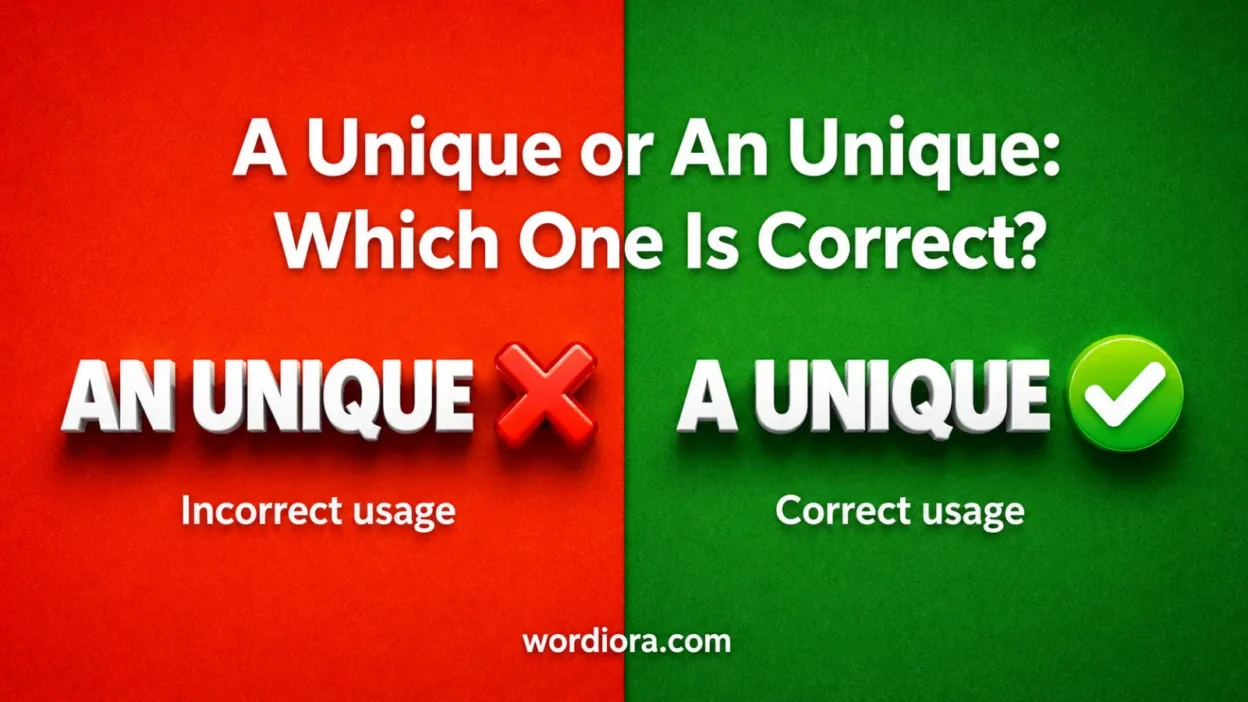
Use a unique, not an unique, in modern US English. The spelling may confuse people because unique begins with the vowel letter u, but English articles depend on sound, not just letters.
The word unique starts with a “you” sound, as in you-neek. Since that first sound acts like a consonant sound, the correct article is a. So, you should write a unique idea, a unique style, and a unique opportunity.
Quick Answer
A unique is correct. An unique is incorrect in standard modern US English. Use a before unique because the word starts with a “you” sound, not a pure vowel sound. The same pattern appears in phrases like a university, a user, and a usual problem.
Why People Confuse Them
Many learners memorize a simple rule: use a before consonants and an before vowels. That rule helps at first, but it misses the real point. English chooses a or an by the first sound of the next word.
That is why an apple is correct. The word apple starts with a vowel sound. However, unique starts with a “y” sound, even though it begins with the letter u.
This also explains why a uniform, a unicorn, and a university sound natural. Each one starts with a “you” sound. So, a unique follows the same pattern.
Key Differences At A Glance
| Context | Best Choice | Why |
|---|---|---|
| Before “unique” in US English | a unique | “Unique” begins with a “you” sound |
| Before a word with a vowel sound | an | Use “an” before sounds like apple, hour, or idea |
| Formal writing | a unique | This is the standard choice |
| School or business writing | a unique | It sounds correct and polished |
| Casual texting | a unique | It still sounds natural |
| “An unique” in modern writing | Avoid it | It sounds awkward and nonstandard |
Meaning and Usage Difference
The difference between a unique and an unique is not a difference in meaning. Both try to point to one thing that is special, rare, or one of a kind. The real difference is grammar.
A unique uses the correct article. It fits the pronunciation of unique and sounds natural to US readers.
Examples:
- She has a unique way of explaining hard ideas.
- This city offers a unique mix of food, music, and history.
- He found a unique solution to the problem.
An unique uses the wrong article before this sound. It may happen because the writer sees the vowel letter u and chooses an too quickly.
Incorrect examples:
- She has an unique way of explaining hard ideas.
- This city offers an unique mix of food, music, and history.
- He found an unique solution to the problem.
The word unique itself is an adjective. It describes a noun, such as idea, person, design, feature, voice, or opportunity.
Tone, Context, and Formality
A unique works in every normal context. You can use it in school essays, job applications, emails, articles, product descriptions, and casual conversation.
It sounds clean and standard:
- This internship gave me a unique chance to learn from experts.
- Our company has a unique approach to customer service.
- That painting has a unique color balance.
An unique sounds unnatural to most modern US readers. In formal writing, it may look like a grammar mistake. In casual writing, people will still notice it because the phrase sounds off when read aloud.
The safest test is simple: say the phrase slowly. A you-neek flows naturally. An you-neek feels clumsy because an does not match the starting sound.
Which One Should You Use?
Use a unique every time before the word unique.
Choose a unique when you mean:
- one of a kind
- different from others
- special in a clear way
- unusual or rare
- not easily copied
Examples:
- The museum has a unique collection of local art.
- She brings a unique perspective to the team.
- The app has a unique feature for beginners.
- We need a unique name for the project.
- It was a unique moment in the company’s history.
Avoid an unique in standard US English. It does not sound natural because unique does not begin with a pure vowel sound.
When One Choice Sounds Wrong
An unique sounds wrong when the phrase appears before any normal noun.
Wrong:
- an unique design
- an unique idea
- an unique person
- an unique experience
- an unique answer
Correct:
- a unique design
- a unique idea
- a unique person
- a unique experience
- a unique answer
The mistake becomes clearer when you compare unique with words that truly take an.
Correct:
- an unusual design
- an interesting idea
- an honest answer
- an open door
Now compare those with unique:
- a unique design
- a unique idea
- a unique answer
- a unique style
The first sound controls the article. Unusual starts with a vowel sound, so it takes an. Unique starts with a “you” sound, so it takes a.
Common Mistakes (and Quick Fixes)
One common mistake is choosing the article by spelling alone. Since unique begins with u, some writers assume an must be correct. Instead, listen to the first sound.
Wrong: She gave an unique answer.
Correct: She gave a unique answer.
Another mistake is treating all u words the same. Some u words take a, while others take an.
Use a with “you” sounds:
- a unique idea
- a university student
- a useful tip
- a uniform policy
Use an with true vowel sounds:
- an umbrella
- an update
- an urgent message
- an unusual case
A third mistake is overusing unique when a simpler word would work better. If something is only slightly different, words like unusual, special, or distinctive may sound more accurate.
Everyday Examples
Here are natural US-English examples with a unique:
- That restaurant has a unique menu.
- Her voice has a unique warmth.
- We need a unique password for each account.
- The teacher gave us a unique assignment.
- This neighborhood has a unique history.
- He has a unique sense of humor.
- The designer created a unique logo.
- It was a unique chance to meet the author.
- The team found a unique way to solve the issue.
- This camera has a unique setting for night shots.
- She brings a unique skill set to the role.
- The trip gave us a unique view of the coast.
Now compare the incorrect form:
- Incorrect: It was an unique chance.
- Correct: It was a unique chance.
- Incorrect: He has an unique voice.
- Correct: He has a unique voice.
- Incorrect: They built an unique home.
- Correct: They built a unique home.
Dictionary-Style Word Details
Verb
- A unique: This is not a verb. It is an article plus an adjective used before a noun, as in a unique idea.
- An unique: This is also not a verb. It is a nonstandard article choice before the adjective unique.
Noun
- A unique: This phrase is not a noun by itself. It usually modifies a noun that comes after it, such as a unique plan, a unique person, or a unique result.
- An unique: This phrase is not a standard noun phrase in modern US English because the article does not fit the sound of unique.
Synonyms
For unique, the closest plain alternatives are one of a kind, rare, special, distinctive, unusual, and singular.
Use them carefully:
- One of a kind fits when something has no exact match.
- Rare fits when something does not happen often.
- Distinctive fits when something has a clear identifying quality.
- Unusual fits when something is not typical.
- Special fits when something has extra value or importance.
Clear antonyms include common, ordinary, typical, and usual.
There are no useful synonyms for an unique because it is not the standard form.
Example Sentences
- A unique: The school offers a unique program for young writers.
- A unique: Her background gives her a unique view of the issue.
- A unique: We wanted a unique gift, not something generic.
- A unique: The old building has a unique charm.
- An unique: Avoid this form in standard US English.
- An unique: Write a unique opportunity, not an unique opportunity.
Word History
The word unique comes into English through French and Latin roots connected with the idea of “one.” That background matches its main meaning: being the only one of its kind.
However, you do not need the history to choose the article. The article depends on pronunciation. Since unique begins with a “you” sound, a unique is the correct modern form.
Phrases Containing
- A unique opportunity: This means a special chance that does not happen often.
- A unique perspective: This means a different or valuable way of seeing something.
- A unique feature: This means a quality that helps something stand apart.
- A unique experience: This means an experience that feels rare or different.
- A unique style: This means a recognizable way of doing or creating something.
- An unique: Avoid this phrase in standard US English.
FAQs
Is it a unique or an unique?
The correct phrase is a unique. Use a because unique starts with a “you” sound. Even though the first letter is u, the first sound is not a pure vowel sound.
Why is “a unique” correct?
A unique is correct because English uses a before consonant sounds. The word unique sounds like you-neek, so it begins with a consonant-like “y” sound.
Is “an unique” ever correct?
In modern US English, an unique is not the standard choice. It sounds awkward to most readers and should be avoided in school, business, and edited writing.
Do all words that start with “u” take “a”?
No. It depends on sound. Use a before words like unique, university, and useful because they start with a “you” sound. Use an before words like umbrella, urgent, and unusual because they start with a vowel sound.
Can I write “an unique experience”?
No. Write a unique experience. The noun after unique does not change the article. The article still depends on the first sound of unique.
What is a simple trick to remember it?
Say the word out loud. If it starts like you, use a. Since unique sounds like you-neek, the correct phrase is a unique.
Conclusion
The correct choice is a unique, not an unique. The rule depends on sound, not spelling. Although unique begins with the vowel letter u, it starts with a “you” sound, so it takes a.
Use a unique in every standard US-English context: a unique idea, a unique person, a unique chance, and a unique style. Avoid an unique because it sounds unnatural and looks incorrect in polished writing.