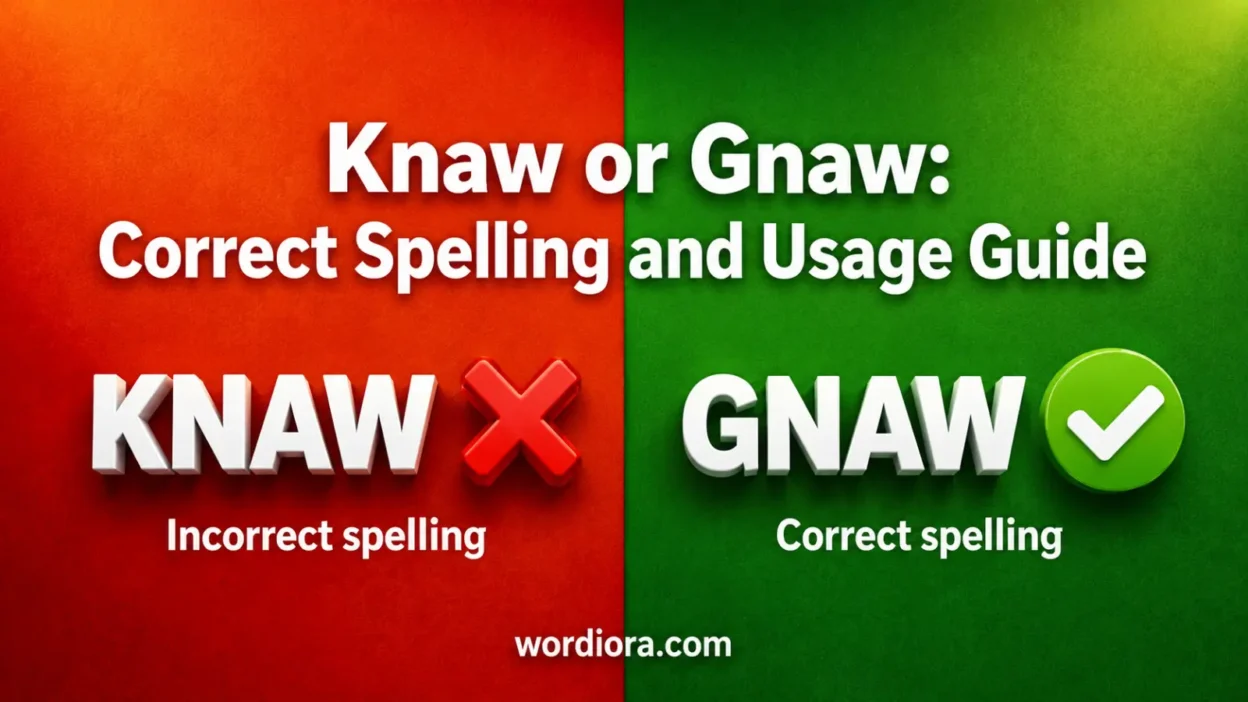
If you are choosing between knaw and gnaw, the correct word for modern US English is gnaw.
Use gnaw when you mean to bite or chew something again and again, wear something down slowly, or bother someone over time. For example, a dog can gnaw on a bone, and guilt can gnaw at your mind.
Knaw is not the standard spelling for that meaning. It may appear in old, dialectal, or nonstandard records, but it looks wrong in normal school, work, and everyday writing today.
Quick Answer
Gnaw is the correct choice when you mean “to bite, chew, or wear away slowly.”
Knaw should not be used for that meaning in modern US English.
Correct: The puppy tried to gnaw on my sneaker.
Incorrect: The puppy tried to knaw on my sneaker.
The word gnaw is pronounced like naw. The g is silent, which is the main reason people misspell it.
Why People Confuse Them
People confuse knaw and gnaw because English has several words with silent first letters.
Words like know, knife, and knock start with kn, but the k is silent. So when people hear gnaw, they may guess that it starts the same way.
That guess makes sense by sound, but it is not the standard spelling. The correct spelling is gnaw, with a silent g.
Another reason for the mistake is that gnaw is not a word many people write every day. It often appears in stories, animal descriptions, health writing, or emotional descriptions.
Key Differences At A Glance
| Context | Best Choice | Why |
|---|---|---|
| A dog chewing a bone | Gnaw | Standard word for repeated biting or chewing |
| A mouse biting through a box | Gnaw | Correct verb for wearing something down by biting |
| Worry bothering someone | Gnaw | Correct figurative use |
| School essay or email | Gnaw | Standard modern spelling |
| Writing “knaw” for chewing | Gnaw | Knaw looks like a spelling mistake |
| Old or dialect quotation | Knaw only if quoted exactly | It may appear in older or dialect text |
Extra comparison:
• Knaw: not the normal modern US spelling for “bite or chew.”
• Gnaw: the standard verb for repeated biting, chewing, wearing away, or bothering over time.
Meaning and Usage Difference
Gnaw means to bite or chew something repeatedly. It often suggests slow, steady action.
A rat can gnaw through a wall. A child might gnaw on a pencil. A beaver can gnaw at a tree.
Gnaw can also be figurative. In that use, it means a feeling, thought, worry, or pain keeps bothering someone.
Example: The unpaid bill began to gnaw at her all weekend.
Knaw does not carry that meaning in standard modern US English. Do not use knaw when you mean chew, bite, erode, or bother.
Tone, Context, and Formality
Gnaw is a normal English word, but it has a slightly vivid feel. It is more specific than chew because it suggests repeated biting or slow wearing down.
In casual speech, people may say:
The dog keeps chewing on the toy.
In more exact writing, you might say:
The dog keeps gnawing on the toy.
The figurative use can sound thoughtful or serious:
A strange doubt gnawed at him during the meeting.
Knaw does not fit standard school, business, or everyday writing. Unless you are quoting an old or dialect source exactly, it will likely look like an error.
Which One Should You Use?
Use gnaw almost every time.
Choose gnaw when you mean:
A person or animal bites something again and again.
Something slowly wears away another thing.
A feeling keeps bothering someone.
Examples:
The puppy likes to gnaw on rope toys.
The squirrels gnawed through the attic vent.
The mistake gnawed at me for days.
Do not choose knaw for modern writing. Even if it appears in a few historical or dialect records, that does not make it the right choice for current US English.
When One Choice Sounds Wrong
Knaw sounds wrong when the meaning is chewing, biting, or worrying.
Wrong: The rabbit began to knaw on the carrot.
Right: The rabbit began to gnaw on the carrot.
Wrong: The question knawed at him all night.
Right: The question gnawed at him all night.
Wrong: Termites can knaw through wood.
Right: Termites can gnaw through wood.
The only time knaw may be acceptable is inside an exact quotation, a historical spelling, or dialect writing. Even then, most readers will need context.
Common Mistakes and Quick Fixes
Mistake 1: Using knaw because it sounds like know.
Fix: Remember that gnaw starts with silent g, not silent k.
Mistake 2: Using gnaw for quick eating.
Weak: He gnawed his burger in two minutes.
Better: He ate his burger in two minutes.
Use gnaw when the action is repeated, slow, or biting-focused.
Mistake 3: Forgetting the figurative pattern gnaw at.
Correct: The deadline gnawed at me all day.
Mistake 4: Treating knaw as an accepted alternate spelling.
Fix: In modern US writing, use gnaw.
Everyday Examples
The dog tried to gnaw on the chair leg.
A mouse gnawed a small hole in the cereal box.
She watched the puppy gnaw on a rubber toy.
The cold wind seemed to gnaw at his hands.
His guilt gnawed at him after the argument.
The beaver gnawed through the branch.
I could hear something gnawing inside the wall.
That one rude comment gnawed at her all afternoon.
Do not write: The dog tried to knaw the bone.
Write: The dog tried to gnaw the bone.
Do not write: Stress knawed at him.
Write: Stress gnawed at him.
Dictionary-Style Word Details
Verb
Knaw: Not commonly used as a verb in standard modern US English for “bite or chew.” It may appear in limited old, dialectal, or nonstandard records, but it should not be used in ordinary writing.
Gnaw: A verb meaning to bite or chew repeatedly, wear away slowly, or bother someone over time.
Examples:
The hamster gnawed on the cardboard tube.
The worry gnawed at him during the drive home.
Noun
Knaw: Not commonly used as a noun in standard modern US English.
Gnaw: Not commonly used as a noun in everyday modern English. The related form gnawing can work as a noun in some contexts, especially when describing a dull, lasting pain or feeling.
Example: He felt a gnawing in his stomach before lunch.
Synonyms
Knaw: No useful standard synonyms for the intended chewing meaning, because it is not the standard word for that meaning.
Gnaw: Closest plain alternatives include chew, bite, nibble, wear away, and erode.
For figurative use, close alternatives include bother, trouble, worry, and eat at.
Clear opposites depend on context. For physical use, possible opposites include repair or restore. For emotional use, possible opposites include comfort or soothe.
Example Sentences
Knaw: Avoid this spelling in modern US writing when you mean “bite or chew.”
Incorrect: The puppy will knaw the toy apart.
Correct: The puppy will gnaw the toy apart.
Gnaw: The correct spelling for the standard word.
The rabbit gnawed on the edge of the basket.
Salt air can gnaw away at metal over time.
A quiet fear gnawed at her before the test.
Word History
Knaw: This spelling appears in limited older, dialectal, or nonstandard records, but it is not the standard modern US spelling for the chewing meaning.
Gnaw: The word comes from older English forms connected with biting or chewing. The older spelling history explains why the word begins with gn, even though the g is silent today.
A safe practical takeaway is simple: modern readers expect gnaw, not knaw.
Phrases Containing
Knaw: No common standard modern US phrases use knaw for the chewing meaning.
Gnaw: Common phrases include:
gnaw at
Meaning: to keep bothering, worrying, biting, or wearing away.
Example: The problem kept gnawing at me.
gnaw on
Meaning: to bite or chew something repeatedly.
Example: The dog likes to gnaw on old tennis balls.
gnaw through
Meaning: to chew until making a hole or passage.
Example: Mice can gnaw through thin plastic.
FAQs
Is it knaw or gnaw?
The correct spelling is gnaw. Use gnaw when you mean to bite, chew, wear away, or bother slowly over time. Knaw is not the standard spelling in modern US English.
Is knaw a real word?
Knaw may appear in old, dialectal, or nonstandard records, but it is not the normal modern spelling. In everyday writing, schoolwork, business writing, and articles, use gnaw.
What does gnaw mean?
Gnaw means to bite or chew something repeatedly. It can also mean to bother someone mentally or emotionally over time. For example, a dog can gnaw on a bone, and guilt can gnaw at someone.
Why is gnaw spelled with a silent g?
Gnaw keeps an older spelling pattern where the g is written but not pronounced. Today, the word sounds like naw, but the correct spelling is still gnaw.
Can gnaw be used for feelings?
Yes. Gnaw is often used figuratively for feelings that keep bothering someone. For example: “The mistake gnawed at him all day.” This means the mistake kept troubling him.
Is “gnaw on” correct?
Yes. Gnaw on is correct when something bites or chews repeatedly. For example: “The puppy likes to gnaw on old shoes.”
Is “gnaw at” correct?
Yes. Gnaw at is correct for both physical and emotional meanings. A mouse can gnaw at wood, and worry can gnaw at your mind.
What is the past tense of gnaw?
The past tense is gnawed. For example: “The rabbit gnawed on the carrot.” Do not write knawed in standard modern English.
What is another word for gnaw?
Close alternatives include chew, bite, nibble, and wear away. For emotional use, close alternatives include bother, worry, or eat at.
How do you use gnaw in a sentence?
You can write: “The dog began to gnaw on the bone.” You can also write: “A small worry gnawed at her before the interview.”
Conclusion
For modern US English, the choice is clear: use gnaw, not knaw, when you mean to bite, chew, wear away, or bother over time.
Gnaw is the standard spelling. It can describe a real chewing action, like a dog gnawing on a bone, or a figurative feeling, like guilt gnawing at someone.
Knaw may appear in limited old or dialect contexts, but it is not the right choice for normal writing today.