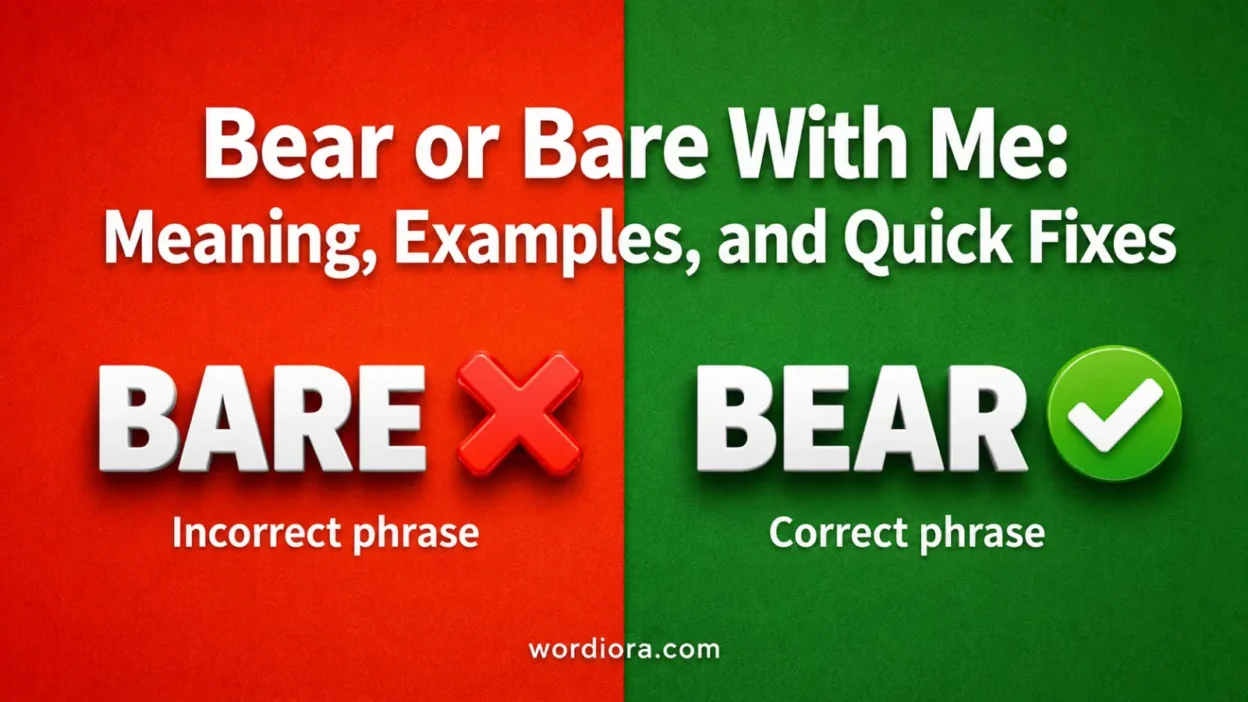
The correct phrase is bear with me, not bare with me, when you mean “please be patient with me.”
This mistake happens because bear and bare sound the same. However, they do not mean the same thing. In this phrase, bear is a verb that means to endure, tolerate, or be patient. So, bear with me asks someone to wait kindly while you finish something, fix a problem, or explain an idea.
Bare can also be a verb, but it means to uncover or reveal. That meaning does not fit a polite request for patience.
So, in emails, texts, customer service messages, school writing, and workplace updates, use bear with me.
Quick Answer
Use bear with me when asking someone to be patient.
Do not write bare with me unless you truly mean “uncover with me,” which is almost never the intended meaning in normal messages.
| Context | Best Choice | Why |
|---|---|---|
| Asking someone to wait | bear with me | It means “please be patient with me.” |
| Writing a work email | please bear with me | It sounds polite and professional. |
| Explaining a delay | bear with me while I check | It fits a short wait or interruption. |
| Talking about revealing something | bare | Bare means uncover or expose. |
| Writing “bare with me” for patience | wrong choice | Bare does not mean wait or be patient. |
Correct: Please bear with me while I find your order number.
Incorrect: Please bare with me while I find your order number.
Why People Confuse Them
People confuse bear and bare because they are homophones. That means they sound alike but have different spellings and meanings.
The confusion also makes sense because bear is often known as a noun first. Many readers think of a large animal, not a verb. Because of that, bare may look more natural to some writers, even though it is wrong in this phrase.
There is another reason: bear has many meanings. It can mean carry, support, endure, tolerate, produce, or go in a direction. In bear with me, the meaning is close to “be patient with me.”
Bare is simpler. It usually means uncovered, plain, or exposed. As a verb, it means to uncover or reveal.
Key Differences At A Glance
Here is the simple comparison:
- Bear in bear with me means be patient, endure, or tolerate for a short time.
- Bare means uncovered, plain, exposed, or to uncover.
- Bear with me is the correct phrase for emails, calls, chats, and speeches.
- Bare with me is a common mistake when the writer means patience.
- Both words sound the same: bear and bare rhyme with care.
The main point is easy: if the meaning is patience, choose bear.
Meaning and Usage Difference
Bear is the correct word in bear with me because it works as a verb meaning to endure or tolerate. In everyday English, the phrase sounds softer than “tolerate me.” It really means “please stay with me and be patient.”
Examples:
Bear with me while I pull up your account.
Please bear with me for one more minute.
Bear with me as I explain the last step.
Bare does not fit those sentences. As a verb, bare means to uncover or reveal.
Examples:
The dog bared its teeth.
She bared her feelings in the letter.
The report laid bare the problem.
That is why bare with me creates the wrong meaning. It does not ask for patience.
Tone, Context, and Formality
Bear with me is polite and common. It works in casual and professional settings.
In a work email, please bear with me sounds respectful:
Please bear with me while I review the file.
In a meeting, it sounds natural:
Bear with me for a second while I share my screen.
In customer service, it helps soften a delay:
Thanks for bearing with me while I check that information.
Bare with me does not sound professional when the intended meaning is patience. Most readers will see it as a mistake. Some may also notice the accidental meaning of “uncover with me,” which can make the sentence awkward.
For a very formal message, you can also write:
Thank you for your patience.
Please allow me a moment to review this.
Which One Should You Use?
Use bear with me any time you want someone to wait, listen, or stay patient.
Choose bear with me in these situations:
You are checking information.
You are fixing a small issue.
You are explaining a long idea.
You need a moment to respond.
You are asking for understanding during a delay.
Examples:
Please bear with me while I update the schedule.
Bear with me for a moment; I’m looking for the file.
Thanks for bearing with me during the setup.
Use bare only when the meaning is about uncovering or revealing something.
Example:
The article bared the truth about the scam.
That sentence uses bare correctly, but it is not the same phrase as bear with me.
When One Choice Sounds Wrong
Bare with me sounds wrong when you mean “wait for me” or “be patient with me.”
Wrong:
Bare with me while I restart the computer.
Correct:
Bear with me while I restart the computer.
Wrong:
Please bare with me as I learn the new system.
Correct:
Please bear with me as I learn the new system.
However, bare is not always wrong. It is wrong only when you use it for the patience phrase.
Correct uses of bare:
He walked across the room in bare feet.
The tree had bare branches in winter.
The witness bared the truth.
So the issue is not that bare is a bad word. It simply has the wrong meaning in bear with me.
Common Mistakes and Quick Fixes
Mistake: Please bare with me.
Fix: Please bear with me.
Mistake: Bare with me for a second.
Fix: Bear with me for a second.
Mistake: Thanks for baring with me.
Fix: Thanks for bearing with me.
Mistake: Bare in mind.
Fix: Bear in mind.
Mistake: I can’t bare the noise.
Fix: I can’t bear the noise.
A helpful memory trick: bear can mean endure. If someone must endure a short wait, they need to bear with you.
Everyday Examples
Work email:
Please bear with me while I confirm the meeting time.
Customer service:
Thank you for bearing with me while I check your account.
Classroom:
Bear with me for a minute while I write the next example.
Text message:
Bear with me — I’m almost done.
Presentation:
Please bear with me as I explain the chart.
Wrong version:
Please bare with me while I open the document.
Correct version:
Please bear with me while I open the document.
In most modern writing, bear with me is a small but useful phrase. It keeps your message polite without sounding too stiff.
Dictionary-Style Word Details
Verb
Bear: Commonly used as a verb. In the phrase bear with me, it means to be patient with someone or to tolerate a short delay.
Example: Please bear with me while I check the details.
Bare: Also used as a verb, but with a different meaning. It means to uncover, reveal, or expose.
Example: The article bared the facts.
Noun
Bear: Commonly used as a noun for the large animal.
Example: A bear crossed the trail near the campsite.
Bare: Not commonly used as a noun in standard US English. It is usually an adjective or verb.
Example as adjective: He opened the box with his bare hands.
Synonyms
Bear with me: Closest plain alternatives include please be patient, please wait, hold on a moment, please stand by, and give me a second.
Bare: Closest plain alternatives depend on the meaning. As a verb, possible alternatives include uncover, reveal, expose, and show.
Clear opposites for bare can include cover or hide, depending on the sentence.
A direct antonym for bear with me is not always natural. In plain wording, the opposite idea would be do not wait or refuse to be patient.
Example Sentences
Bear:
Please bear with me while I find the receipt.
Bear with me for one more minute.
Thanks for bearing with me during the delay.
I can’t bear another loud alarm.
Bare:
The storm left the tree bare.
She bared her thoughts in the journal.
The dog bared its teeth.
The room had only a bare table and two chairs.
Word History
Bear: The word has long-standing English uses connected with carrying, supporting, enduring, and the animal name. For this article, the useful point is the verb sense: bear can mean to endure or tolerate.
Bare: The word is connected with being uncovered, plain, or exposed. As a verb, it means to uncover or reveal.
The exact deep history is not needed to choose the correct phrase. For modern US writing, the rule is practical: patience takes bear, uncovering takes bare.
Phrases Containing
Bear:
bear with me
bear in mind
bear the cost
bear the weight
bear witness
bear fruit
Bare:
bare hands
bare feet
bare minimum
bare bones
bare your soul
lay bare
These phrases show why the spelling matters. Bear often connects to carrying, enduring, producing, or keeping something in mind. Bare connects to being uncovered, plain, or revealed.
FAQs
Is it “bear with me” or “bare with me”?
The correct phrase is bear with me. It means “please be patient with me.” Bare with me is incorrect when you are asking someone to wait.
What does “bear with me” mean?
Bear with me means “please wait,” “please be patient,” or “stay with me while I finish something.” For example: Please bear with me while I check the file.
Why is “bare with me” wrong?
Bare means to uncover, expose, or reveal. That meaning does not fit a polite request for patience. When you want someone to wait, use bear, not bare.
Is “please bear with me” professional?
Yes. Please bear with me is polite and professional. It works well in emails, customer service replies, meetings, and work chats when you need a little time.
What can I say instead of “bear with me”?
You can say please be patient, please give me a moment, please hold on, thanks for your patience, or please allow me a minute. In formal writing, thank you for your patience often sounds smoother.
Is “thanks for bearing with me” correct?
Yes. Thanks for bearing with me is correct. Here, bearing is the -ing form of bear, meaning being patient or waiting through a delay.
Does “bear with me” have anything to do with the animal?
No. In this phrase, bear is a verb, not the animal noun. It means to endure, tolerate, or be patient.
How do you remember bear vs bare with me?
Use this simple trick: bear can mean endure, so someone can bear with you during a delay. Bare means uncover, so it does not fit the meaning of patience.
Conclusion
Use bear with me when you want to ask someone to be patient. It is the correct choice in emails, chats, meetings, calls, and everyday writing.
Use bare only when you mean uncovered, plain, exposed, or to reveal something.
The easiest way to remember the difference is this: bear can mean endure, so people bear with you during a delay. Bare means uncover, so it does not fit a request for patience.