Last Updated: July 27, 2026
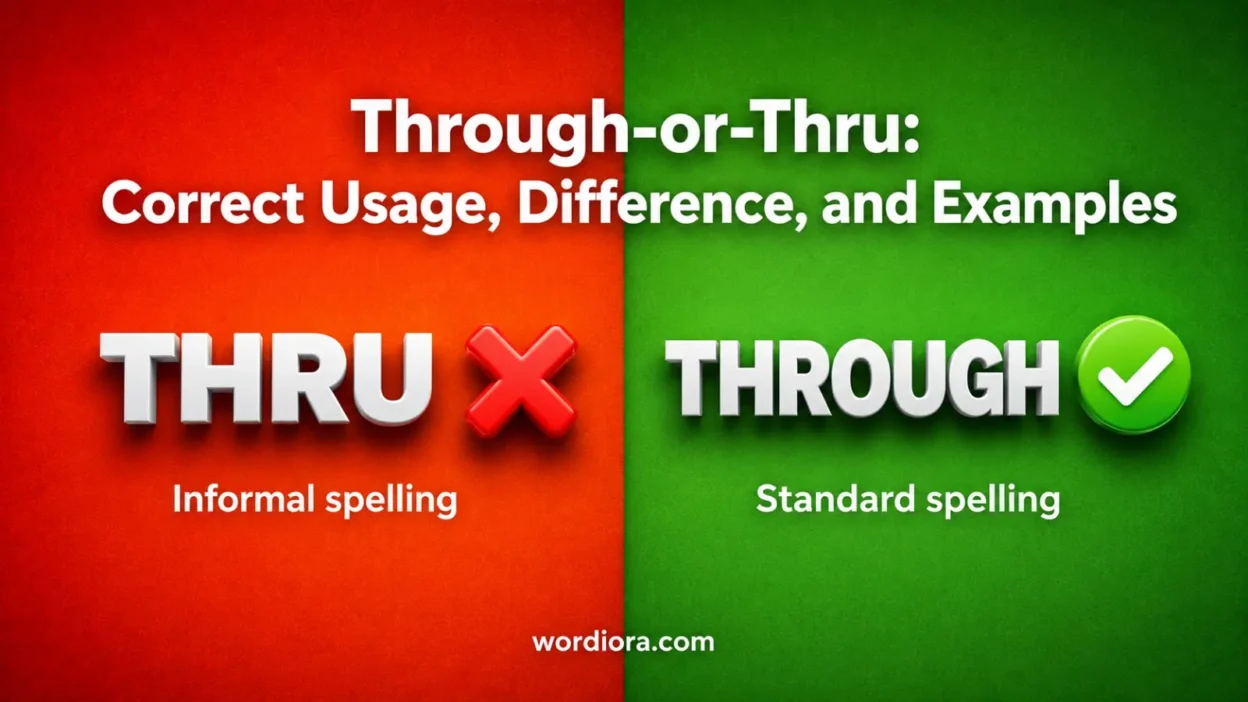
Through-or-thru is a common word-choice question because both forms look familiar. The safest answer is simple: use through in normal writing. Use thru only in informal writing, signs, branding, or fixed casual uses such as drive-thru.
These two forms usually mean the same thing. The difference is not a deep meaning difference. It is mostly a difference in spelling, tone, and setting. Through is the standard form readers expect in essays, emails, reports, instructions, books, and professional messages. Thru is a shortened informal form that looks casual and space-saving.
So, the real question is not “Do they mean different things?” The better question is “Which form fits this situation?”
Quick Answer
Through is correct for school, work, publishing, formal writing, and most everyday sentences.
Thru is an informal spelling of through. It may work in texts, quick notes, signs, ads, and common US terms like drive-thru or no thru traffic.
Use through when you want your writing to look polished:
Correct: We walked through the park after lunch.
Too casual for formal writing: We walked thru the park after lunch.
Use thru only when the casual style is expected:
Fine on a sign: Drive-thru open late.
Fine in a text: I’ll be busy Monday thru Friday.
Why People Confuse Them
People confuse through and thru because they sound the same. Both are usually pronounced like “throo.” The spelling is the part that changes.
The confusion also comes from daily life. A student may see through in a book, then see drive-thru at a restaurant, then see no thru traffic on a street sign. All three uses seem normal, but they do not belong to the same writing style.
Another reason is speed. In texts and signs, shorter spellings feel easier. However, shorter does not always mean better. In a college essay, job application, report, or business email, thru can make the sentence look too casual.
Key Differences At A Glance
| Feature | through | thru |
|---|---|---|
| Standard spelling | Yes | No, informal variant |
| Best for formal writing | Yes | No |
| Meaning | Movement, time, means, completion | Same meanings in informal style |
| Common use | Essays, emails, reports, books | Signs, texts, branding |
| Example | We drove through town. | Drive-thru window |
The easiest rule is this: when in doubt, choose through. It works almost everywhere. Thru works only in limited casual or sign-like settings.
Meaning and Usage Difference
Through can show movement from one side to another:
The dog ran through the gate.
It can show time from beginning to end:
She worked through the weekend.
It can show means or method:
He got the job through a friend.
It can also mean finished:
I’m through with the assignment.
Thru can carry the same basic meanings, but it changes the tone. It tells the reader the writing is informal, shortened, or sign-like:
Text: I’m working thru lunch today.
Sign: No thru traffic.
Because the meanings overlap, do not create a fake definition difference. The real difference is standard use versus informal use.
Tone, Context, and Formality
Through sounds neutral, correct, and professional. It does not feel stiff. You can use it in casual writing too:
I’ll stop by after I get through this meeting.
Thru sounds casual. In the right place, that is fine. On a sign, menu, text message, or brand label, thru can look natural:
Please use the drive-thru lane.
In a formal document, though, thru may look careless:
Weak for work: Send the forms thru email.
Better: Send the forms through email.
For US readers, thru is especially familiar in signs and business names. Still, familiar does not mean suitable for every sentence.
Which One Should You Use?
| Context | Best Choice | Why |
| School essay | through | It is the standard spelling. |
| Business email | through | It looks professional. |
| Resume or cover letter | through | It avoids a casual tone. |
| Legal, medical, or official writing | through | It is clearer and more formal. |
| Text message to a friend | through or thru | Thru is acceptable if the tone is casual. |
| Road sign | thru | Short sign wording is common. |
| Restaurant lane or branding | drive-thru | This spelling is widely recognized in US use. |
| Published article | through | It fits standard edited writing. |
For most writers, the best habit is to use through by default. Save thru for signs, informal notes, and brand-style language.
When One Choice Sounds Wrong
Thru sounds wrong when the sentence needs a serious or polished tone.
Awkward: The applicant completed the process thru the state website.
Better: The applicant completed the process through the state website.
Awkward: The company grew thru better customer service.
Better: The company grew through better customer service.
Awkward: We read thru the policy before signing.
Better: We read through the policy before signing.
However, through can sound too formal if you are copying the exact name or style of a sign or business feature:
Less natural for a fast-food sign: Drive-through open 24 hours.
Common sign style: Drive-thru open 24 hours.
Both can be understood, but context decides which looks natural.
Common Mistakes and Quick Fixes
Mistake 1: Using thru in formal writing.
Fix: Change it to through.
Mistake 2: Thinking thru has a different meaning.
Fix: Treat it as an informal spelling, not a separate idea.
Mistake 3: Using thru because it looks modern.
Fix: Match the reader and setting. Modern does not always mean appropriate.
Mistake 4: Writing through in a brand name that officially uses thru.
Fix: Keep the official spelling when naming a business, product, sign, or labeled service.
Mistake 5: Confusing through with threw.
Fix: Threw is the past tense of throw. It is not part of this through-or-thru choice.
Everyday Examples
Use through in complete, polished sentences:
We walked through the museum before lunch.
The team worked through the problem together.
Please read through the instructions first.
The payment went through this morning.
She stayed calm through the whole meeting.
I found the job through a former coworker.
The train went through Chicago.
He is finally through with finals.
Use thru in casual, short, or sign-like writing:
Drive-thru closes at midnight.
No thru traffic.
I’m booked Tuesday thru Thursday.
Let’s go thru the list later.
Order thru the app if the line is long.
If you are unsure which example fits your writing, choose through.
Dictionary-Style Word Details
Verb
through: Not commonly used as a verb by itself in standard US English. It appears inside verb phrases such as go through, get through, look through, and follow through.
Example: We need to go through the checklist.
thru: Not commonly used as a verb by itself in standard US English. It may appear informally in shortened versions of phrases, but through is better in edited writing.
Casual: Let’s go thru the notes.
Better for formal writing: Let’s go through the notes.
Noun
through: Not commonly used as a standalone noun. It appears in compounds such as drive-through, which can name a service lane, window, or business feature.
Example: The bank has a drive-through.
thru: Not commonly used as a standalone noun in standard formal writing. It appears in informal or branded compounds such as drive-thru.
Example: The drive-thru line was long.
Synonyms
through: Closest plain alternatives depend on meaning. For movement, use across, into and out of, or from one side to the other. For time, use during or from start to finish. For means, use by, using, or by way of. For completion, use finished or done.
thru: The closest plain alternatives are the same as through, but the tone is informal. In formal writing, the best replacement for thru is usually through.
Clear antonyms depend on the sentence. For example, around can contrast with movement through something, and unfinished can contrast with being through with a task. There is no single opposite that fits every use.
Example Sentences
through: The hikers moved through the woods before sunset.
through: She got through the interview without feeling nervous.
through: Our office is open Monday through Friday.
through: The update came through email.
thru: The coffee shop added a second drive-thru lane.
thru: The sign said, “No thru traffic.”
thru: I’ll be out of town Friday thru Sunday.
thru: Text me when you’re thru with practice.
Word History
through: This is the standard modern spelling. It is the form expected in most edited US English.
thru: This spelling has existed as a variant for a long time, but modern dictionaries usually label it as less common, informal, or mainly used in certain contexts. Today, it is most familiar in casual writing, signs, labels, and compounds such as drive-thru.
The safe point is not that thru is newly invented or always wrong. The safe point is that through is the standard choice for regular writing.
Phrases Containing
through:
go through
get through
look through
read through
walk through
through and through
follow through
through the years
Monday through Friday
thru:
drive-thru
no thru traffic
thru lane
thru street
Monday thru Friday
walk-thru
run-thru
Many of the thru phrases look natural on signs, schedules, menus, labels, and casual notes. In full formal sentences, use the through version unless you are quoting or naming something.
Conclusion
The choice between through and thru is mostly about context, not meaning. Through is the standard spelling, so it is the best choice for school, work, formal emails, articles, reports, and most complete sentences.
Thru is an informal spelling. It can work in texts, signs, branding, short labels, and common US uses like drive-thru or no thru traffic.
When you want the safest answer, choose through. When the style is casual, short, or sign-like, thru may fit. That simple rule will keep your writing clear, natural, and appropriate.