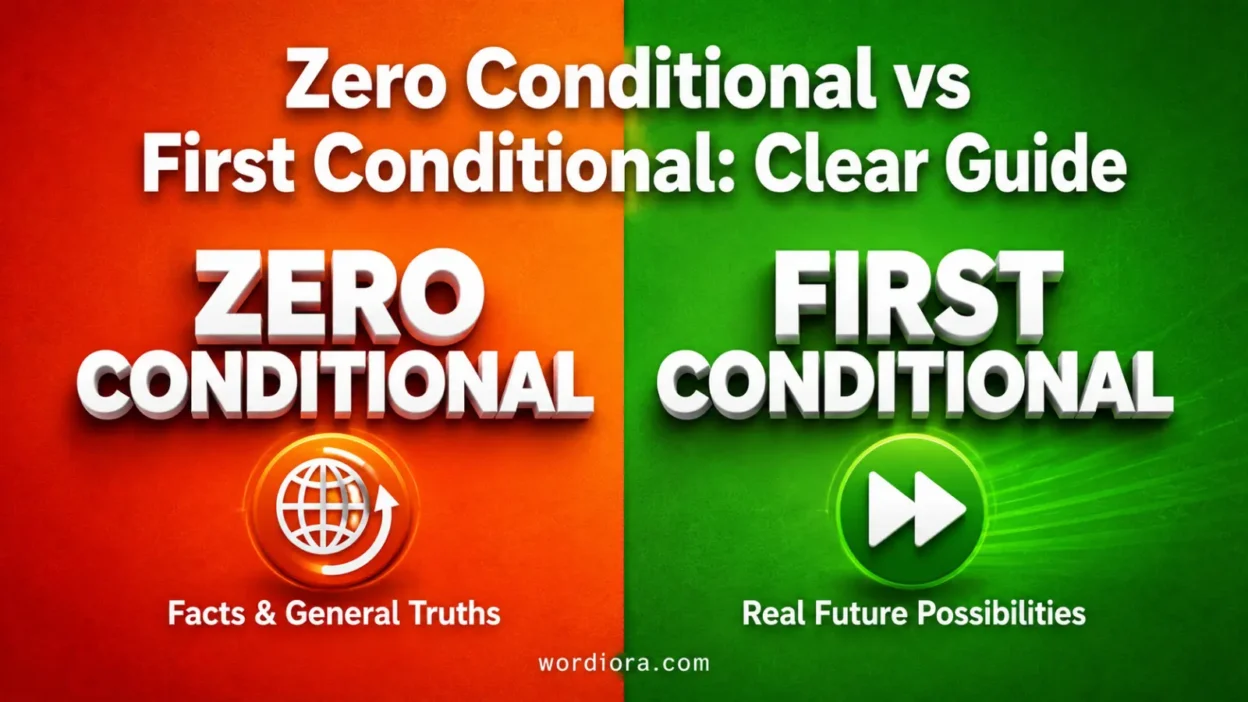
Zero conditional vs first conditional can be confusing because both sentence types often start the same way: if + simple present.
The difference is in the meaning.
Use the zero conditional when you mean something is generally true, always true, or regularly true.
Use the first conditional when you mean something is a real possibility in the future.
Here is the difference in one simple pair:
Zero conditional: If it rains, the ground gets wet.
First conditional: If it rains tonight, we’ll cancel the picnic.
The first sentence gives a general result. The second sentence talks about one possible future situation.
Quick Answer
Both zero conditional and first conditional are correct. The right choice depends on what you want to say.
Use the zero conditional for facts, rules, habits, and regular results.
Use the first conditional for real future possibilities, plans, warnings, offers, and likely results.
A quick test helps:
If the result happens generally or regularly, use the zero conditional.
If the result may happen later because of this one condition, use the first conditional.
Examples:
Zero conditional: If I drink coffee after 7 p.m., I sleep badly.
First conditional: If I drink coffee tonight, I’ll sleep badly.
The first sentence describes a regular pattern. The second sentence predicts a likely result tonight.
Why People Confuse Them
People confuse these two forms because the condition part often looks almost the same.
Both can use:
if + simple present
Examples:
Zero conditional: If you heat ice, it melts.
First conditional: If you heat that frozen pipe too fast, it might crack.
The condition uses the present tense in both sentences. The result clause changes the meaning.
In the zero conditional, the result is usually in the simple present:
If you heat ice, it melts.
In the first conditional, the result often uses will, can, may, might, should, or another future-looking verb form:
If you heat that pipe too fast, it might crack.
That is why the result clause matters so much.
Key Differences At A Glance
| Context | Best Choice | Why |
|---|---|---|
| General facts | Zero conditional | The result is normally true. |
| Scientific facts | Zero conditional | The result is treated as a rule or fact. |
| Personal habits | Zero conditional | The result happens regularly. |
| Workplace rules | Zero conditional | The result follows the rule in general. |
| Future plans | First conditional | The result depends on a possible future condition. |
| Warnings | First conditional | The result may happen if the condition happens. |
| Offers | First conditional | The action depends on a real situation. |
| Promises | First conditional | The speaker is committing to a future result. |
Meaning and Usage Difference
The zero conditional shows a general connection between a condition and a result.
Common form:
If/When + simple present, simple present
Examples:
If you leave milk out, it spoils.
When the Wi-Fi goes down, the app stops working.
If students miss the deadline, they lose points.
These sentences do not focus on one future event. They describe what normally happens.
The first conditional shows a real possible future result.
Common form:
If/When + simple present, will/can/may/might/should + base verb
Examples:
If you leave the milk out tonight, it will spoil.
If the Wi-Fi goes down during the meeting, we can switch to phone audio.
If students miss the deadline Friday, they will lose points.
These sentences focus on a possible future situation.
Here is a compact comparison:
• Zero conditional: general truth, rule, habit, or regular result.
• First conditional: real future possibility, warning, plan, offer, or promise.
The key difference is not just tense. It is meaning.
Tone, Context, and Formality
Neither form is more formal by itself.
The zero conditional can sound factual, instructional, or rule-based because it often explains how something works.
Examples:
If a password is too short, the system rejects it.
If a customer cancels within 24 hours, we charge a fee.
The first conditional can sound practical, conversational, or action-based because it often talks about what may happen next.
Examples:
If your password is too short, the system will reject it.
If the customer cancels today, we’ll charge the fee.
Both forms work in formal and informal English.
In a science class, the zero conditional often fits better:
If water reaches 212°F at sea level, it boils.
In a daily plan, the first conditional often fits better:
If the roads are icy tomorrow morning, I’ll work from home.
Which One Should You Use?
Use the zero conditional when you are explaining a rule, fact, routine, or normal result.
Choose it for sentences like these:
If my phone battery hits 5%, it shuts down fast.
If I skip breakfast, I get cranky.
If you press this button, the screen turns on.
Use the first conditional when you are talking about a real future situation.
Choose it for sentences like these:
If my phone battery hits 5% on the trip, I’ll turn on low-power mode.
If I skip breakfast tomorrow, I’ll be hungry before the meeting.
If you press this button now, the screen will restart.
A useful choice question is:
Am I talking about what usually happens, or what may happen next?
If it is usual, choose zero conditional.
If it may happen next, choose first conditional.
When One Choice Sounds Wrong
The zero conditional sounds wrong when you need a one-time future result.
Weak: If it rains at 6 p.m., we cancel the game.
Better: If it rains at 6 p.m., we’ll cancel the game.
The first sentence could work only if you mean this is the standing rule every time. The second sentence clearly means one possible event today.
The first conditional sounds wrong when you are stating a basic fact.
Weak: If you freeze water, it will become ice.
Better: If you freeze water, it becomes ice.
The first sentence is not always impossible, but it sounds less natural if you are stating a general fact. The zero conditional is cleaner.
Context can change the answer.
If you say, “If you freeze the water tonight, it will be ready for the cooler tomorrow,” the first conditional is correct because you are talking about one future plan.
Common Mistakes and Quick Fixes
Mistake 1: Using first conditional for a general fact
Wrong: If you mix red and blue, you will get purple.
Better: If you mix red and blue, you get purple.
Use the zero conditional for a general result.
Mistake 2: Using zero conditional for a one-time future plan
Wrong: If Sarah arrives late tonight, we start without her.
Better: If Sarah arrives late tonight, we’ll start without her.
Use the first conditional for a possible future event.
Mistake 3: Putting “will” in the if-clause
Wrong: If you will need help, call me.
Better: If you need help, call me.
Better: If you need help, I’ll come over.
In standard first conditional sentences, use the present tense after if.
Mistake 4: Thinking “when” always works the same as “if”
Zero conditional:
When the alarm rings, the doors unlock.
If the alarm rings, the doors unlock.
Here, both can describe a general rule.
First conditional:
If the alarm rings tonight, we’ll leave the building.
When the alarm rings tonight, we’ll leave the building.
These are close, but not identical. If suggests the alarm may or may not ring. When suggests the speaker expects it to happen.
Everyday Examples
Weather
Zero conditional: If it snows, roads get slippery.
First conditional: If it snows tomorrow, school may start late.
Work
Zero conditional: If employees miss the cutoff, payroll moves to the next cycle.
First conditional: If you miss the cutoff today, payroll will move to the next cycle.
School
Zero conditional: If students turn in late work, they lose points.
First conditional: If you turn in the essay late, you’ll lose points.
Food
Zero conditional: If you leave ice cream on the counter, it melts.
First conditional: If you leave the ice cream out, it will melt before dessert.
Health
Zero conditional: If I stare at a screen too long, my eyes hurt.
First conditional: If I stare at the screen all night, my eyes will hurt tomorrow.
Technology
Zero conditional: If the router overheats, the connection drops.
First conditional: If the router overheats during the call, we’ll switch to mobile data.
Family
Zero conditional: If the baby gets hungry, she cries.
First conditional: If the baby gets hungry during the drive, we’ll stop.
Dictionary-Style Word Details
Verb
• Zero conditional: Not commonly used as a verb in standard US English. It is a grammar term for a type of conditional sentence.
• First conditional: Not commonly used as a verb in standard US English. It is also a grammar term for a type of conditional sentence.
Noun
• Zero conditional: A noun phrase meaning a conditional sentence used for general truths, rules, habits, or regular results. Example: “If you heat ice, it melts” is a zero conditional.
• First conditional: A noun phrase meaning a conditional sentence used for real possible future situations and their likely results. Example: “If it rains, I’ll stay home” is a first conditional.
Synonyms
• Zero conditional: Closest plain alternatives include “general conditional,” “real fact conditional,” or “if-sentence for general truths.” These are explanations, not exact everyday replacements.
• First conditional: Closest plain alternatives include “real future conditional,” “possible future conditional,” or “if-sentence for real future possibilities.” These are explanations, not exact everyday replacements.
Clear antonyms do not really fit either term. These labels are part of a grammar system, not ordinary opposite words.
Example Sentences
• Zero conditional: If water gets cold enough, it freezes.
• Zero conditional: If I eat too fast, I get a stomachache.
• Zero conditional: If the store closes early, customers use the pickup locker.
• First conditional: If it gets cold tonight, the water will freeze.
• First conditional: If I eat too fast at dinner, I’ll get a stomachache.
• First conditional: If the store closes early today, customers can use the pickup locker.
Word History
• Zero conditional: The term belongs to modern English grammar teaching. “Zero” refers to the conditional type often used for general truths or regular results, not to the number zero in the sentence itself.
• First conditional: The term also belongs to grammar teaching. “First” names this type within the usual classroom sequence of conditionals.
The labels are teaching terms. They are useful, but the main goal is understanding the meaning and structure behind them.
Phrases Containing
• Zero conditional: zero conditional sentence, zero conditional examples, zero conditional form, zero conditional rule, zero conditional exercises.
• First conditional: first conditional sentence, first conditional examples, first conditional form, first conditional rule, first conditional exercises.
FAQs
What is the difference between zero conditional and first conditional?
The zero conditional talks about general truths, facts, rules, habits, or regular results. The first conditional talks about a real possible future result.
Example:
Zero conditional: If you heat ice, it melts.
First conditional: If you heat the soup now, it will be ready soon.
When should I use the zero conditional?
Use the zero conditional when the result is generally true or regularly happens.
Examples:
If you press this button, the machine starts.
If I skip lunch, I get tired.
If water freezes, it expands.
When should I use the first conditional?
Use the first conditional when you are talking about a real future possibility.
Examples:
If it rains tomorrow, we’ll stay home.
If you finish early, I can pick you up.
If the price drops, I might buy it.
Are zero conditional and first conditional interchangeable?
Not usually. They can use a similar if + present tense structure, but they do not mean the same thing. The zero conditional gives a general result. The first conditional gives a possible future result.
What is the formula for the zero conditional?
The common zero conditional form is:
If + simple present, simple present
Example:
If you heat water enough, it boils.
You can also use when instead of if when the result is expected or regular:
When you heat water enough, it boils.
What is the formula for the first conditional?
The common first conditional form is:
If + simple present, will + base verb
Example:
If it rains, we will cancel the game.
Other modal verbs can also appear in the result clause:
If it rains, we might cancel the game.
If it rains, we can move the party inside.
Can I use “will” after “if” in the first conditional?
In standard first conditional sentences, do not usually put will right after if.
Incorrect: If you will need help, call me.
Correct: If you need help, call me.
Correct: If you need help, I’ll help you.
Can I use “when” instead of “if”?
Sometimes, yes. Use when if the situation is expected or regular. Use if if the situation may or may not happen.
Example:
When the alarm rings, leave the building.
If the alarm rings tonight, leave the building.
When sounds more certain. If sounds more conditional.
Is the zero conditional only for science facts?
No. The zero conditional is common in science, but it is also used for habits, rules, instructions, and everyday patterns.
Examples:
If I drink coffee late, I sleep badly.
If customers miss the deadline, they pay a fee.
If my phone overheats, it shuts down.
Is the first conditional always about the future?
It usually points to a real possible future result, even when the if-clause uses the present tense.
Example:
If she calls tonight, I’ll answer.
The condition uses present tense, but the meaning is future.
Which is correct: “If it rains, the ground gets wet” or “If it rains, the ground will get wet”?
Both can be correct, but they mean slightly different things.
If it rains, the ground gets wet is zero conditional. It states a general fact.
If it rains, the ground will get wet is first conditional. It talks about a possible future result.
How can I quickly tell which one to use?
Ask yourself one question:
Am I talking about what usually happens, or what may happen next?
Use zero conditional for what usually happens.
Use first conditional for what may happen next.
Conclusion
The difference between zero conditional vs first conditional is simple once you focus on meaning.
Use the zero conditional for what is generally true:
If you heat ice, it melts.
Use the first conditional for what may really happen in the future:
If you heat the soup now, it will be ready by lunch.
Think of it this way:
Zero conditional = what normally happens.
First conditional = what may happen next.