
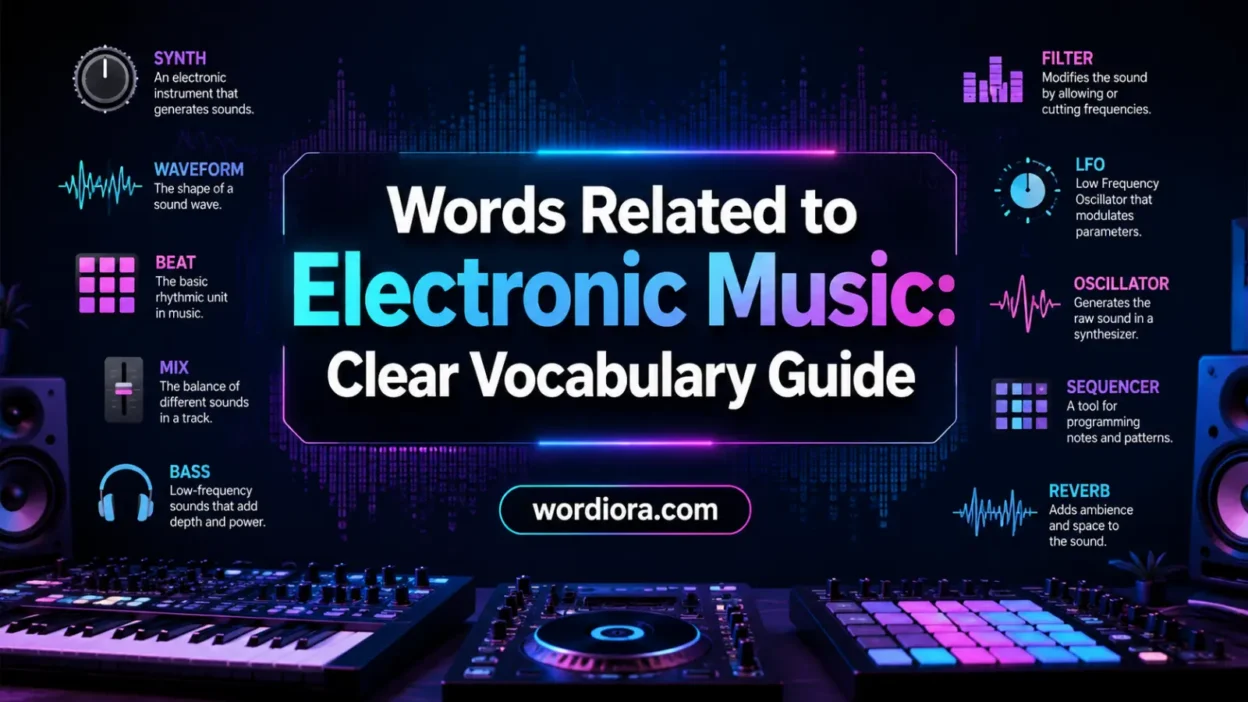
Electronic music has its own rich vocabulary. Some words describe the sound, some describe the tools, and others describe the culture around DJs, clubs, festivals, producers, and digital production.
The best words related to electronic music are not all synonyms. “Techno,” “house,” “ambient,” and “dubstep” are genres. “Synthesizer,” “sampler,” and “drum machine” are tools. “Beat,” “loop,” “drop,” and “bassline” describe musical parts. “DJ,” “producer,” and “remix” describe roles or actions.
This guide organizes the most useful words related to electronic music so you can choose accurate vocabulary for writing, playlists, captions, reviews, school assignments, or music descriptions.
Quick Answer
Words related to electronic music include synth, synthesizer, beat, bassline, loop, sample, remix, DJ, producer, EDM, techno, house, trance, ambient, dubstep, drum machine, sequencer, MIDI, digital, programmed, layered, pulsing, rhythmic, atmospheric, and danceable.
| Word | How It Relates | Best Use |
|---|---|---|
| Synth | Short form of synthesizer | Casual writing about electronic sounds |
| Synthesizer | Electronic instrument that creates and shapes sound | Technical or clear music description |
| Beat | Main rhythmic pulse | Describing rhythm or dance tracks |
| Bassline | Low repeating musical pattern | Describing groove and energy |
| Loop | Repeated sound or musical section | Production and arrangement |
| Sample | Reused piece of recorded sound | Production, remixing, hip-hop, dance music |
| Remix | New version of an existing track | DJ, club, and release contexts |
| DJ | Person who plays and mixes recorded music | Club, radio, party, and festival contexts |
| Producer | Person who creates or shapes recorded music | Studio and track-making contexts |
| EDM | Dance-focused electronic music umbrella | Festivals, clubs, and mainstream dance music |
| Techno | Electronic dance genre with fast beats and synthesized sounds | Genre labels and playlists |
| House | Dance genre known for steady club rhythm | Club music and dance playlists |
| Trance | Electronic dance style often linked with build-ups and melodic repetition | Festival and high-energy contexts |
| Ambient | Electronic or experimental music focused on atmosphere | Calm, spacious, or background sound |
| Drum machine | Electronic device or software for drum sounds | Production tools |
| Sequencer | Tool that arranges notes, patterns, or musical events | Music production and programming |
What The Topic Means
“Words related to electronic music” means vocabulary connected to music made, shaped, arranged, or performed with electronic tools. The topic includes more than one type of word.
Terms can be grouped by what they describe. Some identify the music itself, such as electronic music, EDM, techno, house, trance, ambient, dubstep, electronica, synth-pop, and dance music. Others describe the sounds within a track, including beat, bass, bassline, rhythm, groove, pulse, melody, texture, pad, drone, kick, snare, hi-hat, drop, build-up, and breakdown. Many words refer to the tools used to create electronic music, like synthesizer, synth, sampler, drum machine, sequencer, controller, turntable, mixer, laptop, software, plug-in, and digital audio workstation. Finally, certain terms describe actions taken during production or performance, such as remix, sample, loop, program, mix, produce, layer, sequence, automate, filter, distort, and modulate.
A strong related-word list should keep these categories separate. “Techno” is not another word for all electronic music. “Synthesizer” is not a genre. “Beat” is not a complete track. Each word is useful, but each word belongs in the right context.
Core Related Words
The most useful core words related to electronic music are the words people commonly use when describing how it sounds, how it is made, and where it is played.
Electronic music is the broadest term. Use it when you mean music made or shaped with electronic instruments, computers, recording tools, or sound-processing methods.
EDM is more specific. It usually means electronic dance music, especially music made for clubs, festivals, DJs, and dancing crowds.
Synth is a common short form of synthesizer. It works well in casual writing, music reviews, playlists, and captions.
Synthesizer is the full term for an electronic instrument used to create and control sound.
Beat means the main rhythmic pulse of a track. In everyday music writing, “beat” can also refer to the instrumental backing of a song.
Bassline means the low, repeating musical line that often gives electronic music its drive.
Loop means a repeated sound, beat, melody, or section.
Sample means a piece of recorded sound reused in a new track.
Remix means a new version of a recorded song, often rearranged with new beats, effects, structure, or energy.
DJ means a person who plays, selects, and often mixes recorded music.
Producer means a person who creates, arranges, records, edits, or shapes a track.
Drum machine means an electronic tool used to create drum and percussion sounds.
Sequencer means hardware or software used to arrange musical patterns or events.
MIDI refers to a digital system that lets instruments, controllers, and software communicate musical information.
Digital describes sound, tools, or production methods based on computer technology.
Analog describes electronic gear or sound created through continuous electrical signals rather than digital data.
Related Words By Meaning Group
Music Styles and Genres
Electronic music is the broad category.
EDM is the dance-focused umbrella.
House is a dance style often associated with steady rhythms, club grooves, and repeated patterns.
Techno is a dance style often associated with fast beats, synthesized sounds, and a machine-like drive.
Trance is often associated with melodic repetition, build-ups, and an energetic, sweeping feel.
Ambient is often slower, more atmospheric, and less focused on a strong dance beat.
Dubstep is associated with heavy bass, sharp rhythmic changes, and dramatic drops.
Drum and bass is known for fast breakbeats and strong low-end movement.
Synth-pop blends pop songwriting with prominent synthesizer sounds.
Electronica is a broad label often used for electronic music that may not fit neatly into club-focused categories.
Sound and Rhythm Words
Beat describes the pulse or rhythmic foundation.
Rhythm describes the pattern of sounds and silences.
Groove describes the feel that makes the music move.
Pulse suggests a steady, repeated beat.
Bass describes low-frequency sound.
Bassline describes a low musical pattern that supports the track.
Kick means the deep drum sound that often marks the beat.
Snare means a sharper drum sound used in rhythmic patterns.
Hi-hat means a crisp cymbal-like sound often used to add motion.
Drop means the moment when the full beat, bass, or main energy arrives after a build-up.
Build-up means a rising section that increases tension.
Breakdown means a reduced section where the beat, bass, or main rhythm may drop away.
Texture describes the overall surface or feel of the sound.
Pad means a sustained background synth sound that adds harmony or atmosphere.
Drone means a long, sustained tone or sound.
Tools and Production Words
Synthesizer is an electronic sound-making instrument.
Sampler is a tool used to play or manipulate recorded sounds.
Drum machine creates electronic drum sounds and rhythm patterns.
Sequencer arranges musical notes, beats, or events.
Controller lets a musician control software or hardware.
Mixer combines and adjusts audio signals.
Turntable plays vinyl records and is often associated with DJ culture.
Laptop is common in modern electronic music production and live performance.
Software refers to computer programs used to create, edit, or perform music.
Plug-in means an add-on tool used inside music software.
Digital audio workstation means software used to record, edit, arrange, and mix music.
Interface connects microphones, instruments, or speakers to a computer.
Action Words
Produce means to create or shape a track.
Mix means to combine sounds and balance their levels.
Remix means to make a new version of an existing track.
Sample means to reuse a piece of recorded sound.
Loop means to repeat a sound or musical passage.
Program means to create notes, beats, or patterns electronically.
Sequence means to arrange musical events in order.
Layer means to place sounds together to create a fuller result.
Filter means to shape sound by reducing or emphasizing frequencies.
Modulate means to change a sound over time.
Automate means to make a setting change automatically during a track.
Distort means to alter sound in a rough, gritty, or intense way.
Descriptive Adjectives
Electronic means made or shaped with electronic tools.
Digital means based on computer technology or digital processing.
Synthetic means created artificially rather than recorded from a natural acoustic source.
Programmed means arranged or created using electronic patterns.
Layered means built from multiple sounds.
Pulsing means driven by a repeated beat or movement.
Rhythmic means strongly connected to rhythm.
Atmospheric means creating mood, space, or environment.
Danceable means easy to dance to.
Melodic means focused on tune or melody.
Minimal means simple, stripped-down, or sparse.
Futuristic means modern, sleek, or technology-inspired.
Experimental means unusual, exploratory, or outside mainstream structure.
Hypnotic means repetitive in a way that feels absorbing.
Close Synonyms Vs Broader Related Words
Very few words are true synonyms for electronic music. Most related words are narrower, broader, or context-specific.
Electronic music is the clearest general term. It can include dance music, experimental music, ambient music, synth-pop, and other music shaped by electronic tools.
EDM is not a perfect synonym for electronic music. EDM usually points to dance-focused electronic music made for DJs, clubs, festivals, or high-energy listening. Ambient electronic music, experimental electronic music, and some synth-based pop may be electronic without being EDM.
Electronica is a broad label, but it can sound less precise. It is often used for electronic music that feels artistic, alternative, or not strictly club-focused.
Dance music can overlap with electronic music, but it is not the same thing. Some dance music is electronic, but not all electronic music is made for dancing.
Techno is not a synonym for electronic music. It is a genre within electronic dance music.
House is not a synonym for electronic music either. It is a specific dance style.
Synth music is a descriptive phrase for music with prominent synthesizers, but it does not cover every kind of electronic music.
Digital music is broader and can refer to how music is stored, distributed, or produced. A digital file of an acoustic folk song is digital music, but it is not electronic music in the genre sense.
Words By Context
For Playlists
Use words that help listeners understand style, mood, and energy.
Good choices include EDM, house, techno, trance, ambient, dubstep, synth-pop, chill, dance, club, bass-heavy, upbeat, melodic, atmospheric, and high-energy.
Example: “A high-energy EDM playlist with house, techno, and trance tracks.”
For Music Reviews
Use words that describe sound, structure, and feeling.
Good choices include pulsing, layered, rhythmic, hypnotic, atmospheric, textured, minimal, futuristic, bass-heavy, melodic, distorted, spacious, and synthetic.
Example: “The track has a pulsing beat, a warm synth pad, and a hypnotic bassline.”
For Production Writing
Use words that describe tools and actions.
Good choices include synthesizer, sampler, drum machine, sequencer, MIDI, loop, sample, filter, automate, layer, mix, remix, program, and modulate.
Example: “The producer programmed the drum pattern, layered a synth pad, and filtered the bassline.”
For DJ And Club Contexts
Use words connected to performance and dance settings.
Good choices include DJ, set, mix, track, remix, drop, build-up, breakdown, dance floor, club, rave, festival, crowd, transition, and bass.
Example: “The DJ built tension before the drop and kept the dance floor moving.”
For Calm Or Background Music
Use words that describe space, tone, and atmosphere.
Good choices include ambient, atmospheric, downtempo, chill, spacious, soft, minimal, drone, texture, pad, mellow, and meditative.
Example: “The ambient track uses soft pads and slow-moving textures.”
For High-Energy Music
Use words that emphasize rhythm, speed, and intensity.
Good choices include pulsing, driving, pounding, bass-heavy, fast, rhythmic, explosive, danceable, intense, club-ready, and high-energy.
Example: “The track has a driving beat and a bass-heavy drop.”
Example Sentences
Electronic music can be calm, experimental, danceable, or intense.
The producer built the track around a pulsing synth line.
The beat is simple, but the bassline gives the song its energy.
A drum machine creates the tight rhythm heard throughout the track.
The DJ played a remix that made the chorus feel bigger.
The song uses a short vocal sample as part of the hook.
The loop repeats throughout the track without feeling boring.
The drop brings in a heavier bass sound after the build-up.
The ambient track feels spacious and atmospheric.
The techno track has a fast beat and a sharp synthetic texture.
The house groove makes the song easy to dance to.
The producer layered pads, drums, and a bright lead synth.
The sequencer controls the repeating melody in the background.
The track sounds futuristic because of its clean digital tones.
The remix changes the rhythm while keeping the original vocal.
The breakdown gives listeners a quiet moment before the beat returns.
Common Mistakes When Choosing Related Words
A common mistake is using “techno” for every kind of electronic music. Techno is a specific genre, not a general name for all electronic music.
Another mistake is using “EDM” when the music is not dance-focused. Ambient, experimental, and some synth-based music may be electronic without fitting the usual EDM context.
Do not call every electronic track a “remix.” A remix is a new version of an existing recording. An original electronic track is not a remix unless it reworks another track.
Do not confuse “sample” with “sound.” A sample is a reused recorded piece of audio. A sound can be created from scratch on a synthesizer.
Do not use “DJ” and “producer” as if they always mean the same thing. A DJ plays and mixes recorded music. A producer creates or shapes tracks. Some people do both, but the words still have different meanings.
Do not use “digital” as a direct synonym for “electronic music.” Digital can describe technology, files, tools, or processing. It does not always describe a musical style.
Do not use “beat” when you mean the whole song. In casual speech, people sometimes say “beat” for an instrumental track, but in precise writing, a beat is the rhythmic foundation.
Do not use “ambient” for all slow electronic music. Ambient usually emphasizes atmosphere, space, and texture more than standard song structure or dance rhythm.
Do not use “synth” when you mean all production tools. A synth is one type of electronic instrument, not the whole studio setup.
Quick Reference List
Core terms: electronic music, EDM, electronica, dance music, synth music.
Genres: house, techno, trance, ambient, dubstep, drum and bass, synth-pop, downtempo, electro, chillwave.
Tools: synthesizer, synth, sampler, drum machine, sequencer, controller, mixer, turntable, laptop, software, plug-in, digital audio workstation.
Sound parts: beat, rhythm, groove, pulse, bass, bassline, kick, snare, hi-hat, melody, pad, drone, texture, loop, sample.
Arrangement terms: intro, build-up, drop, breakdown, transition, chorus, hook, outro.
Action words: produce, mix, remix, sample, loop, program, sequence, layer, filter, modulate, automate, distort, edit.
Describing words: electronic, digital, analog, synthetic, programmed, layered, pulsing, rhythmic, atmospheric, danceable, melodic, minimal, futuristic, experimental, hypnotic, bass-heavy.
People and culture: DJ, producer, remixer, artist, performer, crowd, club, rave, festival, dance floor, set, playlist.
Best Picks for Everyday Use
For a general article, use electronic music as the main term. It is broad, clear, and accurate.
For dance-focused music, use EDM. It works best when the context is clubs, festivals, DJs, or dance tracks.
For sound description, use synth, beat, bassline, loop, sample, drop, and atmospheric. These words are easy to understand and common in everyday music writing.
When describing production, include words like producer, synthesizer, sampler, drum machine, sequencer, MIDI, remix, mix, layer, and filter. Genre labels should match the actual style, such as house, techno, trance, ambient, dubstep, drum and bass, and synth-pop. For casual captions, words like synth, beat, bass, drop, remix, DJ, club, dance, and vibe work well. More precise writing benefits from terms like electronic music, synthesizer, programmed beat, bassline, sample, sequencer, production, and arrangement.
Vocabulary can be grouped by function. Some words identify the music itself, including electronic music, EDM, techno, house, trance, ambient, dubstep, electronica, synth-pop, and dance music. Others describe sounds, such as beat, bass, bassline, rhythm, groove, pulse, melody, texture, pad, drone, kick, snare, hi-hat, drop, build-up, and breakdown. Tools are another category, with synthesizer, synth, sampler, drum machine, sequencer, controller, turntable, mixer, laptop, software, plug-in, and digital audio workstation as common terms. Action words capture what happens in production, including remix, sample, loop, program, mix, produce, layer, sequence, automate, filter, distort, and modulate.
The safest everyday set is: electronic music, EDM, synth, beat, bassline, loop, sample, remix, DJ, producer, house, techno, ambient, drum machine, and danceable.
FAQs
Electronic music is music created or shaped using electronic instruments, computers, or sound-processing tools rather than purely acoustic methods.
EDM stands for Electronic Dance Music. It usually refers to dance-focused electronic music made for clubs, festivals, DJs, and high-energy listening.
A synthesizer generates sounds electronically from scratch, while a sampler plays back pre-recorded audio clips that can be manipulated or repeated.
A drop is the moment in a track when the full beat, bass, or main energy arrives, often after a build-up section.
No. Techno and house are specific genres within electronic music. Electronic music is the broader category that includes multiple styles and genres.
A bassline is a low-frequency repeating musical pattern that drives the rhythm and groove of a track.
Remixing a song means creating a new version of an existing track, often by rearranging elements, adding new beats, or changing the style.
A DJ plays and mixes music live for an audience, while a producer creates, arranges, and records tracks in a studio setting.
Words like pulsing, layered, rhythmic, atmospheric, danceable, melodic, minimal, futuristic, and hypnotic are commonly used to describe electronic music.
Not usually. Ambient music focuses on atmosphere and texture rather than dance rhythms, so it falls under electronic music but not necessarily EDM.
Conclusion
Words related to electronic music work best when they are grouped by meaning. Use electronic music for the broad category, EDM for dance-focused electronic styles, and genre names like house, techno, trance, ambient, and dubstep only when they fit the sound.
For production, choose terms like synthesizer, sampler, drum machine, sequencer, loop, sample, remix, and MIDI. For sound, choose beat, bassline, drop, pulse, groove, texture, pad, and atmosphere.
The strongest vocabulary is accurate, not random. A good related-word list should help readers describe the music clearly: what it is, how it sounds, how it is made, and where it is heard.