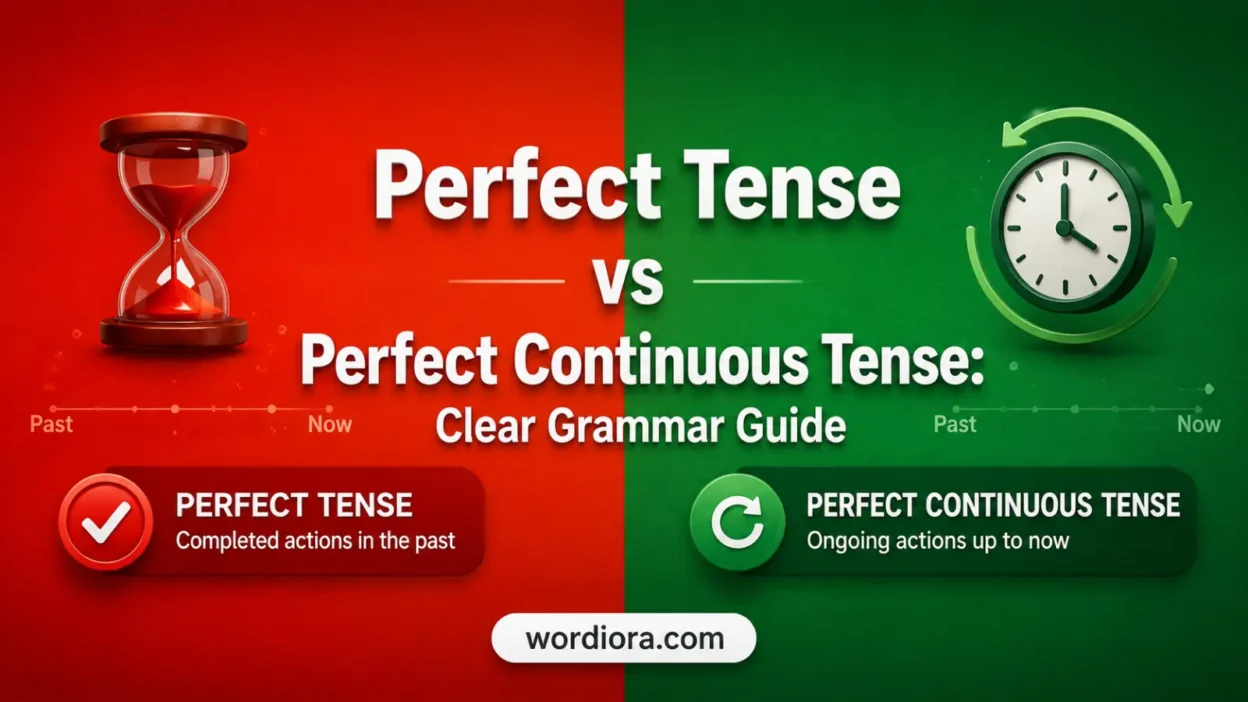
Many English learners struggle with perfect tense vs perfect continuous tense because both connect the past with another point in time. They often describe actions that started earlier and have relevance later.
The confusion usually comes from the fact that both tenses can talk about unfinished situations, recent actions, and experiences. However, they focus on different things.
The perfect tense usually emphasizes the result, completion, or achievement of an action.
The perfect continuous tense usually emphasizes the duration, process, or ongoing nature of an action.
Understanding this distinction makes it much easier to choose the correct form in everyday writing and conversation.
Quick Answer
Use a perfect tense when you want to highlight that an action is completed or when the result is more important than the activity itself.
Use a perfect continuous tense when you want to highlight how long an action has been happening or to emphasize the ongoing process.
Compare these examples:
• I have written five reports.
• I have been writing reports all morning.
The first sentence focuses on the completed work.
The second focuses on the activity and duration.
| Context | Best Choice | Why |
|---|---|---|
| Completed achievement | Perfect Tense | Focuses on the result |
| Length of activity | Perfect Continuous Tense | Focuses on duration |
| Number of completed tasks | Perfect Tense | Highlights accomplishment |
| Ongoing effort | Perfect Continuous Tense | Highlights process |
| Finished action with visible outcome | Perfect Tense | Emphasizes completion |
| Action continuing over time | Perfect Continuous Tense | Emphasizes continuation |
Why People Confuse Them
The two forms share several similarities.
Both connect different points in time.
Both often use words such as:
• since
• for
• recently
• lately
• already
• yet
Consider these examples:
• I have lived here for ten years.
• I have been living here for ten years.
Both sentences are grammatical in many situations.
This overlap makes learners think the tenses mean exactly the same thing. In reality, the emphasis changes.
The first sentence treats the situation as a fact.
The second sentence draws attention to the ongoing experience.
Because both can describe events that began in the past and continue into the present, choosing between them can feel difficult until you understand the focus of each tense.
Key Differences At A Glance
| Feature | Perfect Tense | Perfect Continuous Tense |
|---|---|---|
| Main focus | Result | Duration |
| Emphasis | Completion | Process |
| Structure | Have/has/had + past participle | Have/has/had been + verb-ing |
| Common purpose | Achievement or outcome | Ongoing activity |
| Answers | What happened? | How long has it been happening? |
| Often used with | Already, yet, ever, never | For, since, all day |
| Typical impression | Finished action | Continuing action |
Meaning and Usage Difference
The most important difference is what the speaker wants the listener to notice.
Perfect Tense
The perfect tense highlights the result of an action.
Examples:
• I have finished my homework.
• She has completed the application.
• They have visited Chicago three times.
The focus is not on the process.
The focus is on the completed outcome.
Perfect Continuous Tense
The perfect continuous tense highlights the ongoing activity.
Examples:
• I have been finishing assignments all evening.
• She has been working on the application since Monday.
• They have been traveling around the Midwest for weeks.
The focus is on the activity itself and how long it has been happening.
A Useful Question
Ask yourself:
“What is more important here?”
If the answer is the result, choose the perfect tense.
If the answer is the duration or effort, choose the perfect continuous tense.
Compare:
• I have painted the house.
• I have been painting the house.
The first emphasizes completion.
The second emphasizes the work involved.
Tone, Context, and Formality
Neither tense is more formal than the other.
Both are standard forms used in professional, academic, and casual communication.
The difference is primarily about emphasis.
Perfect Tense Tone
Often sounds more outcome-focused.
Examples:
• We have completed the project.
• The company has launched the product.
• The team has reached its goal.
These statements emphasize success and results.
Perfect Continuous Tone
Often sounds more activity-focused.
Examples:
• We have been working on the project for months.
• The company has been developing the product.
• The team has been pursuing this goal for years.
These statements emphasize effort and progress.
In workplace communication, both forms appear frequently, but they communicate slightly different messages.
Which One Should You Use?
Choose the perfect tense when:
• The action is completed.
• The result matters most.
• You mention achievements.
• You count completed actions.
• You describe experiences.
Examples:
• I have read that book.
• She has won three awards.
• We have completed the training.
Choose the perfect continuous tense when:
• Duration matters.
• The activity is ongoing.
• You want to show effort.
• The process is important.
• The action may still be continuing.
Examples:
• I have been reading all afternoon.
• She has been practicing for months.
• We have been preparing since January.
A simple rule helps:
Perfect Tense = Result
Perfect Continuous Tense = Duration
When One Choice Sounds Wrong
Sometimes only one tense sounds natural.
Completed Achievement
Correct:
• She has written three novels.
Less natural:
• She has been writing three novels.
The first focuses on completed books.
Ongoing Activity
Correct:
• She has been writing all day.
Less natural:
• She has written all day.
The duration makes the continuous form a better choice.
Counting Actions
Correct:
• I have attended five meetings.
Incorrect emphasis:
• I have been attending five meetings.
Numbers and completed totals usually favor the perfect tense.
Ongoing Effort
Correct:
• I have been studying since breakfast.
The duration naturally points toward the continuous form.
Common Mistakes (and Quick Fixes)
Mistake 1: Using Perfect Continuous for Completed Results
Incorrect:
• I have been finishing the report.
Better:
• I have finished the report.
Mistake 2: Ignoring Duration
Less natural:
• I have worked here since 2020.
Often preferred:
• I have been working here since 2020.
Mistake 3: Using Continuous with Stative Verbs
Many stative verbs usually avoid continuous forms.
Examples include:
• know
• believe
• understand
• own
• belong
Incorrect:
• I have been knowing him for years.
Correct:
• I have known him for years.
Mistake 4: Focusing on Process When Result Matters
Less effective:
• We have been completing the project.
Better:
• We have completed the project.
Mistake 5: Focusing on Result When Duration Matters
Less effective:
• I have studied since noon.
Better:
• I have been studying since noon.
Everyday Examples
Imagine common situations in American English.
At Work
• I have completed the presentation.
• I have been working on the presentation all week.
At School
• She has finished her essay.
• She has been writing her essay since lunch.
Fitness
• They have lost ten pounds.
• They have been exercising every day.
Travel
• We have visited New York twice.
• We have been traveling across the country for a month.
Home Projects
• I have painted the fence.
• I have been painting the fence all afternoon.
Notice how the first sentence in each pair focuses on accomplishment, while the second highlights the activity.
Dictionary-Style Word Details
Verb
Perfect Tense: A verb construction that shows a completed action, experience, or state connected to another time reference.
Perfect Continuous Tense: A verb construction that shows an action continuing over a period of time, often emphasizing duration or ongoing activity.
Noun
Perfect Tense: A grammatical tense category used in English.
Perfect Continuous Tense: A grammatical tense category combining perfect and continuous aspects.
Synonyms
Exact synonyms do not truly exist because these are technical grammar terms.
Closest Plain Alternatives
Perfect Tense:
• completed-action tense
• result-focused tense
Perfect Continuous Tense:
• duration-focused tense
• ongoing-action tense
There are no true antonyms because both belong to related grammatical systems.
Example Sentences
Perfect Tense
• I have completed the course.
• She has received the email.
• They have moved to Texas.
• We have reached our destination.
• He has learned the rules.
Perfect Continuous Tense
• I have been completing practice exercises.
• She has been checking emails all morning.
• They have been moving furniture since sunrise.
• We have been driving for hours.
• He has been learning English for years.
Word History
Perfect Tense: The term comes from traditional grammar and refers to actions viewed as completed in relation to another point in time.
Perfect Continuous Tense: The term developed from combining the perfect aspect with the continuous aspect to express ongoing activity over time.
Neither term is a recent invention, and both have long-standing use in English grammar descriptions.
Phrases Containing
Perfect Tense
• present perfect tense
• past perfect tense
• future perfect tense
• perfect aspect
Perfect Continuous Tense
• present perfect continuous tense
• past perfect continuous tense
• future perfect continuous tense
• perfect progressive tense
FAQs
Is perfect tense the same as perfect continuous tense?
No. Perfect tense focuses on results or completion, while perfect continuous tense focuses on duration and ongoing activity.
Which tense is better for showing how long something has happened?
Perfect continuous tense is usually the better choice because it emphasizes duration.
Example:
• I have been waiting for two hours.
Can both tenses sometimes be correct?
Yes. In some situations both are grammatical, but the emphasis changes.
Example:
• I have lived here for ten years.
• I have been living here for ten years.
The meaning is similar, but the second emphasizes the ongoing experience more strongly.
Can stative verbs use the perfect continuous tense?
Usually not.
Examples of stative verbs include:
• know
• own
• believe
• understand
Instead of saying “I have been knowing him,” standard English uses “I have known him.”
Which tense is more common in conversation?
Both are common. Speakers choose between them based on whether they want to emphasize the result or the ongoing activity.
What is the easiest way to remember the difference?
Think of it this way:
• Perfect Tense = Completed result.
• Perfect Continuous Tense = Ongoing process.
Conclusion
The difference between perfect tense vs perfect continuous tense comes down to emphasis.
The perfect tense highlights what has been completed, achieved, or experienced. It focuses on outcomes and results.
The perfect continuous tense highlights how long an activity has been happening. It focuses on duration, effort, and ongoing processes.
When deciding between the two, ask yourself whether the reader should notice the result or the activity. If the result matters most, choose the perfect tense. If the process or duration matters most, choose the perfect continuous tense.
Mastering this distinction helps your writing sound more precise, natural, and confident in everyday English.
You have not enough Humanizer words left. Upgrade your Surfer plan.